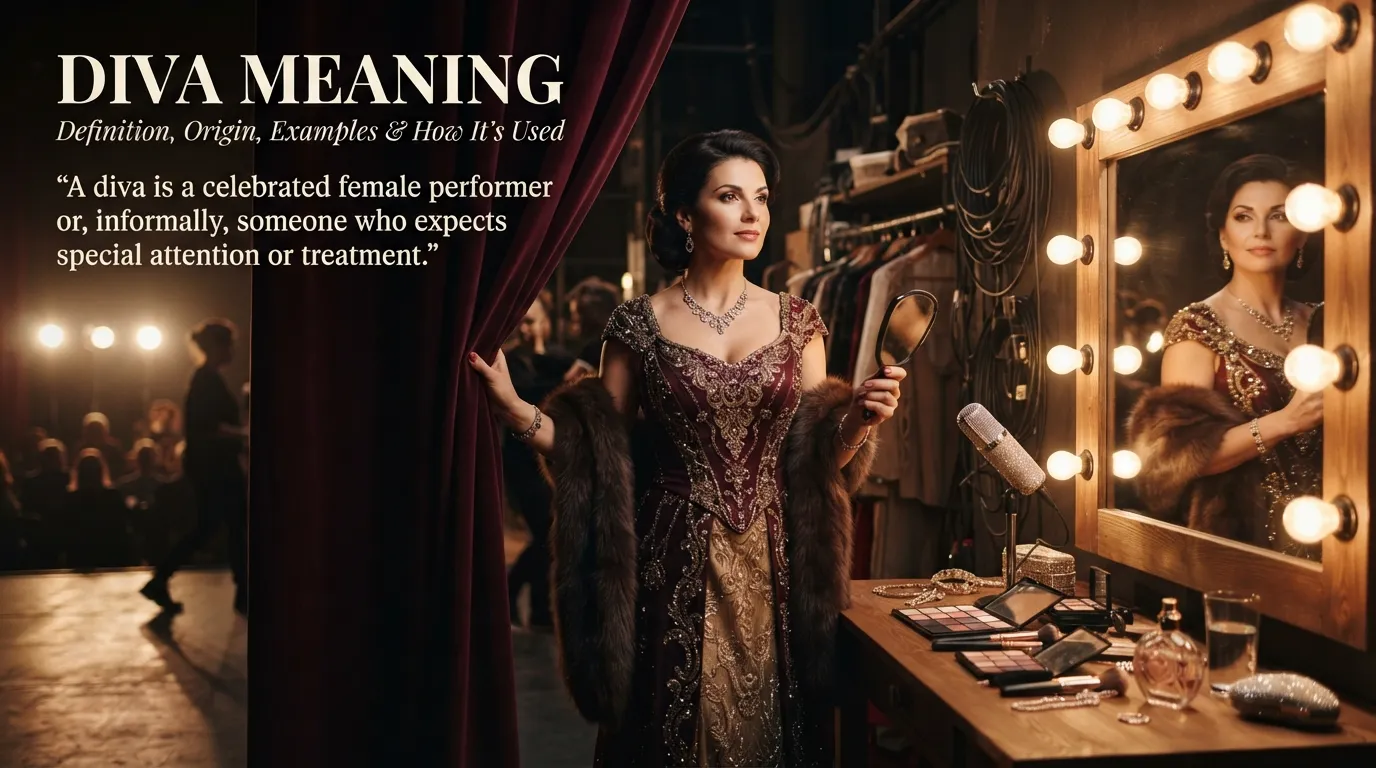
Diva is a word with a fascinating history. It can describe a celebrated female singer, a highly admired woman, or, in modern informal speech, someone who is demanding, dramatic, confident, or particular about how things should be done.
The exact diva meaning depends heavily on context and tone.In its original sense, diva was an Italian word meaning “goddess,” and it became strongly associated with famous female opera singers. Over time, the word moved beyond opera and music.
Today, you may see diva used in everyday conversations, social media captions, entertainment, fashion, dating discussions, workplace conversations, and phrases such as “diva behavior” or “she’s such a diva.”
The word can be complimentary, playful, teasing, or critical. Calling a performer a diva may recognize exceptional talent and star power. Calling someone a diva in another situation may suggest that the person is overly demanding or difficult.
What Does Diva Mean?
Diva means a famous or highly admired female singer or performer, especially one known for exceptional talent and presence. In informal modern English, diva can also describe a woman who is demanding, dramatic, self-important, or very particular.
The word has both positive and negative meanings.
Simple Diva Definition
Diva: A celebrated female singer or performer; informally, a woman who behaves in a demanding, dramatic, or self-important way.
For example:
- “Maria is a talented opera diva.”
- “She became a pop diva after her first album.”
- “He joked that I was being a diva because I wanted everything organized perfectly.”
The surrounding context determines if diva is praise, criticism, or playful teasing.
Diva Meaning in Simple English
In simple English, diva can mean two main things:
1. A famous female performer
A diva may be a successful singer, especially one with exceptional vocal ability and stage presence.
2. A demanding or dramatic person
In casual speech, someone may be called a diva if they expect special treatment or become difficult when things do not go their way.
For example:
Positive:
“She is a true diva with an incredible voice.”
Negative:
“He is acting like a diva today.”
Playful:
“My cat is such a diva she refuses to eat unless her bowl is perfectly clean.”
Diva Meaning and Origin
The word diva comes from Italian. In Italian, diva is the feminine form of divo, ultimately related to the Latin word divus, meaning “divine” or “godlike.”
The literal idea behind the word is therefore connected to a goddess or divine woman.
The term became especially important in opera. During the 19th century, famous female opera singers could become international celebrities. Their extraordinary voices, theatrical performances, and public reputations helped establish diva as a term for a celebrated female singer.
Eventually, English adopted the word and expanded its meaning.
How the Meaning Changed
The evolution can be simplified like this:
Goddess → celebrated female performer → famous female singer → demanding or dramatic person
This explains why the modern word can carry both admiration and criticism.
The History of the Word Diva
The connection between diva and performance culture is particularly strong.
Opera singers were among the most recognizable celebrities of their era. Successful performers often attracted enormous audiences, devoted fans, media attention, and sometimes strong public personalities.
As the term became associated with these performers, diva began to suggest more than simply “female singer.” It could imply:
- Exceptional talent
- Fame
- Glamour
- Confidence
- Strong personality
- High expectations
- Dramatic behavior
The word later spread into popular music.
Today, terms such as pop diva, music diva, and diva singer are commonly used to describe highly successful female vocalists and entertainers.
What Does Diva Mean in Slang?
In slang and informal English, diva often describes someone who is being unusually demanding, dramatic, sensitive, or particular.
For example:
“Why are you being such a diva?”
This usually does not literally mean the person is a famous singer. Instead, it suggests that they are behaving as though they deserve special treatment.
The slang meaning can be:
- Playful
- Teasing
- Sarcastic
- Critical
- Affectionate
Tone matters enormously.
Example
Friend: “Can we leave now?”
You: “Not until I fix my hair.”
Friend: “You’re such a diva.”
This may be playful rather than genuinely insulting.
Diva Meaning on Social Media
On social media platforms, diva is often used more positively than in traditional usage.
People may describe someone as a diva to celebrate:
- Confidence
- Beauty
- Fashion
- Independence
- Glamour
- Performance ability
- Strong personality
For example:
“She walked into the room like a total diva.”
Here, diva may suggest confidence and star quality rather than difficult behavior.
Social media captions may also use phrases such as:
- Diva energy
- Diva behavior
- Certified diva
- Main character diva
- Diva vibes
- Born to be a diva
- Serving diva energy
The meaning is often intentionally exaggerated for humor or style.
Diva Meaning on TikTok
On TikTok, diva can function as a compliment, joke, identity label, or description of dramatic behavior.
Someone might say:
“She is giving diva energy.”
This usually means the person looks or acts confident, glamorous, expressive, or demanding in an entertaining way.
Another example:
“The way she refused to compromise is pure diva behavior.”
Depending on the video, this could be admiration or teasing.
The important point is that diva does not automatically mean “spoiled.” The speaker’s tone and the situation determine the intended meaning.
Diva Meaning on Instagram
On Instagram, diva frequently appears in captions, comments, usernames, and fashion-related posts.
For example:
“Serving diva vibes tonight.”
This generally communicates confidence, glamour, or sophistication.
A caption such as:
“My little diva 💅”
may describe a child, friend, pet, or family member who has a strong personality.
Instagram usage tends to make the word more playful and positive than its traditional negative sense.
Diva Meaning in Text Messages
In texting, diva is often used casually.
Example 1: Playful
A: “I need everyone to wait while I choose my outfit.”
B: “LOL, diva.”
Example 2: Critical
A: “She rejected every restaurant because none were good enough.”
B: “She’s being such a diva.”
Example 3: Complimentary
A: “Did you see her performance?”
B: “Absolutely. She’s a diva!”
The same word can communicate three very different attitudes.
Diva Meaning in Dating
In dating conversations, calling someone a diva can have either a positive or negative meaning.
A person might call their partner a diva because they are:
- Fashion-conscious
- Particular about details
- Dramatic in a humorous way
- Confident
- High-maintenance
- Expecting special treatment
For example:
“My girlfriend is a little diva, but I love her.”
Here, the speaker may be teasing affectionately.
However:
“I stopped dating him because he acted like a diva.”
In this case, the word probably suggests unreasonable demands or difficult behavior.
Diva Meaning in the Workplace
In professional settings, diva is usually more negative.
Calling a coworker a diva may imply that the person:
- Expects special treatment
- Is difficult to work with
- Refuses reasonable compromises
- Has unrealistic expectations
- Creates unnecessary drama
For example:
“The manager described the actor as talented but difficult to work with.”
Calling a professional a diva can therefore sound judgmental or disrespectful.
It is usually safer to describe the specific behavior instead of using the label.
Diva Meaning in Music
Music is one of the most important contexts for the word.
A music diva is generally a highly successful and celebrated female vocalist or performer.
The term may suggest:
- Powerful vocals
- Technical skill
- Stage presence
- Fame
- Glamour
- Emotional performance
- A distinctive artistic identity
The expression pop diva is especially common in discussions of mainstream popular music.
However, being called a diva does not necessarily mean that a singer is difficult or arrogant.
In music journalism and fan culture, it can simply mean an iconic female performer with exceptional star power.
Diva Meaning in Opera
The connection between diva and opera is historically significant.
An opera diva is a celebrated female opera singer, particularly one known for outstanding vocal and dramatic ability.
Because opera historically provided some of the earliest international celebrity performers, the word developed strong associations with:
- Vocal excellence
- Dramatic performance
- Prestige
- Fame
- Luxury
- Theatrical personality
This traditional meaning remains important today.
Is Diva a Compliment or an Insult?
Diva can be either a compliment or an insult.
It depends on:
- Context
- Tone
- Relationship between the speakers
- The person’s behavior
- if the word refers to talent or attitude
| Usage | Likely Meaning | Tone |
| Opera diva | Celebrated female singer | Positive |
| Pop diva | Successful female performer | Positive |
| Diva energy | Confidence/glamour | Usually positive/playful |
| Diva behavior | Demanding or dramatic behavior | Often negative/playful |
| Such a diva! | Depends on context | Playful or critical |
| Little diva | Strong personality | Often affectionate |
| Diva attitude | Demanding behavior | Usually negative |
Diva vs. Queen: What’s the Difference?
Diva traditionally connects to performance, glamour, fame, and exceptional talent. It can also imply demanding behavior.
Queen is broader and often communicates admiration, confidence, leadership, beauty, or excellence.
For example:
“She is a pop diva.”
focuses on her status as a celebrated performer.
“She is a queen.”
may simply express admiration.
Diva vs. Drama Queen
These expressions overlap but are not identical.
A drama queen is someone who tends to exaggerate situations or make events seem more dramatic than they are.
A diva may be dramatic, but the word can also refer to talent, glamour, fame, or demanding standards.
For example:
“She became a famous diva.”
does not necessarily mean she is dramatic.
But:
“She’s such a drama queen.”
specifically emphasizes exaggerated emotional reactions.
Diva vs. High-Maintenance
A high-maintenance person usually requires considerable attention, effort, money, or accommodation.
A diva can be high-maintenance, but the words are not interchangeable.
Someone can be called a diva because they are glamorous or talented without being high-maintenance.
Likewise, someone can be high-maintenance without having the confidence, fame, or performance-related qualities traditionally associated with a diva.
Common Synonyms for Diva
Depending on the context, possible alternatives include:
When Diva Is Positive
- Star
- Superstar
- Icon
- Celebrity
- Songstress
- Performer
- Vocalist
- Queen
- Showstopper
When Diva Is Negative
- Prima donna
- Drama queen
- High-maintenance person
- Attention-seeker
- Demanding person
- Difficult person
Be careful with synonyms because they do not always carry exactly the same emotional meaning.
Diva and Prima Donna: Are They the Same?
Diva and prima donna are closely related but have different histories and common uses.
Prima donna traditionally refers to the principal female singer in an opera company, but in modern English it often describes someone who is demanding, temperamental, or self-important.
For example:
“She is an opera diva.”
sounds complimentary.
“He is acting like a prima donna.”
usually sounds critical.
Examples of Diva in Sentences
Here are realistic examples showing different meanings.
Music
- “The singer became a global pop diva.”
- “She is widely recognized as an opera diva.”
- “The young performer hopes to become the next great music diva.”
Everyday Conversation
- “Don’t be such a diva.”
- “My sister can be a little diva sometimes.”
- “The dog is a complete diva about food.”
Social Media
- “Serving diva energy tonight.”
- “She walked onto the stage like a true diva.”
- “Diva vibes only.”
Workplace
- “The director said the performer had developed a reputation for diva behavior.”
- “Nobody wants to work with someone who constantly makes diva demands.”
Humorous
- “My cat refuses to drink water unless it comes from a glass. What a diva.”
Common Characteristics Associated With a Diva
The word can suggest a combination of qualities rather than one specific trait.
A person described as a diva may be perceived as:
- Confident
- Talented
- Glamorous
- Expressive
- Ambitious
- Particular
- Demanding
- Dramatic
- Self-assured
- Attention-loving
Not every diva has all these characteristics.
The word is highly context-dependent.
Positive Diva Meaning
The positive interpretation usually emphasizes confidence, excellence, glamour, and individuality.
For example:
“She owns the stage like a diva.”
This implies strong performance and confidence.
Similarly:
“She’s got serious diva energy.”
can mean that someone has an impressive, glamorous, commanding presence.
In contemporary informal language, being a diva can even be presented as something empowering or entertaining.
Negative Diva Meaning
The negative interpretation focuses more on unreasonable behavior.
Someone may be called a diva if they:
- Demand special treatment
- Become upset over minor issues
- Refuse to compromise
- Expect everyone to accommodate them
- Make excessive demands
- Seek constant attention
For example:
“The actor was talented, but his diva behavior made production difficult.”
Here, diva behavior clearly carries a negative meaning.
Common Misconceptions About the Word Diva
Misconception 1: Diva Always Means Arrogant
Not necessarily.
A diva can simply mean a celebrated female performer.
Misconception 2: Diva Always Means Singer
Historically and traditionally, the term is strongly connected with singers, especially opera singers. But modern informal English uses it more broadly.
Misconception 3: Diva Is Always an Insult
No. It can be an affectionate joke or a strong compliment.
Misconception 4: Only Famous Women Can Be Divas
In modern slang, anyone can jokingly be called a diva, including friends, children, men, and even pets.
Misconception 5: Diva and Drama Queen Mean Exactly the Same Thing
They overlap, but diva has additional meanings connected with fame, performance, glamour, and talent.
How to Use Diva Correctly
When using diva, consider the context.
Use It Positively
“She is an incredible diva with an unforgettable voice.”
Use It Playfully
“You’re being a diva about your coffee today.”
Use It Carefully
“The singer was criticized for diva-like demands.”
In professional or formal communication, avoid labeling someone a diva unless the context clearly supports the word. A specific description of behavior is usually more precise.
Diva Meaning: Key Facts at a Glance
| Feature | Details |
| Word | Diva |
| Basic meaning | Celebrated female singer or performer |
| Informal meaning | Demanding, dramatic, or particular person |
| Origin | Italian |
| Earlier literal sense | Divine/goddess-like woman |
| Traditional context | Opera |
| Modern contexts | Music, social media, fashion, everyday speech |
| Tone | Positive, playful, or negative |
| Related terms | Prima donna, queen, drama queen, superstar |
| Common phrase | Diva behavior |
| Modern phrase | Diva energy |
| Plural | Divas |
Frequently Asked Questions About Diva Meaning
1. What is the exact meaning of diva?
Diva traditionally means a celebrated female singer or performer, particularly an outstanding opera singer. In informal modern English, it can describe someone who is demanding, dramatic, glamorous, or particular.
2. Is calling someone a diva a compliment?
It can be. When used to praise someone’s talent, confidence, glamour, or stage presence, diva is complimentary. When it describes unreasonable demands or difficult behavior, it can be insulting.
3. What does diva mean in slang?
In slang, diva often describes someone who behaves in a demanding, dramatic, glamorous, or attention-seeking way. The word is frequently used playfully among friends.
4. What does “diva behavior” mean?
Diva behavior usually means acting demanding, difficult, dramatic, or as though you deserve special treatment. On social media, however, the phrase can sometimes be used humorously or positively to describe confidence and glamour.
5. What does “diva energy” mean?
Diva energy generally refers to a confident, glamorous, bold, dramatic, or commanding presence. It is commonly used as a positive or playful expression online.
6. Is diva only used for women?
Traditionally, diva refers to a female performer. In casual modern speech, however, people may jokingly use the term for anyone who is being demanding or dramatic.
7. What is the difference between diva and prima donna?
Both words have historical connections to opera. Diva is often associated with a celebrated female performer and can be strongly positive. Prima donna is now more commonly used to describe someone who is overly demanding or self-important.
8. Does diva mean beautiful?
Not exactly. Diva does not literally mean “beautiful.” It can imply glamour, confidence, fame, or elegance, depending on context.
9. Can a man be called a diva?
Yes, particularly in informal or humorous speech. When applied to a man, diva usually focuses on behavior such as being demanding, dramatic, or particular rather than the traditional female-performer meaning.
10. What is the opposite of a diva?
There is no single exact opposite. Depending on the intended meaning, possible contrasts include someone who is low-maintenance, easygoing, humble, undemanding, or unassuming.
Conclusion
The meaning of diva has evolved significantly from its original connection with the idea of a “goddess.” It became closely associated with celebrated female opera singers and eventually expanded into popular music, entertainment, fashion, social media, and everyday conversation.
Today, diva can describe an extraordinary female performer, a glamorous and confident personality, or someone who is being unusually demanding or dramatic.
The most important thing to remember is context. “She is a diva” can be admiration, teasing, or criticism depending on who says it, how they say it, and what behavior they are describing.
If you’re using the word in casual conversation, pay attention to tone. In professional situations, it’s usually better to describe specific behavior rather than label someone a “diva.”
Understanding these differences will help you recognize the word accurately if you encounter it in music, texting, TikTok, Instagram, dating, workplace conversations, or everyday English.

I am Alex Carter, is a web resources and digital tools writer at Linkvistahub. He enjoys discovering useful websites, online tools, productivity resources, and practical digital solutions that can make everyday tasks easier.