
Have you ever ordered pasta at a restaurant and wondered why it feels slightly firm when you bite into it?
That texture is often described as al dente. But what exactly does al dente meaning refer to, and how can you tell when pasta is perfectly cooked?
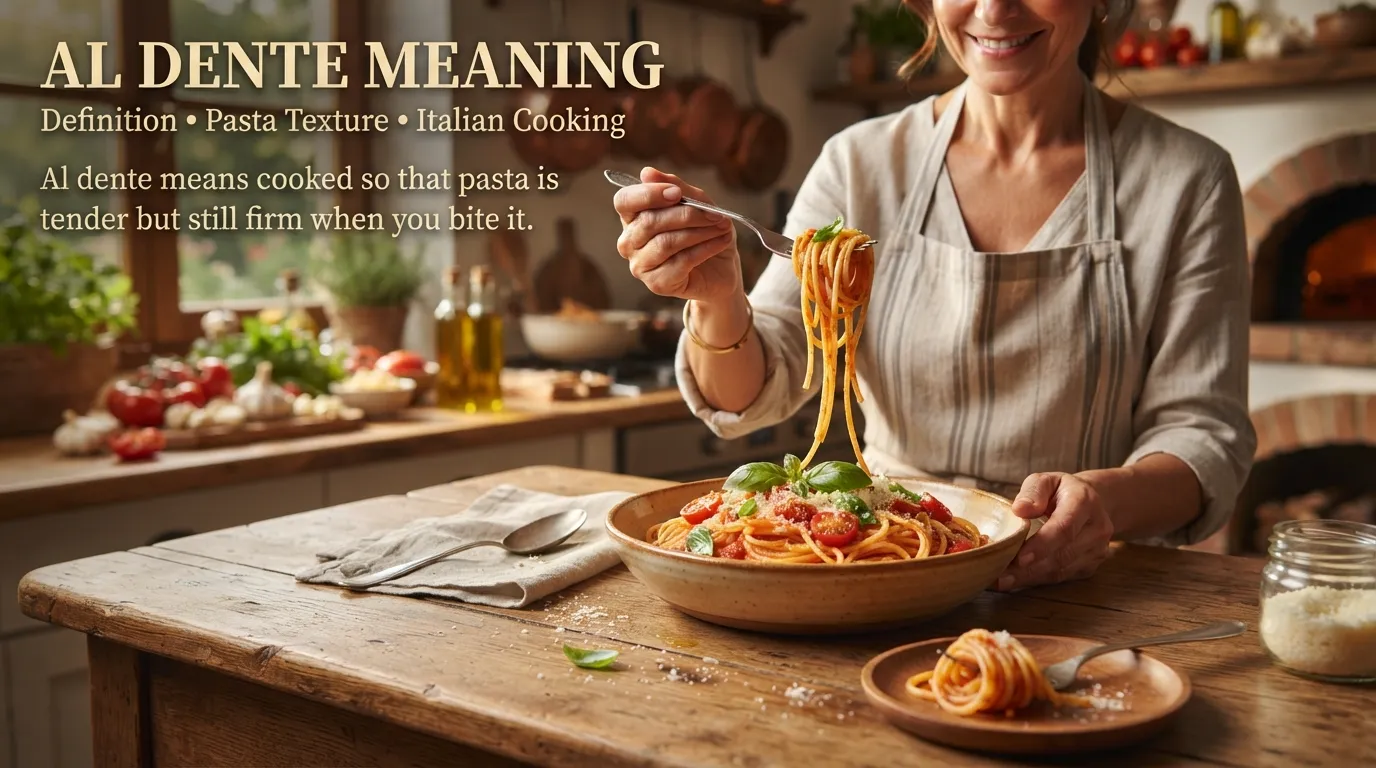
Al dente is an Italian culinary expression that literally means “to the tooth.” In cooking, it describes pasta, rice, vegetables, or other foods that are cooked until they are tender but still have a noticeable firmness when bitten.
The goal is not for the food to be hard or raw. Instead, al dente pasta should feel firm, springy, and pleasantly chewy in the center.
Understanding what al dente means is especially useful if you cook Italian food at home. It can help you prepare spaghetti, penne, fettuccine, macaroni, and other pasta varieties with a texture similar to what you may find in Italian cooking.
What Does Al Dente Mean?
Al dente means “to the tooth” in Italian and describes food that is cooked until tender but still firm enough to offer some resistance when you bite it.
The phrase is most commonly associated with pasta.
When pasta is cooked al dente, it should not be:
- Hard in the center
- Crunchy like uncooked pasta
- Mushy or overly soft
- Completely lacking texture
Instead, properly cooked pasta should be firm, tender, slightly chewy, and pleasant to bite.
Simple Definition of Al Dente
For a quick answer:
Al dente means cooked until food is tender but still firm and slightly chewy when bitten.
The expression comes from Italian cooking, where texture plays an important role in the overall eating experience.
What Does Al Dente Mean Literally?
The literal Italian translation of al dente is “to the tooth.”
The phrase comes from the idea that you should be able to feel the food’s texture with your teeth when you bite into it.
Rather than becoming completely soft, the food retains a degree of firmness.
This is why someone might describe pasta as:
“Firm to the bite.”
That phrase captures the basic idea behind al dente.
Al Dente Meaning in English
In English, al dente is used as a culinary term borrowed from Italian.
It usually means that pasta has been cooked to a firm but tender texture.
For example:
“Cook the spaghetti until al dente.”
This instruction means that the spaghetti should be cooked enough to become tender while maintaining some firmness when bitten.
You may see the phrase on:
- Restaurant menus
- Pasta packages
- Cooking websites
- Recipes
- Food blogs
- Cooking shows
- Italian restaurant descriptions
- Culinary textbooks
Al Dente Pronunciation
Al dente is an Italian phrase, and its pronunciation is commonly represented approximately as:
ahl DEN-tay
The emphasis is generally placed on the second word.
When English speakers use the term, pronunciation can vary slightly, but the Italian-style pronunciation is widely understood in culinary contexts.
The Origin and History of Al Dente
The phrase al dente comes from the Italian culinary language.
Its literal meaning, “to the tooth,” refers to the sensation of food when it is bitten. The expression became strongly associated with pasta preparation and the preference for maintaining a firm texture.
Italian cuisine has many regional traditions, and pasta is prepared in numerous shapes and styles. Cooking time can vary depending on the type, thickness, ingredients, and intended recipe.
The modern culinary use of al dente reflects a broader Italian appreciation for texture and balance rather than simply cooking food until it becomes as soft as possible.
Over time, the expression entered English and other languages and became a widely recognized international cooking term.
Why Is Al Dente Important for Pasta?
Texture can dramatically change the experience of eating pasta.
Pasta that is cooked too long can become soft and mushy. Pasta that is not cooked enough can remain excessively hard or chalky.
Al dente pasta occupies the middle ground.
It provides:
- A pleasant bite
- A slightly chewy texture
- Better structural integrity
- A satisfying mouthfeel
- A texture that works well with sauces
Texture is particularly important when pasta is finished in a sauce. Pasta that is slightly firm can continue cooking briefly as it combines with the sauce.
What Does Al Dente Pasta Taste Like?
Technically, al dente primarily describes texture rather than flavor.
However, texture affects how pasta tastes and feels while eating.
Properly cooked al dente pasta usually feels:
- Firm
- Tender
- Springy
- Slightly chewy
- Substantial
- Not mushy
The center should not feel like a piece of uncooked pasta.
Some types of pasta may retain a slightly firmer center than others depending on their ingredients and cooking method.
How Do You Cook Pasta Al Dente?
Cooking pasta al dente is relatively simple, but timing matters.
Step 1: Bring Water to a Boil
Use a sufficiently large pot and bring the water to a strong boil.
A larger volume of water gives the pasta room to cook properly and helps maintain a stable cooking temperature.
Step 2: Add Salt
Salt the cooking water according to your recipe and preferences.
Salt contributes to the overall seasoning of the pasta.
Step 3: Add the Pasta
Add the pasta to the boiling water.
Stir during the early stage of cooking to help prevent pieces from sticking together.
Step 4: Check the Package Directions
Most dried pasta packages provide a recommended cooking range.
Do not treat the package time as an absolute rule. Pasta can cook differently depending on:
- Shape
- Thickness
- Brand
- Water temperature
- Quantity
- Altitude
- Personal preference
Step 5: Start Testing Early
Begin checking the pasta a little before the package’s suggested cooking time ends.
Take out one piece and allow it to cool slightly before tasting.
Step 6: Bite Into It
The best test is often simply to taste the pasta.
Al dente pasta should be tender but still have some resistance.
If it is crunchy and hard, it needs more cooking.
If it is soft and falling apart, it may be overcooked.
Step 7: Finish in the Sauce When Appropriate
For many pasta dishes, cooks remove the pasta while it still has some firmness and finish it briefly in the sauce.
This can allow the pasta to absorb flavor while reaching the desired texture.
How Do You Know When Pasta Is Al Dente?
The most reliable method is to taste it.
Look for these characteristics:
| Texture | What It Usually Means |
| Very hard and crunchy | Undercooked |
| Firm with a pleasant bite | Al dente |
| Soft but intact | Fully cooked, possibly beyond al dente |
| Mushy and falling apart | Overcooked |
You can also cut or bite a piece of pasta to inspect its center.
However, visual tests are less reliable than tasting because different pasta types cook differently.
Al Dente vs. Undercooked Pasta
These terms are not interchangeable.
Al Dente
Al dente pasta is:
- Cooked
- Tender
- Firm
- Slightly chewy
- Pleasant to eat
Undercooked Pasta
Undercooked pasta is generally:
- Too hard
- Excessively chewy
- Crunchy
- Chalky in the center
- Not fully hydrated
The key difference is that al dente pasta is intentionally firm but cooked, whereas undercooked pasta has not reached the desired level of tenderness.
Al Dente vs. Overcooked Pasta
Overcooked pasta has a completely different texture.
Al Dente
Firm, tender, springy, and slightly chewy.
Overcooked
Soft, mushy, weak, and sometimes sticky.
Overcooked pasta can also break apart more easily when mixed with sauce.
This is why cooking time is so important when preparing pasta dishes.
Can Rice Be Al Dente?
Yes, although the term is most strongly associated with pasta.
In certain culinary contexts, people may use al dente to describe rice or grains that retain a pleasant firmness.
Risotto provides a familiar example.
Properly prepared risotto generally has a creamy consistency while the rice grains maintain some texture. In this context, the idea of cooking grains to retain a bite is closely related to the concept of al dente.
However, the exact desired texture depends on the specific dish.
Can Vegetables Be Al Dente?
The term can also be applied to vegetables.
For example:
“The vegetables were cooked al dente.”
This generally means the vegetables are cooked enough to become tender but still retain some firmness.
You might see this description used for:
- Green beans
- Broccoli
- Carrots
- Asparagus
- Snow peas
- Bell peppers
For vegetables, the phrase emphasizes tender-crisp texture.
Al Dente Meaning in Different Foods
| Food | What Al Dente Generally Means |
| Pasta | Tender but firm and chewy |
| Spaghetti | Firm enough to resist the bite |
| Penne | Cooked through while maintaining structure |
| Rice | Cooked but retaining some texture |
| Risotto rice | Creamy dish with grains that retain a bite |
| Vegetables | Tender but still crisp or firm |
| Grains | Cooked while retaining noticeable texture |
The precise texture varies according to the food.
Different Types of Pasta and Al Dente Cooking
Different pasta shapes can require different cooking times.
Spaghetti
Thin strands can cook relatively quickly.
Start tasting before the package’s maximum cooking time.
Penne
Because penne is thicker and tubular, the center can take longer to cook.
The texture should remain firm without being chalky.
Fettuccine
Fresh and dried fettuccine behave differently.
Fresh pasta generally cooks much faster than dried pasta.
Macaroni
Small shapes can cook quickly, making careful timing important.
Rigatoni
Large tubes often benefit from remaining firm enough to hold their structure when combined with hearty sauces.
Fresh Pasta vs. Dried Pasta
One important consideration is if the pasta is fresh or dried.
Fresh pasta contains more moisture and usually cooks much faster.
Dried pasta is harder and requires more cooking time to hydrate and become tender.
Therefore, you should not use the same cooking time for both.
Fresh Pasta
Fresh pasta often becomes tender quickly.
Dried Pasta
Dried pasta generally takes longer and is commonly cooked to an al dente texture.
Why Do Chefs Prefer Al Dente Pasta?
Many cooks prefer al dente pasta because it provides a more satisfying texture and maintains its structure when combined with sauce.
When pasta becomes too soft, it can lose its shape and feel heavy or mushy.
Firm pasta can also provide contrast against creamy, tomato-based, oily, or meat-based sauces.
For example:
- Spaghetti can hold a tomato sauce while retaining its bite.
- Penne can maintain structure in baked pasta dishes.
- Rigatoni can provide a substantial texture with meat sauces.
- Linguine can complement seafood sauces without becoming overly soft.
Common Mistakes When Cooking Pasta Al Dente
Cooking Only by the Timer
A timer is useful, but tasting is more reliable.
Cooking conditions can vary, so always check the actual pasta.
Leaving Pasta in Hot Water Too Long
Even after the pasta reaches the desired texture, continued cooking can make it softer.
Adding Pasta Too Early
Pasta should generally enter properly boiling water rather than sitting in lukewarm water for an extended period.
Forgetting Carryover Cooking
Pasta can continue cooking briefly after being removed from the water, especially when immediately combined with a hot sauce.
Rinsing Pasta Automatically
For many hot pasta dishes, rinsing is unnecessary and can remove surface starch that helps sauce cling to the pasta.
There are exceptions, such as certain cold pasta preparations or recipes that specifically call for rinsing.
Does Al Dente Mean Raw?
No.
Al dente does not mean raw pasta.
The pasta should be cooked through enough to become tender while retaining firmness.
If the pasta is hard, crunchy, or noticeably chalky in the center, it is generally undercooked rather than properly al dente.
This is one of the most common misunderstandings surrounding the phrase.
Is Al Dente Healthier?
Al dente pasta is often discussed in nutrition conversations because cooking changes the physical structure and digestibility of starch.
However, it would be misleading to say that al dente pasta is automatically “healthy” simply because it is cooked less.
Overall nutrition depends on factors such as:
- Portion size
- Type of pasta
- Ingredients
- Sauce
- Fiber content
- Protein
- Overall dietary pattern
Texture alone does not determine if a meal is nutritionally balanced.
Is Al Dente Better Than Soft Pasta?
“Better” depends on personal preference and the dish.
Some people prefer pasta with a firm bite, while others enjoy softer pasta.
Italian cooking traditions often emphasize al dente texture, but individual preferences vary.
The important point is to understand what the term means rather than assuming that every pasta dish must have exactly the same texture.
Al Dente in Restaurant Menus
Restaurants may use al dente to tell diners that pasta is intentionally prepared with a firm texture.
For example:
“House-made pasta served al dente with tomato basil sauce.”
The phrase helps communicate the expected texture.
If you prefer softer pasta, you can sometimes ask if the kitchen can cook it longer, although restaurants may have their own preparation standards.
Al Dente in Recipes
Recipes commonly use instructions such as:
“Cook the pasta until al dente.”
This means you should cook the pasta until it reaches a tender but firm texture.
If the pasta will later be baked, sautéed, or simmered in sauce, the recipe may intentionally call for slightly less cooking before the next stage.
For example, baked pasta often continues cooking in the oven, so fully softening it in boiling water first could result in an overly soft final dish.
Practical Example: Making Al Dente Spaghetti
Imagine you’re making spaghetti with tomato sauce.
You boil the water, salt it, and add the dried spaghetti.
The package recommends a particular cooking time.
Instead of waiting until the final second, begin tasting the spaghetti slightly early.
You bite into a strand.
It is tender but still has a gentle resistance.
It bends easily and does not taste crunchy.
That is the basic experience people mean when they say the spaghetti is al dente.
You can then drain it and finish it with your sauce according to the recipe.
Al Dente vs. Soft: Quick Comparison
| Feature | Al Dente | Soft Pasta |
| Texture | Firm and tender | Very tender |
| Bite | Noticeable resistance | Little resistance |
| Structure | Holds shape well | May become fragile |
| Chewiness | Moderate | Low |
| Common in Italian pasta traditions | Yes | Less typical |
| Risk | Can be undercooked if taken too far | Can become mushy if overcooked |
Related Italian Cooking Terms
Learning al dente can introduce you to other Italian culinary expressions.
Pasta Secca
Pasta secca refers to dried pasta.
Al Forno
Al forno means “baked” or “in the oven.”
It is commonly associated with dishes that are finished in an oven.
Alla Carbonara
This refers to a traditional Roman-style pasta preparation involving ingredients such as eggs, cheese, cured pork, and black pepper.
Aglio e Olio
This literally refers to garlic and oil and commonly describes pasta prepared with garlic, olive oil, and related ingredients.
These expressions illustrate how Italian food vocabulary often communicates both ingredients and preparation methods.
FAQs
1. What does al dente mean in simple terms?
Al dente means cooked until tender but still firm enough to provide some resistance when you bite it. The expression literally means “to the tooth” in Italian.
2. Does al dente mean undercooked?
No. Proper al dente pasta is cooked and tender but intentionally retains firmness. Pasta that is hard, crunchy, or chalky is generally undercooked.
3. How do you know if pasta is al dente?
The best method is to taste it. Properly al dente pasta should be tender while retaining a noticeable, pleasant bite. It should not be hard or mushy.
4. What is another word for al dente?
There is no perfect one-word English synonym. Depending on context, phrases such as firm to the bite, tender-crisp, or firm but tender can communicate a similar idea.
5. Why do Italians cook pasta al dente?
Al dente cooking provides a firm, satisfying texture and allows pasta to maintain its structure when combined with sauce. It is an important part of many Italian pasta traditions.
6. Can vegetables be cooked al dente?
Yes. When applied to vegetables, al dente generally means they are cooked until tender while retaining some firmness or crispness.
7. Can rice be al dente?
Yes, although the phrase is most strongly associated with pasta. It can describe rice or grains that are cooked but retain a noticeable bite, particularly in certain culinary preparations.
8. Is al dente pasta healthier than overcooked pasta?
Texture alone does not determine if pasta is healthy. Nutrition depends on the pasta type, portion, ingredients, sauce, and overall diet. Cooking to al dente is primarily a matter of texture and culinary preference.
9. What does al dente literally translate to?
The Italian phrase al dente literally translates to “to the tooth.” It refers to the way cooked food feels when bitten.
10. What is the opposite of al dente?
There is not one exact opposite, but overcooked, mushy, or overly soft describes the opposite texture most clearly. Undercooked pasta is also different because it remains too hard rather than properly tender.
Al Dente Meaning: Key Facts at a Glance
| Key Fact | Answer |
| Term | Al dente |
| Language | Italian |
| Literal meaning | “To the tooth” |
| Main culinary meaning | Firm but tender |
| Most common food | Pasta |
| Typical texture | Slightly chewy and springy |
| Opposite texture | Overly soft or mushy |
| Is it raw? | No |
| Common use | Pasta cooking |
| Can it describe vegetables? | Yes |
| Can it describe rice/grains? | Yes, depending on context |
| Main cooking test | Taste and bite |
| Related phrase | Firm to the bite |
Tips for Getting the Perfect Al Dente Texture
If you’re learning to cook pasta, these practical habits can help:
- Read the package directions. Use the recommended time as a starting point.
- Start tasting early. Don’t wait until the very end.
- Use your teeth. Texture is easier to judge by tasting than by looking.
- Think firm, not crunchy. Al dente should feel cooked.
- Consider the recipe. Pasta that will continue cooking in sauce or the oven may need less initial cooking.
- Avoid automatic overcooking. Once pasta becomes soft and mushy, it is difficult to reverse the texture.
- Account for the pasta type. Fresh and dried pasta can have very different cooking times.
Conclusion
The al dente meaning is simple once you understand the texture: it describes food that is tender but still firm enough to offer resistance when bitten.
The phrase comes from Italian and literally means “to the tooth.” It is most closely associated with pasta, where al dente cooking creates a firm, slightly chewy texture without leaving the pasta raw or crunchy.
When cooking pasta at home, don’t rely on a timer alone. Use the package instructions as a guide, then taste the pasta as it approaches the recommended cooking time. Proper al dente pasta should be cooked through while retaining a satisfying bite.
The term can also describe vegetables, rice, and other foods when they retain some firmness after cooking. However, its most familiar use remains al dente pasta.
In short:
Al dente = tender, firm, and pleasant to bite.
Once you recognize that texture, you’ll have a much easier time understanding recipes, restaurant menus, cooking instructions, and conversations about Italian food.

I am Sophia Bennett, is a digital resources and online tools writer at LinkVistaHub. She enjoys exploring useful websites, emerging digital tools, productivity platforms, and practical online resources that help people work smarter and discover valuable information.