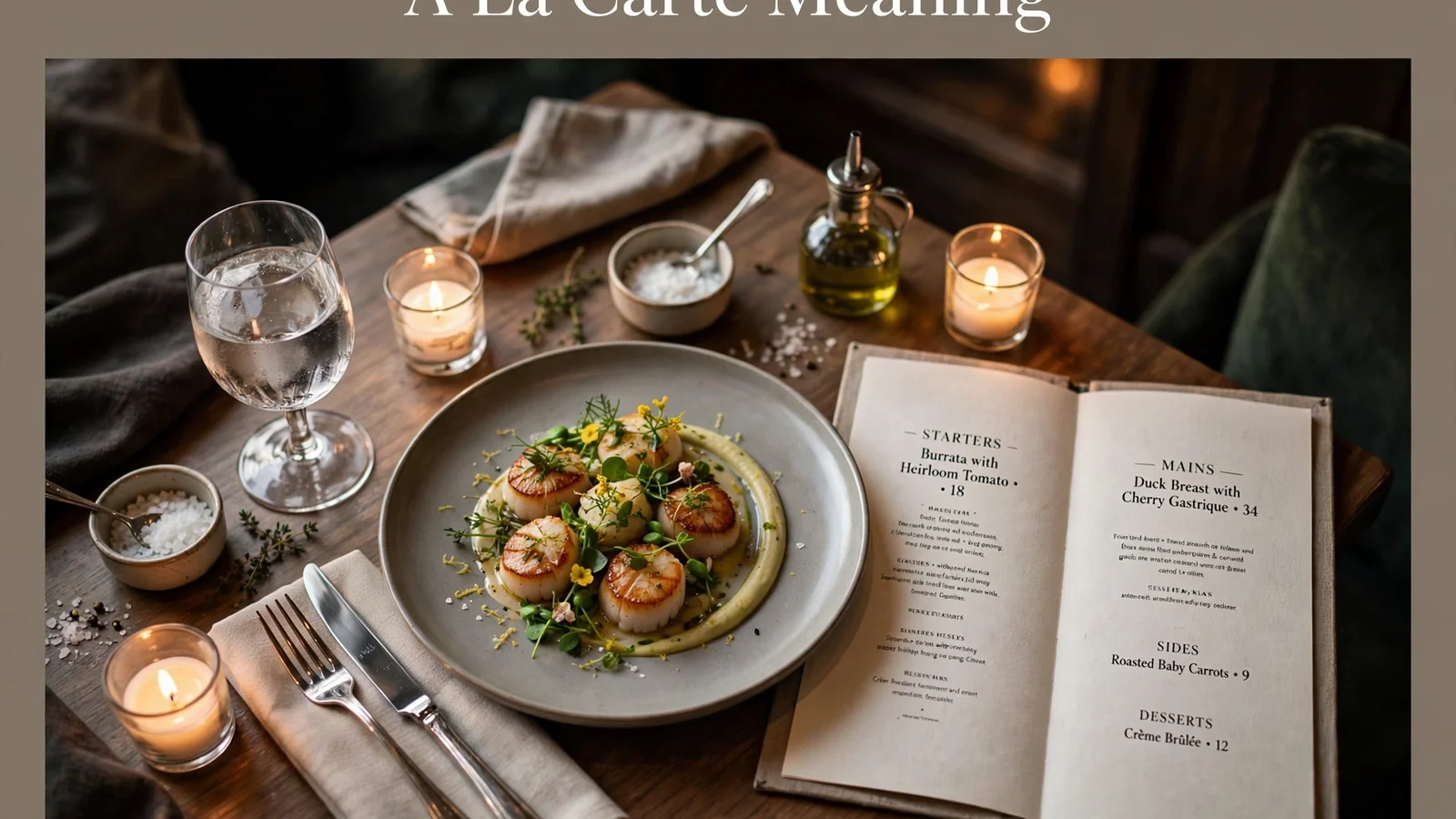
You sit down in a restaurant, open the menu, and your server asks a simple question: “Would you like the set menu, or would you prefer to order a la carte?” If you have ever paused at that moment, you are not alone.
The a la carte meaning is one of the most useful things to know before you eat out, because it decides how much freedom you get and how much you pay. It is the difference between choosing exactly what you want and accepting a fixed set of courses someone else picked.
In this guide, we explain the a la carte definition in plain English, trace it back to its French roots, and show how it compares with table d’hote, prix fixe, and buffet dining.
We also cover the costs, with real bill examples, plus the modern uses of the idea in streaming, software, and weddings. By the end, you will order with total confidence, and you will never overpay for a course you did not want.
You will also learn how to say it correctly, what mistakes to avoid, and when the set menu is actually the smarter choice.
A La Carte Meaning in a Nutshell
A la carte means ordering individual dishes separately from a menu, with each item priced on its own. You pick a starter, a main, and a dessert one by one, and you pay only for what you choose.
The phrase comes from French: à la carte means “according to the card,” where “the card” is the menu. So ordering à la carte literally means ordering according to the menu, item by item.
In short: a la carte gives you freedom. You build your own meal instead of accepting a fixed set menu.
How to Pronounce A La Carte
The correct pronunciation is ah-lah-KART, with the stress on the last syllable. The French spelling is à la carte, and the accent on the à is often dropped in English menus.
Say it slowly once: ah (like the a in “father”), lah (like “la” in “lava”), KART (like the word “cart”). Put them together and you have ah-lah-KART.
Many English speakers say “a la CART-ay,” which is wrong. The final e in carte is silent, so the word ends with a hard T sound.
The Origin of A La Carte
A la carte comes from French, where la carte means “the card” or “the menu.” The full phrase à la carte means “according to the card.”
The idea took hold in Paris in the early 1800s. Before that, most restaurants served a table d’hote meal, a fixed menu at a fixed price, and guests ate whatever the kitchen decided to serve that day.
Then restaurants began printing menus that listed every dish with its own price. Guests could point at the card and choose exactly what they wanted. This was a small revolution in dining.
The phrase crossed into English in the 1820s, and it spread with French cuisine around the world. Today it is used in nearly every English-speaking country.
A La Carte vs Table d’Hote vs Prix Fixe vs Set Menu
These terms all describe how a restaurant sells its food, but they work very differently. Here is the comparison in plain terms.
- A la carte: every dish is listed and priced separately. You choose each course yourself and pay for each one. Maximum choice, maximum control over the bill.
- Table d’hote: a fixed menu of several courses at one set price. The French words mean “the host’s table.” You eat what the kitchen serves that day, with little or no choice.
- Prix fixe: a set price for a meal of several courses, usually with a small choice inside each course. For example, two starters to pick from, then three mains, then two desserts.
- Set menu: the everyday English term for a fixed group of courses at one price. It is the modern version of table d’hote, often used for lunch deals or tasting menus.
- Tasting menu: a long set menu of small courses chosen by the chef. It is the most fixed option of all, and usually the most expensive.
The simplest way to remember it is this. A la carte is a list of separate choices. The others are packages.
How A La Carte Works in Restaurants
Ordering a la carte is simple once you know the pattern. The menu is divided into sections, and you pick from each one.
Step by Step
First, look at the starters section. Pick one if you want one, or skip it entirely. Nothing is forced.
Next, look at the mains. Choose the dish you actually want, not the one that comes with a set menu. Add a side dish if the main does not include one.
Then decide on dessert. You can order one, share one, or skip it and just have coffee. The choice is yours at every step.
Finally, the bill lists each item with its own price. You can see exactly what everything cost, line by line.
What to Watch For
Sides are often sold separately on an a la carte menu. A steak might come with nothing, and fries or vegetables cost extra.
Drinks are always separate. Water, wine, and coffee are each priced on their own, just like the food.
Some restaurants add a service charge at the end. This is normal, but it is worth checking before you order, so the final bill holds no surprises.
A La Carte vs Buffet vs Family Style
A la carte is not the only way to eat out. Buffets and family style work on very different rules.
A buffet offers a fixed price for unlimited food from a spread. You serve yourself and eat as much as you like. It suits big appetites and groups that want variety.
Family style means large shared dishes are placed in the middle of the table. Everyone helps themselves, and the bill is usually split. It suits groups that enjoy sharing.
A la carte suits people who know what they want. You get your own plate, cooked to order, and you pay only for your choices. It suits couples, business meals, and anyone with a specific appetite.
Does A La Carte Cost More?
This is the question most people ask, and the honest answer is: it depends on how much you eat.
When A La Carte Costs More
If you order a starter, a main, a side, and a dessert, the total usually beats the price of a set menu. The set menu is designed to be good value for a full meal.
A three-course set menu might cost 45 dollars. The same three courses ordered a la carte could cost 18 dollars for the starter, 32 for the main, and 12 for dessert, a total of 62 dollars.
When A La Carte Saves Money
If you only want a main course, a la carte wins easily. You pay for one dish instead of a full set menu you will not finish.
A light eater who skips the starter and dessert might pay 32 dollars a la carte instead of 45 dollars for the set menu. That is a saving of 13 dollars.
Two Real Bill Examples
Example one, the hungry diner. Starter 16 dollars, main 34 dollars, side 9 dollars, dessert 12 dollars. Total: 71 dollars. The set menu would have been 55 dollars. A la carte cost more.
Example two, the light eater. Main 28 dollars and a coffee at 5 dollars. Total: 33 dollars. The set menu would have been 48 dollars. A la carte saved money.
The rule is simple. Full appetite, choose the set menu. Small appetite, order a la carte.
A La Carte Beyond Restaurants
The a la carte idea has escaped the restaurant world. Today it describes any pricing model where you pay only for what you pick.
Streaming and Cable TV
Streaming services are the classic modern example. Instead of paying for a cable bundle with hundreds of channels, you pick one service at a time.
This is why people talk about “a la carte TV.” You pay for Netflix, or for a sports channel, or for nothing at all. The bundle is gone.
Software and Apps
Many apps now sell features a la carte. The basic version is free, and you pay separately for extra storage, premium tools, or an ad-free experience.
Business software works the same way. A company buys the core product, then adds modules for reporting, support, or extra users, each priced on its own.
Weddings and Events
Wedding venues often offer a la carte pricing. You pay separately for the venue, the catering, the flowers, and the music, instead of buying one fixed package.
This gives couples control. A couple that wants great food but simple flowers can spend on the food and save on the flowers.
Gyms and Travel
Some gyms let members pay a la carte for classes. You buy a yoga class here and a spin class there, instead of a full monthly membership.
Airlines do it too. The base ticket is cheap, and you pay separately for checked bags, seat selection, and meals. Love it or hate it, that is a la carte pricing.
Realistic Conversation Examples
Hearing the phrase in action makes it clearer. Here are realistic examples.
- “Should we get the set menu, or order a la carte? I am only hungry for a main.” (choosing how to order)
- “The steak is 42 dollars a la carte, and the fries are 9 dollars extra.” (pricing a dish)
- “We went a la carte because the set menu had nothing vegetarian.” (explaining a choice)
- “I wish cable worked like streaming, all a la carte, so I only pay for the channels I watch.” (pricing beyond restaurants)
Notice how the phrase always means the same thing: pick and pay for each item separately.
Usage Tips
A la carte is an easy phrase to use well, once you know a few tips.
First, use it when you mean separate pricing. Saying “a la carte” tells the server you want to choose each dish on its own.
Second, ask about sides before you order. On an a la carte menu, a main dish may arrive alone, so confirm what comes with it.
Third, compare the total before you commit. Add up your starter, main, and dessert, then compare it with the set menu price. The cheaper option is not always the obvious one.
Fourth, use it outside restaurants with care. “A la carte pricing” works for software, TV, and weddings, but it sounds odd for things that are never bundled, like a single coffee.
Common Misconceptions and Mistakes
A few myths and errors follow this phrase around. Let us clear them up.
One common mistake is the spelling “a la cart.” The correct spelling is carte, with an e at the end, from the French word for card or menu. “Cart” is a wheeled vehicle, and it has nothing to do with dinner.
Another error is writing it as one word, “alacarte.” It is always three words: a, la, carte. The French form is à la carte, with the accent on the a.
Some people confuse a la carte with “à la mode.” That phrase means “in the fashion,” and in American English it usually means served with ice cream. It has nothing to do with ordering separately.
Another misconception is that a la carte is always more expensive. As the bill examples above show, it is often cheaper for light eaters and people who skip courses.
Key Facts About A La Carte
Here is a quick summary of everything that matters about the phrase.
- Meaning: Ordering individual dishes separately from a menu, each priced on its own, instead of a fixed set menu.
- Origin: French, à la carte, meaning “according to the card” or “according to the menu,” from la carte (the card).
- Common usage: Restaurants, fine dining, cafes, and by extension streaming, software, weddings, gyms, and airline pricing.
- Tone: Neutral and practical. It sounds knowledgeable in a restaurant and businesslike in pricing talk.
- Popularity: Very common in English. Nearly every restaurant menu in the English-speaking world uses the term.
- Related terms: Table d’hote, prix fixe, set menu, tasting menu, buffet, family style, à la mode.
FAQs About A La Carte Meaning
What does a la carte mean in a restaurant?
A la carte means you order each dish separately from the menu, and each dish has its own price. You choose a starter, a main, and a dessert one by one, and you pay only for the items you pick.
How do you pronounce a la carte?
It is pronounced ah-lah-KART, with the stress on the last syllable. The final e is silent. Many people wrongly say “a la CART-ay,” but the correct ending sounds like the word “cart.”
What is the difference between a la carte and prix fixe?
A la carte lets you pick each dish separately and pay per item. Prix fixe is a set price for a meal of several courses, usually with a small choice inside each course. A la carte gives more freedom, while prix fixe often gives better value for a full meal.
What is the difference between a la carte and table d’hote?
Table d’hote is a fixed menu of several courses at one set price, with little or no choice. A la carte is the opposite: every dish is listed and priced on its own, and you choose exactly what you want.
Is a la carte more expensive than a set menu?
It depends on how much you order. A full three-course a la carte meal usually costs more than the set menu. But if you only want one course, a la carte is almost always cheaper, because you skip the courses you do not want.
What does a la carte mean on a menu?
On a menu, a la carte means each item has its own price next to it. You can order any single dish without buying the rest of the meal. The opposite is a set menu, where several courses are sold together for one price.
Is a la carte the same as a buffet?
No. A buffet is a fixed price for unlimited food from a spread, and you serve yourself. A la carte means each dish is cooked to order and priced separately. A buffet suits big appetites, while a la carte suits people who know exactly what they want.
What does a la carte mean for streaming services?
For streaming, a la carte means paying only for the services you choose, instead of buying a big cable bundle. You subscribe to one service at a time and cancel any you do not use. It is the same idea as the restaurant: pick each item, pay per item.
Can a la carte be used outside restaurants?
Yes. The phrase is now used for any pricing model where you pay per item: software features, wedding services, gym classes, and airline extras like checked bags. It always keeps the same core idea of choosing and paying separately.
Why is it spelled a la carte and not a la cart?
Because it comes from the French word carte, meaning card or menu. “Cart” is an English word for a wheeled vehicle. The phrase means “according to the card,” so the correct spelling is carte, with an e at the end.
Conclusion
The a la carte meaning you came looking for is simple: order each dish separately, pay for each one on its own, and skip the courses you do not want.
It comes from French, where à la carte means “according to the card,” and it has shaped dining since the menus of early 1800s Paris first let guests choose for themselves.
The practical rule is easy to remember. If you want a full meal, compare the set menu price first, because it is often the better deal. If you want just one dish, go a la carte and pay only for that.
The same idea works far beyond the restaurant. From streaming services to wedding plans, choosing item by item puts you in control of the bill.
Next time a server asks, you will know the answer. Take a look at the menu, pick what you actually want, and enjoy the meal you built yourself.

I am Alex Carter, is a web resources and digital tools writer at Linkvistahub. He enjoys discovering useful websites, online tools, productivity resources, and practical digital solutions that can make everyday tasks easier.