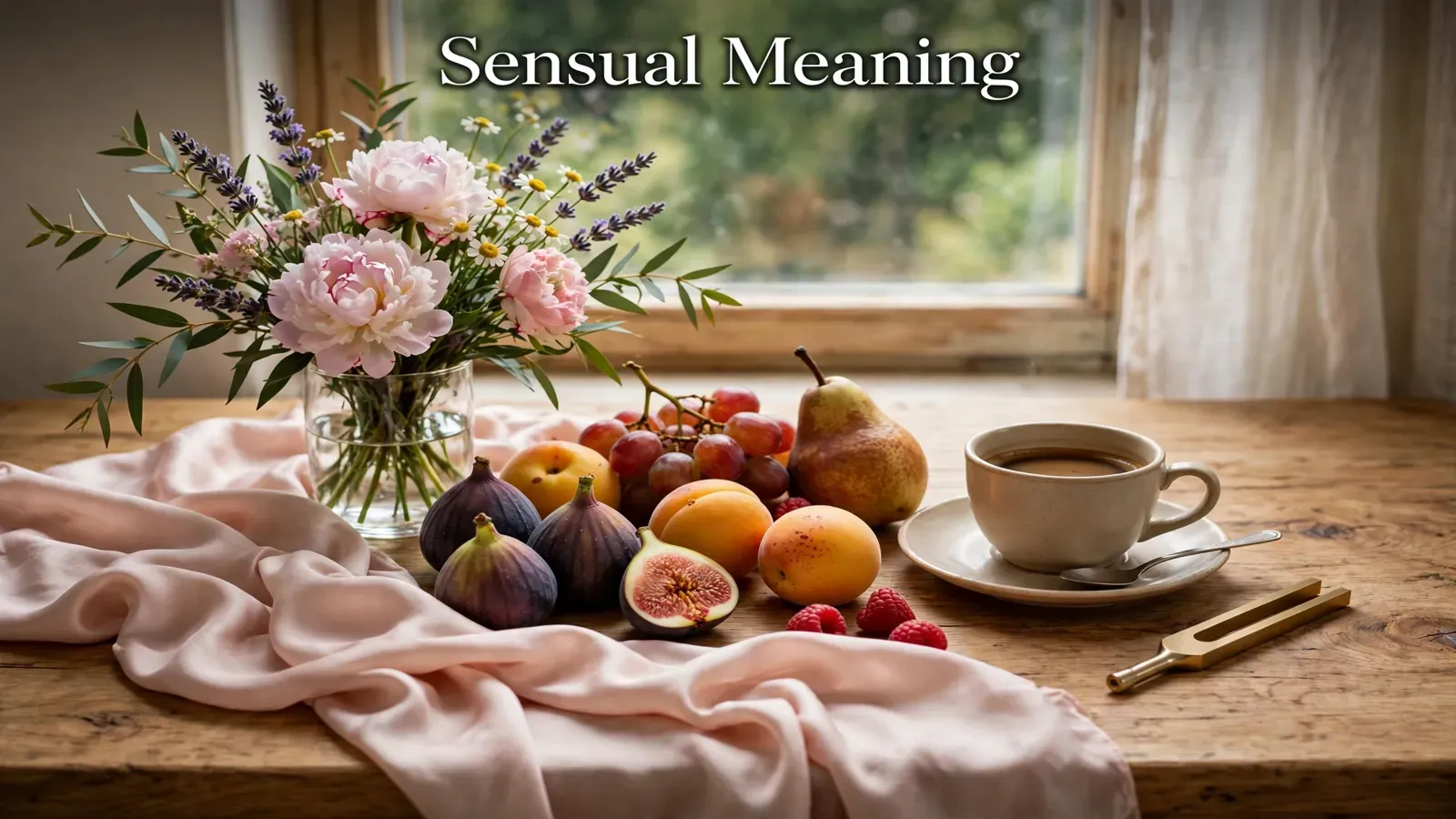
The word sensual is one of those English words that people use often but explain rarely. You may have seen it in a book review, a restaurant description, or a song lyric, and wondered exactly what it means. Is it about the senses, about pleasure, or about something else entirely? The short answer is that sensual meaning is about the physical senses: sight, sound, smell, taste, and touch, and the enjoyment that comes through them. A sensual experience is one that delights the body in a calm, rich, and often beautiful way, like soft fabric against the skin, the smell of fresh bread, or a warm melody on a quiet evening.
In this guide, you will learn the full definition of sensual, where the word comes from, how to use it correctly, and how it differs from similar words that people often confuse with it. You will also see how it compares with close neighbours like sensuous and sensory, so you can always choose exactly the right word every time.
What Does Sensual Mean?
Sensual is an adjective that describes something relating to the physical senses, especially the enjoyment of them. When something is sensual, it appeals to sight, sound, smell, taste, or touch in a way that gives pleasure. For example, a soft blanket can be sensual. Similarly, a rich piece of chocolate can be sensual. In addition, a warm bath, a beautiful melody, or the smell of fresh bread can all feel sensual.
The Cambridge Dictionary defines sensual as relating to the physical senses and the pleasure they give. The Merriam-Webster definition is similar: relating to or consisting in the gratification of the senses or the indulgence of appetite. Both definitions point to the same idea. The word is about the body and its senses, not about the mind alone.
However, it is important to note that sensual is a neutral word in itself. It does not have to mean anything improper. It simply describes an experience that is felt through the senses. A garden full of flowers is sensual because of its colors and scents. A silk shirt is sensual because of the way it feels against the skin. The word becomes more delicate only when writers use it about people, and even then, it usually means attractive in a graceful, physical way rather than anything stronger.
Sensual Meaning in Everyday Language
In everyday language, people use sensual to describe things that feel good to the senses. People use it for food, music, art, nature, and comfort. A chef might describe a sauce as sensual because it is rich and smooth. A writer might describe a voice as sensual because it is warm and soft. A traveler might describe a sunset over the sea as sensual because the colors and the breeze together create a deep feeling of pleasure.
The word also carries a sense of slowness and attention. A sensual experience is rarely rushed. It invites you to notice details: the texture of a fabric, the aroma of a coffee, the warmth of sunlight on your face. In that sense, sensual is close in meaning to words like luxurious, rich, and delightful, but it is more specific. It always points back to the five senses.
In formal writing, writers use sensual in art, literature, and philosophy. In casual speech, it appears less often, and people sometimes use it loosely to mean attractive or appealing. That loose use is one reason people often misunderstand the word.
The Origin of the Word Sensual
The word sensual comes from the Latin word sensualis, which means relating to the senses. That Latin word comes from sensus, meaning sense or feeling, which itself comes from the verb sentire, meaning to feel or to perceive. The same Latin root gives us the words sense, sensible, sensitive, and sentiment.
Sensual entered English in the fifteenth century, through Old French and Middle English. At first, writers used it mainly in religious and philosophical writing. Writers used it to describe the part of human nature that responds to the body and the senses, often in contrast to the spiritual or rational part. In that early use, the word sometimes carried a negative tone, because people saw the senses as a source of temptation.
Over time, the meaning softened. By the nineteenth century, poets and novelists were using sensual to describe beauty in a positive way: the sensual delight of a garden, the sensual richness of a painting, the sensual sound of a violin. The word kept its connection to the senses, but it lost much of its old moral judgment.
The History of Sensual Meaning
The history of sensual follows a clear path from the body to beauty.
In the 1400s and 1500s, the word appeared in sermons and philosophy, where it described the physical appetites and often served as a warning: a sensual life was a life ruled by the body rather than the mind.
During the 1700s, Enlightenment writers began to use the word more neutrally. Thinkers like John Locke, who studied how humans learn through the senses, wrote about sensual experience as a source of knowledge. The senses were no longer only a danger. They were also a way of understanding the world.
By the 1800s, the Romantic poets made the word beautiful. John Keats wrote about the sensual richness of nature, of fruit, of music, and of the human voice. For the Romantics, the senses were a path to truth, not a distraction from it. That use shaped the modern feeling of the word.
Later, in the twentieth century, sensual became common in advertising, food writing, and popular music, where advertisers used it to sell perfume, chocolate, and holidays, because it suggested pleasure without effort. At the same time, it kept its older use in literature and art criticism, where it describes texture, color, and sound.
Today, writers use the word in both ways. In a restaurant review, it may describe a dessert. In a poem, it may describe the feeling of rain on skin. The core meaning has stayed the same for six hundred years: it is about the senses and the pleasure they bring.
How to Use Sensual Meaning
Sensual is an adjective, so writers use it before a noun or after a linking verb. Here are the main patterns.
- Before a noun: a sensual voice, a sensual aroma, a sensual fabric, a sensual experience.
- After a linking verb: The music was sensual, the evening felt sensual, and the garden looked sensual in the morning light.
- With an adverb: deeply sensual, richly sensual, quietly sensual.
The word works best when the pleasure comes through a specific sense. Instead of writing "It was a sensual day," which is vague, it is clearer to write "The afternoon was sensual, with warm sun, soft grass, and the smell of roses." The reader can then feel what you mean.
You should not use sensual as a noun. There is no common noun form in everyday English. The related noun is sensuality, which means the quality of being sensual, or the enjoyment of physical pleasures. You can say "the sensuality of the music" or "the sensuality of the meal."
Sensual in Different Contexts
The word changes its shade of meaning depending on the context. These are the most common ones.
Sensual Meaning and Art
In art, sensual describes work that appeals to the senses through color, texture, and form. You can call a painting with rich reds and soft brushwork sensual, and you can call a sculpture with smooth curves sensual too. The word here is a compliment: the art is not only interesting to think about, but also a pleasure to look at.
Sensual Meaning and Food
For food writing, sensual is one of the most common uses of the word. A sensual dish is one that delights the senses: the smell as it arrives, the color on the plate, the texture in the mouth, the richness of the flavor. Writers use it for chocolate, coffee, ripe fruit, and slow-cooked meals. The word suggests that eating is not only about hunger. It is also about enjoyment.
Sensual Meaning and Music
For music, sensual describes a sound that is warm, smooth, and pleasing to the ear. You can call a slow jazz melody, a soft voice, or a deep cello note sensual. The word suggests that the music is felt in the body as well as heard.
Sensual Meaning and Nature
When writing about nature, sensual describes the pleasure of the natural world. The smell of rain, the feel of warm sand, the sight of a field of flowers, the sound of a stream: you can call all of these sensual. The word here is about attention. It means you are fully present, noticing what your senses are telling you.
Examples of Sensual Meaning in Sentences
These examples show the word in natural use.
- The garden was sensual in June, full of roses, warm earth, and the sound of bees.
- She has a sensual voice, low and warm, that makes people want to keep listening.
- The chef described the chocolate cake as sensual, rich, dark, and smooth.
- After a long day, a hot bath felt deeply sensual, a simple pleasure for tired muscles.
- In one painting, sensual colors, deep reds and golds, seemed to glow on the canvas.
- The silk dress was sensual to touch, cool and soft against the skin.
- At the cafe, the music was slow and sensual, and the whole room seemed to relax.
- He loves the sensual pleasure of fresh bread, the smell, the warmth, and the crisp crust.
Common Misconceptions About Sensual Meaning
The most common misconception is that sensual and sexual mean the same thing. They do not. Sexual means relating to sex. Sensual means relating to the senses. The two words can overlap, because the senses are part of physical attraction, but they are not the same. For example, a meal can be sensual without being sexual. Similarly, a song can be sensual without being sexual. In the same way, a garden can be sensual without being sexual.
Next, a second misconception is that sensual is always a compliment. It is usually positive, but writers can also use it as a criticism. In older writing, a sensual person was someone ruled by appetite. Even today, calling a lifestyle sensual can suggest that it focuses too much on physical pleasure. The tone depends on the context.
Then, a third misconception is that sensual means luxurious or expensive. It does not. A simple pleasure, like the smell of rain or the feel of clean sheets, can be sensual. The word is about the senses, not about price.
Finally, a fourth misconception is that sensual is a modern slang word. It is not. It has been in English for more than six hundred years, and it has a long history in literature, philosophy, and religion.
Related Terms and Words
Several words are close to sensual, and knowing the differences helps you use each one correctly.
- Sensuous: very close to sensual, and often used in the same way. Some writers say sensuous is about the senses in a more aesthetic way, while sensual is more about physical pleasure. In practice, the two are often interchangeable.
- Sensuality: the noun form, meaning the quality of being sensual, or the enjoyment of physical pleasures.
- Sensory: relating to the senses in a neutral, scientific way. A sensory experience is one that involves the senses, but the word does not suggest pleasure. People use sensory in medicine and psychology.
- Sensitive: easily affected by the senses, or able to notice small changes. A sensitive person feels things deeply, but the word is not about pleasure.
- Luxurious: rich and comfortable, often expensive. A luxurious thing may be sensual, but the two words are not the same.
Sensual in Conversation
Here are natural ways the word comes up in everyday conversation.
- "This perfume is so sensual. It smells like warm flowers and vanilla."
- "I love the sensual feeling of fresh sheets after a long day."
- "The restaurant was beautiful, and the food was sensual, rich and full of flavor."
- "She has a sensual voice. I could listen to her read all day."
- "The garden in spring is almost sensual, with all those colors and scents."
- "We spent the afternoon in a sensual kind of calm, just music, sunshine, and good coffee."
Summary
In short, sensual is an adjective that means relating to the physical senses and the pleasure they give. It comes from the Latin word sensualis, built on sensus, meaning sense, and it has been part of English since the fifteenth century. The word describes experiences that delight sight, sound, smell, taste, or touch, from a soft fabric to a rich meal to a warm melody. It is not the same as sexual, it is not only about luxury, and it is not modern slang. It is a precise, useful word for the simple, physical pleasures of life, and it works best when you name the sense that is being delighted.
FAQs About Sensual Meaning
What does sensual mean in simple words?
Sensual means relating to the physical senses and the pleasure they give. Something sensual delights your sight, sound, smell, taste, or touch. A soft blanket, a rich chocolate cake, or a warm bath can all be described as sensual.
Is sensual the same as sexual?
No, sensual and sexual are not the same. Sexual means relating to sex. Sensual means relating to the senses. A meal, a song, or a garden can be sensual without being sexual. The two words can overlap, but they describe different things.
Can sensual be used for food?
Yes, sensual is very common in food writing. A sensual dish is one that delights the senses: the smell, the color, the texture, and the flavor. Chocolate, coffee, ripe fruit, and slow-cooked meals are often described this way.
What is the difference between sensual and sensuous?
Sensual and sensuous are very close in meaning, and they are often used in the same way. Some writers say sensuous is more about beauty and art, while sensual is more about physical pleasure. In everyday use, the difference is small, and most readers will understand either word.
Is sensual a positive or negative word?
Sensual is usually positive, suggesting beauty, richness, and enjoyment. It can be negative in older or formal writing, where it once described a life ruled by appetite. In modern use, the tone depends on the context, but it is most often a compliment.
How do you pronounce sensual?
You pronounce sensual SEN-shoo-uhl, with the stress on the first syllable. The first part sounds like "sen," the middle like "shoo," and the end like a short "uhl." It rhymes roughly with "eventual" without the first vowel sound.
What is the noun form of sensual?
The noun form is sensuality. It means the quality of being sensual, or the enjoyment of physical pleasures. You can say "the sensuality of the music" or "the sensuality of a summer evening." The word is used in literature and art writing.
Can a person be described as sensual?
Yes, you can describe a person as sensual, and it usually means they are attractive in a graceful, physical way, or that they enjoy the pleasures of the senses. The word is softer than sexual, and it often suggests warmth, beauty, and ease rather than anything stronger.
Where does the word sensual come from?
Sensual comes from the Latin word sensualis, meaning relating to the senses. That word comes from sensus, meaning sense or feeling, from the verb sentire, meaning to feel or perceive. It entered English in the fifteenth century, and the same root gives us sense, sensible, sensitive, and sentiment.
Conclusion
Sensual is a simple word with a rich history. The word means relating to the senses and the pleasure they give, and it has carried that meaning from Latin into English for more than six hundred years. It describes the softness of silk, the richness of chocolate, the warmth of a voice, and the colors of a garden. It is not the same as sexual, it is not only about luxury, and it does not need to be complicated. The next time you notice a small pleasure, the smell of fresh bread, the feel of warm sun, the sound of a favorite song, you are noticing something sensual. That attention to the senses is a quiet kind of pleasure, and it is one of the simplest joys in everyday life.

I am Sophia Bennett, is a digital resources and online tools writer at LinkVistaHub. She enjoys exploring useful websites, emerging digital tools, productivity platforms, and practical online resources that help people work smarter and discover valuable information.