Read the word racecar forwards, then read it backwards. It says the same thing. That small trick is the heart of the palindrome meaning, and it is one of the oldest word games in the English language.
A palindrome is a word, phrase, number, or sequence that reads the same in both directions. Once you learn to spot one, you start seeing them everywhere: on road signs, in names, in dates, and even in your DNA.
In this guide, we explain the palindrome definition in plain English, trace the word back to ancient Greek, and share the most famous examples, from level and radar to the legendary sentence about a man, a plan, and a canal.
We also cover palindromic numbers, palindrome names and places, how palindromes show up in science and music, and how you can build your own. By the end, you will spot palindromes in seconds and impress your friends with a few of the best ones ever written.
You will also learn how to say the word correctly, how to build a palindrome of your own, and why scientists, musicians, and puzzle lovers care about these mirrors too.
What Is a Palindrome? A Direct Answer
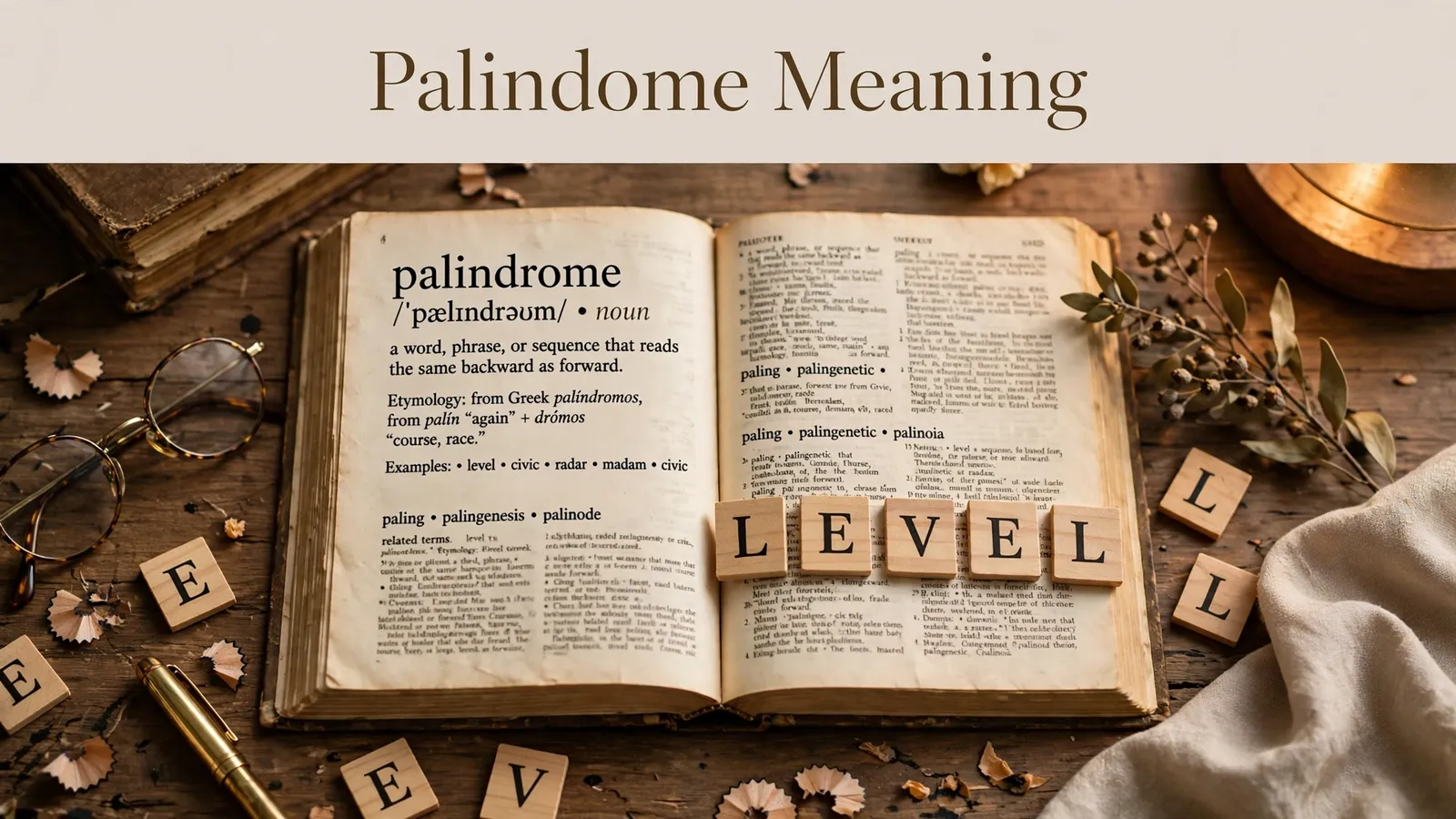
A palindrome is a word, phrase, number, or sequence that reads the same forwards and backwards.
The word level is a palindrome. Read it from the left, it says level. Read it from the right, it also says level. The same is true of radar, madam, civic, and kayak.
For phrases, the rule is the same, but spaces, punctuation, and capital letters are ignored. The famous sentence “A man, a plan, a canal, Panama” reads the same backwards once you remove the commas and spaces.
Numbers work the same way. The number 121 reads the same in both directions, and so does 1331. Dates can be palindromes too, like 02/02/2020.
In short: a palindrome is a mirror. Whatever it says one way, it says the same way back.
The Origin of the Word Palindrome
Palindrome comes from ancient Greek. It combines two words: palin, meaning again, and dromos, meaning running or a course.
Put them together and you get “running back again.” That is a perfect description. The letters run forward, then they run back again and arrive at the same place.
The word entered English in the early 1600s. Writers and scholars of the time loved wordplay, and they needed a name for words that worked in both directions.
The Greek roots also explain why the idea feels so old. Palindromes appear in Latin, Greek, and Hebrew texts that are thousands of years old. People have enjoyed this trick for a very long time.
Today the word is used far beyond word games. Scientists, mathematicians, and musicians all use palindromes in their own fields.
Famous Palindrome Words
Some palindrome words are so common that you use them every day without noticing. Here are the best known ones, grouped by type.
Short Everyday Palindromes
- Mom
- Dad
- Pop
- Noon
- Eye
- Eve
- Bob
- Anna
- Otto
- Hannah
These are short, simple, and easy to remember. Many of them are names, which is part of their charm.
Longer Common Palindromes
- Level
- Radar
- Madam
- Civic
- Kayak
- Racecar
- Rotator
- Deified
- Reviver
- Solos
Each of these is a real English word with a real meaning. They are not made up for the trick. That is what makes them so satisfying.
Fun and Unusual Palindromes
- Madam, I am Adam: this is the classic first sentence, often credited as a joke about the first man.
- Refer
- Tenet
- Peep
- Wow
- Did
- Pip
The shortest palindromes are just three letters long. Even a single letter, like A or I, counts as a palindrome.
Famous Palindrome Sentences
Palindrome sentences are harder to build than single words. Every letter must line up in reverse, so writers have to plan them carefully. Here are the most famous ones.
- “A man, a plan, a canal, Panama.” This is the most famous palindrome sentence in English. It describes the man who planned the Panama Canal.
- “Was it a car or a cat I saw?” A simple question that works perfectly in reverse.
- “Never odd or even.” A short favorite that describes itself.
- “Madam, in Eden, I am Adam.” Another joke about the first man and woman.
- “Do geese see God?” A question that reads the same backwards.
- “No lemon, no melon.” A classic about fruit that only works when the fruit is gone.
- “Race fast, safe car.” A short one that car lovers enjoy.
- “Step on no pets.” A rule for pet owners, and a palindrome too.
To check a sentence, remove the spaces, commas, and question marks. Then read the letters backwards. If they match, you have a palindrome.
Some writers have built entire poems from palindromes. These are called palindromic poems, and they are very hard to write well. The best ones read naturally in both directions.
Palindromic Numbers and Dates
Numbers can be palindromes too. A palindromic number reads the same forwards and backwards, just like a palindromic word.
Famous Palindromic Numbers
- 121
- 1331
- 2002
- 11111
- 12321
- 1001
The number 2002 was a palindrome year. The whole year 2002 read the same in both directions. The next palindrome year after that is 2112.
Mathematicians study palindromic numbers as a hobby and a science. They ask questions like how many palindromic prime numbers exist. A palindromic prime is a prime number that is also a palindrome, like 131 or 151.
Palindrome Dates
Palindrome dates are rare and exciting. The date 02/02/2020 was a palindrome in the month/day/year format. It read the same forwards and backwards: 02022020.
That date was also a palindrome in the day/month/year format used in most of the world. It was the first date like that in 909 years. The previous one was 11/11/1111.
The next big palindrome date will be 12/02/2021, which reads 12022021. People celebrate these dates with parties, weddings, and social media posts.
Palindromes in Names and Places
Palindromes show up in names more often than you might think. Parents sometimes choose them on purpose, and places sometimes end up with them by accident.
Palindrome First Names
- Anna
- Otto
- Bob
- Eve
- Hannah
- Ava
- Ada
- Elle
- Nan
- Nayan
Anna and Otto are two of the most popular palindrome names in English. They are short, classic, and easy to spell in both directions.
Palindrome Places
- Neenah, Wisconsin: a city whose name reads the same backwards.
- Nayan: a name and a place in India with the same mirror quality.
- Wassamassaw: a swamp in South Carolina with a name that works in reverse.
- Kinikinik: a place name in Alberta, Canada, that is also a palindrome.
Town names like these become local points of pride. Residents love telling visitors that their town reads the same backwards.
Palindromes in Science and Math
Palindromes are not just word games. They appear in real science, especially in genetics.
DNA is built from four chemical letters: A, T, C, and G. Some DNA sequences read the same forwards and backwards on the two strands of the double helix. Scientists call these palindromic sequences.
In math, palindromic numbers appear in puzzles and research. One famous question asks about Lychrel numbers, which are numbers that never become palindromes even after repeated reversing and adding.
Palindromes in Music and Literature
Musicians and writers have used palindromes for centuries. The mirror idea works in sound just as well as it works in letters.
Palindromes in Music
Composers sometimes write palindromic music, also called crab canon. The melody plays forwards, then it plays backwards, and the two halves mirror each other.
Johann Sebastian Bach was famous for this trick. He wrote pieces that could be played forwards and backwards at the same time. It was a musical puzzle for his fellow composers.
Palindromes in Literature
Writers use palindromes as jokes, riddles, and hidden messages. Lewis Carroll loved wordplay, and palindromes appear in his puzzles and poems.
James Joyce used palindromes in his novels. The word “tattarrattat” appears in Ulysses as the sound of a knock on a door, and it reads the same in both directions.
Palindrome vs Anagram vs Anadrome
People often mix up palindromes with two related word games. Here is how they differ.
- Palindrome: a word or phrase that reads the same forwards and backwards. Example: level.
- Anagram: a word or phrase made by rearranging the letters of another word. Example: listen becomes silent.
- Anadrome: a word that spells a different word when reversed. Example: live becomes evil, and stop becomes pots.
The key difference is simple. A palindrome mirrors itself. An anagram scrambles letters into a new word. An anadrome reverses into a different word entirely.
A word can be more than one of these at once. The word “stressed” reversed is “desserts,” which makes it an anadrome. It is not a palindrome, because the two words are different.
How to Make Your Own Palindrome
Building a palindrome is a fun puzzle. You can start small and work your way up. Here is a simple step-by-step method.
- Pick a short word as your center. Good centers are single letters like A or I, or short words like “eye” or “mom.”
- Choose a word to place on one side. Try a simple word like “top” or “cat.”
- Mirror it on the other side. If you start with “top,” you need “pot” on the other side to mirror it.
- Read the whole thing backwards. Check that every letter lines up. Fix any letter that breaks the mirror.
- Add words around it to make a sentence. Keep the sentence short at first. A three-word palindrome is a great first success.
- Read it out loud. A good palindrome sounds natural, not forced. If it sounds strange, try different words.
Start with words before you try sentences. A word like “deed” is easy. A sentence like “Was it a car or a cat I saw?” takes more practice. With a little patience, you can build one of your own.
Palindromes in Word Games and Everyday Life
Palindromes show up in games, puzzles, and school lessons. They are a favorite of teachers because they make spelling fun.
In Scrabble, a palindrome word can be a smart play. Words like “civic” or “level” use common letters and score well on the board. They also block your opponent from using the same space.
In crosswords, palindrome answers are a treat. Puzzle makers love them because they fit the grid in a clever way. A clue like “Reads the same both ways” usually points to a palindrome.
Wordle players talk about palindromes too. A five-letter palindrome like “level” or “civic” is a strong opening guess, because the mirrored letters give you twice the information.
Fun Facts About Palindromes
Palindromes have a long and strange history. Here are some of the best facts.
- The longest single palindrome word in English is “tattarrattat,” from James Joyce. It has 12 letters.
- The word “palindrome” itself is not a palindrome. Writers joke about this often.
- February 2, 2020, was called Palindrome Day around the world. It was the first universal palindrome date in 909 years.
- The Sator Square is a Latin word square from ancient Rome. It reads the same forwards, backwards, up, and down.
- The longest palindrome sentence ever written has more than 17,000 words. It was built by a computer program, not a human.
Common Misconceptions and Mistakes
A few myths about palindromes keep circulating. Let us clear them up.
One misconception is that a palindrome must be a single word. It does not. Phrases, sentences, numbers, and dates can all be palindromes.
Another is that spaces and punctuation break a palindrome. They do not. For phrases, you ignore spaces, commas, and question marks and check only the letters.
A common mistake is calling any reversed word a palindrome. A reversed word is only a palindrome if it spells the same word. “Live” reversed is “evil,” so it is an anadrome, not a palindrome.
Another error is thinking palindromes are rare. They are everywhere. Short ones like “mom,” “dad,” and “noon” appear in everyday speech all the time.
Some people think palindromes must be long to count. They do not. Even a single letter counts, and a three-letter word like “eye” is a perfect palindrome.
Key Facts About Palindromes
Here is a quick summary of everything that matters about the word.
- Meaning: A word, phrase, number, or sequence that reads the same forwards and backwards.
- Origin: Greek palin, meaning again, plus dromos, meaning running. It means “running back again.”
- Common usage: Word games, puzzles, school lessons, names, dates, science, and music.
- Tone: Playful and clever. It sounds like a puzzle, not a formal term.
- Popularity: Very common. Most English speakers know the idea, even if they do not know the word.
- Related terms: Anagram, anadrome, palindromic number, palindrome day, Sator Square, crab canon.
FAQs About Palindrome Meaning
What is a palindrome in simple terms?
A palindrome is a word, phrase, number, or sequence that reads the same forwards and backwards. Level, radar, and racecar are simple examples. The letters mirror each other perfectly.
What is the most famous palindrome?
The most famous palindrome sentence is “A man, a plan, a canal, Panama.” The most famous single word is probably racecar or level. Both are known around the world.
What does palindrome mean in Greek?
Palindrome comes from the Greek words palin, meaning again, and dromos, meaning running. Together they mean “running back again,” which describes how the letters run forward and then run back to the same place.
Is mom a palindrome?
Yes. Mom reads the same forwards and backwards: M-O-M. Dad, pop, and noon work the same way. These are some of the first palindromes children learn.
What is a palindrome number?
A palindrome number is a number that reads the same forwards and backwards, like 121, 1331, or 2002. The year 2002 was a palindrome year. The next one will be 2112.
What was the palindrome date 02/02/2020?
The date 02/02/2020 read the same forwards and backwards in both the month/day/year and day/month/year formats. It was the first universal palindrome date in 909 years, and people celebrated it as Palindrome Day.
What is the difference between a palindrome and an anagram?
A palindrome reads the same forwards and backwards, like level. An anagram rearranges the letters of a word to make a new word, like listen becoming silent. A palindrome mirrors itself, while an anagram scrambles the letters.
What is the longest palindrome word?
The longest commonly cited palindrome word in English is “tattarrattat,” a 12-letter word from James Joyce’s Ulysses. It describes the sound of a knock on a door. Longer ones exist in dictionaries, but they are rarely used.
Are palindromes used in science?
Yes. In genetics, palindromic DNA sequences read the same on both strands of the double helix. Enzymes use these sequences as cutting points when scientists edit DNA. Palindromes also appear in math research.
How can I make my own palindrome?
Start with a short center word like “eye” or “mom.” Then add a mirrored word on each side, like “top” and “pot.” Read the whole thing backwards to check it. Start with single words, then try short sentences. Practice makes it easier.
Conclusion
The palindrome meaning you came looking for is simple: a word, phrase, number, or sequence that reads the same forwards and backwards.
Now you also hold the deeper layers. The word comes from Greek, it shows up in names and dates, it helps scientists cut DNA, and it has delighted writers and musicians for thousands of years.
The practical takeaway is easy. Start spotting them. Check the next date, the next name, and the next word you read. You will find mirrors hiding in plain sight.
Then try building one of your own. Pick a short center, mirror a word on each side, and read it backwards. The first time it works, you will understand why people have loved this trick for two thousand years.

I am Alex Carter, is a web resources and digital tools writer at Linkvistahub. He enjoys discovering useful websites, online tools, productivity resources, and practical digital solutions that can make everyday tasks easier.