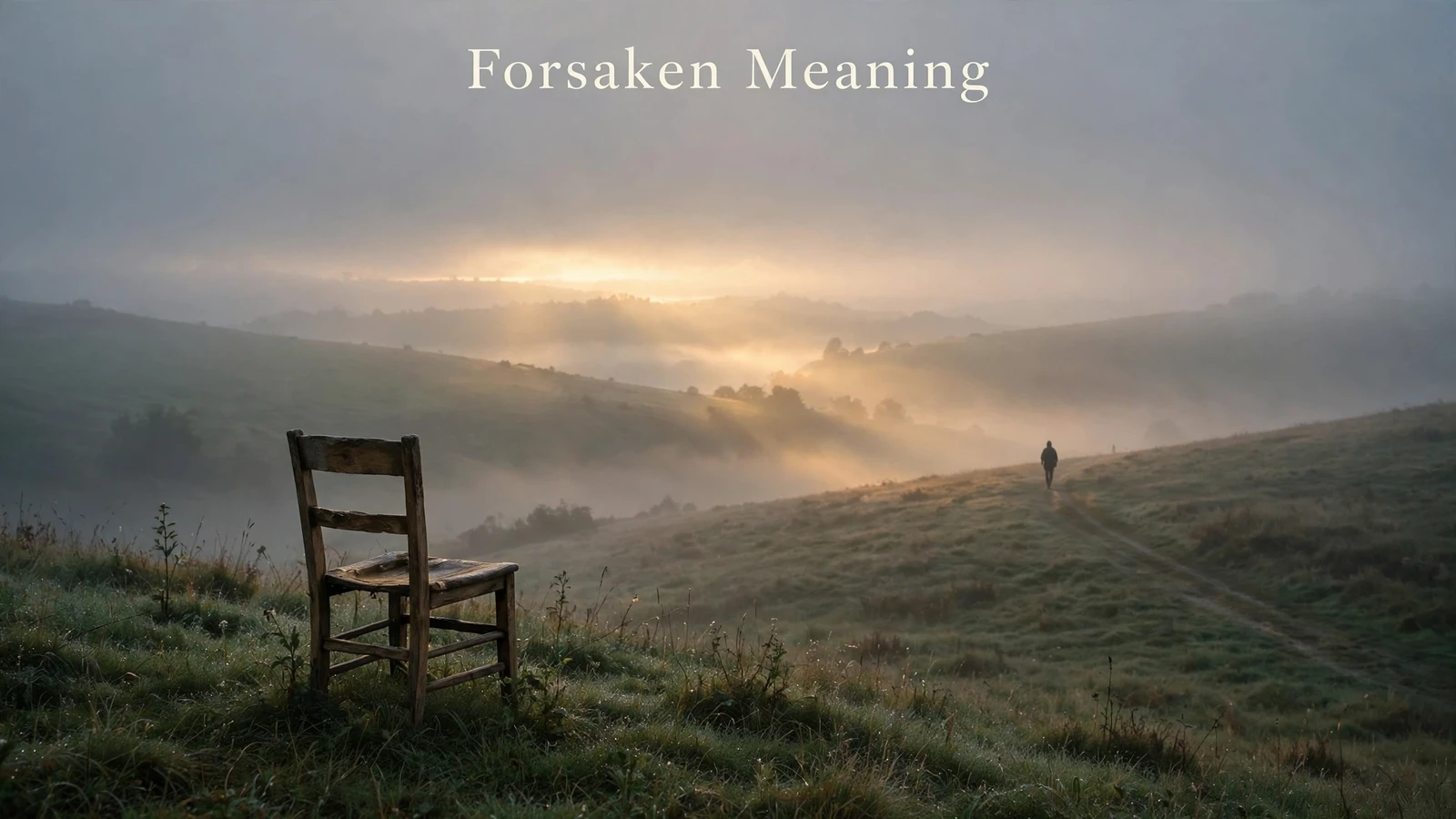
Some words hit harder than others. Forsaken is one of them. It does not just mean left behind. It means left behind by someone who was supposed to stay.
If you have searched for the forsaken meaning, you have probably met the word in a Bible verse, a song lyric, or a moment of real life. It shows up in the most famous cry in the New Testament, in old hymns, in classic novels, and in the mouths of people who feel abandoned by someone they trusted.
In this guide, we unpack every layer of the word. We start with the dictionary definition, trace it back to Old English, and walk through its most famous moment in the Bible, the cry of Jesus on the cross in Psalm 22 and Matthew 27:46.
We also cover how forsaken differs from abandoned and deserted, how it appears in literature and music, and what it means when a person says they feel forsaken today. By the end, you will know exactly what forsaken means in every context, and how to use it without overstating it. Keep reading, and the word will never feel vague again.
Forsaken Meaning in a Nutshell
Forsaken is the past participle of the verb forsake. It means abandoned, deserted, or given up, especially by someone who was expected to stay or protect.
A forsaken place is one that people have left and no longer care for. A forsaken person is one who feels left alone by family, friends, or God.
In short: forsaken is abandonment with a broken promise inside it.
The Core Dictionary Meaning
Here are the shades of meaning, in order of how often people actually use them.
Forsaken as Abandoned
The most common meaning is abandoned or deserted. A forsaken village is one its people have left. A forsaken child is one whose parents have gone.
Forsaken as Given Up
Forsaken can also mean given up or renounced. A person may forsake a bad habit, a belief, or a way of life, deciding to let it go even when it is hard.
Forsaken as Feeling Left Alone
The third meaning is emotional. To feel forsaken is to believe that someone who should have stayed has gone. This is the sense that appears in prayers, poems, and songs.
Forsake, Forsook, Forsaken: The Grammar
Forsaken belongs to a family of verb forms that many English learners find tricky. Here is how they work.
Forsake is the base verb. It means to abandon or give up. “He decided to forsake his old life.”
Forsook is the simple past tense. “She forsook her home and started again.”
Forsaken is the past participle. It appears with have and be. “They have forsaken the town.” “The town was forsaken.”
Forsaken also works as an adjective. “A forsaken chapel stood at the edge of the woods.” In this use, it describes the state of being left behind.
The Origin and History of the Word Forsaken
Forsaken comes from Old English forsacan, which meant to refuse, deny, or abandon. It was built from for, meaning against or away, and sacan, meaning to dispute or deny.
In Old English, the word carried a sense of legal refusal. To forsake something was to deny it formally, to say no to it in public. By the Middle Ages, forsake meant to leave someone or something entirely, and forsaken described whatever was left behind.
The word shares Germanic roots with German versagen, which means to refuse or fail, and Dutch verzaken, which means to renounce. All of them carry the same old idea: a deliberate turning away.
Forsaken in the Bible
The word’s most famous moment comes from the cross itself.
Psalm 22: “My God, My God, Why Have You Forsaken Me?”
Psalm 22 opens with one of the most quoted lines in Scripture: “My God, my God, why have you forsaken me?”
The psalm was written by David, and it describes a person in deep suffering. He feels distant from God, surrounded by enemies, and unsure if anyone will answer. For centuries, readers have seen this psalm as a portrait of suffering that ends in trust. The psalm begins in darkness, but it closes with praise and hope.
Matthew 27:46: The Cry of Jesus on the Cross
In the Gospel of Matthew, Jesus speaks these same words from the cross: “My God, my God, why have you forsaken me?” (Matthew 27:46).
Theologians call this the cry of dereliction. It is the moment when Jesus, bearing the weight of the world’s sin, experiences the feeling of being cut off from the Father. The words matter because they show that Jesus entered fully into human suffering. He did not only suffer physically. He suffered the loneliness that every forsaken person knows.
What the Cry Means for Believers
For Christians, the cry is not a sign that God truly left Jesus. It is a sign that Jesus took on the full human experience of feeling forsaken, so that no believer would ever have to face that feeling alone.
Other Bible Verses About Being Forsaken
The Bible uses the word forsaken in many places. Deuteronomy 31:6 says, “He will never leave you nor forsake you.” Hebrews 13:5 repeats the same promise.
Isaiah 49:15 asks, “Can a mother forget the baby at her breast?” The answer is that even if she could, God will not forget his people. Psalm 27:10 says, “Though my father and mother forsake me, the Lord will receive me.”
Forsaken in Literature and Poetry
Forsaken was a favorite word of poets and novelists. It carried a weight that simpler words like left could not match.
Forsaken in Shakespeare
Shakespeare used forsake and forsaken to mark moments of betrayal and loss. In King Lear, the old king feels forsaken by his daughters. The word captures the pain of a father whose children have turned away from him. In the sonnets, the speaker fears being forsaken by the person he loves. The word turns a breakup into a small tragedy.
Forsaken in Hymns
Hymn writers loved the word forsaken because it sang well and meant so much. Many old hymns speak of the believer who feels forsaken, and of the God who never forsakes. Congregations still sing about being “never forsaken,” and the word carries the weight of centuries.
Forsaken in Classic Novels
In classic novels, forsaken often describes a place. A forsaken house, a forsaken village, or a forsaken road tells the reader at once that something sad happened here. It says that people once lived here, loved here, and then left, and that the leaving still hangs in the air.
Forsaken vs Abandoned vs Deserted vs Neglected
They overlap, but they are not identical. Here is how they differ.
- Forsaken: Left behind by someone who was expected to stay or protect. It carries a sense of broken trust or broken promise.
- Abandoned: Left behind completely, with no care or protection. It is the broadest of the four words.
- Deserted: Left empty, usually a place. A deserted street has no people in it at all.
- Neglected: Not cared for properly over time. Neglect is slow; forsaking is sudden.
The simplest test is this. A house can be abandoned, deserted, or neglected. But it is forsaken only when someone who loved it or owed it care has walked away. A person can feel forsaken by a friend, abandoned by a partner, or neglected by a parent. Each word paints a slightly different picture of the same pain.
Forsaken in Modern Usage
The word forsaken is old, but it is still very much alive in everyday speech, in songs, and in movies.
Forsaken in Relationships
In relationships, forsaken describes the feeling of being left by someone who promised to stay. A spouse who walks out, a parent who disappears, or a friend who stops answering can all leave a person feeling forsaken. The word is stronger than dumped or left. It says the leaving broke something that was supposed to hold.
Forsaken in Friendships
Friendships can end quietly, and the person left behind often feels forsaken. The friend did not argue or explain. They simply stopped showing up. That silence is what makes the word fit. Forsaken is not just about absence. It is about absence without explanation.
Forsaken in Songs and Movies
Songwriters use forsaken to describe heartbreak at its deepest. A song about feeling forsaken is a song about being left when it mattered most.
Movies use the word more carefully. A character called forsaken is usually one the world has forgotten, and the story asks if anyone will come back for them. The word appears in the titles of songs, albums, and films, and listeners know at once what kind of story they are getting.
The Emotional Meaning of Feeling Forsaken
Feeling forsaken is more than being alone. It is the belief that someone who should have stayed chose to go.
Psychologists note that this feeling hits harder than simple loneliness. Loneliness says no one is here. Forsakenness says someone was here, and they left.
People who feel forsaken often ask the same questions. Did I do something wrong? Was I not worth staying for? Will anyone else leave too? These questions are painful, but they are also normal. Feeling forsaken is a common human experience, and it does not mean the feeling is true forever.
How People Cope With Feeling Forsaken
Coping starts with naming the feeling honestly. Saying “I feel forsaken” is more useful than saying “I am fine” when you are not.
Next comes separating the feeling from the fact. A person may have left, but their leaving does not prove you are unlovable. It proves they made a choice.
Talking helps. A trusted friend, a counselor, or a faith community can offer the presence that the forsaking person took away. For many people, faith helps too. The promise in Deuteronomy 31:6, that God will never leave or forsake his people, is quoted by believers precisely in these moments.
Synonyms and Antonyms of Forsaken
Knowing the near neighbors of a word helps you use it precisely. Synonyms include abandoned, deserted, neglected, discarded, rejected, and jilted. Each one leans a little differently, but all of them describe being left behind.
Abandoned is the closest synonym. Deserted fits places best. Rejected fits people best. Jilted fits romantic breakups best.
Antonyms include cherished, embraced, supported, protected, and upheld. These words describe the opposite: someone stayed, cared, and kept their promise. A useful pair is forsaken and cherished. One word describes a promise broken. The other describes a promise kept.
Realistic Conversation Examples
- “After the divorce, he felt forsaken by everyone he trusted.” (emotional abandonment)
- “The old chapel stood forsaken at the end of the lane.” (a deserted place)
- “She promised she would never forsake her family.” (a vow to stay)
- “He forsook his career to care for his mother.” (giving something up)
Usage Tips
Forsaken is a strong word, so aim it carefully. First, save it for real weight. Forsaken means more than left. Using it for a canceled lunch sounds dramatic and odd.
Second, match it to the relationship. Forsaken fits a parent, a spouse, a close friend, or God. It rarely fits a casual acquaintance.
Third, use the right form. Forsake is the verb, forsook is the past, and forsaken is the participle and the adjective. Mixing them up is the most common mistake.
Fourth, watch your tone. In formal writing, forsaken sounds literary and serious. In casual speech, it can sound old fashioned, which is fine when the moment calls for it.
Common Misconceptions and Mistakes
Several myths about forsaken keep circulating. One misconception is that forsaken and abandoned mean exactly the same thing. They are close, but forsaken adds the idea of a broken promise or a duty left undone.
Another is that forsaken is only a Bible word. It is not. It appears in novels, songs, and everyday speech, wherever people talk about being left by someone who mattered.
A common mistake is confusing forsake with forget. To forsake is to leave or give up on purpose. To forget is to lose something from memory. They are very different acts.
Another error is using forsaken when you mean lonely. Loneliness is a feeling of being alone. Forsakenness is the feeling of being left by someone specific. The biggest myth is that feeling forsaken means you truly are forsaken. Feelings are real, but they are not always facts. Many people who feel forsaken are still deeply loved by others.
Key Facts About Forsaken
- Meaning: Abandoned, deserted, or given up, especially by someone who was expected to stay or protect.
- Origin: Old English forsacan, meaning to refuse, deny, or abandon; Germanic roots shared with German and Dutch.
- Common usage: The Bible, literature, hymns, songs, and everyday talk about relationships and loss.
- Tone: Serious, literary, and emotional. It carries more weight than abandoned or left.
- Popularity: Very common in religious and literary contexts; less common in casual speech, where it sounds formal.
- Related terms: Forsake, forsook, abandon, desert, neglect, forsaken by God, cry of dereliction.
FAQs About Forsaken Meaning
What does forsaken mean in simple terms?
Forsaken means abandoned or left behind, especially by someone who was expected to stay. It is the past participle of the verb forsake, and it describes a person or place that has been given up.
What is the difference between forsaken and abandoned?
Abandoned is the broader word. It means left behind with no care. Forsaken adds a layer: the person who left was supposed to stay, protect, or keep a promise. That broken expectation is what makes forsaken sting more.
What does “My God, my God, why have you forsaken me?” mean?
It is the opening line of Psalm 22:1, quoted by Jesus on the cross in Matthew 27:46. It is a cry of deep suffering, expressing the feeling of being cut off from God. Christians believe Jesus spoke it so he could share fully in human pain.
Is forsaken a past tense word?
Forsaken is the past participle of forsake. The simple past is forsook. So you say “he forsook his home” for the past, and “the home was forsaken” or “he has forsaken his home” for the participle form.
What is the opposite of forsaken?
The opposite is cherished, embraced, or supported. These words describe someone who stayed, cared, and kept their promise, which is the reverse of being forsaken.
Why does the Bible say God will never forsake us?
Verses like Deuteronomy 31:6 and Hebrews 13:5 promise that God will never leave or forsake his people. For believers, this promise answers the fear of being forsaken: even when people leave, God stays.
Can a place be forsaken?
Yes. A forsaken place is one that people have left and no longer care for, like a forsaken house, village, or chapel. The word gives the place a sad, haunted feeling.
Is forsaken still used today?
Yes, though it is more common in writing, songs, and religious language than in casual chat. People still say they feel forsaken when a relationship ends badly or when someone they trusted lets them down.
What is the cry of dereliction?
The cry of dereliction is the name theologians give to Jesus’ words on the cross: “My God, my God, why have you forsaken me?” (Matthew 27:46). It names the moment when Jesus expressed the deepest human feeling of being left alone.
Does feeling forsaken mean God has left you?
According to Christian teaching, no. Feeling forsaken and being forsaken are different things. Psalm 22 begins with the cry of forsakenness and ends with praise, which is why believers see it as a journey through darkness toward hope.
Conclusion
Forsaken is one of the heaviest words in English. It names a pain everyone recognizes: the moment when someone who was supposed to stay walks away.
Remember the three layers. At its core, forsaken means abandoned or given up. In the Bible, it is the cry of Psalm 22 and the cross. In daily life, it is the feeling of being left by someone who mattered.
The practical rule is simple. Use the word when the weight fits. A canceled plan is not forsakenness. A broken promise from someone you trusted is.
And if you are the one who feels abandoned right now, remember the arc of Psalm 22. It begins with a cry and ends with praise.

I am Sophia Bennett, is a digital resources and online tools writer at LinkVistaHub. She enjoys exploring useful websites, emerging digital tools, productivity platforms, and practical online resources that help people work smarter and discover valuable information.