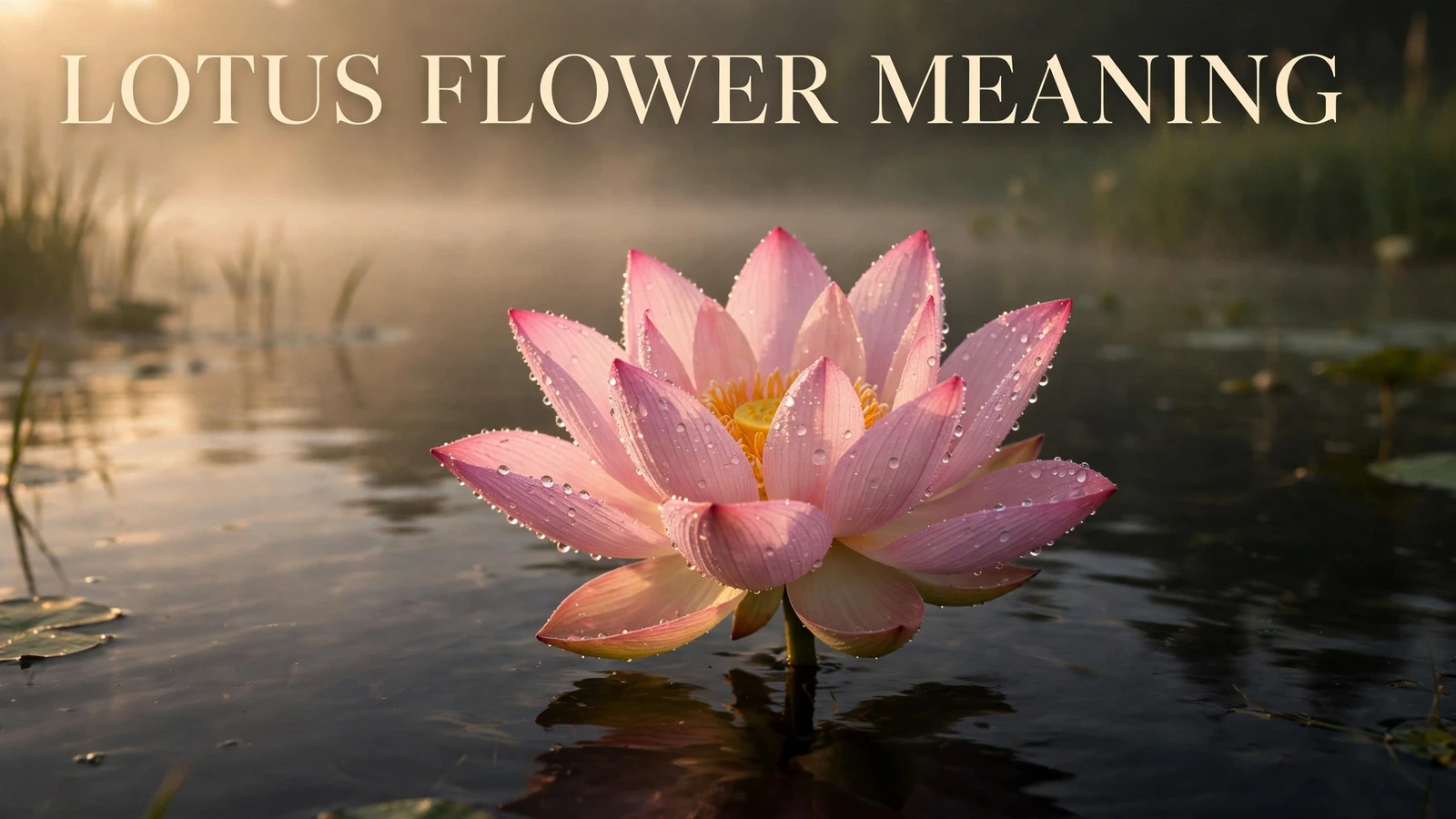
In fact, the lotus flower has a strange and beautiful power. It grows in muddy, murky water, yet it blooms each morning completely clean, its petals untouched by the dirt below. Few images in nature capture the human hope for renewal quite like it.
If you are searching for the lotus flower meaning, this quiet promise probably draws you in: that beauty can rise from hardship, and that a person can stay clean inside even when life around them is messy.
As a result, the meaning of the lotus flower reaches far beyond botany. It sits at the heart of Buddhism and Hinduism, appears in ancient Egyptian art, and today shows up on tattoos, yoga studios, and wedding decor around the world.
First, in this guide, we unpack every layer of the lotus flower symbolism, from its roots in mud to its place in meditation and modern culture.
We also cover each lotus flower color meaning, its role in spiritual growth, the common confusion with the water lily, and what people actually mean when they wear it on their skin or place it in their homes.
Finally, you will know the lotus from every angle, and you will never see it as just a pretty flower again.
What Does the Lotus Flower Symbolize? A Direct Answer
In short, the lotus flower symbolizes purity, rebirth, and resilience. It grows from muddy, dark water, yet its petals open each morning untouched by the mud, which is why cultures across Asia have used it for thousands of years as a symbol of rising above suffering.
In Buddhism, the lotus stands for enlightenment and spiritual awakening. In Hinduism, tradition links it to divine beauty, prosperity, and the unfolding of consciousness. Across traditions, the same core message holds: no matter where you start, you can bloom.
The Core Symbolism of the Lotus Flower
The lotus has several meanings that grow from the way it actually lives. Each part of the plant’s life cycle gave ancient observers a spiritual lesson.
Purity
For example, a lotus grows in muddy ponds, but its petals are self-cleaning. Water beads up and rolls off, carrying dirt away. This natural property made it the perfect symbol of purity: staying untainted by a dirty environment.
Rebirth and Renewal
In addition, the lotus closes at night and sinks below the surface, then rises and opens fresh each morning. This daily cycle made it a symbol of rebirth, a new start offered to everyone, every day.
Resilience
Roots anchored in mud, the flower pushes through dark water to reach the sun. It does not wait for perfect conditions. This is why the lotus is also a symbol of resilience and quiet strength.
Detachment
The lotus touches the water, but the water never soaks it. It lives in the world without letting the world ruin it, a lesson about detachment and inner peace.
The Lotus Flower in Buddhism
In fact, Buddhism gave the lotus some of its most famous meanings. The flower appears in Buddhist art, temples, and teachings across Asia.
Artists often show the Buddha sitting on a giant lotus throne. The image teaches that even in a world full of suffering, a person can sit in perfect calm.
For example, Buddhist texts describe different colored lotuses for different qualities of the mind. The white lotus stands for mental purity. The pink lotus, the most common in art, connects to the Buddha himself.
The lotus also connects to the idea of the journey. Just as the flower rises through mud, water, and air, the soul rises through ignorance, struggle, and finally awakening.
In Tibetan Buddhism, Padmasambhava, the teacher who brought Buddhism to Tibet, carries the name Lotus-Born. His very name ties the religion’s spread to this flower.
The Eight Petals and the Eightfold Path
Specifically, in Buddhist art, the lotus often has eight petals. These stand for the Noble Eightfold Path: right understanding, right intention, right speech, right action, right livelihood, right effort, right mindfulness, and right concentration.
The image is practical, not just decorative. A Buddhist looking at an eight-petaled lotus remembers the actual steps to take in daily life.
The Lotus Flower in Hinduism
Similarly, in Hinduism, the lotus is sacred to several major gods and goddesses. It is one of the most common divine symbols in Indian art.
Goddess Lakshmi, who brings wealth and good fortune, almost always appears seated or standing on a lotus. The message is that true prosperity grows from purity, not greed.
Tradition says Lord Brahma, the creator, emerged from a lotus that grew from the navel of Vishnu. The flower here means the origin of all life.
For example, Goddess Saraswati, the patron of learning and the arts, sits on a white lotus. Knowledge, like the flower, blooms best in a clear, disciplined mind.
The Lotus and the Chakras
Hindu and yogic tradition pictures the body’s energy centers, the chakras, as lotuses with different numbers of petals.
The root chakra, Muladhara, is a four-petaled red lotus at the base of the spine. The crown chakra, Sahasrara, is a thousand-petaled lotus at the top of the head.
Tradition describes spiritual progress as the rising of energy from the lower lotuses to the thousand-petaled bloom at the crown. In art, enlightenment appears as a lotus opening.
As a result, the lotus appears in so many yoga studios. It is not decoration. It is a map of the inner journey.
The Lotus in Ancient Egypt
Meanwhile, long before Buddhism, ancient Egypt honored the blue lotus. It grew along the Nile and opened each morning, so Egyptians linked it to the sun and creation.
For example, Egyptian myths say the sun god rose from a lotus that bloomed out of the dark waters of chaos. The flower became a symbol of creation itself.
The blue lotus also symbolized rebirth in the afterlife. Lotus shapes appear on tomb walls, amulets, and the crowns of pharaohs.
Artists pictured the dead holding lotus flowers as they entered the next world.
The Lotus in China and Japan
In China, the lotus stands for summer, beauty, and the virtue of the gentleman. A famous Confucian saying praises the lotus for rising unstained from mud, comparing it to an honest person in a corrupt world.
People also link the lotus to the Buddhist goddess Guanyin, often shown holding or standing on the flower. She represents compassion that blooms in the middle of suffering.
In Japan, the lotus connects to Buddhism and to the summer Obon festival, when families honor their ancestors. People use lotus petals in offerings, and the flower reminds people that their loved ones continue in a pure form.
Lotus Flower Meaning by Color
Of course, the color of a lotus changes its meaning. Each shade carries its own message.
White Lotus Meaning: Purity and Perfection
The white lotus stands for purity of mind and spiritual perfection. It is the lotus of Saraswati and of the highest, cleanest intentions. A white lotus tattoo often means a fresh start.
Pink Lotus Meaning: Divine and Enlightenment
The pink lotus is the most sacred in Buddhism. It represents the Buddha’s history and the divine promise of enlightenment. In art, gods and enlightened beings sit on pink lotuses.
Red Lotus Meaning: Love and Compassion
The red lotus stands for love, passion, and compassion. It represents the heart’s qualities, warmth toward others and the courage to care deeply.
Blue Lotus Meaning: Wisdom and Knowledge
In contrast, the blue lotus, rare in nature, stands for wisdom, knowledge, and the victory of spirit over the senses. In ancient Egypt it was the flower of the sun and rebirth. It suggests a calm, thoughtful mind.
Purple Lotus Meaning: Mysticism
The purple lotus connects to mysticism and spiritual royalty. In Buddhist art, its eight petals often point to the Noble Eightfold Path. It represents the deep, mysterious side of spiritual life.
Yellow Lotus Meaning: Spiritual Ascension
Finally, the yellow or golden lotus stands for spiritual ascension and enlightenment fully achieved. It glows like the sun, representing the final blooming of consciousness.
Lotus vs Water Lily: A Common Confusion
In fact, many people mix up the lotus and the water lily. They look similar, but they are different plants with different meanings.
For example, the lotus (Nelumbo) rises above the water on a tall, sturdy stalk. Its large round leaves also stand above the surface. Its flowers open high in the air.
The water lily (Nymphaea) floats on the surface. Its flowers rest on the water, and its leaves float flat with a notch cut out of one side.
Overall, the difference matters. The lotus rises above its environment, which is the whole point of its meaning. The water lily rests on it. When you choose a lotus tattoo or image, make sure the flower stands tall.
The Lotus in Yoga and Meditation
The lotus pose, Padmasana, is one of the most famous yoga positions. You cross the legs with each foot resting on the opposite thigh, like the layered petals of the flower.
In fact, the pose is not just for flexibility. It creates a stable, grounded seat for long meditation. The body becomes the lotus: rooted below, open above.
As a result, studios use the lotus in their logos because it promises what yoga offers: growth from wherever you are now into something calmer and clearer.
Lotus Tattoos: What They Mean
The lotus is one of the most popular tattoo designs in the world. People choose it for deeply personal reasons.
For example, a common choice is the lotus as a mark of survival. Someone who has come through addiction, illness, grief, or a hard chapter gets the flower to say: I rose from the mud.
Unalome designs, which combine the lotus with a winding line, are popular in Southeast Asian-inspired tattoos. The line represents life’s twists, and the lotus at the end represents the peace that follows struggle.
The color of a lotus tattoo changes its message, just as in the tradition. A black-and-gray lotus is classic and understated. A pink or blue lotus carries the specific color meanings described above.
Placement matters too. Many people put a small lotus on the wrist, behind the ear, or along the spine, where it serves as a private reminder rather than a public statement.
Real-Life Scenarios
For example, a woman finishing cancer treatment gets a white lotus on her shoulder. It marks the day she chose to start fresh.
A new father gets a small lotus on his forearm. It reminds him to stay calm when parenting gets messy.
A yoga teacher puts a thousand-petaled lotus at the base of her neck. It represents the crown chakra, the goal of her practice.
The Lotus in Weddings and Home Decor
For example, lotus flowers are popular in weddings, especially in Asian and fusion ceremonies. They symbolize a pure, resilient love.
Couples float lotus blooms in bowls of water as centerpieces. The image is simple and powerful: beauty resting on calm water.
In home decor, lotus motifs appear on cushions, wall art, lamps, and door handles. Feng shui tradition values the lotus for bringing harmony and positive energy into a space.
A lotus in the home reminds the family daily: stay pure in intention, keep growing, and let each morning be a fresh start.
Cultural Relevance and Modern Trends
However, the lotus has moved far beyond temples. It is now a global symbol, and its meaning keeps growing.
Wellness brands use the lotus to signal mindfulness and calm. It appears on tea packaging, spa menus, and meditation apps.
On social media, lotus imagery marks posts about healing, self-care, and new beginnings. The hashtag culture has made it a shorthand for personal growth.
Common Misconceptions About the Lotus
Still, a few myths follow the lotus around. Let us clear them up.
First, the lotus is not the same as the water lily. They are different plants, as described above. The rising stalk is the lotus’s signature.
Second, the lotus is not only Buddhist. It is equally important in Hinduism, ancient Egypt, and Chinese philosophy. No single religion owns it.
Third, blue lotus is not a magical drug in the way some internet stories claim. The ancient Egyptian blue lotus was sacred and used in rituals, but modern hype about its effects is mostly exaggerated.
A lotus tattoo does not have one fixed meaning. Its meaning depends on the color, the design, and the wearer’s story. Always ask before assuming.
Finally, the lotus does not mean you must suffer to be worthy. It means growth is possible even in hard conditions, not that hard conditions are required.
Key Facts About the Lotus Flower
Here is a quick summary of everything that matters about the flower.
- Meaning: Purity, rebirth, resilience, enlightenment, and detachment. It symbolizes rising above hardship unstained.
- Origin: Native to Asia and Australia, sacred in ancient Egypt, India, China, and Japan for thousands of years.
- Common usage: Buddhist and Hindu art, yoga and meditation, tattoos, weddings, home decor, wellness branding.
- Tone: Serene, sacred, and hopeful. It carries dignity without heaviness.
- Popularity: One of the most recognized spiritual symbols in the world, used across religions and cultures.
- Related terms: Water lily, Padmasana (lotus pose), chakras, Sahasrara, Lakshmi, Guanyin, unalome, blue lotus.
FAQs About Lotus Flower Meaning
What is the spiritual meaning of the lotus flower?
The lotus spiritually means purity, rebirth, and enlightenment. Because it blooms clean from muddy water, it represents the soul rising above suffering and ignorance into clarity and peace.
What does a lotus flower tattoo mean?
A lotus tattoo usually means survival, resilience, or a fresh start. It marks a person rising from a hard chapter of life. The color adds a layer: white for purity, pink for enlightenment, red for love.
What does the pink lotus mean?
The pink lotus is the most sacred lotus in Buddhism. It represents the Buddha, divine promise, and the highest enlightenment. In art, enlightened beings sit on pink lotus thrones.
What does the blue lotus symbolize?
The blue lotus symbolizes wisdom, knowledge, and the victory of spirit over the senses. In ancient Egypt, it was tied to the sun god and rebirth. It suggests a calm, thoughtful mind.
What is the difference between a lotus and a water lily?
The lotus rises above the water on a tall stalk, with leaves and flowers held high. The water lily floats on the surface, with notched leaves resting flat. The lotus’s rising above its environment is the heart of its symbolism.
Why is the lotus important in Buddhism?
The lotus is important in Buddhism because it pictures the path to enlightenment. Just as the flower rises through mud, water, and air, the mind rises through suffering toward awakening. The Buddha is shown seated on a lotus.
What does the lotus mean in Hinduism?
In Hinduism, the lotus means divine beauty, prosperity, and spiritual unfolding. Lakshmi sits on a lotus, Brahma emerged from one, and the chakras are pictured as lotuses opening along the spine.
Is the lotus flower lucky?
Many cultures treat the lotus as a lucky symbol. In feng shui and Hindu tradition, it is believed to bring harmony, prosperity, and positive energy into a home. Its luck comes from what it represents: clean growth.
What does a closed lotus bud mean?
A closed lotus bud represents potential and the time before awakening. It is the soul not yet opened. An opening bud means the journey has begun, and a fully open bloom means enlightenment or full realization.
Can I grow a lotus at home?
Yes, you can grow lotus in a large container pond with still water and full sun. They need warm weather and rich soil in the pot. The flowers bloom in summer, and the plant goes dormant in winter.
Conclusion
In conclusion, the lotus flower meaning is really a story about you. It begins in mud, pushes through dark water, and opens clean to the morning sun.
Across Buddhism, Hinduism, and ancient Egypt, the flower has carried the same promise. Your past does not decide your future. What matters is the direction you grow.
Finally, the colors add their own voices. White speaks of purity, pink of enlightenment, red of love, and blue of wisdom. Together they form a complete picture of a life well lived.
Keep the image close in daily life. When a day feels muddy, remember the lotus does not fight the mud. It simply keeps rising through it.
Start small, as the flower does. One calm breath, one kind act, one fresh morning. The bloom follows the rising, and it always has.

I am Alex Carter, is a web resources and digital tools writer at Linkvistahub. He enjoys discovering useful websites, online tools, productivity resources, and practical digital solutions that can make everyday tasks easier.