
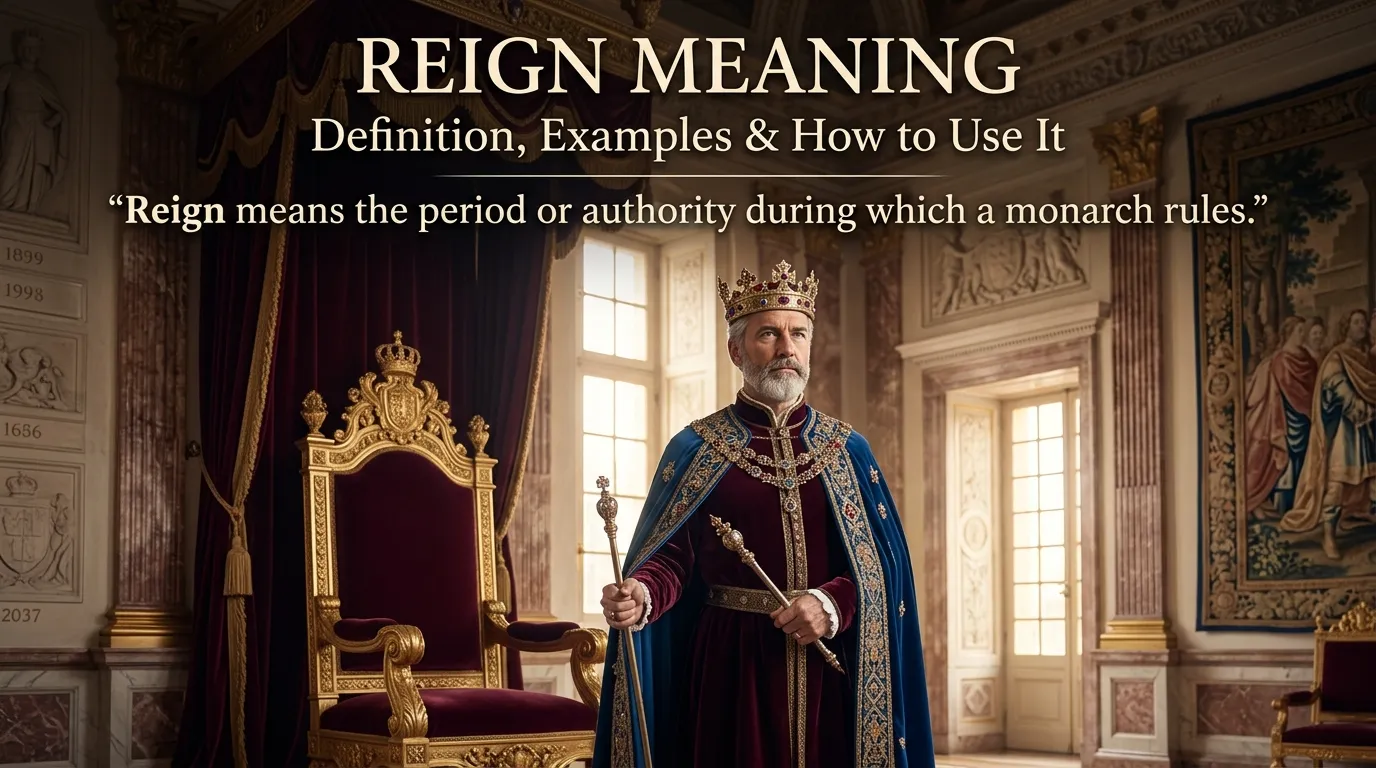
Have you ever read a sentence such as “The king’s reign lasted for 40 years” and wondered exactly what reign meaning refers to?
The word reign is often connected with kings, queens, emperors, and other rulers, but its meaning goes beyond royal history.
In modern English, it can also describe a period when someone or something has control, influence, dominance, or widespread success.
So, what does reign mean in simple terms? As a noun, reign usually means the period during which a monarch rules a country.
As a verb, it means to rule or exercise authority. It can also be used figuratively, as in “the team reigned supreme,” meaning the team was highly successful or dominant.
Understanding reign definition, pronunciation, synonyms, examples, and the difference between reign vs. rule can help you use the word correctly. It is especially useful because reign, rein, and rain sound alike but have completely different meanings.
If you encountered the word in a history book, Bible passage, novel, news article, sports discussion, or everyday conversation, this guide explains everything you need to know about the meaning of the reign in clear, simple English.
What Does Reign Mean?
Reign means the period during which a king, queen, emperor, or other monarch officially rules. It can also mean the act or condition of ruling.
As a noun, reign commonly refers to a ruler’s time in power:
Queen Elizabeth II had the longest reign of any British monarch.
As a verb, reign means to rule:
The king reigned for more than three decades.
The word can also have a figurative meaning. When someone or something reigns supreme, it means they are considered the most successful, powerful, or dominant in a particular area.
For example:
The champion reigned supreme for several years.
Here, “reigned” does not mean the person was literally a king or queen. It describes their dominance or success.
Reign Meaning in Simple English
In simple English:
Reign = a period of ruling or being in power.
It can describe:
- A king’s period of rule
- A queen’s time as monarch
- An emperor’s control
- Someone’s dominance or influence
- A period of exceptional success
Reign Definition
Here is a quick dictionary-style explanation:
Reign (noun): The period during which a monarch rules, or the exercise of royal authority.
Reign (verb): To rule as a monarch or to hold dominant power or influence.
Basic Examples
- The queen’s reign lasted 25 years.
- The emperor reigned over a vast empire.
- The champion continued to reign supreme.
- Peace reigned throughout the kingdom.
- The new manager now reigns over the department.
The last examples show how the word can be used beyond literal monarchy.
Reign Meaning as a Noun
The most common use of reign is as a noun.
It describes the specific period during which a monarch occupies the throne and exercises authority.
For example:
King Henry VIII’s reign changed the course of English history.
In this sentence, reign refers to the entire period when Henry VIII was king.
Another example:
During her reign, the country experienced major political changes.
The word can also refer to the authority or influence associated with ruling.
What Is a Monarch’s Reign?
A monarch’s reign generally begins when they officially become the ruler and ends when they:
- Die,
- Abdicate,
- Are removed from power, or
- Lose the position through another constitutional or political change.
The exact rules can differ between countries and historical periods.
Reign Meaning as a Verb
As a verb, reign means to rule as a monarch.
For example:
The king reigned over the country for 20 years.
Here, reigned means “ruled.”
The verb can also be used more broadly to describe a situation where something dominates or is widespread.
For example:
Confusion reigned after the unexpected announcement.
This does not mean confusion became a king. It means confusion was widespread and seemed to dominate the situation.
Another example:
Excitement reigned in the stadium after the final goal.
The word creates a strong, somewhat dramatic image of a particular feeling dominating an environment.
Reign in Different Contexts
The meaning of reign can change slightly depending on context.
1. Historical Context
In history, reign usually refers to a monarch’s time on the throne.
The king’s reign began in 1680.
This is the most traditional use of the word.
2. Political Context
Reign can describe political authority, particularly in historical discussions involving monarchies.
His reign was marked by political reforms.
3. Figurative Context
In figurative language, reign can mean dominance or strong influence.
Technology companies currently reign supreme in the industry.
The companies are not monarchs. The expression means they are extremely powerful or successful.
4. Literary Context
Writers often use reign to create dramatic or poetic language.
Darkness reigned across the abandoned city.
Here, reigned means darkness was dominant or widespread.
5. Sports Context
Sports writers frequently use reign when discussing a champion or successful team.
The club’s reign as league champions finally ended.
This means the team had held the championship for a period of time.
6. Pop Culture and Entertainment
The word can describe a celebrity’s period of dominance.
Her reign as pop music’s biggest star continued for years.
Again, this is figurative rather than literal.
Reign vs. Rule: What’s the Difference?
Reign and rule are closely related, but they are not always interchangeable.
| Word | Meaning | Typical Use |
| Reign | A monarch’s period of ruling | Kings, queens, emperors |
| Rule | Control or authority over people or situations | Governments, leaders, organizations |
| Govern | Manage or control a country or group | Political and administrative contexts |
| Dominate | Be more powerful or successful than others | Sports, business, competition |
A reign often emphasizes the period or era of authority.
For example:
The queen’s reign lasted 50 years.
Rule focuses more directly on the act of controlling or governing:
The queen ruled the country for 50 years.
Both sentences communicate similar information, but their emphasis is slightly different.
Reign vs. Rein vs. Rain
One of the most common problems with reign is confusing it with rein and rain.
These three words are homophones, meaning they generally sound alike but have different meanings and spellings.
| Word | Meaning | Example |
| Reign | Rule or period of ruling | The king’s reign lasted decades. |
| Rein | A strap used to control a horse; also control | She kept a tight rein on spending. |
| Rain | Water falling from clouds | Heavy rain flooded the streets. |
Reign
Think of royalty.
The king’s reign was peaceful.
Rein
Think of horses or control.
The rider pulled on the reins.
The phrase “rein in” means to control or limit something.
The company needs to rein in its expenses.
Rain
Think of the weather.
Rain fell throughout the afternoon.
Easy Memory Trick
You can remember the difference like this:
- Reign = royalty
- Rein = restraint or horse control
- Rain = weather
This simple association can prevent one of the most common spelling mistakes in English.
Reign Meaning in “Reign Supreme”
One of the most recognizable expressions containing the word is “reign supreme.”
To reign supreme means to be the most powerful, successful, respected, or dominant person or thing in a particular situation.
For example:
The athlete reigned supreme at the tournament.
This means the athlete was the clear winner or dominant competitor.
Another example:
Chocolate reigns supreme among dessert lovers.
The statement means chocolate is considered extremely popular or dominant in that context.
Is “Reign Supreme” Literal?
Usually, no.
It is a figurative expression. The person or thing being described does not literally rule a kingdom.
It is commonly used in:
- Sports
- Entertainment
- Business
- Food
- Fashion
- Technology
- Popular culture
Reign Meaning in “Peace Reigns”
Another common expression is:
“Peace reigns.”
This means peace is widespread or dominant in a particular place.
For example:
After years of conflict, peace finally reigned in the region.
The word creates a metaphor in which peace is treated like a ruler.
You may also encounter:
- Silence reigned.
- Chaos reigned.
- Confusion reigned.
- Fear reigned.
- Joy reigned.
In each case, reigned means that a particular condition or emotion was dominant.
Reign Meaning in the Bible and Religious Writing
The word reign frequently appears in religious and biblical language, particularly when discussing God, Jesus, kings, kingdoms, and divine authority.
In this context, reign often carries a meaning connected with authority, sovereignty, kingship, and spiritual rule.
For example, phrases involving God’s reign can refer to God’s supreme authority or the idea of divine kingship.
The word is also common in religious hymns and traditional Christian language.
Because religious texts use elevated and symbolic language, reign can sometimes mean more than political control. It may refer to spiritual authority or divine sovereignty.
Reign Meaning in Modern English
Although the word has strong historical and royal associations, reign remains useful in modern English.
People use it figuratively when discussing someone who has achieved exceptional influence or dominance.
For example:
The singer’s reign at the top of the charts lasted several months.
Or:
The company reigned as the market leader for years.
This usage gives the sentence a stronger and more dramatic tone than simply saying “was successful.”
Why Do Writers Use “Reign”?
The word can suggest:
- Power
- Authority
- Longevity
- Dominance
- Prestige
- Influence
- Success
That is why journalists, marketers, sports commentators, and creative writers often choose it.
Reign Examples in Everyday Sentences
Here are practical examples showing how reign works in different sentences:
- The king’s reign lasted for forty years.
- Her reign began after the previous monarch died.
- The emperor reigned over a vast territory.
- During his reign, several reforms were introduced.
- The team’s reign as champions came to an end.
- The artist reigned supreme on the music charts.
- Silence reigned throughout the room.
- Chaos reigned after the announcement.
- Peace finally reigned in the kingdom.
- The company’s reign as market leader lasted a decade.
- Fear reigned during the crisis.
- The champion continued to reign supreme.
- Her reign was remembered for major social changes.
- The dynasty’s reign eventually ended.
- The new champion ended the previous player’s reign.
Reign in a Conversation
Although reign is not a common everyday conversational word when used literally, it can appear naturally in certain situations.
Example 1: Talking About History
Person A: How long did the king reign?
Person B: He reigned for nearly three decades.
Example 2: Talking About Sports
Person A: Who dominated the league during that period?
Person B: That team reigned supreme for several seasons.
Example 3: Talking About a Chaotic Situation
Person A: What happened after the announcement?
Person B: Confusion reigned for a few minutes.
Example 4: Talking About Entertainment
Person A: Who was the biggest pop star in the early 2000s?
Person B: Several artists had their moment, but one singer really reigned supreme.
These examples show that reign can sound natural when the context involves history, dominance, or dramatic description.
Positive and Negative Connotations of Reign
The word reign can have either positive or negative associations depending on context.
Positive Uses
It can suggest:
- Leadership
- Stability
- Success
- Excellence
- Strength
- Achievement
Example:
The champion’s reign inspired a new generation of athletes.
Negative Uses
It can suggest:
- Oppression
- Tyranny
- Excessive control
- Fear
- Violence
- Abuse of power
Example:
The dictator’s reign was marked by fear and repression.
Therefore, the word itself is not automatically positive or negative. The surrounding context determines its emotional meaning.
Common Mistakes When Using Reign
Mistake 1: Using “Rain” Instead of “Reign”
Incorrect:
The king’s rain lasted 30 years.
Correct:
The king’s reign lasted 30 years.
“Rain” refers to precipitation, while “reign” refers to ruling.
Mistake 2: Confusing “Reign” With “Rein”
Incorrect:
The manager needs to reign in spending.
Correct:
The manager needs to rein in spending.
Rein in means to control or restrict.
Mistake 3: Assuming Reign Always Means Royalty
Reign can have figurative meanings.
The champion reigned supreme.
The champion is not necessarily a monarch.
Mistake 4: Using Reign When “Rule” Is More Natural
Sometimes rule, govern, or control is clearer.
For example:
The manager rules the office.
This may sound humorous or exaggerated.
If you mean ordinary management, “manages” is usually more natural.
Synonyms for Reign
The best synonym depends on how reign is being used.
When Reign Means Rule
Possible synonyms include:
- Rule
- Govern
- Lead
- Command
- Control
- Preside
- Dominate
- Exercise authority
When Reign Means a Period of Power
Possible alternatives include:
- Rule
- Leadership
- Tenure
- Era
- Period of authority
- Administration
- Sovereignty
However, these words are not always perfect replacements.
For example, tenure generally describes the period someone holds a position, while reign is strongly associated with monarchy or figurative dominance.
Antonyms of Reign
Depending on the context, possible opposites include:
- Submit
- Obey
- Follow
- Surrender
- Yield
- Be ruled
- Be subordinate
For the figurative sense of dominance, antonyms might include:
- Lose
- Fail
- Decline
- Surrender
- Fall behind
Origin and Etymology of Reign
The history of reign is closely connected to the history of monarchy and royal authority.
The word entered English through Old French, ultimately tracing back to Latin roots associated with ruling and kingship. Its development is related to words such as regal, regime, regent, and royal, which also have connections to Latin rex, meaning “king.”
Over time, reign became established in English as a word describing both the authority of a monarch and the period during which that authority is exercised.
Its figurative uses developed naturally from the idea of ruling. If a person or thing is extremely dominant, English speakers can metaphorically describe it as “reigning.”
Reign Pronunciation
Reign is pronounced like “rain.”
The spelling is different, but the pronunciation is essentially the same in standard English.
It is a one-syllable word.
This is why reign, rein, and rain are so easy to confuse in writing.
Reign: Key Facts at a Glance
| Feature | Details |
| Word | Reign |
| Part of speech | Noun and verb |
| Main meaning | A period of ruling or the act of ruling |
| Common context | Monarchies and history |
| Figurative meaning | Dominance, influence, or widespread control |
| Pronunciation | Same as “rain” |
| Origin | Old French and Latin roots |
| Common phrase | Reign supreme |
| Commonly confused with | Rein, rain |
| Tone | Formal, literary, historical, or dramatic |
| Related words | Rule, royal, regal, regime, ruler |
Reign in Literature and Writing
Writers often choose reign because it carries more emotional and historical weight than the simple word “rule.”
Compare:
The king ruled for fifty years.
with:
The king’s reign lasted fifty years.
The second sentence can sound more formal and historical.
Likewise:
Darkness covered the city.
is straightforward, while:
Darkness reigned over the city.
creates a more dramatic image.
This makes reign especially useful in:
- Historical writing
- Fiction
- Poetry
- Journalism
- Political commentary
- Sports writing
- Biographical writing
How to Use Reign Correctly
If you want to use reign correctly, first ask what kind of meaning you need.
Use “reign” when:
- Talking about a monarch’s time in power.
- Describing royal authority.
- Discussing a historical dynasty.
- Describing dominance figuratively.
- Using phrases such as “reign supreme.”
- Describing a condition that dominates a situation.
Use “rein” when:
- Referring to controlling a horse.
- Using the phrase “rein in.”
Reign vs. Dominance
Reign and dominance overlap when discussing success or power, but they have different styles.
Dominance focuses directly on superiority or control.
The team’s dominance lasted for five seasons.
Reign presents that dominance metaphorically as a period of ruling.
The team’s reign lasted for five seasons.
The second sentence sounds more dramatic and often works better in headlines or storytelling.
Reign vs. Tenure
These words can both refer to a period in which someone holds a position, but they are not identical.
Tenure is commonly used for someone’s period in a job, office, or position.
During her tenure as CEO, the company expanded internationally.
Reign is traditionally associated with monarchs and is often more dramatic when used figuratively.
During her reign as champion, she won six major titles.
Calling a CEO’s time a “reign” can imply unusually strong control or dominance.
Why “Reign” Still Matters Today
You might think reign is an old-fashioned word because of its connection to kings and queens. However, it continues to appear frequently in modern English.
It survives because the concept of power and dominance remains relevant.
Sports commentators use it to describe champions. Journalists use it to describe political eras. Entertainment writers use it for successful celebrities. Fiction writers use it to create dramatic imagery.
The word therefore connects traditional language with modern communication.
Frequently Asked Questions About Reign Meaning
1. What does reign mean in simple words?
Reign means the period when a king, queen, or other monarch rules. As a verb, it means to rule. It can also mean to dominate or be very influential.
2. What is an example of reign?
A simple example is:
The queen’s reign lasted for 30 years.
Here, reign means the period during which she was queen.
Another example is:
The team reigned supreme for several seasons.
Here, reigned means the team was highly successful or dominant.
3. Is reign the same as rule?
They are closely related but not exactly the same. Rule generally means to control or govern, while reign often refers specifically to a monarch’s period of authority. Reign can also be used figuratively to describe dominance.
4. What does “reign supreme” mean?
Reign supreme means to be the most successful, powerful, or dominant person or thing in a particular situation.
For example:
The athlete reigned supreme at the competition.
It means the athlete was clearly dominant.
5. Are reign and rain pronounced the same?
Yes. Reign and rain are normally pronounced the same way in English, but they have completely different meanings.
Reign relates to ruling, while rain refers to water falling from clouds.
6. What is the difference between reign and rein?
Reign means ruling or a period of ruling. Rein refers to a strap used to control a horse and appears in expressions such as “rein in,” meaning to control or limit something.
7. Can reign be used for someone who is not a king or queen?
Yes, but usually in a figurative sense.
For example:
The athlete reigned supreme for a decade.
The athlete is not a monarch. The sentence means the athlete was exceptionally dominant.
8. What does “peace reigns” mean?
Peace reigns means that peace is widespread or dominant in a particular place or situation.
It is a figurative expression in which peace is compared to a ruler.
9. What is the opposite of reign?
There is no single perfect opposite in every context. Depending on the sentence, opposites may include submit, obey, surrender, yield, lose, or be ruled.
10. Is reign a formal word?
Yes. Reign can sound formal, historical, literary, or dramatic. However, it is also common in modern expressions such as “reign supreme.”
Conclusion
The reign meaning is simple once you understand its two main uses. Literally, reign refers to the period during which a monarch rules or to the act of ruling.
Figuratively, it can describe a person, organization, emotion, or idea that is dominant, powerful, or highly influential.
The word is especially common in historical writing, royal contexts, sports, journalism, literature, and dramatic descriptions.
Expressions such as “reign supreme” and “peace reigns” show how naturally the word has moved beyond its original royal setting.
One of the most important things to remember is the difference between reign, rein, and rain. They sound alike, but their meanings are completely different: reign relates to ruling, rein relates to control, and rain relates to weather.
If you remember “reign = rule or a period of power,” you will have the core meaning. From there, context will help you understand if the word refers to a historical monarch, a dominant champion, a powerful organization, or a condition that seems to control a situation.

I am Sophia Bennett, is a digital resources and online tools writer at LinkVistaHub. She enjoys exploring useful websites, emerging digital tools, productivity platforms, and practical online resources that help people work smarter and discover valuable information.