
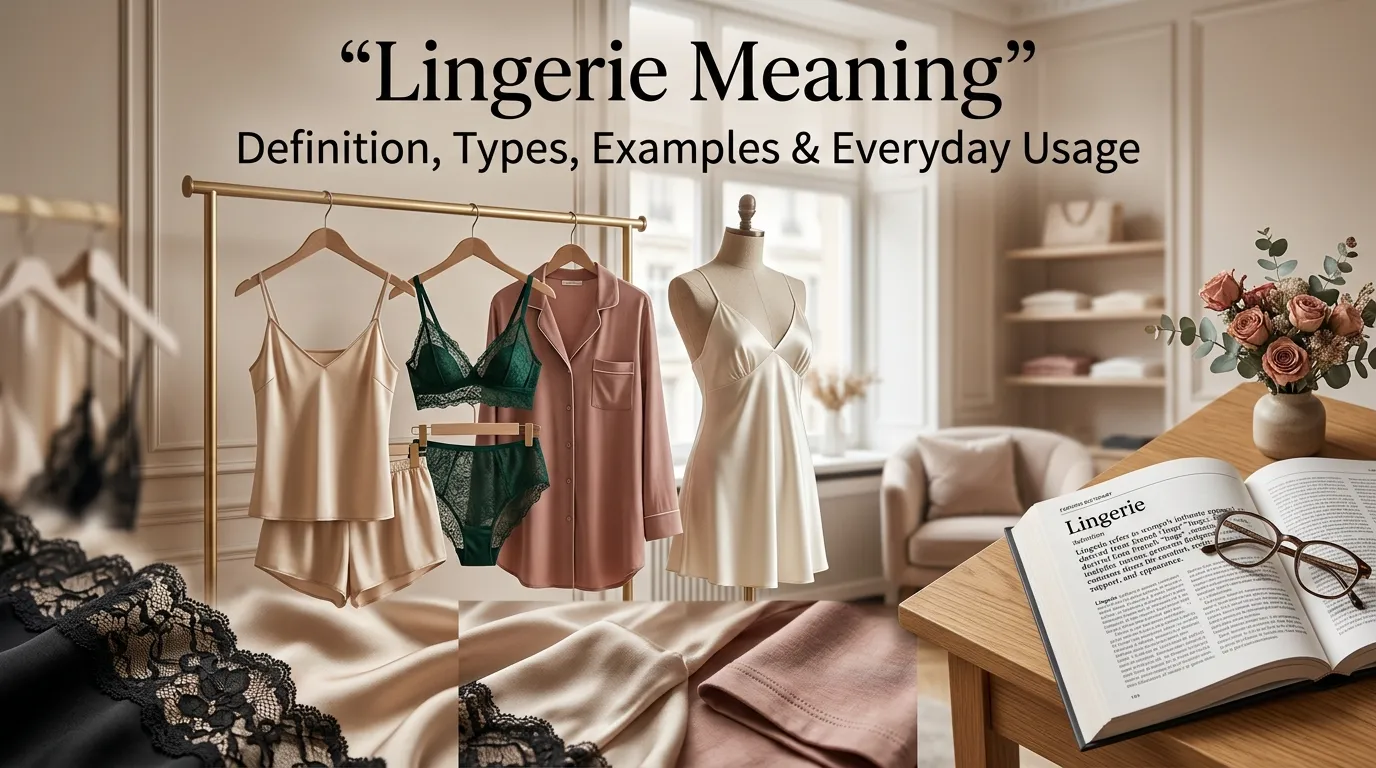
Lingerie means women’s underwear or intimate clothing, especially garments designed to be attractive, elegant, comfortable, or fashionable.
The word commonly refers to items such as bras, panties, slips, camisoles, robes, bodysuits, corsets, and nightwear. In modern English, lingerie can describe both practical undergarments and clothing intended to create a particular aesthetic or feeling.
If you have ever seen the word lingerie in a fashion store, online product description, magazine, movie, or social media post and wondered exactly what it means, the answer is simpler than it may seem.
Lingerie is a broad term for intimate apparel, but its meaning has evolved significantly over time.
Understanding the lingerie meaning is useful because the word can carry different shades of meaning depending on context.
What Does Lingerie Mean?
The simplest lingerie meaning is women’s intimate apparel or underwear, particularly clothing designed with an emphasis on style, elegance, or attractiveness.
The term traditionally refers to garments worn next to the skin underneath outer clothing. However, modern lingerie can sometimes function as outerwear or become part of a visible fashion outfit.
Lingerie Definition in Simple English
Lingerie is a general term for women’s intimate clothing, including underwear, bras, slips, camisoles, and similar garments.
For example:
- “She bought new lingerie for her vacation.”
- “The store specializes in luxury lingerie.”
- “The designer launched a new lingerie collection.”
- “She chose comfortable cotton lingerie for everyday wear.”
The meaning depends on context. A fashion article might use lingerie to discuss design and materials, while an everyday conversation might simply use underwear.
Lingerie Meaning in Different Contexts
The word can have slightly different associations depending on where you encounter it.
| Context | Meaning of Lingerie |
| Everyday English | Women’s underwear or intimate apparel |
| Fashion | Stylish, designed, or decorative intimate clothing |
| Retail | A category of bras, panties, slips, sleepwear, and related garments |
| Advertising | Often associated with elegance, beauty, confidence, and sensuality |
| Social media | Fashionable or aesthetic intimate apparel |
| Romantic context | Intimate clothing associated with romance or attraction |
| Historical context | Specialized undergarments worn beneath clothing |
The core meaning remains the same: intimate apparel, but the emotional or stylistic association can change.
Where Does the Word Lingerie Come From?
The word lingerie comes from French.
It is related to the French word linge, meaning linen or cloth, which ultimately connects to the idea of fabric and clothing. The French term lingerie historically referred more broadly to linen goods or garments made from linen.
Over time, the word developed a more specialized association with women’s undergarments and intimate apparel.
This is a useful example of how words change meaning. A term that originally had a relatively broad connection to fabric eventually became strongly associated with a particular category of clothing.
Why Does Lingerie Sound French?
English borrowed the word from French, which is why lingerie has a distinctly French appearance and pronunciation.
Many fashion-related English words have French origins because French has historically influenced the vocabulary of clothing, luxury goods, cuisine, art, and style.
A Brief History of Lingerie
The concept of underwear is much older than the word lingerie. People have worn garments beneath their outer clothing for thousands of years for reasons including hygiene, warmth, modesty, comfort, and protection.
What changed over time was the design and cultural role of these garments.
Early Undergarments
Ancient civilizations used simple garments beneath or instead of outer clothing. These items were often functional rather than decorative.
Their purposes included:
- Protecting the body from clothing
- Providing warmth
- Maintaining modesty
- Absorbing sweat
- Making outer garments easier to wear
- Creating a particular silhouette
Medieval and Renaissance Clothing
As European clothing became more structured, undergarments also became more important.
People used various forms of linen garments and foundational clothing beneath dresses and other outerwear. These garments helped maintain cleanliness and shape clothing.
The 18th and 19th Centuries
During these periods, structured undergarments became increasingly important to fashion.
Corsets, petticoats, chemises, and other garments helped create fashionable silhouettes.
Underwear was often designed around the outer shape, fashionable at the time.
The 20th Century
The twentieth century transformed lingerie dramatically.
Advances in manufacturing, changing social attitudes, new fabrics, and changing ideas about women’s clothing all influenced lingerie design.
The rise of modern bras, commercially produced underwear, elastic materials, synthetic fibers, and mass-market fashion made lingerie more accessible.
Lingerie Today
Modern lingerie ranges from highly practical basics to luxury designer pieces.
Today, people may choose lingerie based on:
- Comfort
- Fit
- Fabric
- Personal style
- Fashion
- Support
- Function
- Confidence
- Special occasions
This shift reflects a broader change in fashion: intimate clothing is no longer viewed only as something hidden beneath clothing. It can also be part of personal expression.
What Are the Different Types of Lingerie?
The term lingerie covers many different garments. Not every piece serves the same purpose.
1. Bras
A bra is an undergarment designed to support and cover the breasts.
Common styles include:
- T-shirt bras
- Sports bras
- Push-up bras
- Bralettes
- Strapless bras
- Balconette bras
- Wireless bras
- Full-coverage bras
Different bras provide different levels of support, coverage, and styling.
2. Panties
Panties are underwear worn around the lower body.
Common styles include:
- Briefs
- Bikinis
- Boyshorts
- Hipsters
- High-waisted underwear
- Thongs
The best choice depends on comfort, clothing, personal preference, and intended use.
3. Camisoles
A camisole is a lightweight sleeveless garment that can be worn as an underlayer or, in some cases, as part of an outfit.
Camisoles may be made from:
- Cotton
- Silk
- Satin
- Lace
- Blended fabrics
4. Slips
A slip is a lightweight garment traditionally worn beneath a dress or skirt.
Slips can help clothing:
- Hang smoothly
- Reduce transparency
- Feel more comfortable against the skin
- Prevent certain fabrics from clinging
5. Bodysuits
A bodysuit combines a top with a fitted lower section.
Some bodysuits are designed as lingerie, while others are worn as everyday fashion clothing.
6. Corsets
Corsets are structured garments historically associated with shaping the torso.
Modern corset-inspired lingerie may be designed primarily for fashion rather than the historical shaping purposes associated with traditional corsetry.
7. Robes and Gowns
Lingerie collections sometimes include robes, nightgowns, and other sleepwear.
These pieces can be practical, decorative, or both.
8. Bralettes
Bralettes are usually softer and less structured than traditional bras.
They often emphasize comfort and simple styling rather than heavy support.
Lingerie vs. Underwear: What’s the Difference?
Underwear and lingerie are closely related, but they are not always interchangeable.
Underwear is the broader everyday term for clothing worn beneath outer clothes.
Lingerie generally has a more specific association with women’s intimate apparel, fashion, elegance, or decorative design.
| Word | General Meaning | Typical Tone |
| Underwear | Clothing worn beneath outer clothing | Neutral, everyday |
| Lingerie | Women’s intimate or fashionable undergarments | Fashion-oriented |
| Undergarments | Clothing worn underneath other clothing | Formal/neutral |
| Intimates | Intimate apparel, often a retail term | Modern/fashionable |
| Underclothes | Clothing worn beneath outer garments | Traditional |
| Sleepwear | Clothing intended for sleeping | Functional |
For example, saying “I need new underwear” sounds completely ordinary. Saying “She designs luxury lingerie” sounds more connected to fashion and style.
Is Lingerie Only for Women?
Traditionally, lingerie has primarily referred to women’s underwear and intimate apparel.
In modern fashion and retail language, however, the boundaries around intimate apparel are becoming more flexible. Brands may use terms such as intimates, underwear, or underclothing for products designed for different genders.
Therefore, the traditional definition is female-oriented, while modern fashion terminology can be broader.
Why Is Lingerie Associated With Elegance and Beauty?
Lingerie has a strong connection with fashion because designers often pay attention to details that are less important in basic underwear.
These can include:
- Lace
- Embroidery
- Satin
- Silk
- Decorative stitching
- Color
- Patterns
- Textures
- Delicate straps
- Decorative finishes
This doesn’t mean all lingerie is designed to be sensual. Much modern lingerie emphasizes comfort, fit, body confidence, practicality, and personal expression.
Lingerie Meaning in Fashion
In fashion, lingerie can be much more than something hidden beneath clothes.
The concept of lingerie-inspired fashion has influenced dresses, tops, skirts, bodysuits, and other garments.
For example, a slip dress may resemble traditional lingerie while being intentionally designed as outerwear.
This has helped blur the traditional line between underwear and outer clothing.
Why Lingerie-Inspired Fashion Became Popular
Several trends contributed to this change:
- Designers experimented with traditionally private clothing.
- Celebrities and fashion influencers popularized visible lingerie-inspired pieces.
- Consumers became more interested in individual expression.
- Social media accelerated fashion trends.
- Modern fabrics made delicate-looking garments easier to wear.
Lingerie and Body Confidence
For many people, lingerie is connected to self-expression and confidence.
A person may choose a particular garment because it makes them feel:
- Comfortable
- Confident
- Attractive
- Stylish
- Feminine
- Empowered
- Relaxed
These feelings are personal. There is no single emotional meaning attached to lingerie.
One person might choose simple cotton underwear because comfort matters most. Another might prefer a detailed lace set because they enjoy the design.
Both choices fit within the broader concept of lingerie.
Common Materials Used in Lingerie
Different materials create different experiences.
Cotton
Cotton is widely valued for its softness and breathability.
It is particularly common in everyday underwear.
Silk
Silk has a smooth, luxurious feel and has long been associated with premium intimate apparel.
Satin
Satin provides a smooth, glossy appearance and is frequently used in fashion-focused lingerie and sleepwear.
Lace
Lace is often used for decorative purposes. It can create an intricate and delicate appearance.
Microfiber
Microfiber fabrics are often chosen for their smooth texture and lightweight feel.
Mesh
Mesh can create a lightweight, breathable structure and is commonly used in fashion-oriented designs.
How Lingerie Is Used in Everyday Life
Lingerie isn’t limited to special occasions.
People wear intimate apparel every day for practical reasons.
For example:
Scenario 1: Workday
Someone may choose a comfortable, seamless bra and underwear under professional clothing because they want a smooth fit and all-day comfort.
Scenario 2: Exercise
A person may choose supportive athletic underwear or a sports bra designed for physical activity.
Scenario 3: Special Occasion
Someone attending a wedding may choose undergarments that work well beneath a fitted or formal outfit.
Scenario 4: Relaxing at Home
A person might choose comfortable sleepwear or soft lingerie for relaxation.
These examples show why lingerie can be both functional and fashionable.
How Is Lingerie Used in a Sentence?
Here are some natural examples:
- “The store has a large lingerie collection.”
- “She prefers cotton lingerie for everyday comfort.”
- “The brand launched a new lingerie line.”
- “The designer is known for elegant lingerie.”
- “I need lingerie that works under a fitted dress.”
- “The collection focuses on comfortable, everyday lingerie.”
Lingerie in a Conversation
Person A: “Where did you find that?”
Person B: “At a lingerie store downtown.”
Here, lingerie simply identifies the type of store.
Another example:
Person A: “What does the brand specialize in?”
Person B: “Luxury lingerie and sleepwear.”
This use is primarily fashion-related.
Common Misconceptions About Lingerie
Misconception 1: All Lingerie Is Sexy
Not necessarily.
Lingerie can be simple, comfortable, practical, athletic, decorative, or luxurious.
Misconception 2: Lingerie Means Only Bras and Panties
The term can include many garments, including slips, camisoles, robes, bodysuits, and other intimate apparel.
Misconception 3: Lingerie Is Only for Special Occasions
Many people wear lingerie every day.
Misconception 4: Lingerie Must Be Expensive
Price does not determine if a garment qualifies as lingerie.
Misconception 5: Lingerie Always Has a Romantic Meaning
Context matters. A fashion retailer can discuss lingerie entirely in terms of design, fit, comfort, or clothing technology.
Lingerie vs. Intimates
The word intimates has become increasingly common in fashion and retail.
Both terms can refer to intimate apparel, but they have slightly different branding associations.
Lingerie often sounds more traditional, elegant, or fashion-oriented.
Intimates can sound more modern and inclusive.
For example:
- “Luxury lingerie collection”
- “Women’s intimates”
- “Everyday intimates”
- “Lingerie boutique”
All of these can describe related product categories.
Lingerie vs. Sleepwear
These terms should not be confused.
Lingerie primarily refers to intimate apparel.
Sleepwear specifically refers to clothing designed for sleeping.
There can be overlap. A nightgown or robe may be marketed as part of a lingerie collection while also functioning as sleepwear.
Lingerie in Modern Culture
Modern lingerie exists at the intersection of fashion, comfort, identity, marketing, and self-expression.
Social media platforms have also changed how people encounter lingerie-related fashion.
On platforms such as Instagram, TikTok, Pinterest, and fashion websites, lingerie may appear in:
- Fashion inspiration
- Styling tutorials
- Brand campaigns
- Product reviews
- Outfit ideas
- Body-positive fashion discussions
- Clothing-haul content
The modern conversation increasingly focuses on fit, comfort, representation, and individual choice rather than a single definition of beauty.
Lingerie and Social Media
On social media, lingerie generally retains its standard meaning rather than becoming a special slang word.
For example:
- A TikTok creator might discuss a lingerie trend.
- An Instagram fashion account might showcase a lingerie-inspired outfit.
- A Pinterest user might save lingerie styling ideas.
- A Reddit user might ask about lingerie sizing or comfort.
- A fashion influencer might review different lingerie brands.
The word itself is not normally a secret code, acronym, or slang expression.
Lingerie in Online Shopping
Online retailers frequently use lingerie as a category name.
You may see sections such as:
- Lingerie
- Lingerie sets
- Everyday lingerie
- Luxury lingerie
- Lingerie and sleepwear
- Bridal lingerie
- Plus-size lingerie
- Seamless lingerie
When shopping online, understanding the term helps you navigate product categories more easily.
Choosing Lingerie: What Matters Most?
If you’re buying lingerie, appearance is only one factor.
Consider:
1. Fit
A garment should fit comfortably without causing unnecessary pressure or discomfort.
2. Fabric
Choose materials based on comfort, climate, activity, and personal preference.
3. Purpose
Ask if you need something for:
- Everyday wear
- Exercise
- Sleep
- A formal outfit
- Fashion
- Comfort
4. Clothing Compatibility
Some garments work better under particular outfits.
For example, seamless underwear may be useful beneath close-fitting clothing.
5. Personal Preference
There is no universal “best” lingerie style. Comfort and individual needs matter.
Quick Facts About Lingerie
| Key Fact | Answer |
| Primary meaning | Women’s intimate apparel or underwear |
| Word origin | French |
| Main association | Intimate clothing and fashion |
| Common examples | Bras, panties, slips, camisoles, bodysuits |
| Typical tone | Fashionable, elegant, sometimes sensual |
| Everyday use | Yes |
| Slang term? | No, generally a standard fashion word |
| Related terms | Underwear, intimates, undergarments |
| Modern use | Fashion, comfort, personal style, retail |
| Broader category | Intimate apparel |
Is Lingerie a Formal or Informal Word?
Lingerie is neither highly formal nor strongly informal.
It is a standard fashion and retail term.
However, it can sound more polished than underwear.
Compare:
- “I bought some underwear.” — everyday and neutral.
- “I bought some lingerie.” — more fashion-oriented.
- “The company sells intimate apparel.” — professional or commercial.
The best word depends on the setting and audience.
What Is the Difference Between Lingerie and Undergarments?
The distinction is mostly one of usage and connotation.
Undergarments is a broad, somewhat formal term for clothing worn beneath outer clothing.
Lingerie is more closely associated with women’s intimate apparel and often carries a stronger fashion or decorative association.
For example, a medical or clothing-care article might use undergarments, while a fashion magazine might use lingerie.
Common Search Questions About Lingerie
People often search for phrases such as:
- lingerie meaning
- what does lingerie mean
- lingerie definition
- lingerie meaning in English
- what is lingerie
- lingerie vs underwear
- types of lingerie
- lingerie examples
- lingerie meaning in fashion
- women’s lingerie meaning
- lingerie clothing meaning
All of these searches generally point toward the same central idea: understanding the word and the type of clothing it describes.
Frequently Asked Questions
1. What does lingerie mean in simple words?
Lingerie means women’s intimate clothing or underwear, especially garments associated with fashion, elegance, comfort, or style.
2. Is lingerie the same as underwear?
They overlap, but they are not exactly identical in everyday usage. Underwear is a broad term, while lingerie usually refers to women’s intimate apparel with a stronger fashion or decorative association.
3. Why is lingerie called lingerie?
The word comes from French and is historically connected with linge, a French word associated with linen or cloth. Its meaning gradually became more closely associated with intimate apparel.
4. What are examples of lingerie?
Common examples include bras, panties, camisoles, slips, bodysuits, bralettes, robes, nightgowns, and corset-inspired garments.
5. Is lingerie only worn for romantic purposes?
No. Lingerie can be worn every day for comfort, support, fashion, fit, personal preference, or practical reasons. Romantic use is only one possible context.
6. Is lingerie a slang word?
No. Lingerie is a standard English fashion and clothing term borrowed from French. It is not normally considered internet slang.
7. Can lingerie be worn as outerwear?
Some lingerie-inspired garments can be worn as outerwear. Slip dresses, bodysuits, camisoles, and similar designs have sometimes become part of mainstream fashion.
8. What is another word for lingerie?
Depending on the context, alternatives include intimates, intimate apparel, underwear, undergarments, underclothes, and underclothing. These words are related but may have slightly different meanings.
9. Does lingerie always mean expensive clothing?
No. Lingerie can range from affordable everyday basics to luxury designer garments. Price does not determine if something is lingerie.
10. Why is lingerie important in fashion?
Lingerie influences both the practical construction and appearance of clothing. It can provide support, shape, comfort, and a foundation for outer garments while also serving as a form of personal style.
Conclusion
The lingerie meaning is straightforward: lingerie refers primarily to women’s intimate apparel or underwear, often with an emphasis on style, design, comfort, or elegance.
The word has French origins and has developed from a broad association with linen and cloth into a familiar term in modern fashion.
Today, lingerie includes far more than traditional bras and panties. Depending on the brand and context, it can encompass camisoles, slips, bodysuits, robes, nightwear, bralettes, and other intimate garments.
One of the most important things to remember is that lingerie does not automatically mean sexy clothing. It can be practical, comfortable, fashionable, minimalist, luxurious, or simply part of everyday dressing.
In modern culture, lingerie also reflects broader changes in fashion. Comfort, body confidence, personal expression, inclusivity, and individual choice have become important parts of the conversation.

I am Sophia Bennett, is a digital resources and online tools writer at LinkVistaHub. She enjoys exploring useful websites, emerging digital tools, productivity platforms, and practical online resources that help people work smarter and discover valuable information.