
If you have ever contacted a company about a defective product, returned a computer component, or dealt with an IT support team, you may have seen the abbreviation RMA.
But what does RMA mean, and why does the same three-letter acronym appear in so many different conversations?
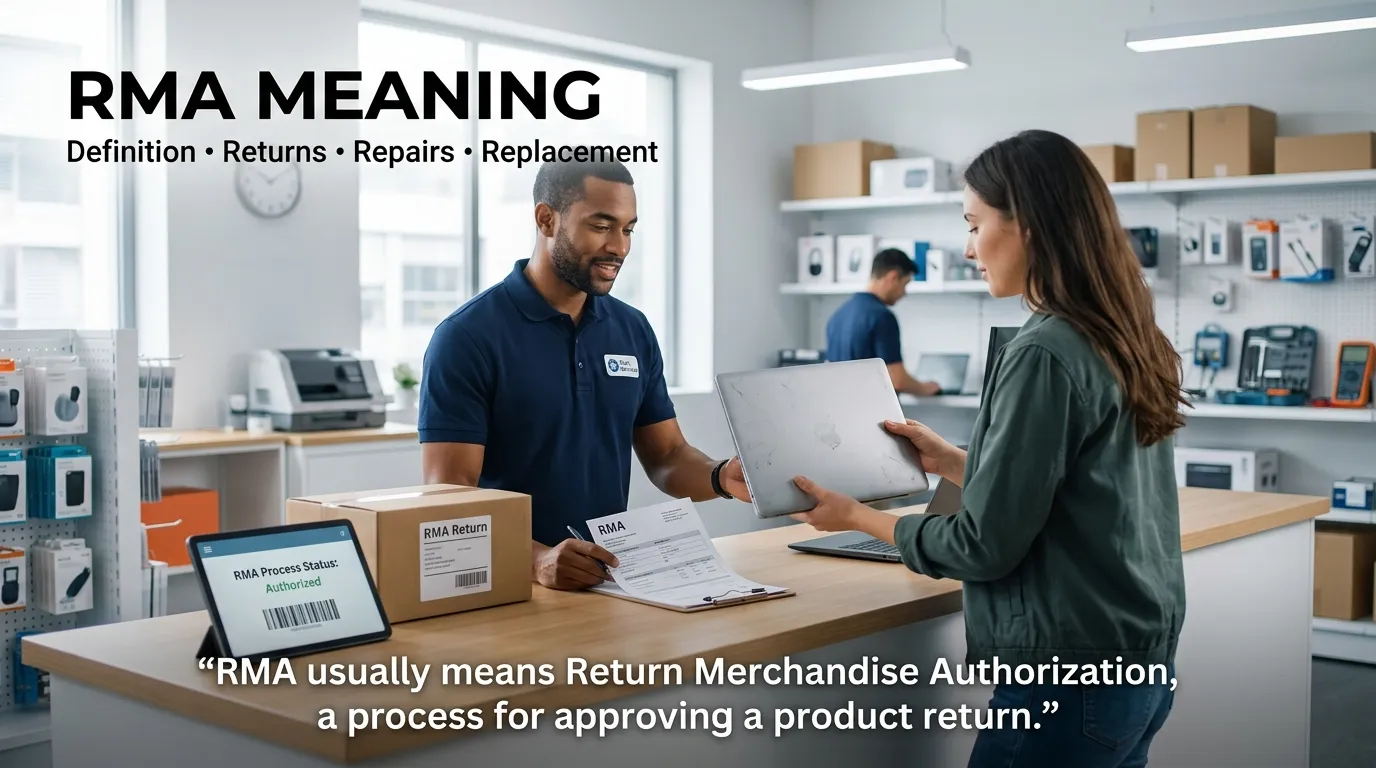
The most common RMA meaning in retail, electronics, e-commerce, and customer service is Return Merchandise Authorization or Return Merchandise Authorization.
It refers to a number or approval given by a seller or manufacturer that allows a customer to return a product for inspection, repair, replacement, or refund.
In technology and IT, RMA can also refer to Remote Monitoring and Management, a system used by IT professionals to monitor and manage devices remotely.
Depending on the context, RMA may have other meanings in government, finance, education, medicine, logistics, and organizations. Understanding the context is therefore important.
RMA Meaning: A Quick Definition
RMA most commonly means Return Merchandise Authorization. It is an approval or reference number that a company provides before a customer sends a product back.
For example, if you purchase a laptop that arrives damaged, the seller may ask you to request an RMA before returning it.
An RMA process can help a company:
- Identify the returned product
- Track the return
- Verify the customer’s purchase
- Determine why the item was returned
- Arrange a repair or replacement
- Process a refund
- Manage warranty claims
- Prevent unauthorized returns
In another common technology context, RMA can mean Remote Monitoring and Management. This refers to software and services that allow IT professionals or managed service providers to monitor, maintain, and troubleshoot computers, servers, networks, and other devices remotely.
So, the correct meaning depends on where you encountered the acronym.
What Does RMA Stand For?
RMA has several meanings, but these are among the most common:
| RMA Meaning | Context | What It Refers To |
| Return Merchandise Authorization | Retail, e-commerce, electronics | Permission or reference for returning merchandise |
| Remote Monitoring and Management | IT and technology | Remote monitoring and administration of devices |
| Return Material Authorization | Manufacturing, hardware | Authorization to return defective or unwanted materials |
| Royal Military Academy | Military/education | Name used by certain military academies |
| Risk Management Agency | Government/agriculture | A government organization or risk-management context |
| Registered Medical Assistant | Healthcare | A professional credential or designation in some contexts |
The exact expansion can vary by company, industry, and country.
RMA Meaning in Returns and Customer Service
The most familiar RMA meaning is Return Merchandise Authorization.
An RMA is generally part of a company’s product-return process. Instead of simply sending an item back without notice, the customer contacts the seller or manufacturer and requests authorization.
The company may then provide an RMA number.
That number is used to identify the return.
Example of an RMA
Imagine you buy a wireless keyboard online.
After two days, several keys stopped working. You contact the seller, explain the problem, and provide your order information.
The seller approves the return and gives you:
RMA Number: 847291
You may be instructed to write that number on the return package or include it with the paperwork.
Once the company receives the keyboard, employees can use the RMA number to find information about:
- Your order
- The product
- The reason for the return
- Warranty information
- The requested resolution
- The return’s status
This makes the process easier for both the customer and the company.
How Does an RMA Process Work?
Although every company has its own policy, a typical RMA process looks like this:
1. The Customer Reports a Problem
The customer contacts the seller or manufacturer.
The issue could involve:
- A defective product
- Shipping damage
- Missing parts
- Incorrect merchandise
- A warranty problem
- Compatibility issues
- A product that does not work as advertised
2. The Company Reviews the Request
Customer service may ask for information such as:
- Order number
- Serial number
- Purchase date
- Product model
- Description of the problem
- Photos or videos of damage
3. The Company Approves or Denies the Return
If the return meets the company’s policy, the company may issue an RMA.
Some businesses may use different terminology, such as a return authorization number, return number, or case number.
4. The Customer Sends the Product Back
The company provides return instructions.
Depending on the situation, the customer may receive a prepaid shipping label.
5. The Company Inspects the Product
The returned product may be tested or inspected.
For warranty claims, technicians may try to determine whether the product has a manufacturing defect or another problem.
6. The Company Resolves the Case
Possible outcomes include:
- Refund
- Replacement
- Repair
- Store credit
- Exchange
- Rejection of the warranty claim
The exact outcome depends on the company’s return and warranty policy.
RMA Number Meaning
An RMA number is a unique identifier associated with a return request.
Think of it as a tracking reference for the return process.
For example:
“Please include your RMA number inside the package.”
This means the company wants the customer to include the reference number so employees can connect the physical product with the correct return request.
An RMA number is not necessarily the same thing as a shipping tracking number.
RMA Number vs. Tracking Number
An RMA number identifies the return case.
A tracking number identifies the shipment.
For example:
| Term | Purpose |
| RMA number | Identifies the return authorization/case |
| Order number | Identifies the original purchase |
| Serial number | Identifies a specific product |
| Tracking number | Identifies a shipment |
| Invoice number | Identifies a billing document |
A single return may involve several of these numbers.
RMA Meaning in Electronics and Hardware
RMA is especially common in the electronics industry.
Manufacturers and retailers may use RMA systems for products such as:
- Graphics cards
- Motherboards
- CPUs
- Hard drives
- SSDs
- Monitors
- Printers
- Networking equipment
- Servers
- Smartphones
- Cameras
- Power supplies
- Computer accessories
For example, a customer may write:
“My graphics card failed after six months. The manufacturer opened an RMA for me.”
Here, RMA refers to the authorized warranty-return process.
What Happens During a Hardware RMA?
A hardware company may:
- Receive the customer’s claim.
- Verify warranty eligibility.
- Issue an RMA number.
- Provide shipping instructions.
- Receive the hardware.
- Test the hardware.
- Repair or replace it if appropriate.
- Ship the repaired or replacement product back.
Some manufacturers may send a replacement before receiving the defective product, while others require the defective unit first.
RMA Meaning in E-Commerce
Online retailers use RMA systems to organize product returns.
Suppose someone orders a pair of headphones online but receives the wrong model.
The customer contacts the retailer and requests a return.
The retailer may create an RMA record containing:
- Customer information
- Order number
- Product details
- Return reason
- Refund or replacement request
- RMA number
- Shipping information
- Return status
This creates an organized record from the moment the return begins until it is completed.
Common E-Commerce RMA Reasons
Customers may request an RMA because:
- The item arrived damaged.
- The wrong product was shipped.
- The item is defective.
- The product is missing accessories.
- The item does not fit.
- The customer received a duplicate.
- The product does not meet expectations.
- The item is covered by warranty.
Not every return requires an RMA. Some retailers use simpler return systems, while others require authorization before accepting a package.
RMA Meaning in IT: Remote Monitoring and Management
In the IT industry, RMA can also mean Remote Monitoring and Management.
This is completely different from product returns.
Remote Monitoring and Management refers to technology that allows IT professionals to monitor and maintain computers, servers, networks, and other devices remotely.
This is particularly relevant to:
- Managed service providers
- IT departments
- Small businesses
- Enterprise networks
- Remote workers
- Server administrators
- Technical support teams
What Can Remote Monitoring and Management Do?
RMM systems may allow IT professionals to:
- Monitor device health
- Detect system problems
- Install updates
- Manage software
- Monitor security events
- Check system performance
- Automate maintenance tasks
- Troubleshoot devices remotely
- Generate alerts
- Manage multiple endpoints
For example:
“Our IT provider uses RMA software to monitor all of our office computers.”
In this sentence, RMA refers to Remote Monitoring and Management, not a product return.
However, RMM is also a very common abbreviation for Remote Monitoring and Management, so the exact acronym used can depend on the company or source.
RMA vs. RMM: What’s the Difference?
These two abbreviations can cause confusion in IT discussions.
| Acronym | Common Meaning | Context |
| RMA | Return Merchandise Authorization | Product returns |
| RMM | Remote Monitoring and Management | IT management |
If someone says:
“We need an RMA for this server.”
They may be talking about returning defective hardware.
If someone says:
“Our MSP uses RMM software.”
They are talking about remote IT monitoring and management.
Because acronyms can vary between organizations, checking the surrounding context is important.
RMA Meaning in Manufacturing
In manufacturing and hardware industries, RMA may also stand for Return Material Authorization.
The phrase “material” is particularly common in industrial and manufacturing environments.
A company might receive defective components from a supplier and create an RMA before sending those components back.
The process helps manufacturers track:
- Defective components
- Supplier issues
- Quality-control problems
- Warranty claims
- Replacement materials
- Product failures
- Return costs
Example
A manufacturer purchases 1,000 electronic components from a supplier.
After testing, 25 failed quality inspection.
The manufacturer contacts the supplier and receives an RMA number before returning the defective components.
This allows both companies to document the transaction.
RMA Meaning in Warranty Claims
RMA is closely connected with warranties.
When a product fails during its warranty period, the manufacturer may require an RMA before accepting the item for repair or replacement.
However, an RMA does not automatically mean the warranty claim has been approved.
The company may still inspect the product.
For example, a manufacturer could determine that a product failed because of:
- Manufacturing defects
- Normal wear
- Accidental damage
- Liquid damage
- Improper installation
- Unauthorized modification
- Physical abuse
The warranty terms determine what happens next.
What Is an RMA in a Business Email?
RMA is commonly used in professional emails involving returns and technical support.
Examples include:
“Could you please provide an RMA number for the defective units?”
“Your RMA request has been approved.”
“Please include the RMA number on the shipping label.”
“We received your return under RMA 58342.”
“The replacement unit will be shipped after the RMA inspection is complete.”
In these examples, RMA functions as standard business terminology rather than slang.
RMA Meaning in Text Messages and Online Communication
Unlike abbreviations such as LOL, BRB, or IMO, RMA is not primarily internet slang.
People generally use it in practical or professional contexts.
You might see RMA in:
- Customer-service chats
- Online shopping support
- Technical forums
- Hardware communities
- IT discussions
- Business software
- Vendor communications
- Reddit discussions about defective hardware
For example:
“The SSD died after three months, so I’m starting an RMA.”
Here, the writer is almost certainly referring to a product return or warranty process.
RMA on Reddit and Gaming Communities
RMA can appear frequently in computer hardware discussions.
A gamer might post:
“My GPU is crashing constantly. Should I RMA it?”
In this context, RMA means returning the graphics card to the manufacturer or retailer for inspection, replacement, or another warranty-related resolution.
Similarly, someone might say:
“I had to RMA my motherboard.”
That means the motherboard was returned through an authorized process.
RMA is therefore an especially useful shorthand in PC-building and hardware communities.
RMA Meaning in Different Contexts
Because RMA is an acronym, context is everything.
Retail
Return Merchandise Authorization
Used when returning products.
Electronics
Return Merchandise Authorization
Usually associated with defective or warranty-covered hardware.
Manufacturing
Return Material Authorization
Used for defective materials or components.
IT
Remote Monitoring and Management
Used for remote device monitoring and administration, although RMM is also widely used for this concept.
Military/Education
Royal Military Academy
May refer to an institution whose official name uses those words.
Government
Risk Management Agency
Can refer to a government agency or organization using that name.
Healthcare
RMA may represent a professional designation or credential in certain contexts, depending on the jurisdiction and organization.
The important lesson is simple: never assume an acronym has only one meaning.
RMA vs. Return Authorization
The terms RMA and return authorization are often used almost interchangeably.
A return authorization is the approval that allows the return.
An RMA may refer to:
- The authorization itself
- The return case
- The reference number
- The complete return process
For example, a company may say:
“Your return authorization has been approved.”
Another company may say:
“Your RMA has been approved.”
The practical meaning may be nearly identical.
RMA vs. Refund
An RMA is not the same as a refund.
An RMA concerns the return process.
A refund is money returned to the customer.
A product can have an RMA without resulting in a refund.
For example:
Product → RMA → Inspection → Replacement
Or:
Product → RMA → Inspection → Repair
Another possible process is:
Product → RMA → Inspection → Refund
Therefore, receiving an RMA does not necessarily mean that the customer will receive their money back.
RMA vs. Exchange
An exchange means the customer receives another product instead of keeping the original.
An RMA may be used to manage that exchange.
For example:
“The company issued an RMA and will exchange the defective monitor.”
The RMA is the administrative process, while the exchange is the resolution.
RMA Meaning: Real-Life Scenarios
Understanding realistic situations makes the acronym easier to remember.
Scenario 1: Defective Laptop
A customer purchases a laptop.
After a week, the screen develops a serious hardware problem.
The customer contacts the manufacturer.
The manufacturer verifies the purchase and issues an RMA.
The laptop is shipped back for inspection.
The manufacturer repairs or replaces it.
Meaning: Return Merchandise Authorization.
Scenario 2: Failed Graphics Card
A gamer notices that a graphics card constantly crashes.
After troubleshooting, the manufacturer confirms that the card may be defective.
The customer receives an RMA number and ships the card back.
Meaning: Return Merchandise Authorization.
Scenario 3: Manufacturing Components
A factory discovers that a batch of components does not meet quality standards.
The supplier authorizes the factory to return the defective components.
Meaning: Return Material Authorization.
Scenario 4: IT Management
An IT provider monitors hundreds of computers remotely and receives automatic alerts when systems experience problems.
The company describes its platform as remote monitoring and management technology.
Meaning: Remote Monitoring and Management, although RMM is a common acronym for this concept.
Common RMA Terms You Should Know
If you are dealing with an RMA, you may encounter several related terms.
Return Authorization
Permission to send a product back.
RMA Number
The reference number assigned to the return.
Warranty Claim
A request for service under a product warranty.
Return Label
A shipping label used to send the product back.
Replacement
A new or refurbished product provided instead of the returned product.
Repair
The company fixes the returned product.
Refund
The customer receives money back.
Defective Item
A product that does not function properly or does not meet specifications.
DOA
DOA commonly means “dead on arrival,” referring to a product that does not work when received.
Common Mistakes About RMA
Several misunderstandings occur when people encounter the term.
Mistake 1: Thinking RMA Always Means Refund
It does not.
An RMA begins or identifies a return process. The final outcome may be a refund, repair, replacement, exchange, or another resolution.
Mistake 2: Assuming Every Return Needs an RMA
Not every retailer requires an RMA.
Some companies use automated return portals or simple order-based return systems.
Always follow the seller’s instructions.
Mistake 3: Confusing RMA With a Shipping Number
An RMA number identifies the return case.
A carrier tracking number identifies the shipment.
They serve different purposes.
Mistake 4: Assuming RMA Always Means Return Merchandise Authorization
The acronym has multiple meanings.
In an IT conversation, it may refer to something completely different.
Mistake 5: Sending a Product Without Authorization
If a company requires an RMA, sending a package without one can delay processing or cause the package to be rejected.
How to Use RMA Correctly in a Sentence
Here are natural examples:
- “I need an RMA for this defective hard drive.”
- “The manufacturer issued an RMA number.”
- “Please include the RMA number with your return.”
- “Our warranty claim resulted in an RMA.”
- “The RMA is still being processed.”
- “The company received my RMA shipment.”
- “I contacted support to request an RMA.”
- “The replacement was sent after the RMA inspection.”
In technical conversations:
- “The device was returned through the RMA process.”
- “The vendor approved the hardware RMA.”
In IT conversations, always check whether RMA means Remote Monitoring and Management or whether the writer intended RMM.
Is RMA Formal or Informal?
RMA is generally a technical and professional abbreviation.
It is common in:
- Customer service
- Retail
- E-commerce
- Electronics
- Manufacturing
- IT
- Logistics
- Warranty departments
It is not normally considered slang.
A customer might use it casually in a hardware forum, but the term itself remains professional and industry-specific.
For example:
“I’m going to RMA this GPU.”
This is informal sentence construction, but RMA itself is still technical terminology.
RMA Summary Table
| Fact | Details |
| Primary RMA meaning | Return Merchandise Authorization |
| Other common meaning | Remote Monitoring and Management |
| Manufacturing meaning | Return Material Authorization |
| Main context | Product returns and warranties |
| Common industries | Retail, electronics, manufacturing, IT |
| RMA number | Identifier for a return case |
| Tone | Professional and technical |
| Internet slang? | No |
| Related terms | Return authorization, warranty claim, refund, replacement |
| Common users | Customers, retailers, manufacturers, technicians, IT professionals |
| Main purpose | Organizing and managing a return or technical process |
FAQs
What does RMA mean in simple words?
RMA most commonly means Return Merchandise Authorization. It is an approval or reference number that a seller or manufacturer gives a customer before the customer returns a product. The company uses the RMA to organize and track the return.
What is an RMA number?
An RMA number is a unique reference number connected to a product-return case. It helps the company identify the customer’s return, order, product, and reason for returning it.
Does RMA mean refund?
No. RMA does not automatically mean refund. An RMA usually identifies or authorizes the return process. After inspection, the company may provide a refund, replacement, repair, exchange, or another resolution depending on its policies.
What does RMA mean for a computer?
For computer hardware, RMA usually refers to returning a defective component to the manufacturer or retailer. This can apply to graphics cards, motherboards, hard drives, SSDs, monitors, power supplies, and other equipment.
What does RMA mean in IT?
In IT, RMA can mean Remote Monitoring and Management, although RMM is also a widely used abbreviation for that concept. In a hardware-supported conversation, however, RMA usually refers to a return authorization.
Is RMA the same as a warranty?
No. A warranty is a promise or coverage provided under specific terms. An RMA is part of a return, repair, replacement, or warranty-service process. A warranty claim may lead to an RMA, but the two terms do not mean the same thing.
Can I return something without an RMA?
It depends on the company’s return policy. Some businesses require customers to obtain an RMA before shipping anything back, while others allow returns through an online portal or order-based system without a separate RMA number.
How long does an RMA take?
There is no universal RMA timeframe. Processing time depends on the company, shipping method, product, inspection process, warranty policy, and whether the item is repaired or replaced. The seller or manufacturer should provide the applicable timeframe.
What does RMA mean on Reddit?
On Reddit, particularly in computer hardware, electronics, and gaming communities, RMA usually means Return Merchandise Authorization. Users often use it when discussing defective GPUs, CPUs, motherboards, storage drives, monitors, or other hardware.
Is RMA a slang word?
No. RMA is generally an industry abbreviation rather than slang. It is frequently used in professional communication involving product returns, warranties, electronics, manufacturing, and technical support.
Conclusion
The RMA meaning you encounter depends heavily on context. In retail, electronics, e-commerce, and warranty discussions, RMA most commonly means Return Merchandise Authorization. It is part of the process used to approve, identify, and manage a product return.
In manufacturing, RMA may mean Return Material Authorization, while in IT, it can refer to Remote Monitoring and Management. Other organizations and industries may use RMA for entirely different terms.
The easiest way to understand RMA is to look at the surrounding conversation. If someone is discussing a defective laptop, graphics card, refund, warranty, or replacement, RMA probably relates to a product return.
If the discussion involves servers, monitoring, remote support, or endpoint management, the acronym may have a technology-related meaning.

I am Alex Carter, is a web resources and digital tools writer at Linkvistahub. He enjoys discovering useful websites, online tools, productivity resources, and practical digital solutions that can make everyday tasks easier.