
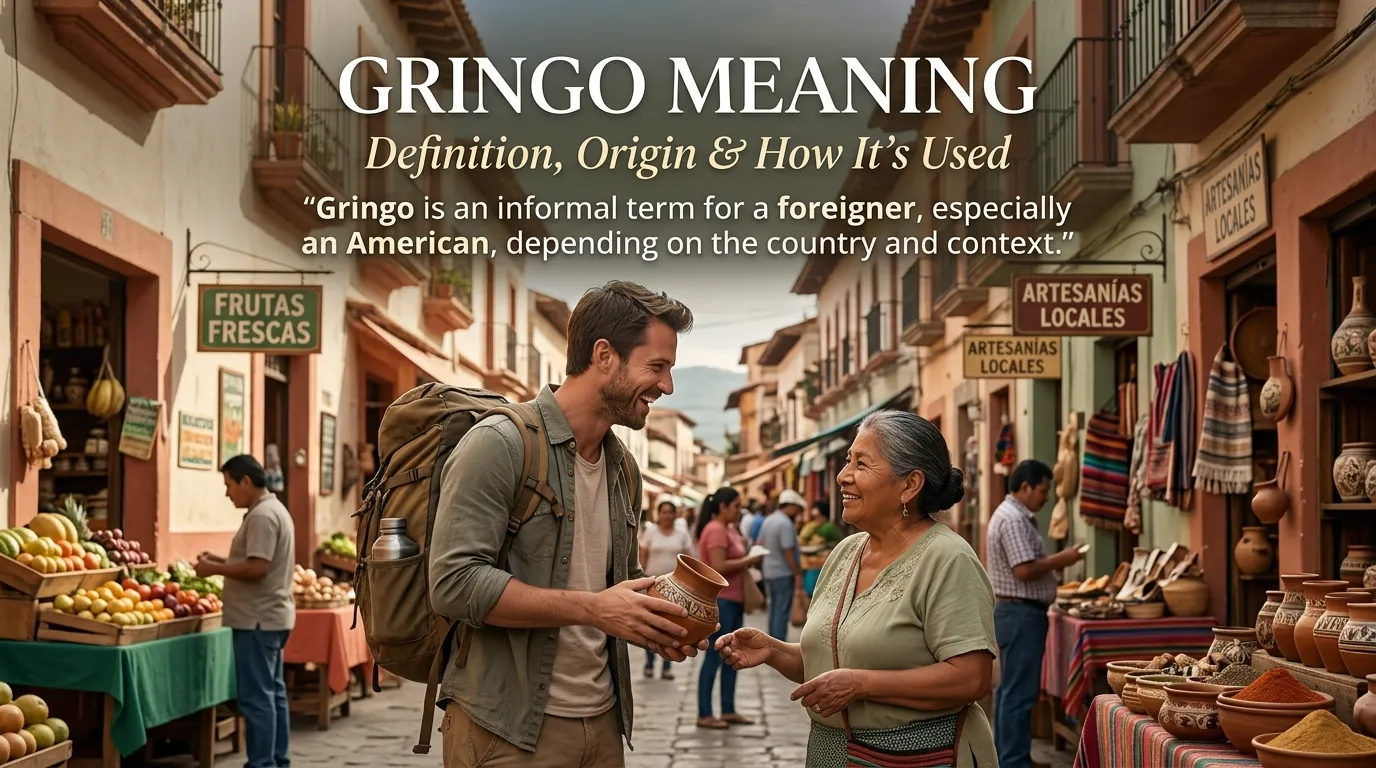
Gringo is a Spanish and Portuguese word commonly used to refer to a foreigner, especially someone from the United States or another English-speaking country.
Its exact meaning depends heavily on the country, speaker, situation, and tone. In some contexts, gringo is simply a casual description of a foreigner; in others, it can sound teasing, dismissive, or insulting.
If you have encountered the word gringo in a Spanish conversation, movie, song, travel video, TikTok caption, or social media comment, you may wonder:
Does gringo mean American, foreigner, or something offensive? The answer is more nuanced than a single English translation.
Understanding gringo meaning requires looking at regional usage, historical background, cultural context, and tone.
In Mexico, for example, the word is commonly associated with people from the United States, while in some South American countries it can have a broader meaning and refer to a foreigner, particularly someone who appears to be from Europe or North America.
What Does Gringo Mean?
Gringo means a foreigner, often specifically an American or English-speaking foreigner, depending on the Spanish-speaking country and context.
In simple terms:
Gringo = a foreign person, especially someone from the United States, in many Spanish-speaking contexts.
However, there is no single worldwide definition.
The word can describe:
- A person from the United States
- An English-speaking foreigner
- A person from another country
- A light-skinned or foreign-looking person in some regional contexts
- A tourist or expatriate
- A foreign culture or product, depending on the expression
For example:
“Ese gringo vive en México.”
This can mean: “That American/foreigner lives in Mexico.”
if the speaker means American specifically or simply foreigner depends on local usage.
Gringo Meaning in English
The closest English translations of gringo include:
- Foreigner
- American
- American foreigner
- English-speaking foreigner
- Outsider
- Tourist, in certain contexts
The translation “American” is particularly common when discussing Mexican Spanish.
But translating gringo as “American” everywhere would be inaccurate.
In countries where gringo has a broader meaning, a person from Germany, Canada, the United States, or another foreign country may potentially be called a gringo.
Is Gringo the Same as American?
Not necessarily.
In many Mexican contexts:
gringo → American
But in other Latin American contexts:
gringo → foreigner
This regional difference is one of the most important things to understand about the word.
Gringo Origin: Where Did the Word Come From?
The origin of gringo is debated.
Several explanations have been proposed over the centuries, but there is no universally accepted story that definitively explains how the word was created.
One popular story claims that the word came from the phrase “green go”, supposedly connected with American soldiers wearing green uniforms. Another famous explanation connects gringo with a supposed song lyric such as “green grow…” heard by Spanish speakers.
These stories are widely repeated, but they are generally treated as folk etymologies rather than established historical explanations.
Another explanation connects the term to older Spanish usage involving unfamiliar or unintelligible speech.
The safest conclusion is that the word has a long history in Spanish and that its exact origin is uncertain.
Why Is the Origin Uncertain?
Words often change meaning as they move between regions and generations.
Historical spellings, dictionaries, written records, and regional speech patterns can help linguists trace a word, but popular stories can also develop afterward and become attached to the word.
That appears to be important in the case of gringo.
Therefore, claims such as “gringo definitely came from American soldiers saying…” should be treated cautiously.
The Historical Meaning of Gringo
The word is not exclusively a modern slang term.
Historical Spanish usage shows that gringo has been used to describe foreigners or people whose speech was difficult for the speaker to understand.
Over time, its meaning developed differently in different parts of the Spanish-speaking world.
In some places, the association with Americans became particularly strong. In others, the term retained a broader sense of “foreigner.”
This explains why two Spanish speakers from different countries may understand gringo somewhat differently.
Gringo Meaning in Mexico
In Mexico, gringo is strongly associated with people from the United States.
A Mexican speaker might use gringo when talking about:
- American tourists
- American residents
- People from the United States
- American culture
- American businesses or products
For example:
“Hay muchos gringos visitando Cancún.”
Depending on the context, this could mean:
“There are many American tourists visiting Cancún.”
The word does not automatically function as a slur.
Its tone depends on the speaker and situation.
A person might say it casually, humorously, critically, or insultingly.
Is Gringo Offensive in Mexico?
Not automatically.
This is an important distinction.
Gringo can be neutral, informal, humorous, or derogatory depending on context.
Compare:
“Mi vecino es gringo.”
“My neighbor is American.”
This may simply be descriptive.
But if the word is delivered with contempt or combined with an insult, it can clearly become derogatory.
The surrounding language matters as much as the word itself.
Gringo Meaning in Other Latin American Countries
The meaning of gringo varies throughout Latin America.
In some countries, it can refer broadly to foreigners, particularly people who appear to come from the United States, Canada, or Europe.
In certain South American contexts, a person from Europe may also be described as gringo.
This means that there is no reliable rule saying:
“Gringo always means an American.”
A better rule is:
The local country and context determine who the speaker means by gringo.
This regional flexibility is common with informal words.
Gringo vs. Gringa
The feminine form of gringo is:
gringa
Examples:
- El gringo — the male foreigner/American
- La gringa — the female foreigner/American
- Los gringos — male or mixed group
- Las gringas — female group
For example:
“Ella es gringa.”
“She is American/foreign.”
Again, the exact meaning depends on the region.
Gringo as a Noun and Adjective
Gringo can function as both a noun and an adjective.
As a noun
It identifies a person.
“El gringo vive aquí.”
Meaning:
“The American/foreigner lives here.”
As an adjective
It can describe something associated with foreigners or Americans.
For example:
“Comida gringa”
could refer to American-style food or food perceived as foreign/American, depending on context.
This adjective use is especially useful for understanding expressions involving Americanized culture.
Common Gringo Expressions
The word appears in several informal expressions.
Gringo Food
Gringo food may refer informally to food associated with the United States or food considered Americanized.
The phrase is highly context-dependent and can be neutral, humorous, or critical.
Gringo Style
Gringo style can describe something perceived as American or foreign.
For example:
“That restaurant has a gringo style.”
The speaker could be talking about décor, food, service, fashion, or cultural influence.
Gringo Spanish
Gringo Spanish can refer informally to Spanish spoken by an English-speaking foreigner.
It may describe:
- A noticeable accent
- Beginner Spanish
- English-influenced grammar
- Foreign pronunciation
Depending on who says it and how, it can be playful or mocking.
Gringo in Everyday Conversations
The easiest way to understand gringo is to examine realistic situations.
Example 1: Neutral Description
Person A: “¿Quién es él?”
Person B: “Es un gringo que vive aquí.”
English:
Person A: “Who is he?”
Person B: “He’s an American/foreigner who lives here.”
The word may simply identify his background.
Example 2: Tourism
“Los gringos vienen mucho durante el verano.”
Possible meaning:
“Americans come here a lot during the summer.”
Example 3: Friendly Humor
“Mi español es terrible. Soy un gringo aprendiendo.”
Possible meaning:
“My Spanish is terrible. I’m just a foreigner learning.”
Here, the speaker may even use gringo to describe themselves humorously.
Example 4: Negative Context
“Ese gringo no respeta las reglas.”
Possible meaning:
“That foreigner/American doesn’t respect the rules.”
The sentence expresses criticism, but the negative meaning comes from the entire statement, not necessarily from gringo alone.
Gringo on Social Media
You may encounter gringo meaning searches because the word appears frequently in online conversations involving travel, Spanish-speaking cultures, immigration, language learning, and Latin American culture.
On social platforms such as:
- TikTok
- Snapchat
- YouTube
- Discord
Gringo may appear in captions, comments, jokes, memes, travel discussions, and language-learning communities.
Gringo on TikTok
On TikTok, someone may use gringo humorously when discussing:
- Traveling through Latin America
- Learning Spanish
- Cultural misunderstandings
- American habits
- Food differences
- Pronunciation mistakes
- Tourist experiences
The tone is usually determined by the creator.
A humorous video might call an American traveler a gringo without intending serious offense.
Gringo on Instagram
Instagram captions may use gringo in travel or cultural content.
For example:
“A gringo trying authentic Mexican food for the first time.”
This may simply be a playful description of an American tourist.
Gringo on Reddit
Reddit discussions often use the word when people discuss:
- Living abroad
- Traveling
- Learning Spanish
- Moving to Latin America
- American cultural habits
- Differences between Latin American countries
Because Reddit contains many different communities, the tone can range from neutral and educational to sarcastic or insulting.
Gringo in Discord and Gaming
In gaming or Discord conversations, gringo can be used as a nickname or cultural joke.
For example, Spanish-speaking players might use it to refer to an English-speaking player.
if it is friendly or insulting depends on the relationship between the speakers.
Gringo in Dating Conversations
Someone dating or socializing across cultures may encounter the term.
For example:
“Mi novio es gringo.”
This can mean:
“My boyfriend is American/foreign.”
There is nothing inherently insulting about the sentence.
A speaker could use gringo casually to describe their partner’s nationality or cultural background.
In dating apps and social media, however, stereotypes can sometimes be attached to labels. It is better to pay attention to the actual conversation rather than assuming that gringo is automatically positive or negative.
Gringo in the Workplace
In professional settings, context becomes especially important.
Calling a colleague gringo informally among friends may be harmless.
However, using nationality-based labels in a formal workplace can create unnecessary ambiguity or discomfort.
If you need to communicate professionally, it is usually clearer to say:
- American
- From the United States
- Foreign colleague
- International employee
The appropriate choice depends on the actual information you need to communicate.
Is Gringo a Slur?
Gringo is not universally considered a slur.
Its status depends on:
- Country
- Speaker
- Listener
- Tone
- Relationship
- Context
- Surrounding words
In many situations, it is simply an informal label for an American or foreigner.
In other situations, it can be used as a derogatory term.
The same basic principle applies to many informal nationality labels: a word’s dictionary meaning does not always determine how it feels in a particular conversation.
A Useful Context Test
If you hear gringo, ask:
- Who is speaking?
- Who are they describing?
- Where are they from?
- What was the tone?
- What words appeared around gringo?
- Was the conversation friendly, neutral, sarcastic, or hostile?
These questions usually provide more information than the word alone.
Positive, Neutral, and Negative Connotations
The word can carry different connotations.
| Context | Possible tone | Example |
| Casual description | Neutral | “He’s a gringo.” |
| Friendly joke | Playful | “Look at this gringo learning salsa.” |
| Travel discussion | Neutral | “The gringos are visiting.” |
| Cultural criticism | Negative | “Those gringos don’t understand our customs.” |
| Insulting statement | Derogatory | Depends on surrounding language |
The key point is that gringo itself does not guarantee a particular emotional tone.
Gringo vs. Foreigner
These words overlap, but they are not identical.
Foreigner is a broad English term for someone from another country.
Gringo is a Spanish/Portuguese term whose meaning changes by region.
For example:
A Mexican speaker may call a person from the United States a gringo.
But:
A person from the United States may also be called a foreigner in Mexico because they are from another country.
Therefore, gringo has a stronger cultural and regional component.
Gringo vs. Americano
This distinction can be confusing.
In English, American normally refers to someone from the United States.
In Spanish, americano can have a broader geographic meaning because the Americas include North, Central, and South America.
As a result, gringo may sometimes be used conversationally to distinguish a U.S. person from the broader geographic category represented by americano.
However, actual usage varies by country.
Gringo vs. Gabacho
In Mexican Spanish, gabacho is another informal term that can refer to someone from the United States, particularly an American.
The two terms can overlap, but they are not always interchangeable in tone or usage.
Gringo is much more widely recognized internationally.
Gabacho is more regionally marked and can carry its own historical and colloquial nuances.
Gringo vs. Gringo-Style Stereotypes
One common mistake is assuming that gringo itself describes a specific personality.
It does not.
The word identifies a perceived foreign or American identity in context. It does not logically mean that someone is:
- Rich
- Ignorant
- Loud
- Friendly
- Unfriendly
- Conservative
- Liberal
- Wealthy
- Poor
- A tourist
Those are stereotypes, not definitions.
For accurate communication, separate the person’s nationality or foreign status from assumptions about their character.
Common Misconceptions About Gringo
Misconception 1: Gringo Always Means American
Not everywhere.
In some regions, it has a broader meaning.
Misconception 2: Gringo Always Means White Person
Not necessarily.
The word’s meaning is primarily regional and cultural rather than a universal racial classification.
Misconception 3: Gringo Is Always an Insult
No.
It can be neutral or informal, although it can also be used negatively.
Misconception 4: The “Green Go” Story Is Proven
The popular “green go” explanation is frequently repeated, but the etymology of gringo is disputed and should not be presented as an established fact.
Misconception 5: Every Spanish Speaker Uses Gringo the Same Way
Spanish is spoken across many countries, and vocabulary can vary substantially by region.
How to Use Gringo Correctly
If you are learning Spanish, you may encounter gringo frequently.
Use it carefully because it is informal.
Good situations
It may be appropriate when:
- Discussing regional Spanish vocabulary
- Quoting someone
- Having a casual conversation
- Talking about cultural differences
- Describing a foreigner in an informal setting
Situations requiring caution
Be more careful when:
- Speaking in a formal workplace
- Referring to someone you do not know
- Writing professional documents
- Discussing nationality-sensitive topics
- You are unsure how the listener uses the word
If precision matters, simply use the person’s nationality.
For example:
“American” is clearer than gringo when you specifically mean someone from the United States.
Pronunciation of Gringo
In Spanish, gringo is pronounced with two syllables.
The stress falls on the first syllable.
The pronunciation can vary slightly according to regional accent, but the word is generally easy for English speakers to recognize once they hear it.
Gringo in Popular Culture
The word appears in films, television, music, literature, travel content, and discussions about Latin American and U.S. culture.
Because gringo is culturally recognizable, English-language media sometimes use it to immediately signal a Latin American perspective toward an American character.
However, fictional usage may exaggerate regional stereotypes.
When encountering the word in a movie or song, consider:
- Who says it?
- Who is being described?
- What country does the speaker represent?
- Is the scene humorous?
- Is the word being used critically?
- What surrounding language changes its meaning?
Why Gringo Can Be Difficult to Translate
A dictionary might provide a translation such as “foreigner” or “American.”
Neither word captures every situation.
This is because translation involves cultural meaning as well as literal vocabulary.
For example:
“gringo” → “American”
may work in one Mexican conversation.
But:
“gringo” → “foreigner”
may be more accurate in another Latin American context.
Sometimes the best translation depends entirely on the surrounding sentence.
Quick Summary Table
| Fact | Details |
| Word | Gringo |
| Language | Spanish and Portuguese usage |
| Basic meaning | Foreigner; often an American |
| Common U.S.-related meaning | Person from the United States |
| Feminine form | Gringa |
| Plural | Gringos / gringas |
| Tone | Neutral, informal, humorous, or derogatory |
| Formality | Informal |
| Meaning worldwide | Varies by region |
| Common context | Travel, culture, nationality, everyday speech |
| Related words | Gringa, foreigner, American, gabacho |
| Origin | Historically documented but exact etymology disputed |
Real-Life Scenarios
Scenario 1: An American Tourist
An American visits Mexico and speaks basic Spanish.
A local person says:
“El gringo está aprendiendo español.”
The speaker may simply mean:
“The American is learning Spanish.”
There is no automatic insult.
Scenario 2: A Foreign Resident
A European moves to a Latin American country.
A local speaker calls the person gringo.
Here, the term may refer more generally to the person’s foreign identity rather than specifically to U.S. nationality.
Scenario 3: A Self-Description
An American Spanish learner jokes:
“Soy un gringo tratando de hablar español.”
The speaker is using the term about themselves.
This is a good example of how gringo can be used humorously and informally without functioning as an insult.
Scenario 4: A Negative Comment
Someone says:
“No me gustan esos gringos.”
The statement expresses dislike toward a group.
Here, the negative attitude is clear from the sentence itself.
This demonstrates why context matters when evaluating the tone of gringo.
FAQs
1. What does gringo mean in English?
Gringo generally means foreigner, but in many contexts it specifically means a person from the United States. The exact meaning depends on the country and context.
2. Is gringo a bad word?
Not necessarily. Gringo can be neutral, informal, playful, or derogatory. Its tone depends on how and where it is used.
3. Does gringo mean American?
Often, especially in Mexico, gringo commonly refers to someone from the United States. However, in other regions it can have a broader meaning.
4. What is the female version of gringo?
The feminine form is gringa. For example, la gringa can mean “the American woman” or “the foreign woman,” depending on regional usage.
5. What is the plural of gringo?
The plural forms are gringos for a male or mixed group and gringas for a group of women.
6. Where did the word gringo come from?
The exact origin is debated. Several popular explanations exist, including the famous “green go” story, but that explanation is not established as the definitive etymology.
7. Can a Canadian be called a gringo?
Possibly. In regions where gringo means a foreigner or North American, a Canadian may be described as a gringo. In places where the word specifically means someone from the United States, the usage may differ.
8. Can Europeans be called gringos?
Yes, in some Latin American contexts the word can be used more broadly for foreigners, including Europeans. Regional usage is important.
9. Is gringo racist?
The word does not have one universal racial meaning. It can refer to foreigners or Americans, and it can be used neutrally or negatively. If a particular use is discriminatory depends on the context and surrounding language.
10. What is the difference between gringo and foreigner?
Foreigner is a general English word for someone from another country. Gringo is a regional Spanish/Portuguese term whose meaning can specifically point to Americans or more broadly to foreigners.
Conclusion
The simplest way to understand gringo meaning is “foreigner,” often specifically “American,” depending on the country and context.
The word has a long and somewhat disputed history, and its usage has evolved across Spanish-speaking regions.
In Mexico, it is especially associated with people from the United States. Elsewhere in Latin America, it may have a broader meaning.
Most importantly, gringo is not automatically an insult. It can be neutral, casual, humorous, or derogatory depending on the speaker, tone, relationship, and surrounding words.
If you are learning Spanish, the safest approach is to understand gringo as a context-dependent informal term rather than assuming it always means “American” or always carries a negative meaning.

I am Sophia Bennett, is a digital resources and online tools writer at LinkVistaHub. She enjoys exploring useful websites, emerging digital tools, productivity platforms, and practical online resources that help people work smarter and discover valuable information.