Have you ever heard Auld Lang Syne at midnight on New Year’s Eve and wondered what the words actually mean?
The melody is familiar to millions of people, yet the title can seem mysterious because it comes from Scots, an older language variety closely related to English.
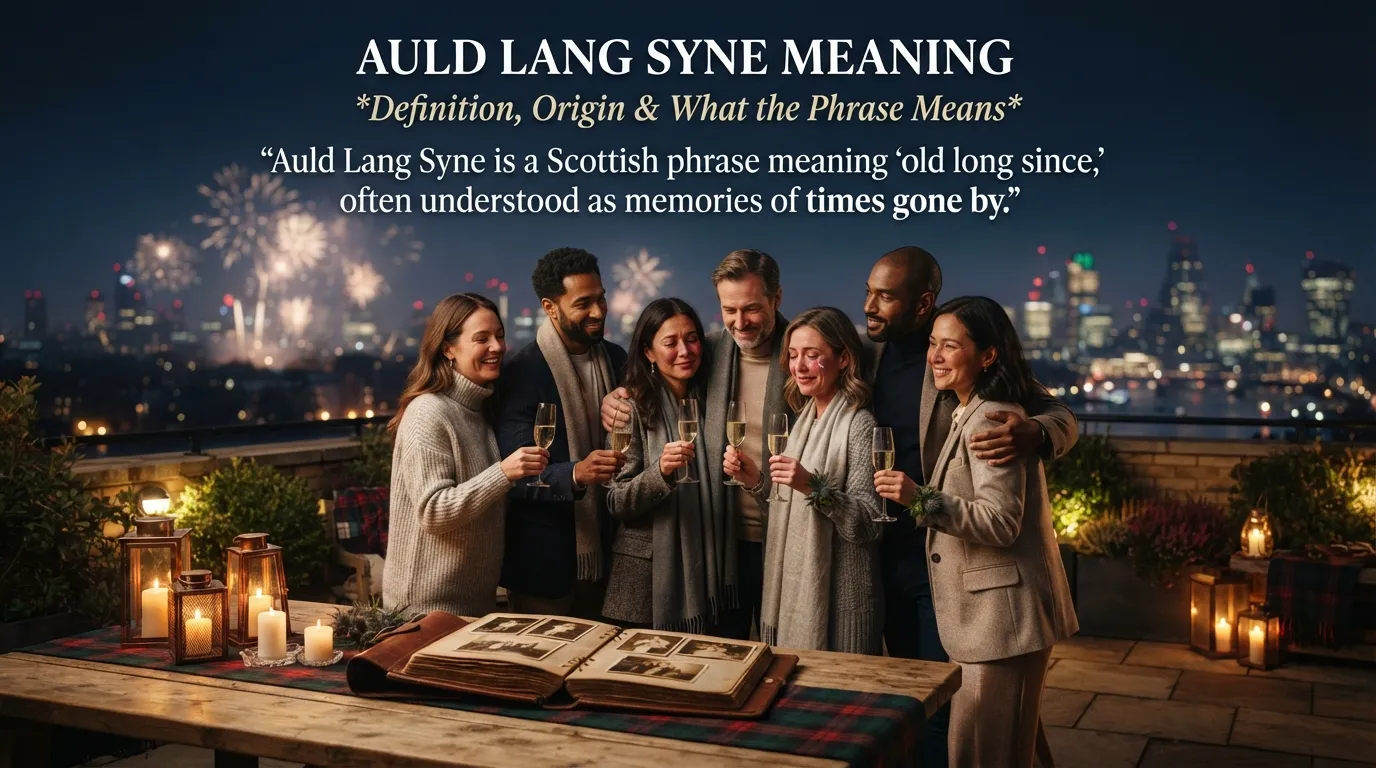
The Auld Lang Syne meaning is essentially “old long since,” “for old times’ sake,” or “times long past.” The phrase expresses the idea of remembering old friendships, shared experiences, and meaningful moments from the past.
The song is strongly associated with New Year’s Eve, when people around the world sing it as one year ends and another begins.
However, its meaning is much broader than a New Year celebration. At its heart, Auld Lang Syne is about friendship, remembrance, nostalgia, shared memories, and maintaining human connections over time.
The song is based on a poem associated with Scottish poet Robert Burns, who wrote down and adapted traditional Scottish material in the late 18th century.
Over time, the song traveled far beyond Scotland and became an international New Year’s tradition.
What Does Auld Lang Syne Mean?
Auld Lang Syne is a Scots expression that can be understood as “old long since” or, more naturally in modern English, “for old times’ sake.”
The phrase refers to things that happened long ago and to the memories and relationships associated with those earlier times.
A simple modern interpretation is:
Auld Lang Syne means remembering and honoring old times, old friendships, and shared memories.
The individual words help explain the phrase:
| Scots word | Approximate modern English meaning |
| Auld | Old |
| Lang | Long |
| Syne | Since, ago, or formerly |
So, a literal interpretation of auld lang syne is close to “old long since.”
That literal wording sounds unusual in modern English, which is why the phrase is usually translated by meaning rather than word-for-word.
Simple Definition
Auld Lang Syne: A Scots phrase meaning “for old times’ sake” or referring to times long past, especially in the context of friendship and remembrance.
What Does “For Auld Lang Syne” Mean?
The expression “for auld lang syne” can be understood as:
- For old times’ sake
- In memory of the old days
- Because of our shared past
- To remember times we once enjoyed together
- In honor of old friendships
For example, if two longtime friends reunite after many years, one might describe their meeting as being “for auld lang syne.”
The phrase therefore carries an emotional idea: the past still has value because of the people and experiences we shared.
Auld Lang Syne Meaning in Modern English
Modern English does not have a perfect one-word equivalent for auld lang syne.
Depending on the sentence, possible translations include:
- For old times’ sake
- For the sake of old times
- Times long past
- The good old days
- In remembrance of the past
- Old memories
- Long ago
However, these expressions are not completely interchangeable.
For example, “the good old days” emphasizes nostalgia, while “for old times’ sake” emphasizes doing something because of a shared history.
That distinction helps explain why the original phrase has remained culturally meaningful.
Auld Lang Syne Origin
The origins of Auld Lang Syne are Scottish.
The song is closely associated with Robert Burns, the famous Scottish poet who lived from 1759 to 1796. Burns wrote down and adapted traditional Scottish material, helping preserve and popularize a version of the song.
The words were published after Burns had written them down in the late 18th century.
However, the song did not suddenly appear from nowhere when Burns wrote it. Like many traditional songs, Auld Lang Syne has roots in older Scottish oral and musical traditions.
This is an important distinction.
Was Auld Lang Syne Written Entirely by Robert Burns?
It is more accurate to say that Burns recorded and adapted traditional material rather than treating him as the sole creator of every element of the song.
Burns himself indicated that the song drew from older Scottish tradition.
The history of traditional songs is often complicated because melodies and verses can circulate orally for generations before someone writes them down.
As a result, the modern version of Auld Lang Syne represents both:
- Older Scottish folk tradition
- Burns’s literary preservation and adaptation
Who Wrote Auld Lang Syne?
Robert Burns is the writer most strongly associated with the familiar lyrics of Auld Lang Syne.
Burns was one of Scotland’s most important poets and is often called the national poet of Scotland.
He wrote in both English and Scots and frequently incorporated Scottish language, culture, songs, and traditions into his work.
His association with Auld Lang Syne helped transform a traditional Scottish song into an enduring piece of international culture.
What Does “Syne” Mean?
The word syne is a Scots word that can mean “since,” “ago,” “then,” or “formerly,” depending on context.
In the expression auld lang syne, it contributes to the idea of times gone by.
This is why translations such as “old times” or “times long past” capture the general meaning better than trying to translate each word literally.
Why Does “Auld Lang Syne” Sound Strange in English?
Modern English speakers are generally more familiar with words such as:
- Old
- Long ago
- Formerly
- Since
- Past
Scots vocabulary can look unusual to contemporary English speakers, even though Scots and English have a long shared linguistic history.
The title therefore sounds poetic and mysterious to many listeners.
Auld Lang Syne Lyrics: What Is the Song About?
The song asks if people should forget old acquaintances and old times.
Its central idea is simple:
Should we forget the people and experiences that shaped our lives?
The answer presented by the song is essentially no.
Instead, people should remember their shared history and celebrate friendship.
Because the complete lyrics are a copyrighted text in some modern arrangements or editions, it is better to focus on the song’s meaning rather than reproduce an entire lyric passage.
The familiar opening question establishes the emotional theme:
“Should acquaintances be forgotten…”
The song then develops ideas involving:
- Old friendships
- Shared experiences
- Distance and separation
- Remembering the past
- Drinking a cup together
- Reconnecting with friends
- Honoring relationships
The famous “cup o’ kindness” idea is especially important because it represents friendship and goodwill.
What Is the Message of Auld Lang Syne?
The main message of Auld Lang Syne is that old relationships and shared memories deserve to be remembered.
The song does not simply celebrate the past because everything in the past was perfect.
Instead, it recognizes that human beings naturally carry memories of:
- Childhood
- Friendship
- Family
- Community
- Youth
- Shared adventures
- Places they once knew
- People they have lost touch with
The song turns those memories into a moment of collective remembrance.
Why Do We Sing Auld Lang Syne on New Year’s Eve?
The connection between Auld Lang Syne and New Year’s Eve developed gradually.
The song’s subject naturally fits the transition from one year to another.
At midnight, people are simultaneously:
- Saying goodbye to the old year
- Welcoming the new year
- Remembering what happened
- Thinking about people they shared the year with
- Looking toward the future
Auld Lang Syne provides a musical bridge between those two moments.
The song essentially asks people not to forget the past while moving forward.
That makes it particularly appropriate for New Year’s celebrations.
Auld Lang Syne and New Year’s Eve Tradition
The tradition became especially prominent in English-speaking countries and eventually spread internationally.
Today, many people associate the song almost automatically with:
December 31 → midnight → New Year → Auld Lang Syne
It may be performed at:
- New Year’s Eve parties
- Public celebrations
- Family gatherings
- Restaurants
- Hotels
- Concerts
- Television broadcasts
- Community events
- School celebrations
The tradition can vary considerably from one place to another.
Some people sing the entire song. Others sing only the most familiar section.
Some simply play the melody while people hug, toast, or count down to midnight.
Why Does Auld Lang Syne Feel Emotional?
The song’s emotional power comes from its combination of nostalgia and transition.
Nostalgia encourages people to think about the past.
New Year’s Eve encourages people to think about the future.
Auld Lang Syne connects the two.
This creates a unique emotional moment:
We are moving forward, but we do not have to forget where we came from.
That idea can resonate with people even if they do not understand the original Scots language.
Auld Lang Syne Symbolism
The song has several major symbolic themes.
1. Friendship
The most important theme is friendship.
The song suggests that old relationships retain meaning even after years have passed.
2. Memory
The song encourages remembrance.
It asks listeners to value shared experiences instead of allowing them to disappear from memory.
3. Time
The title itself points toward the passage of time.
Years pass, people change, and circumstances shift, but memories remain part of personal history.
4. Reunion
The song describes people coming together again.
This makes it especially meaningful when longtime friends or family members reunite.
5. Transition
At New Year’s, the song symbolizes the transition from one period into another.
It looks backward while the celebration itself looks forward.
Auld Lang Syne Meaning in Different Contexts
Although New Year’s Eve is its most famous context, Auld Lang Syne can be used in other situations.
Farewells
The song may be associated with saying goodbye to people or places.
For example, it may be appropriate at the end of:
- A school year
- A graduation
- A long-term project
- A community gathering
- A retirement celebration
- A farewell party
Reunions
Because the song celebrates old relationships, it can also suit reunions.
A group of school friends meeting after decades might use the song to acknowledge their shared history.
Memorial and Remembrance Events
The song’s themes of memory and separation can also make it emotionally relevant at remembrance events.
However, its meaning is not inherently about death.
It is primarily about remembering shared experiences and relationships.
Auld Lang Syne in Popular Culture
The song has appeared in countless films, television programs, stage performances, recordings, advertisements, and public celebrations.
Its melody is so recognizable that even a few musical notes can immediately signal:
- New Year’s Eve
- Nostalgia
- Farewell
- Reflection
- The passage of time
- A closing chapter
Popular culture has therefore helped turn Auld Lang Syne into something larger than an individual song.
It has become a cultural symbol.
Auld Lang Syne on Social Media
The phrase can also appear in modern online communication.
On platforms such as Instagram, TikTok, Facebook, Reddit, and other social networks, users may reference Auld Lang Syne when posting about:
- Old friendships
- Childhood memories
- End-of-year reflections
- Graduations
- Reunions
- Travel memories
- Year-in-review posts
- Nostalgic photographs
For example, someone might caption a collection of old photographs:
“For auld lang syne.”
In this context, the phrase means something like:
“For the sake of those old memories.”
The expression can therefore work as a short, poetic alternative to saying “remembering the good old days.”
Auld Lang Syne in Text Messages
You are unlikely to use the phrase frequently in everyday texting, but it can appear in sentimental or humorous messages.
For example:
Friend 1: “Can’t believe it’s been ten years since graduation.”
Friend 2: “We should all meet up for auld lang syne.”
Here, the phrase communicates the idea of meeting again because of their shared past.
A shorter social-media-style message might simply say:
“For auld lang syne ❤️”
This suggests nostalgia and remembrance.
Auld Lang Syne in Dating and Relationships
The phrase can occasionally appear in romantic contexts, particularly when two people have a long shared history.
For example:
“We decided to have dinner together for auld lang syne.”
The meaning is not necessarily romantic.
It means they are reconnecting because of their past relationship or shared memories.
This makes the expression different from words such as romantic, nostalgic, or sentimental. Nostalgia is central, while romance depends on the situation.
Auld Lang Syne in the Workplace
In professional settings, the phrase is less common in ordinary conversation but may appear at:
- Retirement parties
- Company anniversaries
- Farewell events
- Team reunions
- End-of-year celebrations
For example:
“The former team members gathered for auld lang syne.”
This means they gathered to remember their shared time together.
In formal business writing, simpler phrases such as “in remembrance of our shared history” may be clearer.
Common Misconceptions About Auld Lang Syne
Misconception 1: It Means “Happy New Year”
Not literally.
The song became associated with New Year’s Eve, but Auld Lang Syne does not mean “Happy New Year.”
Its meaning concerns old times, remembrance, and friendship.
Misconception 2: It Was Written Specifically for New Year’s Eve
No.
The song was not originally created as a New Year’s anthem.
Its New Year’s association developed later because its themes fit the transition between years.
Misconception 3: Auld Lang Syne Is Just About Drinking
The song includes the image of sharing a cup of kindness, but its central theme is friendship and remembrance, not drinking.
Misconception 4: The Phrase Is Modern English
It is a Scots expression, which explains why the wording looks unfamiliar to many English speakers.
Misconception 5: Robert Burns Invented Everything From Scratch
Burns is strongly associated with the song, but he worked with traditional Scottish material.
The history of the song is therefore connected to both Scottish folk tradition and Burns’s literary work.
Auld Lang Syne vs. “The Good Old Days”
These expressions are related but not identical.
| Expression | Main idea | Typical feeling |
| Auld Lang Syne | Remembering old times and friendships | Nostalgic, sentimental |
| The good old days | Remembering an earlier period positively | Nostalgic |
| For old times’ sake | Doing something because of shared history | Sentimental |
| Long ago | Something happened in the distant past | Neutral |
| In memory of | Honoring someone or something remembered | Respectful |
Auld Lang Syne is distinctive because it combines time, friendship, remembrance, and reunion.
Auld Lang Syne vs. For Old Times’ Sake
“For old times’ sake” is probably the closest everyday English equivalent.
For example:
“Let’s have one last dinner together for old times’ sake.”
This is similar to:
“Let’s have one last dinner together for auld lang syne.”
The Scots phrase simply carries a more traditional and poetic feeling.
How to Use Auld Lang Syne Correctly
If you want to use the phrase in writing, remember that it is generally associated with nostalgia.
Natural examples
- “We met again for auld lang syne.”
- “They gathered for auld lang syne.”
- “The reunion was a moment of auld lang syne.”
- “For auld lang syne, they shared stories from childhood.”
- “The New Year’s celebration ended with Auld Lang Syne.”
The phrase is usually most effective when the context involves shared history or memories.
Real-Life Examples
Example 1: Old Friends
Two childhood friends have not seen each other for twenty years.
One says:
“Let’s meet for dinner sometime, for auld lang syne.”
Meaning:
Let’s meet because of the memories and friendship we share from the past.
Example 2: New Year’s Eve
A family gathers at midnight on December 31.
They hold hands and sing Auld Lang Syne.
The song represents:
- The year that has ended
- Shared memories
- Family connections
- Hope for the future
Example 3: Retirement
A longtime employee retires after decades with a company.
Former colleagues gather for a farewell dinner and play the song.
Here, Auld Lang Syne symbolizes their shared years and the memories created together.
Why Is Auld Lang Syne Still Popular?
The song has survived because its central message remains universal.
People everywhere understand the experience of:
- Growing older
- Losing touch with friends
- Reconnecting
- Remembering childhood
- Leaving one stage of life
- Starting another
- Feeling nostalgic
The words may be old-fashioned, but the emotional idea is timeless.
Every generation has its own version of “the old days.”
That makes Auld Lang Syne remarkably adaptable.
Auld Lang Syne Meaning: Key Facts at a Glance
| Category | Information |
| Phrase | Auld Lang Syne |
| Language | Scots |
| Basic meaning | Old times; times long past |
| Common translation | For old times’ sake |
| Associated poet | Robert Burns |
| Cultural origin | Scotland |
| Most famous occasion | New Year’s Eve |
| Main themes | Friendship, memory, nostalgia, time |
| Tone | Sentimental, reflective, nostalgic |
| Common modern use | New Year celebrations and reunions |
| Famous concept | Remembering old friendships |
| Related phrase | The good old days |
| Literal sense | Old/long ago or times past |
Frequently Asked Questions About Auld Lang Syne Meaning
1. What does Auld Lang Syne mean in simple words?
Auld Lang Syne means “for old times’ sake” or “times long past.” It refers to remembering old friendships, experiences, and meaningful moments from the past.
2. What does Auld Lang Syne literally translate to?
A literal interpretation is close to “old long since.” However, the natural English meaning is closer to “for old times’ sake” or “times long past.”
3. Why do people sing Auld Lang Syne on New Year’s Eve?
People sing it because its themes of remembering the past and shared experiences fit the transition from one year to another. It became strongly associated with New Year’s celebrations over time.
4. Is Auld Lang Syne a Scottish song?
Yes. Auld Lang Syne is strongly rooted in Scottish tradition and is associated with the Scottish poet Robert Burns, who recorded and adapted traditional material.
5. Who wrote Auld Lang Syne?
Robert Burns is credited with the familiar poem and is the writer most strongly associated with the song. However, the work draws on older Scottish traditional material.
6. What language is Auld Lang Syne?
The phrase and traditional lyrics are written in Scots, a language variety historically spoken in Scotland and closely related to English.
7. Does Auld Lang Syne mean Happy New Year?
No. The phrase does not literally mean “Happy New Year.” Its meaning concerns old times, memories, friendship, and remembrance. Its New Year’s association comes from tradition.
8. Is Auld Lang Syne a sad song?
It can feel both sad and joyful. Its themes involve the passage of time and separation, but they also celebrate friendship, reunion, and shared memories.
9. Can you use Auld Lang Syne outside New Year’s Eve?
Yes. The phrase can be used when talking about old friendships, reunions, nostalgia, farewells, and shared memories. New Year’s Eve is simply its most famous modern context.
10. What does “for auld lang syne” mean?
“For auld lang syne” means “for old times’ sake.” It suggests doing something because of the memories, friendship, or history shared with another person.
Conclusion
The Auld Lang Syne meaning is much richer than its familiar New Year’s association might suggest. At its heart, the Scots phrase refers to times long past and the importance of remembering them.
The song became closely associated with Robert Burns and Scottish tradition before eventually becoming an international symbol of New Year’s Eve. Its familiar melody now accompanies one of the world’s most recognizable moments of transition: saying goodbye to one year and welcoming another.
Its enduring appeal comes from a simple human truth: people value the relationships and experiences that shaped their lives.
If it is sung at midnight, played at a retirement celebration, mentioned during a reunion, or used as a nostalgic social-media caption, Auld Lang Syne carries the same basic message: moving forward does not mean forgetting the past.
So when you hear the song at the next New Year’s celebration, you can understand what those unfamiliar Scottish words are really expressing.
Auld Lang Syne means remembering old times, honoring shared memories, and valuing friendships that have lasted through time for old times’ sake.

I am Sophia Bennett, is a digital resources and online tools writer at LinkVistaHub. She enjoys exploring useful websites, emerging digital tools, productivity platforms, and practical online resources that help people work smarter and discover valuable information.