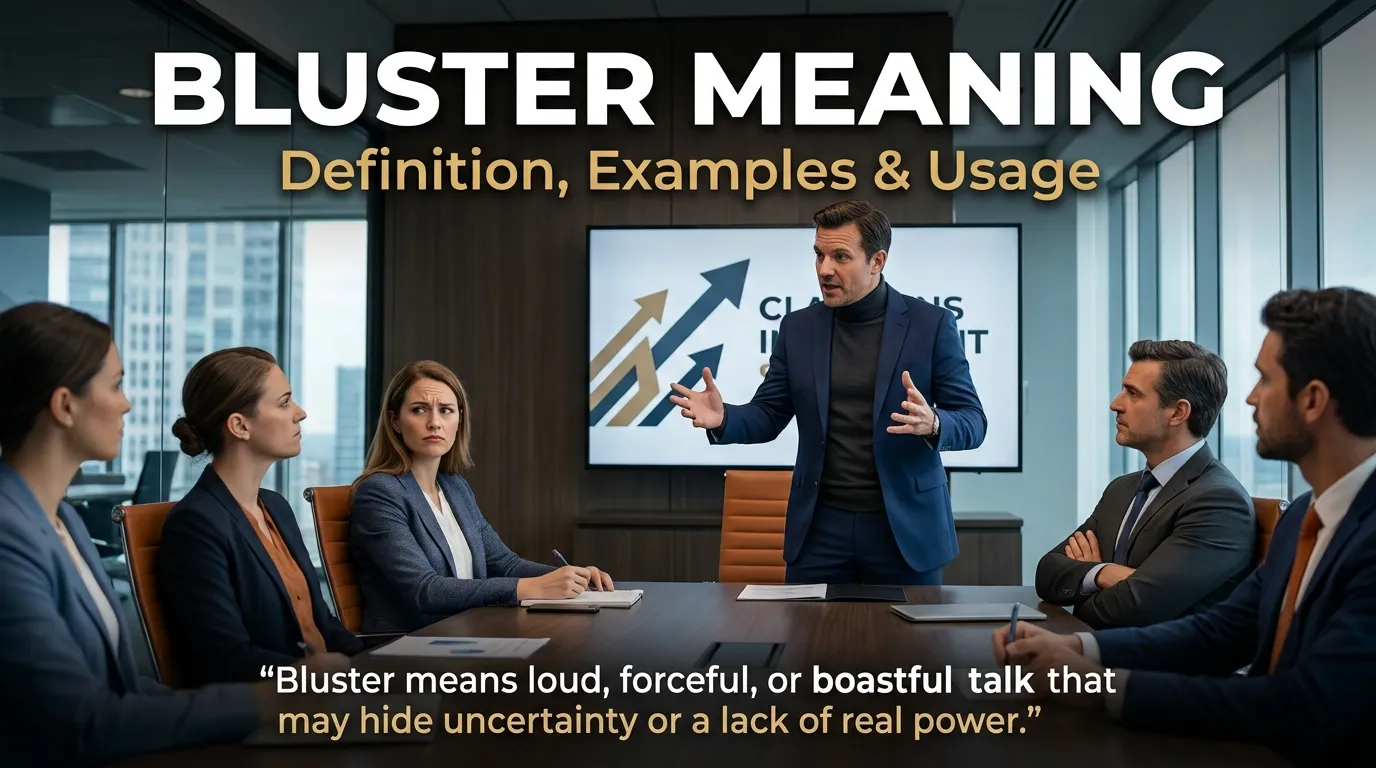
The word bluster describes loud, forceful, or overly confident behavior, especially when someone is trying to make themselves seem more powerful, important, or threatening than they really are.
In simple terms, bluster meaning can be understood as to speak or act aggressively and confidently without having much real strength or intention behind it. As a noun, bluster can also mean loud, boastful, or threatening talk.
You may encounter bluster in news articles, books, workplace discussions, political commentary, sports writing, or everyday conversations.
It often carries a negative tone because it suggests that someone’s strong words or aggressive behavior may be mostly show, boasting, or empty threats.
For example, if someone says, “He kept blustering about how he would defeat everyone,” the sentence suggests that he was talking confidently and aggressively, but his claims may not have been backed by action.
What Does Bluster Mean?
Bluster means to speak or behave in a loud, aggressive, boastful, or threatening way, often without having the power, evidence, or intention to support those claims.
It can function as both a verb and a noun.
Bluster as a Verb
As a verb, bluster describes an action or manner of speaking.
Example:
The manager blustered about firing everyone, but no one believed he would actually do it.
Here, blustered suggests that the manager made loud or threatening statements without necessarily intending to follow through.
Bluster as a Noun
As a noun, bluster refers to loud, aggressive, boastful, or threatening speech or behavior.
Example:
His angry speech was mostly bluster.
This means his speech sounded threatening, but it probably did not represent genuine power or intention.
Bluster Definition in Simple English
If you want a quick definition:
Bluster means loud, aggressive, or boastful talk or behavior that may not be backed by real action.
Think of it as:
Strong words + aggressive attitude + little real substance = bluster
For example:
- Someone threatens to quit every week but never leaves.
- A person loudly claims they can beat everyone but cannot prove it.
- A competitor makes dramatic claims about winning but has no evidence.
- Someone acts intimidating because they want others to believe they are powerful.
In these situations, their behavior could be described as bluster.
Bluster Pronunciation
The word bluster is pronounced with two syllables.
It sounds similar to:
BLUS-ter
The stress falls on the first syllable.
The pronunciation is generally represented in English dictionaries as /ˈblʌstər/.
What Is the Origin of Bluster?
The history of bluster is somewhat uncertain, but the word has been used in English for centuries.
It originally developed around ideas involving noisy movement, disturbance, and loud or violent speech. Over time, its meaning became increasingly associated with loud, boastful, or threatening behavior.
The word is also connected historically with descriptions of wind and stormy weather. This connection makes sense because bluster can describe something loud, forceful, and energetic without necessarily producing lasting results.
Today, the human-behavior meaning is especially common.
How Is Bluster Used in a Sentence?
Here are several natural examples:
- The politician’s speech was full of bluster.
- He likes to bluster when he feels challenged.
- She ignored his bluster and continued with the plan.
- The coach dismissed the rival team’s threats as mere bluster.
- His confident promises turned out to be nothing more than bluster.
- Don’t be intimidated by his bluster.
- The company responded to the competitor’s bluster with actual results.
- He blustered about taking legal action but never followed through.
Notice that bluster often suggests a contrast between what someone says and what they can actually do.
Bluster Meaning in Different Contexts
The meaning remains relatively consistent, but its use changes depending on the situation.
Bluster in Everyday Conversation
In ordinary conversation, bluster often describes someone who is unnecessarily loud, angry, or intimidating.
Example:
Don’t worry about him. He’s just blustering.
This suggests that the person is making a lot of noise or threats but may not actually do anything.
Bluster in the Workplace
In professional settings, bluster can describe exaggerated confidence, aggressive claims, or unsupported promises.
Example:
The executive’s announcement sounded impressive, but some employees saw it as corporate bluster.
Here, bluster implies that the language sounded powerful but lacked substance.
Bluster in Politics
Political writing frequently uses bluster to describe strong statements, threats, or exaggerated claims.
Example:
Analysts questioned if the leader’s threats were genuine policy or political bluster.
This does not necessarily prove that the threats were false. It communicates doubt about if the aggressive language would lead to meaningful action.
Bluster in Sports
Sports writers may use bluster to describe pre-game confidence or trash talk.
Example:
The team’s pre-game bluster disappeared after the first quarter.
The sentence suggests that the team talked confidently before the game but failed to perform accordingly.
Bluster in Online Communication
You may occasionally see bluster used on platforms such as Reddit, Discord, X, TikTok, Instagram, or gaming communities.
For example:
That’s just internet bluster.
This means someone is making dramatic claims online that may not be supported by real actions.
It is not traditional internet slang, however. Bluster is a standard English word that can be used in online communication.
Bluster vs. Boast
| Word | Main Idea | Typical Tone |
| Bluster | Loud, aggressive, boastful talk | Negative |
| Boast | Talking proudly about achievements | Often negative |
| Brag | Talking too proudly about yourself | Usually negative |
| Threaten | Say you will cause harm or trouble | Negative |
| Bravado | Confident behavior intended to impress | Often negative |
| Bluff | Pretend to have strength or confidence | Context-dependent |
Example of Boast
She boasted about winning the competition.
The focus is on proudly talking about an achievement.
Example of Bluster
He blustered that nobody could compete with him.
The focus is on aggressive, forceful confidence that may not be genuine.
A person can boast without blustering, and someone can bluster without making a straightforward boast.
Bluster vs. Bluff
These words are also easy to confuse.
A bluff involves deliberately pretending to have a stronger position, greater confidence, or better information than you actually have.
Bluster is broader. It refers to loud, forceful, aggressive, or boastful behavior and speech.
For example:
The player was bluffing about having a winning hand.
This suggests deliberate deception.
The player was blustering about how unbeatable he was.
This emphasizes loud, aggressive talk.
Bluster vs. Bravado
Bravado means a show of confidence or courage that may be exaggerated or intended to hide fear or uncertainty.
Bluster often focuses more strongly on loud, aggressive, or threatening speech.
For example:
His bravado helped him appear confident.
His bluster annoyed everyone in the room.
The first may describe a performance of courage. The second suggests noisy and aggressive behavior.
Bluster Synonyms
Depending on context, useful bluster synonyms include:
- Boast
- Brag
- Bravado
- Swagger
- Bombast
- Grandstanding
- Braggadocio
- Threatening talk
- Loud talk
- Empty threats
- Aggressive talk
- Showmanship
However, these words are not always interchangeable.
Bombast
Bombast usually refers to language that sounds impressive or important but contains little real meaning.
Swagger
Swagger describes a confident or arrogant manner, especially in the way someone walks or behaves.
Grandstanding
Grandstanding means behaving or speaking dramatically to attract attention or gain approval.
Braggadocio
Braggadocio means excessive confidence or boasting.
Empty Threat
An empty threat is a threat that someone does not intend or cannot carry out.
Bluster can include empty threats, but it does not always have to involve threats.
Positive and Negative Connotations of Bluster
The word bluster usually has a negative connotation.
If you call someone’s speech bluster, you are often suggesting that the person is:
- Overconfident
- Aggressive
- Arrogant
- Noisy
- Exaggerating
- Trying to intimidate others
- Making claims without enough evidence
However, the word can sometimes be used humorously.
Negative Example
His bluster made negotiations more difficult.
Humorous Example
Grandpa’s bluster about being the strongest man in the family made everyone laugh.
In the second example, the word is less serious and may simply describe exaggerated behavior.
Common Expressions With Bluster
Mere Bluster
Mere bluster means talk or behavior that sounds powerful but has little substance.
Her threats were mere bluster.
Empty Bluster
Empty bluster emphasizes that aggressive words are not supported by action.
The competitor’s announcement was empty bluster.
Political Bluster
This refers to aggressive or exaggerated political language.
Voters may become tired of political bluster.
Wind and Bluster
In literary or descriptive writing, bluster can still refer to forceful wind or stormy conditions.
The winter wind began to bluster around the house.
This is an older or more literal sense related to noisy, forceful weather.
Can Bluster Describe Weather?
Yes.
Although the human-behavior meaning is common, bluster can also describe wind that blows strongly and noisily.
Example:
Cold winds blustered through the valley.
In this context, there is no person boasting or threatening anyone. The word describes the forceful, noisy movement of the wind.
This is one reason the word has a vivid quality: if describing a person or the weather, bluster suggests force, noise, and disturbance.
Real-Life Scenarios Where Bluster Fits
Understanding real situations can make the word easier to remember.
Scenario 1: Workplace Argument
A coworker becomes angry during a meeting and loudly says:
“I’ll make sure everyone knows how badly this company is run!”
If the person continues making dramatic statements but takes no meaningful action, another employee might say:
“That sounded like a lot of bluster.”
Scenario 2: Competitive Gaming
A gamer repeatedly says:
“You’re going to lose. Nobody here can beat me.”
If their performance does not match their confidence, another player might describe their comments as bluster.
Scenario 3: Business Competition
A company announces that its new product will completely dominate the market, but provides little evidence.
A journalist might describe the announcement as corporate bluster.
Scenario 4: Family Conversation
Someone jokingly insists:
“I’m the best cook in this entire family!”
If everyone knows the claim is exaggerated, the statement might be described playfully as bluster.
How to Use Bluster Correctly
Follow these practical tips.
Use It When There Is a Gap Between Talk and Substance
Bluster works especially well when someone’s words sound stronger than their actual position.
Use It for Aggressive Confidence
If someone is simply proud of an accomplishment, boasting may be better.
If they are aggressively trying to dominate a conversation, bluster may fit better.
Consider the Tone
Because bluster usually carries criticism, avoid using it when you genuinely want to praise someone’s confidence.
Instead of:
“Her presentation was an impressive bluster.”
Say:
“Her presentation was confident and persuasive.”
Unless you specifically mean that the confidence was exaggerated.
Common Mistakes With Bluster
Mistake 1: Treating Bluster as a Synonym for Confidence
Confidence is not automatically bluster.
Confidence can be supported by ability, experience, or evidence.
Bluster often suggests excessive or unsupported confidence.
Mistake 2: Using Bluster for Every Loud Person
Someone can speak loudly without blustering.
The word usually carries an additional sense of aggressive, boastful, threatening, or exaggerated behavior.
Mistake 3: Assuming Bluster Always Means Lying
Bluster does not necessarily mean someone is deliberately lying.
A person may genuinely believe what they are saying but still communicate in a loud, exaggerated, or aggressive manner.
Mistake 4: Confusing Bluster With Bluff
A bluff generally involves deliberate deception about one’s position.
Bluster can happen without deliberate deception.
Is Bluster a Formal Word?
Yes. Bluster is a standard English word and can appear in formal writing.
It is especially common in:
- Journalism
- Political analysis
- Literature
- Business writing
- Editorials
- Academic discussion
- Formal commentary
It is also perfectly understandable in casual conversation.
For example:
“He’s all bluster.”
This is natural conversational English.
Is Bluster a Slang Word?
No. Bluster is not primarily slang.
It is a traditional English vocabulary word. Younger speakers may use it online, but its meaning does not depend on TikTok, Instagram, Snapchat, Reddit, gaming culture, or texting.
If you see someone write:
“That’s just bluster.”
They are using a standard English expression meaning that the person’s strong or dramatic words may lack real substance.
Bluster in Text Messages
In texting, people generally use shorter words such as “talking big,” “all talk,” or “empty threats.”
Still, bluster can appear when someone wants to sound more precise.
Example:
“Ignore him. It’s just bluster.”
This means:
“He’s talking aggressively, but you probably don’t need to take it seriously.”
Bluster in Dating and Relationships
In relationships, bluster may describe exaggerated confidence, dramatic threats, or aggressive communication.
For example:
“His threats to leave during every argument sounded more like bluster than a serious decision.”
The word should be used carefully, though. Real threats, intimidation, or abusive behavior should not automatically be dismissed as “bluster.” Context matters, and serious threats should be taken seriously.
Bluster in Gaming
Gaming communities often contain competitive trash talk.
A player might say:
“You’re going to get destroyed.”
If the person talks aggressively before losing badly, another player might call the comments bluster.
However, trash talk and bluster are not exact synonyms.
Trash talk is often intentional competitive teasing or provocation.
Bluster emphasizes exaggerated force, confidence, or threats.
Bluster Meaning in Literature
Authors often use bluster to reveal personality.
A character who constantly blusters may appear:
- Insecure
- Arrogant
- Dramatic
- Intimidating
- Comedic
- Defensive
- Desperate to appear powerful
For example, a novelist might create a character who makes grand threats whenever challenged. Describing that character’s speech as bluster tells the reader that the character’s words may be bigger than their actual courage.
This makes bluster a useful word for character development.
Bluster and Body Language
Bluster is not limited to words.
Someone may bluster through a combination of:
- Loud speech
- Aggressive gestures
- Arrogant posture
- Dramatic claims
- Threatening expressions
- Excessive confidence
For example, someone who pounds a table and loudly claims that nobody can challenge them may be described as blustering.
Quick Summary Table
| Fact | Details |
| Word | Bluster |
| Part of speech | Verb and noun |
| Basic meaning | Loud, aggressive, boastful, or threatening talk or behavior |
| Common implication | Words may lack substance or action |
| Tone | Usually negative; sometimes humorous |
| Pronunciation | /ˈblʌstər/ |
| Origin | English; historically associated with noisy or forceful behavior and weather |
| Common contexts | Everyday speech, politics, business, sports, literature |
| Weather meaning | Strong, noisy, forceful wind |
| Main synonyms | Boast, brag, bombast, swagger, bravado |
| Opposite ideas | Humility, restraint, sincerity, quiet confidence |
| Slang? | No |
| Verb example | He blustered about winning. |
| Noun example | His speech was mostly bluster. |
What Is the Opposite of Bluster?
There is no single perfect opposite of bluster, because the best choice depends on context.
Possible opposites include:
- Humility
- Restraint
- Calmness
- Sincerity
- Modesty
- Quiet confidence
- Measured speech
For example:
Instead of bluster, she responded with calm confidence.
This contrast highlights the difference between aggressive performance and controlled confidence.
Bluster vs. Confidence: Why the Difference Matters
One of the most important distinctions is between real confidence and bluster.
Real confidence does not need constant exaggeration.
A confident person might say:
“We’ve prepared well, and I believe we can win.”
A blustering person might say:
“We’re going to destroy everyone. Nobody has a chance against us.”
The first statement communicates confidence without unnecessary aggression. The second emphasizes dominance and exaggeration.
This distinction is useful in professional communication, leadership, negotiations, sports, and everyday relationships.
FAQs
1. What does bluster mean in simple words?
Bluster means loud, aggressive, boastful, or threatening talk that may not be supported by real action or ability. It can also describe forceful or noisy wind.
2. Is bluster positive or negative?
Bluster is usually negative because it suggests exaggeration, aggression, arrogance, or empty talk. However, it can be used humorously when describing someone who makes exaggerated claims.
3. What is an example of bluster?
An example is someone loudly claiming, “Nobody can beat me!” while having no evidence to support the claim. If the person is mostly trying to intimidate others, their behavior could be called bluster.
4. What is a synonym for bluster?
Common synonyms include boast, brag, bravado, bombast, swagger, grandstanding, and aggressive talk. The best synonym depends on the exact context.
5. Is bluster the same as bluff?
No. A bluff usually involves pretending to have a stronger position than you really have, often intentionally. Bluster means loud, aggressive, boastful, or threatening behavior and does not necessarily involve deliberate deception.
6. Can bluster describe a person?
Yes, but it usually describes the person’s behavior or manner of speaking, rather than the person as a permanent characteristic.
For example:
He tends to bluster when someone challenges him.
7. Can bluster describe wind?
Yes. Bluster can describe strong, noisy, or forceful wind.
For example:
The wind blustered through the trees.
8. What is the difference between bluster and brag?
Brag means talking proudly or excessively about your achievements or abilities. Bluster adds an element of loudness, aggression, intimidation, or exaggerated force.
9. Is bluster commonly used in everyday English?
Yes, although it may sound somewhat more sophisticated than very common words such as brag, boast, or talk big. It is especially common in journalism, literature, political commentary, and formal discussions.
10. What does “all bluster” mean?
When someone is described as all bluster, it means they appear powerful or confident because of their words and behavior, but they may lack the ability, courage, or intention to back those words up.
Conclusion
The bluster meaning is best understood as loud, aggressive, boastful, or threatening speech or behavior that may have less substance behind it than it appears to have.
As a verb, bluster describes the act of speaking or behaving in this way. As a noun, it refers to the talk or behavior itself.
The word is particularly useful when you want to distinguish genuine confidence from exaggerated confidence. Someone who calmly explains their abilities may be confident, while someone who constantly makes dramatic claims and threats may be blustering.
Remember the simple idea:
Bluster = forceful words or behavior that may be bigger than the reality behind them.
Use bluster when context suggests exaggeration, intimidation, aggressive confidence, or empty-sounding talk. If the person is simply proud, boast or brag may be more accurate. If they are deliberately pretending to have an advantage, bluff may be the better choice.
Ultimately, understanding this distinction will help you recognize and use bluster naturally in conversations, professional writing, journalism, literature, social media discussions, and everyday English.

I am Sophia Bennett, is a digital resources and online tools writer at LinkVistaHub. She enjoys exploring useful websites, emerging digital tools, productivity platforms, and practical online resources that help people work smarter and discover valuable information.