
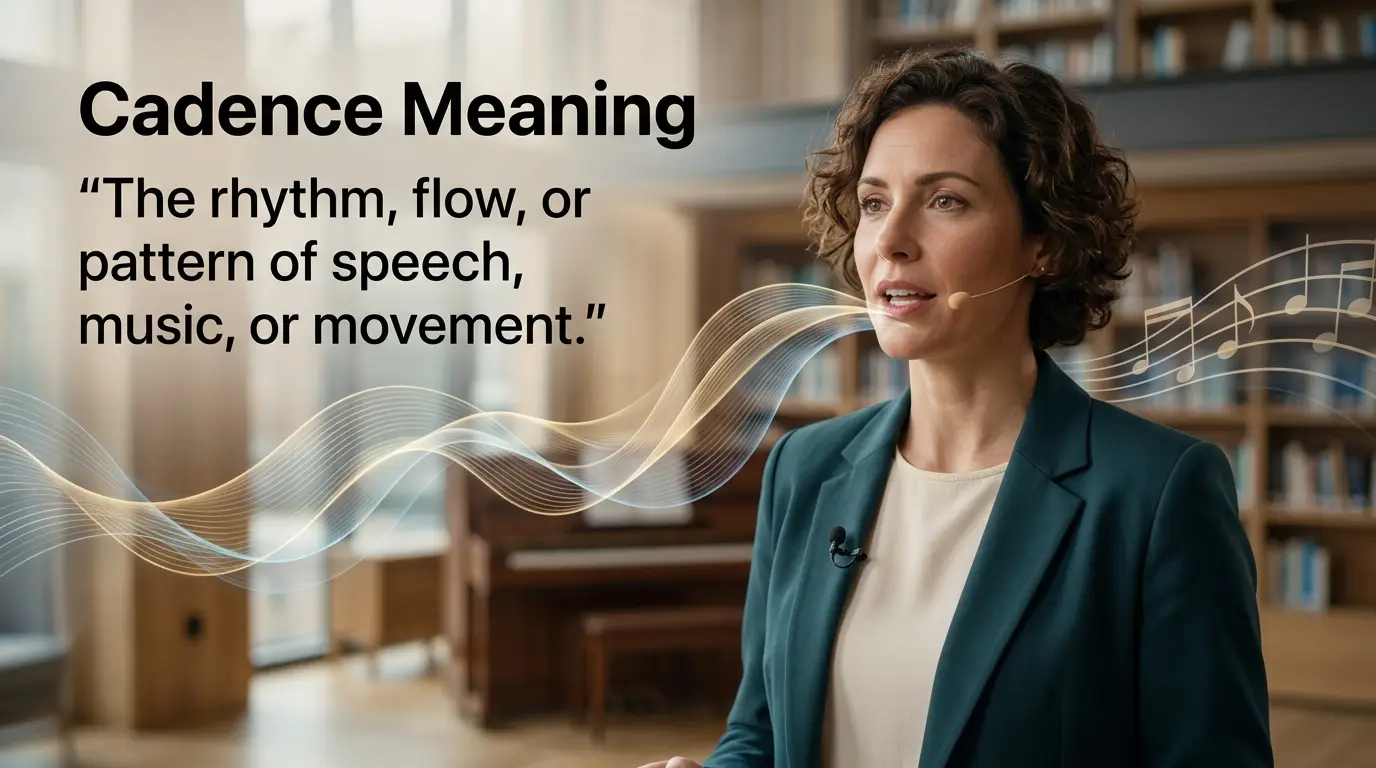
Have you ever noticed how some people sound naturally engaging when they speak, while others seem flat or rushed? The difference may come down to cadence.
This versatile word describes the rhythm, flow, or pattern of sounds, speech, movement, or repeated activity.
You might encounter it when discussing music, public speaking, writing, exercise, military drills, business, or even everyday routines.
The cadence meaning changes slightly depending on context, But the central idea remains the same: a recognizable pattern or rhythm that develops through timing, repetition, or movement.
In music, it can describe a rhythmic or harmonic ending. In business, a communication cadence can refer to how regularly meetings, emails, or reports occur.
Understanding cadence is useful because the word appears in many professional and everyday situations.
You may see phrases such as speaking cadence, conversation cadence, sales cadence, meeting cadence, running cadence, and cadence in music.
What Does Cadence Mean?
Cadence means a rhythm, flow, or regular pattern in which something happens or sounds.
The exact definition depends on the situation:
- In speech, cadence is the rhythm and rise-and-fall pattern of someone’s voice.
- In music, cadence can refer to a rhythmic or harmonic progression, especially one that creates a sense of ending.
- In movement or exercise, cadence is the rate or rhythm of repeated movements.
- In business, cadence often means how regularly a recurring activity takes place.
- In writing, cadence describes the rhythm and flow created by sentence structure and word choice.
Simple Definition of Cadence
If you want the simplest possible explanation:
Cadence is the rhythm or regular flow of something.
For example, if a manager says, “We have a weekly meeting cadence,” they mean that the team has a regular rhythm of meeting once each week.
If someone says, “Her speaking cadence is calm and deliberate,” they are describing the rhythm and timing of her speech.
Cadence Meaning in Different Contexts
Cadence is a flexible word, so its meaning can change according to the subject being discussed.
| Context | Cadence Meaning | Example |
| Speech | Rhythm and flow of someone’s voice | His speaking cadence was confident. |
| Music | Rhythmic or harmonic movement toward resolution | The song ends with a strong cadence. |
| Running | Steps taken per minute | Her running cadence increased during the race. |
| Cycling | Pedaling rate | The cyclist maintained a steady cadence. |
| Business | Regular frequency of activities | The team follows a weekly meeting cadence. |
| Sales | Planned sequence and timing of outreach | The sales cadence includes five emails. |
| Writing | Rhythm created by sentence patterns | The author’s cadence makes the prose engaging. |
| Military | Rhythm associated with marching or drills | Soldiers marched to a steady cadence. |
This is why understanding the surrounding context is important when interpreting cadence meaning.
What Is the Origin of the Word Cadence?
The word cadence has a long history connected to the idea of falling, ending, or reaching a point of resolution.
It ultimately traces back to the Latin word cadere, meaning “to fall.” The word developed through French and Italian usage before becoming established in English.
Its historical connection to “falling” makes sense when considering some of its older musical meanings. A cadence can create a feeling that musical movement is falling toward an ending or resolution.
Over time, the meaning expanded beyond music.
Today, cadence can describe:
- The rhythm of speech
- The flow of writing
- Repeated physical movement
- Regular business activities
- Exercise intensity
- Military marching
- Recurring schedules
The word therefore evolved from a relatively specialized musical concept into a broadly useful term for describing rhythm, timing, and recurring patterns.
How Do You Pronounce Cadence?
Cadence is pronounced:
KAY-dence
The phonetic pronunciation is approximately:
/ˈkeɪdəns/
The emphasis is placed on the first syllable: KAY.
Example
You might say:
“I like the cadence of her voice.”
The word sounds similar to guidance in its ending, although the pronunciation is not identical.
Cadence Meaning in Speech
One of the most common modern uses of cadence relates to speaking.
A person’s speaking cadence is the pattern created by:
- The speed of speech
- Pauses
- Emphasis
- Pitch changes
- Sentence endings
- Word stress
- Changes in intensity
Someone with a natural speaking cadence may sound expressive and easy to follow.
For example:
“The speaker’s calm cadence made the presentation feel reassuring.”
This does not necessarily mean the speaker had a particular accent. Cadence and accent are different things.
A person can have a strong accent while speaking with a smooth cadence, or have little noticeable accent while using a choppy cadence.
Why Speaking Cadence Matters
Cadence can influence how listeners perceive communication.
A deliberate cadence can make someone sound:
- Confident
- Thoughtful
- Calm
- Persuasive
- Professional
- Authoritative
A very fast or irregular cadence can sometimes make speech sound:
- Nervous
- Excited
- Rushed
- Uncertain
- Difficult to follow
Public speakers often practice cadence because pauses and changes in vocal rhythm can make an important message more memorable.
Cadence Meaning in Music
In music, cadence has a more technical meaning.
A musical cadence is a progression or rhythmic/harmonic movement that creates a feeling of resolution, pause, or conclusion.
In Western music theory, several types of cadences are commonly discussed.
Perfect Authentic Cadence
A perfect authentic cadence generally produces a strong sense of final resolution.
It is often associated with the feeling:
“The musical thought has ended.”
Imperfect Authentic Cadence
An imperfect authentic cadence also moves toward resolution but does not meet all the conditions associated with a perfect authentic cadence.
Half Cadence
A half cadence ends on a dominant harmony, creating a feeling that the musical phrase is not finished.
It can feel like a musical comma rather than a period.
Plagal Cadence
The plagal cadence is traditionally associated with the progression IV to I.
It is sometimes nicknamed the “Amen cadence” because of its association with traditional hymns.
Deceptive Cadence
A deceptive cadence creates an expectation of resolution but moves somewhere unexpected instead.
This can create surprise or emotional tension.
Cadence Meaning in Running
In running, cadence usually refers to the number of steps a runner takes per minute.
For example:
“The runner increased her cadence during the final mile.”
Running cadence can be measured using a running watch, fitness tracker, or specialized running app.
However, cadence should not be treated as a universal number that every runner must achieve. Individual biomechanics, pace, terrain, fitness level, and running style all affect what cadence is appropriate.
Example of Running Cadence
Suppose a runner takes 170 steps per minute.
Their running cadence is:
170 steps per minute
If they speed up while maintaining their form, their cadence may increase.
Cadence Meaning in Cycling
In cycling, cadence generally refers to the number of pedal revolutions a cyclist makes per minute.
For example:
“The cyclist maintained a steady cadence while climbing the hill.”
Cyclists pay attention to cadence because it can help them manage effort and maintain an efficient rhythm.
Unlike running cadence, cycling cadence is generally expressed as revolutions per minute (RPM).
Cadence Meaning in Business
The word has become especially common in modern business communication.
In a business setting, cadence often means the regular frequency or rhythm of an activity.
Examples include:
- Weekly meeting cadence
- Monthly reporting cadence
- Project update cadence
- Communication cadence
- Customer follow-up cadence
- Marketing cadence
- Content publishing cadence
For example:
“Our team has a monthly reporting cadence.”
This means reports are produced and reviewed on a regular monthly schedule.
What Does Meeting Cadence Mean?
Meeting cadence means the regular schedule or frequency at which meetings take place.
For example:
- Daily stand-up
- Weekly team meeting
- Monthly leadership review
- Quarterly strategy meeting
A manager might say:
“Let’s establish a weekly meeting cadence.”
The meaning is simply to create a predictable rhythm for meetings.
Cadence Meaning in Sales
Sales cadence is another important modern usage.
A sales cadence is a planned sequence of interactions between a salesperson and a prospect.
It might include:
- An introductory email
- A follow-up email
- A phone call
- A LinkedIn message
- Another follow-up
- A final check-in
The exact sequence varies by company and sales strategy.
In this context, cadence is about timing and consistency, not merely communication.
For example:
“Our sales cadence includes six touches over two weeks.”
Here, cadence describes the organized rhythm of sales outreach.
Cadence Meaning in Writing
Cadence can also describe the rhythm and flow of written language.
Writers create cadence through:
- Sentence length
- Punctuation
- Repetition
- Word choice
- Paragraph structure
- Pauses
- Sentence variety
Compare these two styles:
Flat:
The storm arrived. The rain started. The wind increased. The streets flooded.
More rhythmic:
The storm arrived slowly, then all at once. Rain hammered the windows, the wind grew louder, and the streets disappeared beneath rising water.
The second version has a stronger literary cadence.
Good writing cadence can make prose feel:
- Natural
- Emotional
- Dramatic
- Relaxed
- Urgent
- Poetic
Cadence Meaning in Everyday Conversation
You do not need to work in music, fitness, or business to encounter cadence.
People use the concept naturally when describing how someone talks or behaves.
Example 1
Person A: “Why does he sound so confident when he presents?”
Person B: “I think it’s his speaking cadence. He pauses at exactly the right moments.”
Example 2
Person A: “How often should we send project updates?”
Person B: “Let’s establish a weekly cadence.”
Example 3
Person A: “The podcast feels easy to listen to.”
Person B: “Yeah, the host has a really natural cadence.”
These examples show that cadence often describes something that feels consistent, rhythmic, or naturally flowing.
Cadence vs. Rhythm: What’s the Difference?
Rhythm and cadence are closely related, but they are not always interchangeable.
| Word | Basic Meaning | Typical Use |
| Rhythm | A pattern of beats, movement, or timing | Music, dance, speech, routines |
| Cadence | A particular flow, pattern, or movement toward an ending or recurring point | Speech, music, business, writing |
| Tempo | The speed at which something occurs | Music, exercise |
| Pace | The speed or rate of progress | Work, speech, running, storytelling |
| Frequency | How often something happens | Meetings, communication, events |
A simple way to remember the difference is:
Rhythm = pattern
Tempo = speed
Pace = rate of progress
Frequency = how often
Cadence = rhythm or recurring flow, often involving timing and structure
Cadence vs. Pace
These words are sometimes confused.
Pace focuses primarily on speed or rate.
Cadence focuses more on the pattern or rhythm.
For example:
“The speaker’s pace was fast.”
This tells us how quickly the person spoke.
“The speaker’s cadence was energetic and varied.”
This tells us about the rhythm and flow of the speech.
Someone can speak quickly while still having a controlled cadence.
Cadence vs. Tempo
Tempo is strongly associated with speed, especially in music.
Cadence is more closely connected with rhythm, phrasing, and resolution.
For example:
- A song can have a fast tempo.
- A musical phrase can have a particular cadence.
- A runner can have a particular cadence.
- A business can have a weekly cadence.
Using the words interchangeably can therefore make your meaning less precise.
Cadence vs. Cadenza
These words sound similar, but they mean different things.
Cadence refers broadly to rhythm, flow, or musical resolution.
Cadenza is a specialized musical term referring to a virtuosic solo passage, traditionally allowing a performer an opportunity to display technical skill.
So:
Cadence ≠ Cadenza
Remembering this distinction is especially useful when discussing classical music.
Positive and Negative Connotations of Cadence
Cadence is generally a neutral word, but its connotation depends on the context.
Positive Uses
A person might describe:
- A soothing cadence
- A confident cadence
- A natural cadence
- A compelling cadence
- A graceful cadence
- A steady cadence
These descriptions suggest effective rhythm and flow.
Negative or Critical Uses
You might also hear:
- A monotonous cadence
- An awkward cadence
- An inconsistent cadence
- A rushed cadence
- A choppy cadence
These suggest that the rhythm is distracting or ineffective.
Common Mistakes When Using Cadence
Mistake 1: Treating cadence as only a music term
Cadence has expanded far beyond music.
It is now widely used in speech, business, sports, writing, and everyday communication.
Mistake 2: Assuming cadence always means speed
Cadence can involve speed, but it is fundamentally about rhythm, pattern, and flow.
Mistake 3: Confusing cadence with accent
An accent concerns pronunciation associated with a language, region, or speech community.
Cadence concerns the rhythm and flow of speech.
Mistake 4: Using cadence when frequency is clearer
In some situations, “frequency” is more straightforward.
For example:
“How often do we meet?”
is clearer than:
“What is our meeting cadence?”
However, in professional environments, “meeting cadence” is perfectly natural.
How to Use Cadence in a Sentence
Here are practical examples across different contexts:
- Her speaking cadence was calm and professional.
- The poem has a beautiful cadence.
- The team established a weekly meeting cadence.
- The runner increased her cadence during the final stretch.
- The cyclist maintained a steady pedaling cadence.
- The song ends with a powerful musical cadence.
- The writer’s sentence cadence creates a dramatic effect.
- We need a more consistent content publishing cadence.
- The salesperson followed a structured sales cadence.
- The speaker’s natural cadence kept the audience engaged.
Real-Life Scenario: Why Cadence Matters in Public Speaking
Imagine two people giving the same presentation.
The first speaker rushes through every sentence without pausing.
The second speaker varies their speed, pauses before important points, and allows key statements to land.
Both speakers may use exactly the same words.
Yet the second presentation may feel more confident and engaging.
That difference is partly related to vocal cadence.
Good cadence gives listeners time to process information and can help emphasize important ideas.
Real-Life Scenario: Cadence in a Workplace
Imagine a marketing team struggling with communication.
One person sends updates every day. Another sends them randomly. A third only communicates when something goes wrong.
The team decides to establish:
- Daily internal check-ins
- Weekly project updates
- Monthly performance reports
- Quarterly strategy reviews
They have created a communication cadence.
The benefit is predictability. Everyone understands when information will be shared and when decisions will be reviewed.
Real-Life Scenario: Cadence in Fitness
A cyclist notices that their effort feels inconsistent during long rides.
Instead of constantly changing their pedaling rhythm, they work on maintaining a steady cadence appropriate to their fitness level and terrain.
The goal isn’t simply to pedal as fast as possible.
It is to find a sustainable rhythm.
This illustrates the broader meaning of cadence: a controlled, repeatable pattern of movement.
Modern Uses of Cadence
The word has become increasingly common in professional and digital environments.
You may encounter:
- Content cadence how frequently content is published
- Social media cadence the regular pattern of social posts
- Email cadence timing and frequency of email communication
- Sales cadence structured prospect outreach
- Meeting cadence recurring meeting schedule
- Project cadence regular project activities or reviews
- Release cadence frequency of software or product releases
- Training cadence regular rhythm of training sessions
For example:
“We need to improve our content cadence.”
This could mean the team needs a more consistent publishing schedule.
Cadence Meaning on Social Media
Cadence is not generally slang on platforms such as TikTok, Instagram, Snapchat, Reddit, Discord, or X.
Instead, it retains its standard meaning.
However, creators and marketers increasingly use the word when discussing content strategy.
For example:
“Our TikTok posting cadence has increased.”
This means the creator is publishing TikTok content more frequently or consistently.
Similarly:
“What’s your Instagram content cadence?”
means:
“How often and according to what schedule do you post on Instagram?”
Is Cadence a Slang Word?
No. Cadence is not normally considered slang.
It is a standard English noun used in both casual and professional communication.
Its meaning can be specialized in certain fields, but the word itself is not inherently slang.
You might hear it in:
- Business meetings
- Music classes
- Fitness discussions
- Writing workshops
- Public speaking
- Military contexts
- Everyday conversation
Quick Summary of Cadence Meaning
| Key Fact | Explanation |
| Word | Cadence |
| Pronunciation | KAY-dence |
| Part of speech | Noun |
| Core meaning | Rhythm, flow, or regular pattern |
| Historical roots | Latin cadere, through French/Italian development |
| Speech | Rhythm and flow of voice |
| Music | Harmonic or rhythmic movement toward resolution |
| Running | Steps per minute |
| Cycling | Pedal revolutions per minute |
| Business | Regular frequency of an activity |
| Tone | Neutral |
| Slang? | No |
| Related words | Rhythm, pace, tempo, frequency, flow |
| Common phrase | Speaking cadence |
| Modern business phrase | Meeting cadence / sales cadence |
FAQs
What is the simple meaning of cadence?
Cadence simply means the rhythm, flow, or regular pattern of something. It can describe speech, music, movement, writing, or recurring activities such as meetings and reports.
What does cadence mean in a sentence?
In a sentence such as “She has a soothing speaking cadence,” cadence means the rhythm and flow of her speech.
In “We have a weekly meeting cadence,” it means the regular pattern or frequency of meetings.
What does cadence mean in speaking?
In speaking, cadence refers to the rhythm and flow of someone’s voice, including changes in speed, pauses, emphasis, pitch, and sentence endings.
What does cadence mean in business?
In business, cadence usually means a regular and predictable schedule or rhythm for an activity. Examples include meeting cadence, reporting cadence, sales cadence, and communication cadence.
What does cadence mean in music?
In music, cadence can refer to a harmonic or rhythmic progression that creates a sense of pause, conclusion, or resolution. Different types of musical cadences produce different effects.
Is cadence the same as rhythm?
Not exactly. The concepts overlap, but rhythm is the broader idea of a pattern of beats or movement. Cadence often emphasizes the particular flow, phrasing, timing, or resolution of something.
Is cadence the same as pace?
No. Pace mainly describes speed or rate of progress, while cadence focuses more on rhythm and pattern. Someone can have a fast pace but still maintain a controlled cadence.
Is cadence a positive word?
Cadence is generally neutral. It can have a positive or negative connotation depending on how it is used. A “smooth cadence” sounds positive, while a “monotonous cadence” suggests a problem.
What does cadence mean in running?
In running, cadence usually means the number of steps taken per minute. It is one measure runners can use to understand their movement pattern.
How do you pronounce cadence?
Cadence is pronounced KAY-dence, with the stress on the first syllable.
Conclusion
The cadence meaning is easiest to understand when you think about rhythm, flow, and recurring patterns.
In running and cycling, it describes repeated movement. In business, it often refers to a predictable schedule for meetings, communication, sales activities, or other recurring tasks.
The word is not slang, although it has become increasingly common in modern professional language. Its flexibility is one reason you may encounter it in seemingly unrelated fields.
When you see the word cadence, ask one simple question:
What kind of rhythm or recurring pattern is being described?
Once you understand that central idea, phrases such as speaking cadence, musical cadence, running cadence, sales cadence, and meeting cadence become much easier to understand.
In short, cadence is about more than simply moving quickly or doing something repeatedly. It describes the organized rhythm and flow that gives speech, movement, music, writing, or recurring activities their distinctive pattern.

I am Alex Carter, is a web resources and digital tools writer at Linkvistahub. He enjoys discovering useful websites, online tools, productivity resources, and practical digital solutions that can make everyday tasks easier.