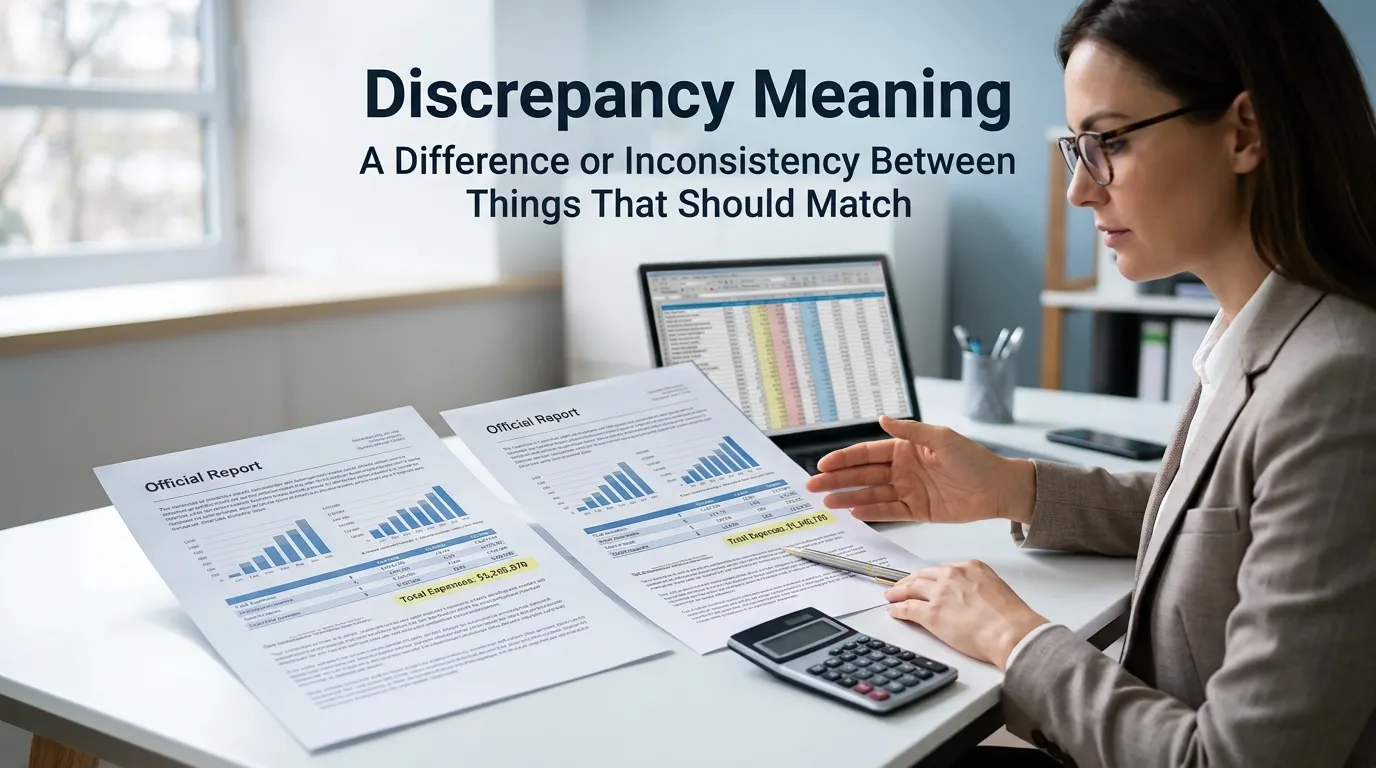
If you have ever noticed that two reports show different numbers, someone gave you information that does not match the facts, or two versions of the same story seem inconsistent, you have encountered a discrepancy.
But what exactly does discrepancy mean, and how should you use the word in everyday English?
Discrepancy meaning is a difference, inconsistency, or mismatch between two or more things that are expected to agree.
The word is common in business, accounting, education, law, research, finance, and everyday communication.
For example, if a receipt says you paid $50 but your bank statement shows a $45 charge, there is a discrepancy between the two records.
Understanding this word is useful because a discrepancy does not always mean that someone intentionally made a mistake.
It can result from an error, outdated information, misunderstanding, missing data, or simple differences in calculation.
What Does Discrepancy Mean?
A discrepancy is a noticeable difference or inconsistency between things that should normally match, agree, or correspond.
Simple Definition of Discrepancy
Discrepancy = a difference or mismatch between two things that are expected to be the same or consistent.
For example:
There was a discrepancy between the amount on the invoice and the amount shown in the payment record.
This means the two amounts were different when they were expected to match.
The word is usually used when comparing:
- Two numbers
- Two documents
- Two statements
- Two accounts
- Two records
- Two versions of information
- Expected and actual results
- Someone’s words and actions
A discrepancy can be small or significant, depending on the situation.
Discrepancy in Simple Words
If you want to explain the word in very simple language, you can say:
A discrepancy is something that does not match when it should.
For instance, imagine you count 20 products in a box, but the inventory record says there should be 25. The five-item difference is a discrepancy.
Discrepancy Meaning in Different Contexts
The meaning remains similar across different situations, but the context determines what is being compared.
| Context | Meaning | Example |
| Everyday English | A mismatch or inconsistency | There is a discrepancy in their stories. |
| Business | Difference between records or figures | We found a discrepancy in the sales report. |
| Accounting | Difference between financial amounts | The accountant noticed a discrepancy in the accounts. |
| Banking | Difference between expected and recorded transactions | There is a discrepancy in my bank statement. |
| Research | Inconsistency between findings or data | Researchers found a discrepancy between the results. |
| Education | Difference between expected and actual information | There was a discrepancy in the student’s records. |
| Law | Inconsistency between statements or evidence | The lawyer pointed out a discrepancy in the testimony. |
| Workplace | Information that does not agree | HR discovered a discrepancy in the employee records. |
Discrepancy Examples in Everyday Life
The word may sound formal, but the situation it describes is extremely common.
Example 1: Shopping
You buy an item for $30, but your receipt says $35.
There is a discrepancy between the advertised price and the receipt.
Example 2: Bank Account
You expect $1,000 to be deposited, but your account shows $950.
I noticed a discrepancy in my bank account.
Example 3: Work Schedule
Your manager says your shift starts at 9:00 a.m., but the official schedule says 10:00 a.m.
There is a discrepancy between the manager’s instructions and the schedule.
Example 4: Two Stories
Two people describe the same event differently.
There were several discrepancies between their accounts of what happened.
Example 5: Inventory
A store’s computer system says there are 100 products, but employees count only 96.
The store discovered a discrepancy in its inventory.
Discrepancy Meaning in Business
In business communication, discrepancy often refers to differences between records, figures, documents, or expectations.
For example:
The finance team identified a discrepancy between the invoice and the purchase order.
Businesses frequently use the term when discussing:
- Invoices
- Payments
- Sales figures
- Payroll
- Inventory
- Financial statements
- Customer accounts
- Contracts
- Purchase orders
- Expense reports
The word is particularly useful because it sounds neutral. Instead of immediately saying someone made a mistake, a professional can say:
We noticed a discrepancy in the report.
This focuses on the difference without directly assigning blame.
Workplace Example
Manager: “The sales report shows $18,000, but the accounting system shows $17,500.”
Employee: “I’ll check the records and see where the discrepancy came from.”
Here, discrepancy simply means that the two figures do not match.
Discrepancy Meaning in Accounting and Finance
In accounting, a discrepancy is a difference between financial records that should agree.
For example, an accountant may compare:
- Bank statements
- Company records
- Invoices
- Receipts
- Payments
- Payroll records
- Expense reports
Suppose a company’s accounting records show a payment of $2,000, while the bank statement shows $1,800.
There is a $200 discrepancy.
A discrepancy does not automatically prove fraud. It may be caused by:
- A data-entry mistake
- A transaction that has not been recorded
- Bank processing delays
- Duplicate entries
- Incorrect calculations
- Missing receipts
- Different reporting dates
The next step is usually to investigate the reason for the difference.
Discrepancy Meaning in Law
In legal contexts, discrepancy usually refers to an inconsistency between statements, documents, testimony, or evidence.
For example:
The attorney noticed a discrepancy between the witness’s original statement and later testimony.
This does not necessarily mean the witness is lying. The difference could result from:
- Memory problems
- Confusion
- Miscommunication
- A recording error
- Different interpretations of an event
However, discrepancies can become important when evaluating the reliability or consistency of evidence.
Discrepancy Meaning in Research and Data
Researchers use discrepancy when data, measurements, findings, or expected outcomes do not agree.
For example:
The researchers found a discrepancy between the survey results and the previous study.
A data discrepancy might occur because of:
- Different sample sizes
- Different measurement methods
- Data-entry errors
- Missing information
- Changes over time
- Different definitions
- Statistical variation
In research, identifying a discrepancy can actually be useful. It may encourage researchers to investigate why two results differ.
Discrepancy vs. Difference
Difference is a much broader and more neutral word.
A difference simply means that two things are not the same.
A discrepancy usually suggests that the difference is unexpected, inconsistent, or problematic.
Compare these sentences:
There is a difference between the two colors.
This is completely normal.
There is a discrepancy between the two financial reports.
This suggests the reports were expected to agree but do not.
Quick Comparison
| Word | Meaning | Typical Tone |
| Difference | Things are not the same | Neutral |
| Discrepancy | An unexpected mismatch or inconsistency | More formal |
| Variation | A difference within a range or pattern | Neutral/technical |
| Error | Something is incorrect | Direct |
| Conflict | Two things contradict each other | Stronger |
Discrepancy vs. Inconsistency
These words are closely related, but they are not always interchangeable.
Discrepancy generally focuses on a difference between two or more pieces of information.
Inconsistency often describes a lack of agreement, uniformity, or logical consistency.
For example:
There is a discrepancy between the two reports.
The reports contain different information.
His explanation was inconsistent.
His explanation did not remain logically or factually consistent.
Both words can describe mismatched information, but discrepancy is particularly common when comparing records, numbers, or statements.
Discrepancy vs. Contradiction
A contradiction is usually stronger than a discrepancy.
A contradiction means that two statements or facts directly oppose each other.
For example:
John said he was at home, while Sarah said she saw him at the office.
That could be a contradiction.
But if one record lists John’s arrival time as 8:05 and another lists it as 8:10, that is more naturally called a discrepancy.
In short:
Discrepancy = mismatch
Contradiction = direct opposition
Discrepancy Synonyms
Several words can have a similar meaning to discrepancy, although their exact use depends on context.
Common discrepancy synonyms include:
- Inconsistency
- Difference
- Mismatch
- Variation
- Divergence
- Disagreement
- Irregularity
- Disparity
- Deviation
- Conflict
- Error
Best Synonyms by Context
For numbers:
- Difference
- Mismatch
- Variation
- Error
For formal writing:
- Discrepancy
- Divergence
- Disparity
Discrepancy Antonyms
An antonym is a word with an opposite or contrasting meaning.
Depending on the context, possible opposites of discrepancy include:
- Agreement
- Consistency
- Match
- Similarity
- Correspondence
- Harmony
- Accuracy
- Conformity
For example:
There was a discrepancy between the two reports.
Opposite:
There was complete consistency between the two reports.
How to Use “Discrepancy” in a Sentence
The most common structure is:
a discrepancy between A and B
Examples:
- There is a discrepancy between the two reports.
- We found a discrepancy between the invoice and receipt.
- The auditor identified a discrepancy between the records.
- There was a discrepancy between his statement and the evidence.
- The employee reported a discrepancy in the payment amount.
Another common structure is:
a discrepancy in something
Examples:
- We found a discrepancy in the financial records.
- There is a discrepancy in the inventory count.
- The manager noticed a discrepancy in the report.
- Please investigate the discrepancy in the account.
You can also describe the size of a discrepancy:
The audit revealed a significant discrepancy in the financial records.
Real-Life Conversation Examples
Conversation 1: Workplace
Alex: “Did you finish checking the invoices?”
Maria: “Almost. I found a discrepancy between one invoice and the purchase order.”
Alex: “What’s different?”
Maria: “The invoice lists 50 units, but the purchase order lists 45.”
Conversation 2: Banking
Customer: “I noticed a discrepancy on my statement.”
Bank Employee: “What seems to be different?”
Customer: “The amount charged is higher than the amount shown on my receipt.”
Conversation 3: School
Teacher: “Your assignment says you submitted it on Monday.”
Student: “Yes.”
Teacher: “There’s a discrepancy in the submission records. The system shows Tuesday.”
Here, discrepancy refers to conflicting records rather than an accusation.
Positive and Negative Connotations of Discrepancy
The word discrepancy is generally neutral, but its emotional effect depends on the context.
Neutral Use
We noticed a discrepancy and will review the records.
This simply identifies a problem.
Negative Use
The audit revealed several discrepancies in the company’s financial records.
This may suggest serious mistakes or problems.
Constructive Use
The discrepancy helped the research team identify an issue with the data.
Here, finding the discrepancy leads to improvement.
So, the word itself does not automatically imply dishonesty or wrongdoing.
Common Misconceptions About Discrepancy
Misconception 1: A Discrepancy Always Means Someone Lied
Not necessarily.
A discrepancy can result from a simple mistake or outdated information.
Misconception 2: Discrepancy Only Refers to Money
Financial discrepancies are common, but the word applies to many areas, including statements, records, research, schedules, and data.
Misconception 3: Discrepancy Means a Huge Difference
A discrepancy can be very small.
For example, a $2 difference between two records can still be called a discrepancy if the amounts were expected to match exactly.
Misconception 4: Discrepancy and Error Always Mean the Same Thing
They do not.
A discrepancy describes the difference. An error describes something that is incorrect.
A discrepancy may reveal an error, but you usually need to investigate before determining the cause.
Word Origin and History of “Discrepancy”
The word discrepancy comes from the Latin discrepare, meaning to sound differently, disagree, or be discordant.
It entered English through French and developed into its modern sense of a difference or lack of agreement.
The historical idea behind the word is interesting: things that do not “sound together” or agree can be described as discrepant.
Today, the word is especially common in formal and professional English, where accuracy and agreement between records matter.
Is “Discrepancy” Formal or Casual?
Discrepancy is primarily a formal or semi-formal word.
You may hear it in:
- Business meetings
- Emails
- Financial reports
- Academic writing
- Legal documents
- Customer service
- News reports
- Research papers
In casual conversation, people may be more likely to say:
- Something doesn’t match.
- The numbers are different.
- There’s a mistake.
- Something seems off.
- The information doesn’t line up.
For example:
Formal:
We identified a discrepancy between the two records.
Casual:
These two records don’t match.
Both communicate essentially the same idea, but the first sounds more professional.
Common Phrases With “Discrepancy”
Some expressions appear frequently in professional English.
“Discrepancy between”
There is a discrepancy between the reported figures and the actual results.
“Discrepancy in”
We found a discrepancy in the inventory records.
“Significant discrepancy”
The audit found a significant discrepancy.
“Minor discrepancy”
There was only a minor discrepancy in the calculation.
“Notice a discrepancy”
The accountant noticed a discrepancy in the payment records.
“Identify a discrepancy”
The team identified a discrepancy between the two datasets.
“Investigate a discrepancy”
The company will investigate the discrepancy before issuing a correction.
“Resolve a discrepancy”
The accounting department resolved the discrepancy.
How to Handle a Discrepancy Professionally
If you discover information that does not match, avoid immediately blaming someone.
A better approach is:
- Identify the difference.
- Check the original sources.
- Compare dates and versions.
- Verify calculations or entries.
- Ask for clarification when necessary.
- Determine the cause.
- Correct the information if needed.
- Document the resolution.
For example, instead of saying:
You made a mistake on this report.
You could say:
I noticed a discrepancy between this report and the original figures. Could we review them together?
This sounds more professional and keeps the conversation focused on solving the problem.
Discrepancy Meaning: Key Facts at a Glance
| Key Fact | Answer |
| Meaning | A difference or mismatch between things expected to agree |
| Part of speech | Noun |
| Plural | Discrepancies |
| Common phrase | Discrepancy between |
| Common contexts | Business, finance, law, research, records, everyday English |
| Tone | Formal, professional, usually neutral |
| Common synonyms | Difference, mismatch, inconsistency, disparity |
| Opposites | Agreement, consistency, match |
| Origin | Latin discrepare, meaning to disagree or sound differently |
| Does it imply dishonesty? | No |
| Example | There is a discrepancy between the two reports. |
Singular and Plural Forms
The singular form is discrepancy.
The accountant found a discrepancy.
The plural form is discrepancies.
The accountant found several discrepancies.
The spelling changes from -y to -ies in the plural:
discrepancy → discrepancies
A common spelling mistake is writing discrepancys. The correct plural is discrepancies.
Frequently Asked Questions
What is the simple meaning of discrepancy?
A discrepancy is a difference or mismatch between two things that are expected to agree or match. For example, if two documents show different prices for the same item, there is a discrepancy between them.
Is discrepancy a positive or negative word?
Discrepancy is generally neutral, but it often appears in situations involving errors or problems. Finding a discrepancy does not automatically mean something dishonest happened.
What is an example of a discrepancy?
If a receipt says you paid $100 but your bank statement shows a $90 transaction, the $10 difference is a discrepancy.
What is another word for discrepancy?
Common alternatives include difference, mismatch, inconsistency, disparity, variation, divergence, irregularity, and disagreement. The best synonym depends on the context.
Is discrepancy the same as a mistake?
No. A discrepancy is a difference between pieces of information. A mistake or error may be the reason for that difference, but the discrepancy itself does not prove what caused it.
What is the difference between discrepancy and inconsistency?
A discrepancy usually highlights a mismatch between two or more things, such as numbers or records. Inconsistency is broader and can describe information, behavior, reasoning, or statements that do not remain consistent.
How do you use discrepancy in a sentence?
A common structure is “a discrepancy between A and B.”
For example:
There is a discrepancy between the invoice and the payment record.
You can also say:
We found a discrepancy in the financial report.
Is discrepancy a formal word?
Yes. Discrepancy is more common in formal and professional English than in casual conversation. It is frequently used in business, accounting, research, law, and official documentation.
What is the opposite of discrepancy?
Depending on the context, opposites include agreement, consistency, correspondence, conformity, similarity, and match.
Conclusion
The simplest way to remember discrepancy meaning is: a difference between things that are expected to match or agree.
The word is especially useful when discussing records, numbers, statements, reports, evidence, or data. A discrepancy may be minor or significant, and it does not automatically indicate a mistake, deception, or fraud. The difference simply tells you that something needs closer attention.
Remember these three points:
- Discrepancy means a mismatch or inconsistency.
- “Discrepancy between” and “discrepancy in” are common sentence patterns.
- A discrepancy identifies a difference; it does not automatically explain its cause.
Once you understand this distinction, words such as discrepancy, inconsistency, mismatch, disparity, and contradiction become much easier to use accurately.
If you encounter the term in a financial statement, workplace email, research paper, legal document, or everyday conversation, discrepancy usually signals one simple idea: something does not quite line up with something else.

I am Sophia Bennett, is a digital resources and online tools writer at LinkVistaHub. She enjoys exploring useful websites, emerging digital tools, productivity platforms, and practical online resources that help people work smarter and discover valuable information.