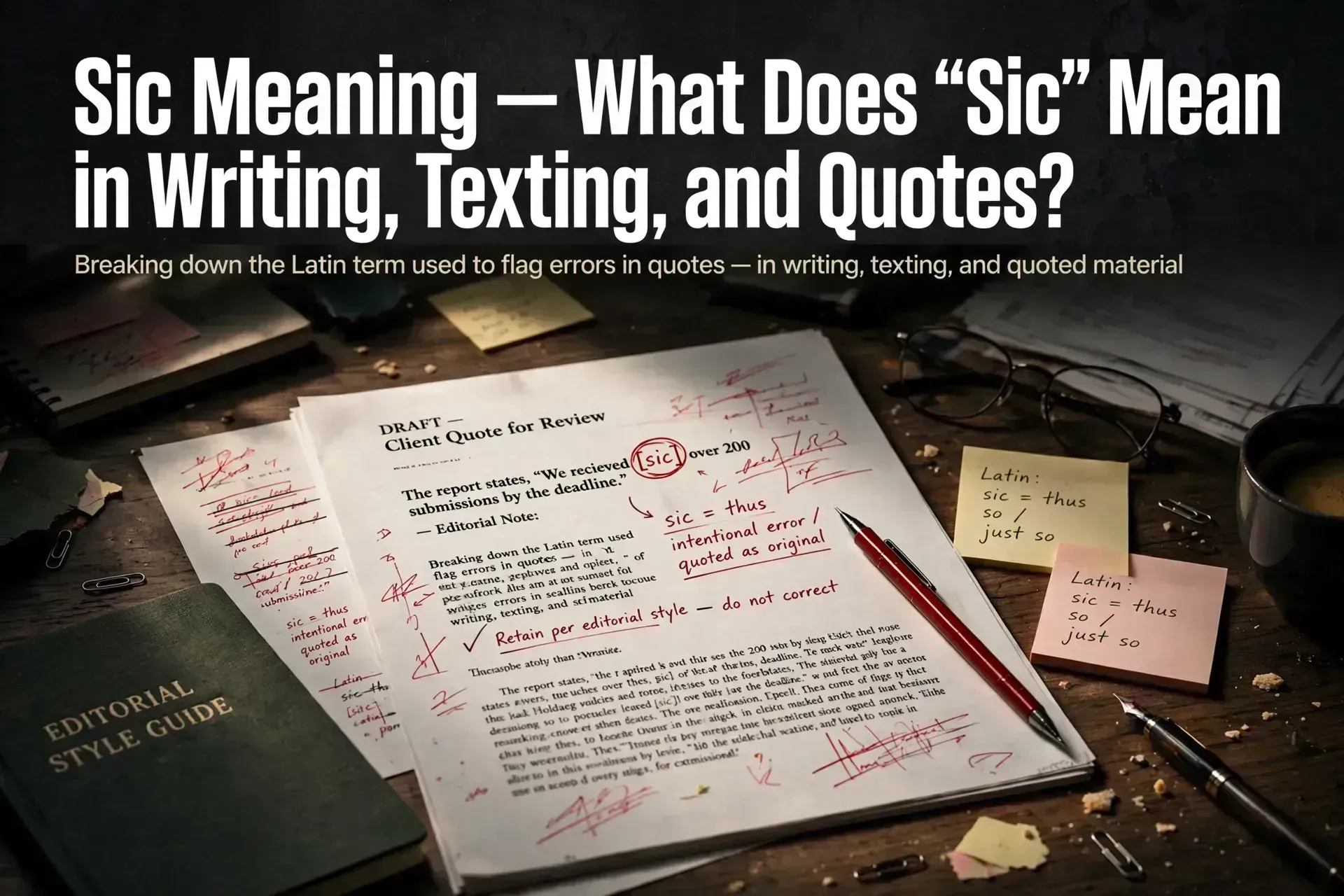
If you have ever spotted [sic] inside a quotation, in a newspaper, book, legal document, or social media post, you may have wondered why a writer would deliberately reproduce a spelling mistake or odd phrase. The answer is one small Latin word: sic.
Sic meaning is essentially “thus,” “so,” or “exactly as written.” Placed in brackets after an unusual word, spelling, or grammar slip inside a quotation, [sic] tells readers the wording appeared that way in the original source. The person quoting did not introduce the error.
You will find [sic] in journalism, academia, legal writing, history, and social media: usually neutral, sometimes sarcastic.
This guide explains what sic means, how to use it correctly, where it came from, what [sic] means in texting and social media, and how it differs from related editorial terms.
What Does Sic Mean?
Sic means “thus,” “so,” or “exactly as written.” It shows a quoted passage was reproduced exactly, including any apparent spelling, grammar, punctuation, or factual slip, usually appearing as [sic] inside the quotation.
For example:
The report stated that the building was “constructed in 1985 [sic].”
The [sic] shows the quoted person actually used that wording:
She wrote, “I definately agree [sic] with the proposal.”
“Definately” is misspelled, and [sic] shows the spelling came from the original. Without it, readers might blame the quoter.
What Does [sic] Stand For?
From the Latin word sic (“thus,” “so,” or “in this manner”), it communicates one thing: “This is how it appeared in the original.”
It is not an acronym: despite the capital-letter look, sic is a Latin word, not English initials.
What Does [Sic] Mean in a Quote?
Inside a quotation, [sic] tells readers an unusual feature of the original was preserved on purpose: a spelling or grammar slip, odd punctuation, strange word choice, or apparent factual error.
For example:
The witness said, “The two cars were parked their [sic] overnight.”
It signals “their” came from the original, not from the writer failing to correct it to “there.”
Why Do Writers Use [Sic]?
The main reason is accuracy: quoting obliges faithful reproduction, and changing wording could alter meaning or misrepresent the speaker. [sic] preserves the original while flagging the oddity, which is essential in journalism, academia, law, history, biographies, interviews, and court records.
Sic Meaning in Simple English
The simplest explanation: [sic] means “this is exactly how it appeared in the original.”
Imagine quoting an email that read:
“We recieved your application.”
You would write:
The email stated, “We recieved [sic] your application.”
“Recieved” is misspelled. [sic] shows you copied the original exactly, protecting the quotation’s accuracy.
Where Does the Word Sic Come From?
Sic is Latin for “thus,” “so,” or “in this manner.” From Latin’s long influence on academic, legal, and literary English, [sic] became an editorial convention meaning: take the text as it stands, “unusual, but exactly as it appeared in the source.”
How Is Sic Used in Writing?
Place it immediately after the questionable word or phrase:
The letter described the event as “truely [sic] remarkable.”
Square brackets mark it as an editorial addition, not part of the original.
Why Are Square Brackets Used?
Square brackets mark editor insertions: e.g., “He [the manager] approved the request.” In “This is definately [sic] correct,” the [sic] is the writer’s addition, kept distinct from the original.
When Should You Use [Sic]?
Use [sic] sparingly when preserving the original matters and readers might otherwise blame you for the error.
1. Quoting a Spelling Error
The document described the product as “enviromentally [sic] friendly.”
The spelling appeared that way in the original.
2. Quoting a Grammar Error
The statement said, “They was [sic] responsible for the project.”
The notation preserves the original grammar.
3. Quoting Unusual Word Choice
The advertisement called the product “the most unique-est [sic] option available.”
It flags the odd construction while keeping the quote intact.
4. Quoting an Apparent Factual Error
The article claimed that the company was founded in “1995 [sic].”
1995 appeared in the source. But [sic] alone does not prove it wrong. If you know the correct date, add a factual correction instead.
What Does Sic Mean in Academic Writing?
Researchers use [sic] to reproduce sources exactly. An intentional historical spelling needs no flag, but a relevant obvious error does:
The original survey described participants as “highley [sic] satisfied.”
The original stays intact, and the writer is not blamed for the error.
Should You Use [Sic] for Every Error?
No. Overuse clutters writing and spotlights trivial slips. If an error is irrelevant, most style guides allow silent correction. Always follow your required citation style.
Sic Meaning in Journalism
Journalists use [sic] when quoting verbatim. If a politician posts “We definately need to act now,” the report reads:
The politician said, “We definately [sic] need to act now.”
The spelling mistake belonged to the original statement.
Why Is This Important for Journalists?
Quotations must reflect what was actually said; silent correction can distort the record. But style varies (some publications correct minor errors), so [sic] is not a universal requirement.
Sic Meaning in Legal Documents
Legal writing and court records must quote exact words, errors included:
The witness stated, “I seen [sic] the vehicle leaving the property.”
“I seen” came from the original. Legal wording can carry evidentiary weight, so exactness matters, but follow the court’s style rules rather than adding [sic] automatically.
Sic Meaning in Books and Historical Documents
Historians face archaic spelling, obsolete vocabulary, and dialect. [sic] separates the source’s wording from modern editorial changes:
The diary described the journey as “most wonderfull [sic].”
But an old spelling is not an error: [sic] should not mark wording merely for differing from modern English, as that wrongly implies the writer made a mistake.
Sic vs. Sic!
Normally written [sic]: brackets show the quoter added it. Variants include [sic!] and bare sic. The exclamation mark adds emphasis, sometimes flagging a striking error:
The advertisement promised “100% garanteed [sic!] results.”
[Sic!] can sound judgmental or sarcastic, so in formal writing, plain [sic] is safer.
Sic Meaning in Texting and Social Media
Unlike LOL or BRB, sic is not a texting abbreviation. Online it keeps its editorial meaning:
He literally wrote “your the best [sic].”
Here [sic] notes that the original writer used “your” instead of “you’re.”
Sic on Reddit
Redditors use [sic] when quoting comments or sources: “The original post says, ‘I could of [sic] done it myself.’” Humorous uses exist but are less formal.
Sic on Instagram and TikTok
Users quote captions with [sic]: “The caption literally said ‘their going [sic] to win.’”, sometimes as a joke.
Sic on Discord and Gaming Chats
In gaming chats, [sic] quotes a player’s message, often joking about spelling: “He said ‘your team is trash [sic].’” Rarely needed in fast live chat, though.
Does Sic Mean “I Know This Is Wrong”?
Often, with a qualification. [sic] signals “the original really said it this way,” not “I think this is wrong.”
The historical document described the event as “occured [sic].”
The note is about fidelity, not judgment.
Can Sic Be Sarcastic?
Yes, in informal writing [sic] can be sarcastic:
My “expert” friend [sic] gave me financial advice.
Here it questions the word “expert” rather than flagging a typo:
He called himself a “professional chef [sic].”
The writer suggests the person does not deserve the description.
Is Sarcastic [Sic] Formal?
No. It is informal and rhetorical. In academic, journalistic, or legal writing, keep [sic] strictly neutral.
Sic Meaning vs. Other Editorial Terms
Several editorial marks resemble [sic] but serve different purposes:
| Term | Meaning | Main Purpose |
|---|---|---|
| [sic] | “Exactly as written” | Preserve an unusual original wording |
| [emphasis added] | The quoted emphasis was added by the writer | Clarify added formatting or emphasis |
| [brackets] | Editorial material inserted into a quote | Clarify or modify a quotation |
| ellipsis (…) | Omitted material | Shorten a quotation |
| [citation needed] | Source support is requested | Flag an unsupported claim |
| [original emphasis] | Emphasis existed in the source | Show that formatting was not added |
| correction | A mistake is explicitly fixed | Clarify or amend information |
Sic vs. [Emphasis Added]
“This is the most important point” [emphasis added]: emphasis added by the writer. Versus “This is definately [sic] important”: original spelling preserved.
Sic vs. Ellipsis
Ellipsis marks omitted material: “The results … were unexpected.” [Sic] marks preserved odd wording: “The results were unexpected [sic].”
Common Mistakes When Using Sic
Mistake 1: Treating Sic as an Acronym
It is a Latin word, not English initials.
Mistake 2: Using Sic Outside a Quotation Without a Reason
The familiar editorial use of [sic] is tied to quoted or reproduced material.
Mistake 3: Assuming Every Unusual Word Is an Error
A word may be dialectal, historical, technical, or deliberately unusual, so check before flagging it.
Mistake 4: Using Sic to Correct Someone
[Sic] flags the oddity; it fixes nothing.
Mistake 5: Overusing Sic
Flagging every tiny typo clutters the quotation. Use [sic] only when it genuinely helps the reader.
Mistake 6: Using [Sic] as Proof That Something Is False
[Sic] says nothing about factual truth: only that the wording was reproduced as it appeared.
How to Use Sic Correctly
- Preserve the original wording.
- Place [sic] immediately after the relevant error or unusual wording.
- Use square brackets to mark the editorial note.
- Use it only when accuracy or clarity benefits.
- Follow the required style guide.
- Do not use it to ridicule someone.
- Do not assume unfamiliar language is wrong.
- Avoid unnecessary repetition.
Example of Correct Usage
Original: “The company recieved hundreds of applications.”
Quotation: the company reported one applicant had “recieved [sic]” an interview invitation; the spelling clearly belonged to the source.
Why Sic Matters in Research and Communication
This tiny mark delivers transparency: readers know the quoter did not silently alter the original. It matters when exact wording counts, a quote is evidence, the source is historic, or readers might blame the writer: a small tool for editorial honesty.
Key Facts About Sic Meaning
| Fact | Explanation |
|---|---|
| Primary meaning | “Thus,” “so,” or “exactly as written” |
| Language of origin | Latin |
| Most common form | [sic] |
| Main use | Quoted or reproduced material |
| Purpose | Show that unusual wording comes from the original source |
| Common contexts | Journalism, academia, law, books, history |
| Commonly follows | Spelling, grammar, punctuation, or wording that looks unusual |
| Tone | Usually neutral; can be sarcastic in informal use |
| Acronym? | No |
| Similar idea | “This is how it appeared in the source” |
Frequently Asked Questions About Sic Meaning
1. What does sic mean in simple terms?
“Exactly as written.” Bracketed inside a quotation, it shows an apparent mistake was present in the original source.
2. What does [sic] mean after a quote?
The wording was reproduced exactly, flaws included. The quoter introduced nothing.
3. Is sic a Latin word?
Yes. It is Latin for “thus,” “so,” or “in this manner,” adopted into English as an editorial convention.
4. Does sic mean the writer made a mistake?
Usually the opposite: the error was in the original source and was intentionally preserved.
5. Is sic an abbreviation?
No. sic is a Latin word, not an acronym.
6. Why do people put [sic] in quotes?
To preserve exact wording while showing that an apparent error belongs to the original speaker or writer.
7. Can [sic] be used sarcastically?
In informal writing, yes, but that differs from its traditional neutral editorial function.
8. Does sic mean “correct”?
No. It says nothing about truth; it only shows the wording matches the source.
9. Should [sic] be italicized?
Often, given its Latin origin. But always follow your publication’s style guide.
10. What is the difference between [sic] and [sic!]?
Plain [sic] is neutral. [Sic!] adds emphasis and can sound sarcastic, so prefer [sic] in formal writing.
Conclusion
The sic meaning is simple: [sic] shows quoted wording was reproduced exactly as it appeared in the original. From Latin “thus” (“in this manner”), it is standard in journalism, academia, law, and historical research.
It flags errors without blaming the quoter, but never means “this is false.” Online it can turn sarcastic, yet its traditional editorial role is the one to know.
Use it thoughtfully: preserve the original, place [sic] right after the passage, and add it only when it genuinely helps the reader.

I am Alex Carter, is a web resources and digital tools writer at Linkvistahub. He enjoys discovering useful websites, online tools, productivity resources, and practical digital solutions that can make everyday tasks easier.