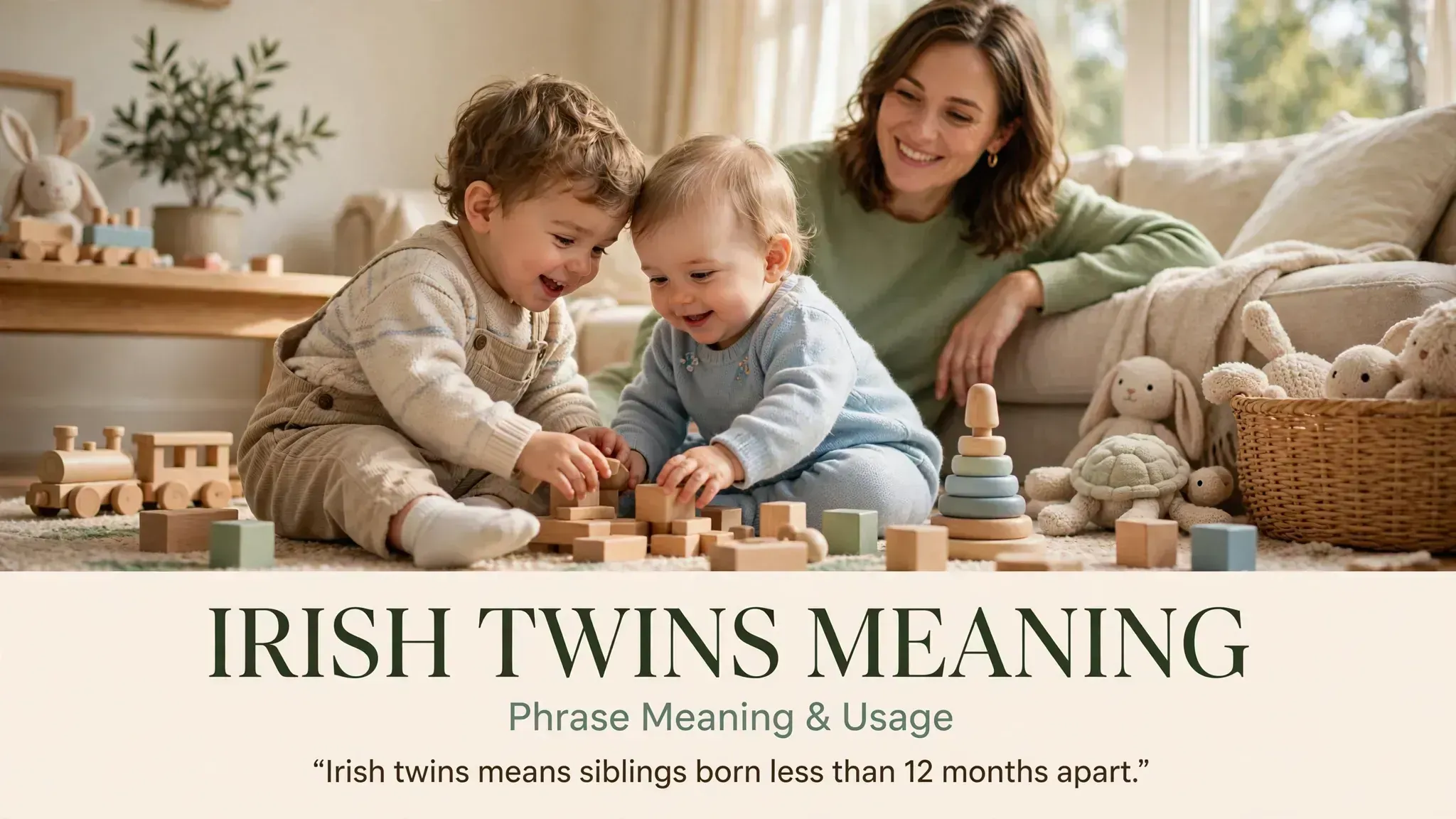
Irish twins meaning refers to two siblings born less than 12 months apart, usually within the same calendar year or within a year of each other.
The term is an informal expression commonly used in the United States to describe children whose birthdays are very close together. Despite the name, Irish twins are not actual twins. They are siblings born from separate pregnancies who happen to have a small age gap.
Have you ever met two siblings who look almost the same age, share similar interests, and seem more like twins than ordinary brothers or sisters?
People may jokingly call them Irish twins. The expression often appears in family conversations, parenting discussions, social media posts, and online searches about sibling age differences.
However, the phrase has a complicated history. It originated in anti-Irish stereotypes and was historically used in a derogatory way toward Irish Catholic immigrant families.
Today, some people use it casually or humorously, while others avoid it because of its historical associations.
What Does Irish Twins Mean?
The term Irish twins describes two siblings born less than 12 months apart. They are not biological twins because each child develops during a separate pregnancy.
For example, if one baby is born in January and the next baby arrives in November of the same year, the children are commonly described as Irish twins.
The expression is informal rather than a medical classification. There is no official medical category called Irish twins, and the phrase does not describe a special type of twin pregnancy.
People generally use it to highlight how close the siblings are in age.
Simple Definition of Irish Twins
Irish twins are siblings born less than one year apart, usually from separate pregnancies.
For example:
- A child born on February 10, 2025, and a sibling born on December 20, 2025.
- A child born in March 2024 and a sibling born in February 2025.
- Two siblings whose birthdays are separated by only a few months.
In each example, the children are siblings with a very small age gap rather than twins born during the same pregnancy.
How Far Apart Are Irish Twins?
The traditional definition of Irish twins is two siblings born less than 12 months apart.
However, everyday usage is not always consistent. Some people use the expression for siblings born within 12 months, while others apply it more loosely to siblings born around a year apart.
The important distinction is that the phrase generally describes an unusually small age difference.
| Age Gap | Common Interpretation |
| 2–5 months | Very close age gap; often called Irish twins |
| 6–9 months | Commonly described as Irish twins |
| 10–11 months | Fits the traditional under-12-month definition |
| Exactly 12 months | Usually outside the strict definition |
| 13–18 months | Sometimes used loosely, but not the traditional definition |
| 2 years or more | Generally not considered Irish twins |
These ranges describe informal usage, not a medical standard.
Are Irish Twins Born in the Same Year?
Not necessarily.
Two siblings born in January and December of the same year fit the common definition. However, siblings born in December and the following November can also be Irish twins because they are less than 12 months apart.
The actual time between their birth dates matters more than if they share a calendar year.
Irish Twins vs. Actual Twins
Although the names sound similar, Irish twins and actual twins are different.
Actual twins develop during the same pregnancy. Irish twins are born from two separate pregnancies.
| Feature | Irish Twins | Actual Twins |
| Meaning | Siblings born less than 12 months apart | Two babies born from the same pregnancy |
| Pregnancy | Separate pregnancies | One pregnancy |
| Birth dates | Different dates, usually months apart | Usually the same date |
| Age difference | Less than one year under the traditional definition | Usually minutes or hours at birth |
| Genetic relationship | Full or half siblings, depending on parentage | May be identical or fraternal |
| Medical classification | Informal expression | Recognized multiple birth |
| Development | Each child has an individual developmental timeline | Twins may share many early milestones |
Irish twins can be full siblings or half siblings. Their exact biological relationship depends on their parents.
Are Irish Twins Really Twins?
No. The expression is a nickname for closely spaced siblings.
Actual twins are two babies from one pregnancy. Irish twins are two children from separate pregnancies who happen to be born within a short period.
Although Irish twins may look similar in age, the term does not indicate that they share the same conception date, pregnancy, or birth.
Origin and History of the Term Irish Twins
The expression Irish twins has a history connected to Irish immigration and prejudice in the United States.
During the 19th and early 20th centuries, many Irish immigrants faced anti-Irish and anti-Catholic discrimination. Irish Catholic families were sometimes stereotyped as having many children and closely spaced births.
The expression developed within this broader environment of ethnic stereotyping. It was often used to mock or criticize Irish families rather than simply describe a small sibling age gap.
Over time, the phrase became established in American English as an informal expression for siblings born less than a year apart.
Why Is Ireland Mentioned in the Phrase?
The reference to Ireland reflects the stereotype associated with Irish immigrant families, particularly Irish Catholics, in historical American society.
It does not mean that Irish people have a unique biological tendency to produce siblings close in age. Nor is the expression an official term in Irish medicine or family studies.
The name comes from cultural history rather than a special biological characteristic.
Is Irish Twins a Derogatory Term?
The phrase can be considered offensive because of its historical connection to ethnic and religious stereotypes.
Today, its tone depends on how it is used.
- Casual: A family may use it as a nickname for siblings born close together.
- Humorous: Parents may joke about the challenges of raising two very young children.
- Critical: Someone may use it in a way that mocks a family’s reproductive choices.
- Historically insensitive: The expression may be uncomfortable for people who recognize its anti-Irish background.
If you want a neutral alternative, use phrases such as siblings born less than a year apart, closely spaced siblings, or siblings with a small age gap.
Why Do People Use the Term Irish Twins Today?
Despite its history, the expression remains familiar in some English-speaking communities.
People use it because it is short, memorable, and easy to understand. It also provides a convenient way to describe siblings whose birthdays are unusually close together.
Common reasons include:
- Explaining a small age difference between children.
- Sharing a family story.
- Discussing parenting experiences.
- Making a lighthearted comment about sibling relationships.
- Describing two children who are close in age.
- Talking about family planning or birth spacing.
For example, a parent might say, “My children are Irish twins; they’re only nine months apart.”
The speaker may intend no insult. Still, awareness of the phrase’s history can help people decide if a different expression would be more appropriate.
Irish Twins Meaning in Text Messages and Social Media
The meaning generally stays the same across social platforms: siblings born less than a year apart.
However, social media often gives the expression a humorous or personal tone.
Irish Twins Meaning on TikTok
On TikTok, the phrase may appear in parenting videos, family stories, and humorous posts about raising two young children.
A creator might post a video showing two toddlers and write:
“POV: You have Irish twins, and both want to be carried.”
The caption highlights the challenges of caring for two children at similar developmental stages.
Irish Twins Meaning on Instagram
On Instagram, the expression may appear in family photos, birthday posts, or captions celebrating siblings.
Example:
“Two babies, one busy year! My Irish twins are growing so fast.”
The phrase identifies the children’s close age gap.
Irish Twins Meaning on Snapchat
In Snapchat messages, someone might use the term while explaining their family.
Example:
Person A: “Are those your twins?”
Person B: “Not exactly. They’re Irish twins, born ten months apart.”
Here, the speaker clarifies that the children are siblings rather than actual twins.
Irish Twins Meaning on Reddit
On Reddit, people may discuss the expression in parenting forums, family communities, and conversations about its historical background.
Some discussions focus on the practical experience of raising children close in age. Others debate if the phrase is appropriate because of its history.
Irish Twins in Everyday Conversations
The term is not exclusive to social media.
A person might say:
“My brother and I are Irish twins. He’s only eleven months older than me.”
This describes a close sibling age gap in casual conversation.
Real-Life Examples of Irish Twins
The following examples show how the term works in everyday situations.
Example 1: Siblings Born in the Same Year
A family welcomes a baby in January. Another baby arrives in November.
Because the children are born less than 12 months apart, people may describe them as Irish twins.
Example 2: Siblings Born in Different Years
One child is born on December 15, 2024, and a sibling is born on October 15, 2025.
The age gap is ten months, so the children fit the traditional definition even though their birth years differ.
Example 4: A Parenting Discussion
Parent A: “My kids are only eight months apart.”
Parent B: “That’s a really small age gap. How has it been?”
Parent A: “Busy, but they enjoy growing up together.”
This example shows that people can discuss the same family situation without using the historical expression.
What Is It Like to Raise Irish Twins?
Raising two children who are less than a year apart can be rewarding, but it can also require considerable time, planning, and support.
Every family is different, and the experience depends on factors such as health, childcare arrangements, financial resources, family support, and each child’s temperament.
Potential Benefits
1. Similar developmental stages
The children may enjoy some of the same toys, activities, and family routines as they grow.
2. Shared experiences
They may attend school around the same time and participate in similar activities.
3. A close sibling relationship
Growing up close in age may create opportunities for shared interests and companionship, although it does not guarantee that siblings will always be close.
4. Similar family routines
Parents may be able to organize certain activities around both children as they grow older.
Potential Challenges
1. Caring for two very young children
Both children may need significant hands-on attention.
2. Sleep and feeding routines
Parents may need to manage different feeding, sleeping, and developmental needs at the same time.
3. Financial pressure
Two children close in age can mean overlapping costs for diapers, childcare, clothing, and other necessities.
4. Individual attention
Parents may need to make deliberate time for each child so both feel supported as individuals.
5. Physical and emotional recovery
Pregnancy and childbirth can place significant demands on a parent’s body and emotional well-being. Closely spaced pregnancies may also involve additional medical considerations.
Anyone planning another pregnancy soon after giving birth should discuss individual circumstances and pregnancy spacing with a qualified healthcare professional.
Irish Twins and Pregnancy Spacing
The phrase often appears in discussions about pregnancy spacing because it describes siblings born within a short period.
However, the expression itself is not a medical diagnosis or a recommendation about when to have another baby.
Pregnancy spacing is a separate health topic. The interval between a birth and the next conception can matter for maternal recovery and pregnancy outcomes, and the appropriate advice depends on individual circumstances.
It is important to distinguish three things:
- Irish twins: An informal term describing a short gap between siblings’ births.
- Birth spacing: The time between one birth and the next conception or birth, depending on how the interval is measured.
- Twin pregnancy: A pregnancy involving two babies.
These terms describe different concepts and should not be used interchangeably.
Irish Twins vs. Other Family Terms
Several expressions describe children who share a close family relationship or age gap.
| Term | Meaning |
| Irish twins | Siblings born less than 12 months apart |
| Actual twins | Two babies from the same pregnancy |
| Fraternal twins | Twins who develop from two separate eggs fertilized by two sperm |
| Identical twins | Twins who develop when one fertilized egg splits into two embryos |
| Siblings close in age | A general, neutral phrase for siblings with a small age gap |
| Pseudo-twins | An informal term sometimes used for children close in age who are not biological twins |
| Triplets | Three babies from the same pregnancy |
The term “pseudo-twins” may be used in different ways, so its meaning should be determined from context. It is not a universal substitute for Irish twins.
Common Misconceptions About Irish Twins
Misconception 1: Irish Twins Are Actual Twins
This is incorrect. Irish twins are siblings from separate pregnancies.
Misconception 2: Irish Twins Must Be Born in the Same Calendar Year
Not necessarily. The traditional definition focuses on an age gap of less than 12 months, regardless of if the birth dates fall in different calendar years.
Misconception 3: The Term Is a Medical Classification
It is an informal expression, not a recognized medical diagnosis.
Misconception 4: Irish Twins Always Look Alike
The expression describes age spacing, not physical appearance or genetic similarity. Closely spaced siblings can look very different.
Misconception 5: Irish Twins Always Have a Close Relationship
A small age gap may provide opportunities for shared experiences, but every sibling relationship develops differently.
Misconception 6: The Term Is Historically Neutral
The phrase has roots in ethnic and religious stereotypes. Although some people use it casually today, its history is worth understanding.
Is There a Better Term Than Irish Twins?
If you want to describe siblings accurately without using a historically loaded expression, several alternatives work well.
- Siblings born less than a year apart
- Closely spaced siblings
- Siblings with a small age gap
- Children born ten months apart
- Brothers or sisters close in age
For example, instead of saying, “They are Irish twins,” you can say, “They are siblings born eleven months apart.”
This alternative is clear, factual, and suitable for both casual and formal conversations.
Irish Twins Meaning: Key Facts at a Glance
| Key Fact | Explanation |
| Definition | Siblings born less than 12 months apart |
| Actual twins? | No; they are born from separate pregnancies |
| Origin | Informal American English associated with historical anti-Irish stereotypes |
| Common usage | Family conversations, parenting discussions, social media |
| Tone | Casual, humorous, or potentially offensive |
| Medical status | Not a medical classification |
| Birth-year requirement | Siblings may be born in the same or different calendar years |
| Neutral alternatives | Closely spaced siblings; siblings born less than a year apart |
Frequently Asked Questions About Irish Twins
1. What is the exact definition of Irish twins?
Irish twins are siblings born less than 12 months apart. The phrase is informal and does not describe actual twins, who develop during the same pregnancy.
2. Can Irish twins be born in different years?
Yes. For example, a child born in December and a sibling born the following October are ten months apart. They fit the traditional definition despite having different birth years.
3. Can Irish twins be ten months apart?
Yes. Ten months is less than 12 months, so siblings born ten months apart fit the traditional definition.
4. Can Irish twins be 13 months apart?
Under the traditional definition, no. Thirteen months is more than a year. Some people use the phrase loosely for siblings with a small age gap, but “closely spaced siblings” is more precise.
5. Why are they called Irish twins?
The expression developed in a historical environment where Irish immigrant and Irish Catholic families faced stereotypes about large families and closely spaced births. It later became a common informal expression in American English.
6. Is the term Irish twins offensive?
It can be. Some people use it casually, but its historical connection to anti-Irish stereotypes may make it uncomfortable or offensive to others. A neutral alternative is “siblings born less than a year apart.”
7. Are Irish twins always the same gender?
No. Irish twins can be two boys, two girls, or one boy and one girl. The expression concerns the age gap, not gender.
8. Do Irish twins share the same birthday?
Usually not, because they are born months apart. They may share the same calendar birthday by coincidence if their birthdays fall on the same month and day in different years, but that is not part of the definition.
9. Is having Irish twins the same as having a twin pregnancy?
No. Irish twins are children from separate pregnancies, while a twin pregnancy involves two babies developing during the same pregnancy.
10. What is the most respectful way to describe Irish twins?
A clear, neutral option is “siblings born less than a year apart.” You can also state their actual age difference, such as “brothers born ten months apart.”
Conclusion
The Irish twins meaning is straightforward: it refers to siblings born less than 12 months apart, usually from separate pregnancies. Despite the name, these children are not actual twins, and the expression is not a medical classification.
The term is common in American English and appears in family conversations, parenting discussions, and social media.
However, its historical association with anti-Irish stereotypes means that not everyone finds it appropriate.
If you encounter the phrase, remember the key distinction between a close sibling age gap and a twin pregnancy.
If you are describing your own family or discussing someone else’s children, phrases such as “siblings born less than a year apart” communicate the same information more neutrally.
Ultimately, understanding both the definition and the history of Irish twins helps you use the expression accurately, recognize its cultural context, and choose respectful language when needed.

I am Sophia Bennett, is a digital resources and online tools writer at LinkVistaHub. She enjoys exploring useful websites, emerging digital tools, productivity platforms, and practical online resources that help people work smarter and discover valuable information.