Have you ever watched a movie where a character smiles politely but somehow makes you feel uneasy?
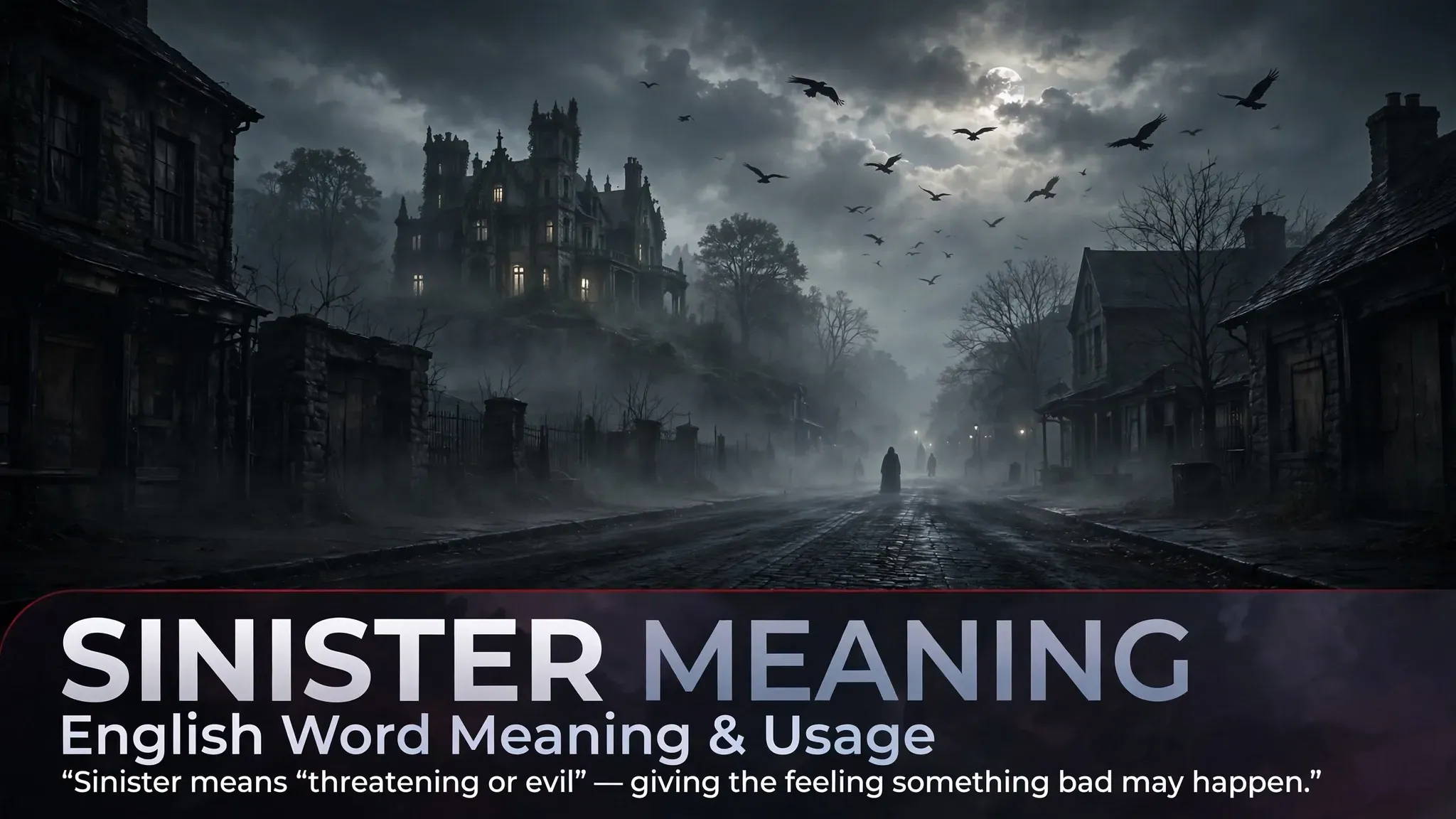
Or have you entered a quiet room that felt strange, threatening, or full of mystery? You might describe that feeling as sinister.
This powerful word helps us express the sense that something seems dangerous, evil, or connected to hidden harmful intentions.
The sinister meaning is usually something that appears threatening, evil, or likely to cause harm. People use the word to describe a suspicious person, an unsettling atmosphere, a mysterious smile, or a situation that suggests danger.
For example, a sinister laugh in a horror movie might make viewers expect something terrible to happen.
However, sinister does not always mean that something is definitely evil. Sometimes, it describes an impression or feeling rather than a proven fact.
A dark hallway may look sinister because of its lighting, while a person’s behavior may seem sinister because it appears secretive or threatening.
What Does Sinister Mean?
Sinister means suggesting evil, danger, harmful intentions, or something threatening and unpleasant.
The word is commonly used when a person, place, expression, sound, or situation creates a feeling of fear or suspicion.
For example:
- A sinister smile: A smile that appears threatening or suggests hidden harmful intentions.
- A sinister figure: A person who seems dangerous, mysterious, or threatening.
- A sinister atmosphere: An environment that feels dark, unsettling, or full of danger.
- A sinister plan: A plan that appears intended to cause harm or achieve something dishonest.
- A sinister warning: A message that suggests a threat or something unpleasant may happen.
In simple English, sinister means dark, threatening, or suggesting something evil.
The word often describes how something appears rather than proving that the person or situation is actually dangerous. Context matters when deciding whether the word is appropriate.
Sinister Meaning in Simple English
In simple English, sinister describes something that makes you suspect danger, evil, or harmful intentions.
Imagine that someone enters a room, smiles strangely, and quietly says, “You will regret this.” Their behavior might seem sinister because it suggests a possible threat.
Here are a few easy examples:
- “The house looked sinister at night.” The house appeared frightening or threatening.
- “He gave me a sinister look.” His expression seemed unfriendly or dangerous.
- “The movie had a sinister villain.” The villain appeared evil or threatening.
- “She uncovered a sinister plan.” She discovered a plan that seemed intended to cause harm.
Sinister is stronger than simply saying something is unusual or strange. It often suggests that there may be something harmful or evil behind what you see.
What Is the Short Definition of Sinister?
Sinister means suggesting evil, danger, or harmful intentions.
This short definition works well for vocabulary learning, reading comprehension, and everyday English.
Origin and History of the Word Sinister
The word sinister comes from the Latin word sinister, which originally meant “left” or “on the left side.”
Over time, the word developed negative associations in certain cultural and religious traditions. In some historical European beliefs, the left side was associated with bad luck or unfavorable signs, while the right side was often treated more positively.
These associations influenced the development of the word’s English meaning. By the time sinister became established in English, it could describe something unfavorable, threatening, or evil.
The historical association between left-handedness and bad luck also contributed to negative attitudes toward left-handed people in some societies. However, being left-handed has no inherent connection to evil, danger, or bad character.
Today, sinister is primarily used to describe threatening appearances, suspicious intentions, and dark or disturbing situations. Its original connection with the left side is mainly relevant when discussing its etymology or historical usage.
How Is Sinister Used in Modern English?
Sinister appears in several contexts, including everyday conversations, literature, movies, news reporting, and descriptions of suspicious behavior.
1. Describing a Person
When sinister describes a person, it suggests that the person appears threatening, evil, or likely to cause harm.
Examples:
- “The sinister stranger watched the house from across the street.”
- “The story’s sinister villain fooled everyone.”
- “His sinister expression made the others uncomfortable.”
These sentences communicate suspicion or danger. They do not necessarily prove that the person is guilty of wrongdoing.
2. Describing a Place
A location may seem sinister because of its appearance, atmosphere, or associations.
Examples:
- “The abandoned hospital looked sinister after sunset.”
- “They walked through a sinister forest filled with strange noises.”
- “The empty building had a sinister atmosphere.”
Writers often use sinister to create suspense and make readers expect something unsettling.
3. Describing a Plan or Intention
Sinister can describe an action or plan that seems dishonest, harmful, or deliberately threatening.
Examples:
- “The detective uncovered a sinister plot.”
- “They suspected that the organization had a sinister agenda.”
- “The message hinted at a sinister plan.”
In these cases, the word focuses on the possible purpose behind an action.
4. Describing an Expression or Sound
Facial expressions, laughter, voices, and other sounds can seem sinister when they suggest danger or hidden intentions.
Examples:
- “A sinister laugh echoed through the hallway.”
- “He spoke in a sinister whisper.”
- “She noticed a sinister grin on the character’s face.”
These descriptions are especially common in suspense stories and horror films.
Sinister Meaning in Movies, Books, and Horror Stories
In fiction, sinister is a useful word because it creates suspense without revealing everything immediately.
A writer may describe a character as sinister before explaining what the character intends to do. This encourages readers to wonder whether the character can be trusted.
For example, consider this sentence:
“The caretaker welcomed the visitors with a warm smile, but something about his sinister expression made them hesitate.”
The contrast between the welcome and the expression creates uncertainty. The visitors do not yet know what is wrong, but they sense that something may be dangerous.
Common Sinister Characters in Fiction
A sinister character may be:
- A mysterious stranger with unclear intentions.
- A villain who hides harmful plans behind a friendly appearance.
- A corrupt official who uses power dishonestly.
- A manipulative character who attempts to control others.
- A seemingly harmless character whose actions gradually reveal a threat.
Not every villain must be sinister. Some villains are openly aggressive, humorous, or sympathetic. Sinister is most useful when the character creates a sense of hidden danger or unsettling intent.
Why Does Sinister Create Suspense?
The word suggests a threat without explaining its full nature. Readers and viewers may ask themselves:
- What is the character hiding?
- Is the setting dangerous?
- Can the person be trusted?
- What might happen next?
This uncertainty makes sinister especially effective in mysteries, thrillers, gothic fiction, and horror stories.
Sinister Meaning in Everyday Conversations
People sometimes use sinister in everyday English to describe something that seems suspicious or threatening.
However, the word is relatively strong. It can sound dramatic if used to describe a minor inconvenience or an ordinary situation.
Consider these examples:
Conversation 1: A strange message
Person A: “Did you read the message he sent?”
Person B: “Yes. The wording sounded a little sinister.”
Meaning: The message seemed threatening or suggested harmful intentions.
Conversation 2: A horror movie
Person A: “What did you think of the villain?”
Person B: “He had a sinister smile that made every scene uncomfortable.”
Meaning: The villain’s smile seemed threatening and unsettling.
Conversation 3: A suspicious business proposal
Person A: “The offer sounds too good to be true.”
Person B: “I agree. There may be something sinister behind it.”
Meaning: The speaker suspects that the offer may hide harmful or dishonest intentions.
In everyday communication, sinister often expresses suspicion. It is best to use it when the situation genuinely feels threatening or disturbing.
Sinister Meaning in Text Messages and Social Media
Sinister is not generally used as a special internet slang term. It retains its standard English meaning across text messages and social media.
People may use it to describe a creepy video, a suspicious message, a frightening character, or an unsettling event.
Sinister Meaning in Text Messages
Examples include:
- “That message sounds sinister.”
- “Why did he send such a sinister-looking picture?”
- “The way she said that felt sinister.”
- “That was a sinister thing to suggest.”
In these messages, sinister suggests something threatening, suspicious, or potentially harmful.
Sinister on TikTok and Instagram
On TikTok and Instagram, people may use the word in captions, comments, or videos involving horror, mysteries, villains, disturbing images, and unsettling stories.
For example:
- “This character has such a sinister smile.”
- “The ending took a sinister turn.”
- “That background music sounds sinister.”
These are ordinary uses of the word, not separate platform-specific definitions.
Sinister on Snapchat, Discord, and Reddit
The key point is that the meaning generally stays the same across platforms: sinister suggests danger, evil, or harmful intentions.
Sinister vs. Creepy vs. Menacing vs. Evil
These words overlap, but they are not interchangeable in every situation.
| Word | Meaning | Main Emphasis | Example |
| Sinister | Suggesting evil or harmful intentions | Hidden danger or an evil impression | A sinister plan |
| Creepy | Causing discomfort, fear, or unease | An unsettling feeling | A creepy noise |
| Menacing | Appearing to threaten harm | An obvious or direct threat | A menacing gesture |
| Evil | Morally wrong or deeply harmful | Bad intentions or actions | An evil act |
| Ominous | Suggesting that something bad may happen | A warning or sign of future trouble | Ominous clouds |
| Suspicious | Causing doubt or distrust | Something that seems questionable | A suspicious transaction |
| Eerie | Strange, mysterious, and unsettling | An unusual atmosphere | An eerie silence |
| Malevolent | Intending to cause harm or suffering | A deliberate wish to harm | A malevolent character |
Sinister vs. Creepy
Creepy usually describes something that causes discomfort, unease, or fear. Sinister more strongly suggests evil or harmful intentions.
For example, an empty house may look creepy, while a character secretly planning to harm someone may seem sinister.
Something can be both creepy and sinister, but the words emphasize different aspects.
Sinister vs. Menacing
Menacing suggests an apparent threat. Sinister often suggests something evil or harmful that may be hidden beneath the surface.
A person who raises a fist aggressively may look menacing. A person who quietly arranges a harmful plan may seem sinister.
Sinister vs. Evil
Evil is a stronger moral judgment. It directly describes something as deeply wrong or harmful.
Sinister often describes an impression or appearance that suggests evil, even when the truth is not yet known.
For example, a character may appear sinister early in a story, but the reader may later discover that the character had innocent intentions.
Sinister vs. Ominous
Ominous describes something that suggests trouble or danger may be approaching. Sinister focuses more on an evil, threatening, or harmful quality.
Dark clouds gathering before a storm might look ominous. A threatening message from a mysterious stranger might sound sinister.
Synonyms and Antonyms of Sinister
Learning related words helps you express different levels of fear, suspicion, and danger.
Common Synonyms
- Menacing: Appearing to threaten harm.
- Threatening: Suggesting that someone or something may cause harm.
- Evil: Morally bad or deeply harmful.
- Malevolent: Intending to cause harm.
- Ominous: Suggesting that something bad may happen.
- Dark: Potentially frightening, disturbing, or morally troubling.
- Foreboding: Creating a feeling that something unpleasant is approaching.
- Unsettling: Causing discomfort or unease.
- Suspicious: Appearing questionable or untrustworthy.
- Eerie: Strange and frightening in an unusual way.
Choose the synonym that best matches your intended meaning. For instance, unsettling is useful when something causes discomfort without necessarily suggesting evil.
Common Antonyms
Antonyms are words with opposite or contrasting meanings.
- Benevolent: Kind and wishing others well.
- Friendly: Showing warmth or goodwill.
- Harmless: Not likely to cause harm.
- Innocent: Not guilty of wrongdoing or not intended to cause harm.
- Reassuring: Making someone feel less worried.
- Pleasant: Giving enjoyment or comfort.
- Trustworthy: Deserving confidence or trust.
- Good-natured: Kind, friendly, and pleasant.
For example, a sinister expression may seem threatening, while a reassuring expression makes someone feel safe.
Common Examples of Sinister in Sentences
Here are additional examples to help you understand how the word works.
- “The detective discovered a sinister connection between the two incidents.” The connection appeared to involve something harmful or suspicious.
- “A sinister shadow moved across the wall.” The shadow created a frightening impression.
- “The stranger gave the shopkeeper a sinister look.” The expression seemed threatening.
- “The novel begins with a sinister warning.” The warning suggests possible danger.
- “The abandoned mansion had a sinister reputation.” People associated the mansion with frightening or troubling events.
- “The villain revealed his sinister intentions.” The villain disclosed a harmful plan.
- “The music became more sinister as the scene progressed.” The music began to suggest danger.
- “Investigators examined the suspicious circumstances before drawing conclusions about a possible sinister motive.” They looked for evidence before deciding what happened.
- “The cheerful advertisement concealed a sinister message in the film’s fictional storyline.” The message suggested a hidden threat.
- “Her sinister whisper made the room fall silent.” Her voice created a sense of danger or unease.
These examples show that sinister can describe people, actions, expressions, sounds, places, and situations.
Is Sinister Always a Negative Word?
Sinister almost always has a negative connotation in modern English because it suggests danger, evil, or harmful intentions.
However, using the word does not always mean that the speaker has confirmed wrongdoing.
For example, saying “the building looked sinister” describes its appearance. It does not prove that anything dangerous happened there.
Similarly, calling a fictional character sinister may be a compliment to the writer’s ability to create suspense. The word remains negative in meaning, but its use can praise an effective horror or thriller story.
It is also possible to use sinister humorously or dramatically. Someone might call a friend’s mischievous grin sinister even when no real threat exists. In that situation, the context makes the exaggeration clear.
Common Misconceptions About Sinister
Misconception 1: Sinister Always Means Evil
Not necessarily. Sinister often means that something appears evil or suggests harmful intentions. The appearance may be misleading, so context and evidence matter.
Misconception 2: Sinister and Creepy Are Identical
Both words can describe unsettling things, but sinister more strongly suggests evil or hidden harmful intentions. Creepy focuses more on discomfort and unease.
Misconception 3: Sinister Is Only Used in Horror Movies
The word is common in horror, but it also appears in news reports, novels, everyday conversations, and descriptions of suspicious behavior.
Misconception 4: Sinister Is Internet Slang
Sinister is a standard English adjective. People use it online, but it does not generally have a separate meaning specific to social media.
Misconception 5: Sinister Proves That Someone Is Dangerous
The word describes an impression, appearance, or suspected intention. Calling someone sinister does not establish that the person has committed wrongdoing.
How to Use Sinister Correctly
To use sinister effectively, think about whether you want to describe an appearance, an atmosphere, a suspected motive, or a confirmed harmful action.
Use Sinister When You Mean:
- Something seems evil or threatening.
- A person appears to have harmful intentions.
- A plan seems dishonest or dangerous.
- A setting creates a feeling of hidden danger.
- A sound or expression makes a scene unsettling.
Avoid Using It When:
- You only mean something is unfamiliar.
- You want to describe a harmless surprise.
- There is no threatening or disturbing quality.
- A simpler word, such as strange or unusual, better communicates your meaning.
For example, “The room had a sinister atmosphere” is appropriate for a frightening setting. “The room had a sinister shape” may be confusing unless the shape somehow suggests danger or evil.
A useful writing tip is to pair sinister with a specific noun, such as plan, smile, motive, figure, plot, or atmosphere. This makes the meaning clearer.
Key Facts About Sinister Meaning
| Fact | Explanation |
| Primary meaning | Suggesting evil, danger, or harmful intentions |
| Part of speech | Adjective |
| Word origin | Latin sinister, meaning “left” or “on the left side” |
| Common contexts | Everyday English, fiction, suspense, horror, and descriptions of suspicious behavior |
| Tone | Usually negative, threatening, or unsettling |
| Common phrases | Sinister smile, sinister plan, sinister plot, sinister figure |
| Similar words | Menacing, creepy, ominous, malevolent, threatening |
| Opposite ideas | Benevolent, harmless, friendly, reassuring |
| Is it slang? | No, it is a standard English word |
| Main usage tip | Use it when something suggests hidden danger, evil, or harmful intentions |
Frequently Asked Questions About Sinister Meaning
1. What does sinister mean in one sentence?
Sinister means suggesting evil, danger, or harmful intentions. It is often used to describe a threatening person, suspicious plan, unsettling expression, or frightening atmosphere.
2. What is the best synonym for sinister?
The best synonym depends on context. Menacing works when something appears threatening, malevolent describes an intention to cause harm, and ominous suggests that something bad may happen.
3. Does sinister mean evil?
Sinister often suggests evil, but it does not always prove that something is actually evil. It may describe an appearance, impression, or suspicion rather than a confirmed fact.
4. What does a sinister smile mean?
A sinister smile is a smile that appears threatening, dishonest, or connected to hidden harmful intentions. In fiction, it often signals that a character may have a secret plan.
5. What does sinister mean in a text message?
In a text message, sinister usually means that something sounds threatening, suspicious, or unsettling. For example, “That message seems sinister” means the message gives the reader an impression of possible danger or harmful intent.
6. What is the opposite of sinister?
Possible opposites include benevolent, friendly, harmless, reassuring, and good-natured. The best choice depends on whether you are describing a person’s intentions, an expression, or an atmosphere.
7. Is sinister a strong word?
Yes. Sinister is generally stronger than strange or unusual because it suggests danger, evil, or harmful intentions. It is especially effective in suspenseful or serious contexts.
8. What does sinister mean in literature?
In literature, sinister describes a person, setting, event, or detail that suggests hidden danger or evil. Authors often use it to create suspense and make readers question whether a character or situation can be trusted.
9. Where did the word sinister come from?
Sinister comes from the Latin word sinister, which originally meant “left” or “on the left side.” Historical cultural associations contributed to its later negative meanings in English.
10. Can sinister be used humorously?
Yes. Someone might jokingly describe a friend’s mischievous grin or a harmless prank as sinister. The word still suggests something threatening, but the surrounding context makes the exaggeration playful rather than serious.
Conclusion
The sinister meaning is connected to evil, danger, suspicion, and harmful intentions. It is commonly used to describe a threatening person, an unsettling atmosphere, a suspicious plan, or an expression that seems to hide something unpleasant.
Although sinister often appears in horror stories and thrillers, it is also useful in everyday English, literature, social media, and discussions of suspicious situations.
Its meaning is stronger than simply strange or creepy because it suggests a possible connection to evil or harm.
Remember that sinister describes how something appears or what it seems to suggest. It does not automatically prove that a person is dangerous or that a situation involves wrongdoing.
Choosing the word carefully helps you communicate suspicion without confusing an impression with a fact.
By understanding its definition, origin, synonyms, and examples, you can use sinister more accurately and recognize its meaning whenever it appears in conversation or writing.

I am Alex Carter, is a web resources and digital tools writer at Linkvistahub. He enjoys discovering useful websites, online tools, productivity resources, and practical digital solutions that can make everyday tasks easier.