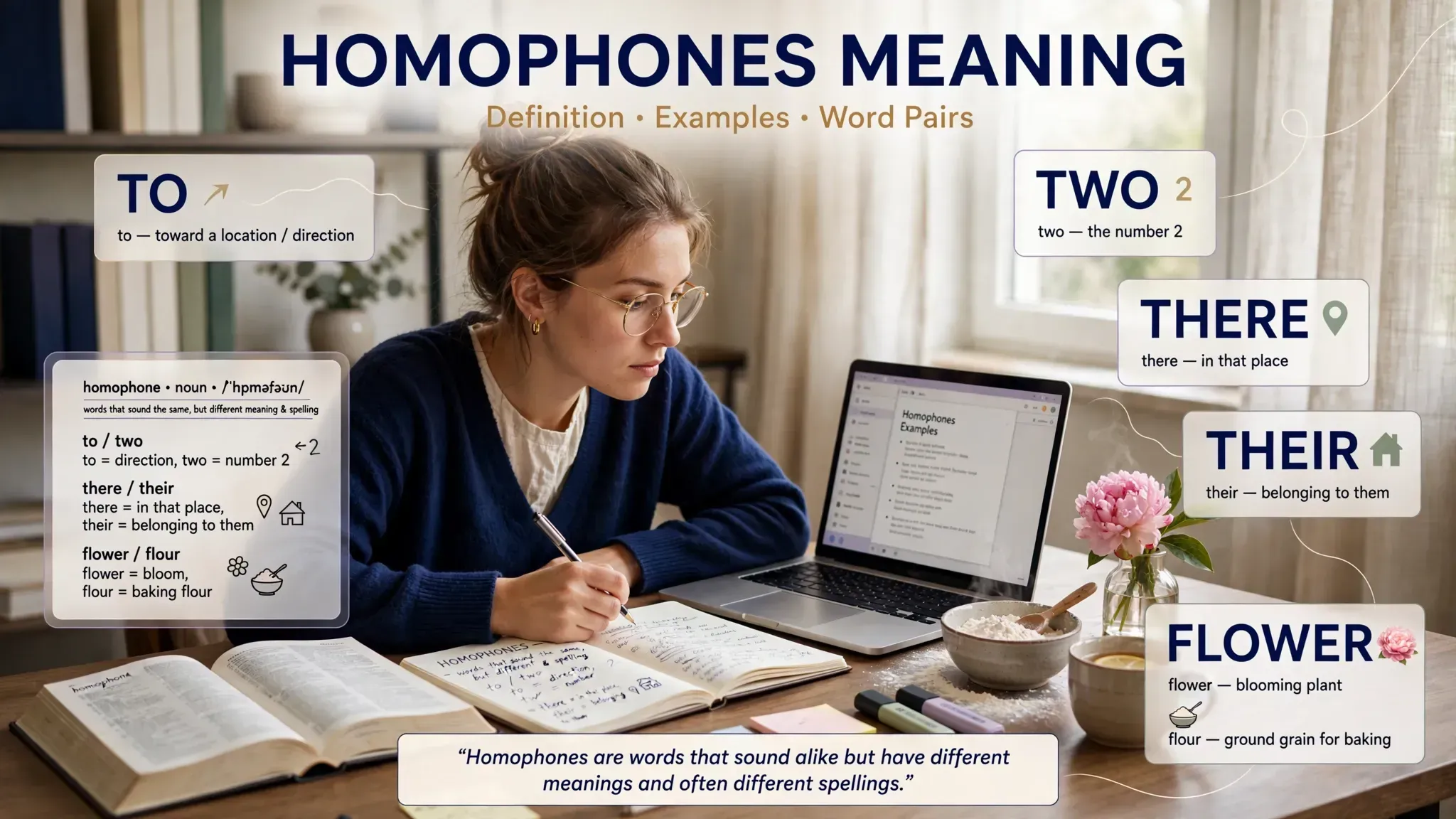
Homophones meaning: Homophones are words that sound the same when spoken but have different meanings.
They often have different spellings, although some homophones are spelled the same way. For example, there, their, and they sound alike but have different meanings and uses.
Have you ever confused right with write or sea with sea? These are common examples of homophones in the English language.
Although they sound identical, their meanings depend on how they are spelled and used in a sentence.
Understanding homophones, homophone examples, and commonly confused English words can improve your spelling, reading comprehension, writing, and everyday communication.
They are especially important for students learning English, writers who want to avoid spelling mistakes, and anyone preparing for an English test.
Homophones can make English interesting, but they can also create confusion. A sentence may sound perfectly clear when spoken, yet become confusing when written incorrectly.
Learning how these words work helps you recognize their differences and choose the correct word for each situation.
What Does Homophones Mean?
Homophones are words that have the same pronunciation but different meanings. They are usually spelled differently and may belong to different grammatical categories.
The word homophone comes from two Greek elements:
- Homo- means the same.
- -Phone means sound or voice.
Together, these elements describe words that share the same sound.
Consider these examples:
- Sun and son: Sun is the star that gives Earth light, while son means a male child.
- Flower and flour: A flower is the reproductive structure of a plant, while flour is a powder used in baking.
- Pair and pear: A pair means two matching or associated things, while a pear is a type of fruit.
- Hear and here: Hear means to perceive sound, while here refers to a location.
- Brake and break: A brake slows or stops a vehicle, while break means to separate, damage, or interrupt something.
Each pair sounds alike in common pronunciation, but the words have different meanings.
Homophones are especially important in written English because readers cannot always rely on sound to determine which word the writer intended. The surrounding sentence provides the necessary clues.
Why Are Homophones Important in English?
Homophones are more than a vocabulary topic. They affect how people read, write, communicate, and understand language.
1. They Improve Spelling
Learning homophones helps you distinguish words that sound identical but require different spellings.
For example:
- Incorrect: “I can hear you.”
- Correct: “I can hear you.”
The correct spelling depends on the intended meaning.
2. They Make Writing Clearer
Choosing the wrong homophone can change the meaning of a sentence.
Compare:
- “Their house is beautiful.”
- “There is a house nearby.”
Both sentences contain a similar-sounding word, but each word performs a different job.
3. They Help English Learners
English learners often find homophones challenging because pronunciation alone does not reveal spelling or meaning.
Studying homophone pairs builds vocabulary and helps learners understand how words function in different contexts.
4. They Create Wordplay and Humor
Homophones are frequently used in jokes, riddles, advertising, poetry, and creative writing.
For example:
“Why did the baker stop making donuts? He was tired of the whole business.”
The joke plays on whole and whole, which sound alike but have different meanings.
Types of Homophones
Homophones can be understood through several categories. The most useful distinction is between words that sound alike but are spelled differently and words that sound alike and share the same spelling.
1. Homophones With Different Spellings
These are the most familiar type of homophone.
Examples:
| Homophone | Meaning of the First Word | Meaning of the Second Word |
| To / Too | Indicates direction or an infinitive marker | Also or excessively |
| See / Sea | Perceive with the eyes | Large body of salt water |
| Write / Right | Form words using letters | Correct, or a direction |
| Buy / By | Purchase something | Near, or through the action of |
| One / Won | The number 1 | Past tense of win |
| Knight / Night | A historical warrior or titleholder | The period of darkness |
| Mail / Male | Letters and packages | A sex category or related adjective |
| Weak / Week | Lacking strength | Seven days |
| Meat / Meet | Animal flesh used as food | Come together |
| Allowed / Aloud | Permitted | Spoken audibly |
These examples show why spelling and context matter.
2. Homophones With the Same Spelling
Some words have the same spelling and pronunciation but different meanings. These are often discussed as homonyms or, more precisely in many cases, homographs that are also homophones.
For example:
- Bat: A flying mammal or a piece of sports equipment.
- Bark: The outer covering of a tree or the sound a dog makes.
- Match: A small stick used to create a flame or a contest between competitors.
These words sound alike and share the same spelling, but their meanings differ.
Terminology can vary slightly between linguistic references. In everyday English lessons, these are commonly taught as examples of words with multiple meanings, while homophones often refer specifically to words such as sea and sea.
3. Homophones With More Than Two Words
Some sounds correspond to three or more words.
The classic example is:
- There: Refers to a place or introduces an expression.
- Their: Shows possession.
- They’re: A contraction of they are.
Other examples include:
- To, too, and two
- By, buy, and bye
- Bare, bear, and occasionally other words with the same pronunciation in particular accents
These groups are especially useful to memorize because they appear frequently in everyday writing.
50 Common Homophones With Meanings and Examples
The following examples cover some of the most useful homophones in American English. Pronunciation may vary slightly by region or accent.
| Homophones | Meanings | Example Sentence |
| Ate / Eight | Consumed food / Number 8 | I ate eight grapes. |
| Be / Bee | Exist / Flying insect | A bee can be noisy. |
| Blue / Blew | A color / Past tense of blow | The wind blew my blue hat away. |
| Brake / Break | Stop a vehicle / Damage or interrupt | Apply the brake before you break the rules. |
| Buy / By | Purchase / Near or through | I will buy it by Friday. |
| Cell / Sell | Small compartment / Exchange for money | They sell cell phones. |
| Dear / Deer | Beloved / Hoofed animal | My dear friend saw a deer. |
| Die / Dye | Stop living / Change a color | The dye stained the cloth. |
| Fair / Fare | Just or an event / Travel charge | The bus fare was fair. |
| Flour / Flower | Baking powder / Plant bloom | The flower sat beside the flour. |
| For / Four | Intended for / Number 4 | This gift is for four children. |
| Hair / Hare | Strands growing on the body / Rabbit-like animal | A hare brushed against her hair. |
| Hear / Here | Perceive sound / In this place | Come here so I can hear you. |
| Hole / Whole | An opening / Complete | The whole ball fell into the hole. |
| Hour / Our | Sixty minutes / Belonging to us | Our meeting lasted an hour. |
| Knight / Night | Warrior / Darkness | The knight rode at night. |
| Know / No | Understand / Negative response | I know the answer is no. |
| Mail / Male | Letters and packages / Male sex or gender category | The male employee collected the mail. |
| Meat / Meet | Food / Come together | We will meet before buying meat. |
| Morning / Mourning | Early part of the day / Grieving | The morning ceremony included mourning rituals. |
| One / Won | Number 1 / Achieved victory | She won one prize. |
| Pair / Pear | Two items / Fruit | I bought a pair of pears. |
| Peace / Piece | Calm or absence of conflict / A portion | I want peace and a piece of cake. |
| Plain / Plane | Simple or flat land / Aircraft | The plane flew over the plain. |
| Principal / Principle | School leader or main / Rule or belief | The principal explained the principle. |
| Read / Red | Interpret writing / A color | I read about the red car. |
| Right / Write | Correct or direction / Form words | Write the right answer. |
| Road / Rode | Route / Past tense of ride | We rode along the road. |
| Role / Roll | Function or part / Turn over or a bread roll | He played a role in making the roll. |
| Sail / Sale | Travel by boat / Selling event | The boat’s sail was on sale. |
| See / Sea | Look with the eyes / Ocean | We could see the sea. |
| Son / Sun | Male child / Star at the center of our solar system | Her son watched the sun rise. |
| Stare / Stair | Look fixedly / Step in a staircase | Don’t stare while climbing the stairs. |
| Steal / Steel | Take unlawfully / Strong metal alloy | It is wrong to steal steel. |
| Tail / Tale | Animal’s rear appendage / Story | The tale described a fox’s tail. |
| Their / There | Belonging to them / A place | Their bags are over there. |
| Threw / Through | Past tense of throw / From one side to another | He threw the ball through the hoop. |
| To / Too / Two | Direction or infinitive marker / Also or excessively / Number 2 | I want two tickets, too. |
| Waist / Waste | Middle of the body / Use carelessly or discarded material | Don’t waste food around your waist measurement. |
| Wait / Weight | Stay until later / How heavy something is | Wait while I check the weight. |
| Way / Weigh | Method or route / Measure heaviness | Weigh the package before choosing the way to ship it. |
| Weak / Week | Lacking strength / Seven days | I felt weak for a week. |
| Wear / Where | Have clothing on / In what place | Where will you wear the jacket? |
| Weather / if | Atmospheric conditions / If or which of two alternatives | I don’t know if the weather will improve. |
| Which / Witch | Asking about a choice / A person associated with magic | Which witch appears in the story? |
| Wood / Would | Material from trees / Conditional or past form of will | Would you carry the wood? |
| Your / You’re | Belonging to you / You are | You’re holding your bag. |
| Yoke / Yolk | Harness joining animals or parts / Yellow center of an egg | The yolk broke under the yoke-shaped tool. |
| Cereal / Serial | Breakfast grain food / Arranged in a series | The cereal was part of a serial advertisement. |
| Idle / Idol | Inactive / Someone admired | The idle fan waited for the idol. |
| Lessen / Lesson | Reduce / An instructional session | The lesson helped lessen my confusion. |
Learning tip: Some sentences in a homophone table are designed to illustrate both words, rather than model the most natural everyday phrasing. For the best results, study each word’s definition and then create your own sentence.
Homophones vs. Homonyms vs. Homographs
These three terms are related, but they do not mean exactly the same thing.
What Is a Homophone?
A homophone is a word that sounds the same as another word but has a different meaning.
Examples: sea/see, right/write, and pair/pear.
What Is a Homonym?
The word homonym is used in different ways in linguistic teaching. It commonly refers to words that share a spelling and pronunciation but have different meanings.
Examples include bats (animal or sports equipment) and bark (tree covering or a dog’s sound).
Some educational resources also use homonyms more broadly for words that share either spelling or sound, so check how a particular textbook defines the term.
What Is a Homograph?
Homographs are words spelled the same way but with different meanings. Their pronunciations may be the same or different.
Examples:
- Lead /leed/: to guide.
- Lead /led/: a metallic element.
These words have the same spelling but different pronunciations and meanings.
Another example is tear:
- Tear /teer/: a drop of liquid from the eye.
- Tear /tair/: to rip something.
Comparison Table
| Feature | Homophones | Homographs | Homonyms |
| Same sound | Yes | Not always | Usually, under the narrower definition |
| Same spelling | Not required | Yes | Yes, under the narrower definition |
| Different meanings | Yes | Yes | Yes |
| Example | See / sea | Lead / lead | Bat / bat |
The easiest way to remember the terms is to focus on their word roots: phone relates to sound, graph relates to writing, and onym relates to a name or word.
Why Do Homophones Exist in English?
Homophones developed through the history of the English language. Changes in pronunciation, spelling, and vocabulary have all contributed to their existence.
Historical Sound Changes
Over time, English pronunciation changed. Words that were once pronounced differently sometimes came to sound alike.
The spelling of many words remained relatively stable even as their spoken forms evolved.
This helped create pairs such as knight and night, which share a pronunciation in modern standard English despite their different spellings and histories.
Borrowed Words
English has borrowed words from many languages, including French, Latin, and Germanic languages.
These words entered English with different histories and spellings. As pronunciation evolved, some eventually came to sound alike.
Spelling Conventions
English spelling does not always map neatly to pronunciation. The same sound can be represented by different letter combinations.
For example, the long a sound appears in words such as eight, weight, and great, but the spelling patterns differ.
This makes English homophones a natural result of the language’s development.
Homophones in Everyday Communication
Homophones are used constantly, even when speakers do not consciously think about them.
In Conversations
Spoken English relies on context to distinguish homophones.
If someone says, “I need to buy a pair of shoes,” the listener uses the meaning of the sentence to understand buy and pair.
In Text Messages
Homophones can cause misunderstandings when people type quickly.
Example:
- “You’re going to love this.”
- “You’re going to love this.”
The first is a common spelling error. The second is correct because you’re means you are.
In Emails and Workplace Writing
Homophone mistakes can affect the clarity and professionalism of business communication.
Compare:
- “Please review the report before the meeting.”
- “Please review the report before the meeting’s principal.”
The second sentence would need a very different context and illustrates how word choice affects meaning.
Common workplace errors include their/there/they’re, to/too, and principal/principle.
In School Assignments
Students often learn homophones through spelling exercises, reading activities, and sentence-writing tasks.
Understanding them can improve performance in grammar tests and help students develop stronger editing skills.
Homophones in Literature, Poetry, and Wordplay
Writers use homophones to create humor, double meanings, rhythm, and memorable phrases.
Puns
A pun uses words with similar or identical sounds to create a humorous or clever effect.
For example:
“I used to be a banker, but I lost interest.”
The joke relies on interest meaning both curiosity and money earned or charged in financial contexts.
This is an example of wordplay involving multiple meanings, rather than a strict homophone pair.
Poetry
Homophones can support rhyme and rhythm in poems. Writers may use sound similarities to connect ideas even when the words have different spellings.
Advertising
Brands sometimes use homophones to make slogans catchy or memorable. A clever phrase can communicate two ideas at once.
However, effective wordplay depends on the audience recognizing the intended meanings.
Common Homophone Mistakes and How to Avoid Them
Even fluent English speakers sometimes confuse homophones. The following strategies can help.
Mistake 1: Confusing Their, There, and They’re
- They indicate possession: “Their car is new.”
- It refers to a place: “The car is over there.”
- They mean “they are”: “They’re buying a car.”
A useful check is to replace they’re with they are. If the sentence still makes sense, the contraction is probably correct.
Mistake 2: Confusing Your and You’re
- Your: “Your jacket is blue.”
- You’re: “You’re wearing a blue jacket.”
Replace you with you to check if it fits.
Mistake 3: Confusing To, Too, and Two
- To: “I went to school.”
- Too: “I want to go too.”
- Two: “I have two books.”
Memorizing a short example for each word makes the distinction easier.
Mistake 4: Confusing Weather and if
- Weather concerns atmospheric conditions.
- if introduces alternatives or uncertainty.
Example: “I don’t know if the weather will improve.”
The sentence includes both words, making their different meanings easy to see.
Mistake 5: Relying Only on Spell-Check
Spell-check tools may not catch homophone errors because the incorrect word can still be a valid English word.
For example, a grammar checker might miss “I can see the mountains” if the tool fails to recognize the context.
Always reread your sentence and ask if the word’s meaning fits.
How to Learn Homophones Effectively
If you want to remember homophones, practice them in context rather than memorizing isolated lists.
1. Learn Words in Pairs
Start with common examples:
- See / sea
- Right / write
- Buy / by
- Hear / here
- Peace / piece
Write a short definition beside each word.
2. Create Example Sentences
Write one sentence for each meaning.
For example:
- “I can see the mountains.”
- “The sea looks calm.”
Creating your own sentences helps connect spelling with meaning.
3. Use Flashcards
Place one homophone on the front of a card and its meaning and example on the back.
Review the cards regularly, focusing on words you confuse most often.
4. Read Your Writing Aloud
Reading aloud can help you notice awkward sentences, but remember that homophones sound alike. You must still check if the spelling matches the intended meaning.
5. Practice Editing
Take a paragraph containing common homophones and identify which words need correction.
This teaches you to use context instead of relying solely on memory.
Homophones Practice Quiz
Test your understanding with these five questions.
1. I can ___ the birds outside.
- A. Here
- B. Hear
2. ___ going to the library.
- A. Their
- B. They’re
3. She bought a ___ of shoes.
- A. Pair
- B. Pear
4. Please ___ your name at the top.
- A. Write
- B. Right
5. The ___ is shining brightly.
- A. Son
- B. Sun
Answers: 1. Hear; 2. They’re; 3. Pair; 4. Write; 5. Sun.
If you answered all five correctly, you understand several of the most common homophone pairs.
Homophones Meaning: Key Facts at a Glance
| Key Fact | Explanation |
| Definition | Words that sound alike but have different meanings |
| Word origin | Greek elements meaning “same” and “sound” |
| Common examples | See/sea, right/write, sun/son |
| Main purpose in learning | Improve spelling, vocabulary, reading, and writing |
| Common challenge | Choosing the correct spelling from context |
| Related terms | Homonyms, homographs, heteronyms |
| Common uses | Education, conversation, writing, poetry, jokes |
| Tone | Neutral linguistic term |
| Best learning method | Practice definitions in example sentences |
Frequently Asked Questions About Homophones
1. What is the simple meaning of homophones?
Homophones are words that sound the same but have different meanings. They are usually spelled differently. For example, sun refers to the star that lights Earth, while son means a male child.
2. What are 10 examples of homophones?
Ten common examples are sea/see, sun/son, right/write, pair/pear, hear/here, buy/by, flower/flour, break/break, knight/night, and weak/weak. Each pair has the same pronunciation in common American English but different meanings.
3. What is the difference between homophones and homonyms?
Homophones share the same pronunciation but have different meanings. Under the narrower definition, homonyms share the same spelling and pronunciation but have different meanings. For example, sea and sea are homophones, while bat can mean either a flying mammal or sports equipment.
4. What are homophones for kids?
Homophones for kids are words that sound alike but mean different things. Easy examples include cat and kat only as a spelling exercise, but the standard English examples are sun/son, see/sea, two/too, and bee/be. Using pictures and short sentences makes learning easier.
5. Can homophones have the same spelling?
Yes. Some words sound the same and share the same spelling but have different meanings. For example, bark can refer to the outer covering of a tree or the sound a dog makes. These are often categorized as homonyms in educational contexts.
6. Why are homophones difficult to learn?
Homophones can be difficult because pronunciation alone does not tell you which spelling to use. English spelling also reflects historical changes and words borrowed from other languages. Learning definitions and practicing complete sentences helps solve this problem.
7. What is the difference between homophones and homographs?
Homophones sound the same but can have different spellings. Homographs have the same spelling but can have different meanings and sometimes different pronunciations. For example, sea/sea are homophones, while lead meaning “guide” and lead meaning the metal are homographs with different pronunciations.
8. Are homophones used in everyday English?
Yes. Homophones appear in everyday speech, text messages, emails, books, advertisements, and conversations. People use them naturally, often without realizing it. Correct spelling becomes especially important when writing because the reader cannot always determine the intended word from sound alone.
9. How can I identify a homophone in a sentence?
Look for words that sound alike but have different meanings or spellings. Then use the surrounding sentence to determine which word fits. For example, in “I can see the sea,” see describes vision, while sea identifies a body of water.
10. What is the easiest way to remember homophones?
Learn them in pairs or groups, write example sentences, and use each word in a meaningful context. Flashcards, short quizzes, and proofreading exercises can also help. Regular practice is more effective than memorizing a long list without understanding the meanings.
Conclusion
Understanding homophones’ meaning is an important step toward stronger English vocabulary, spelling, and communication. Homophones are words that share the same pronunciation but have different meanings, such as see and sea, right and write, and sun and son.
Although these words sound alike, their spellings and meanings determine how they should be used. Learning the differences helps prevent writing mistakes, improves reading comprehension, and makes everyday communication clearer.
The best way to master homophones is to study common pairs, learn their definitions, and practice using them in complete sentences. Pay attention to context, proofread your writing, and remember that spell-check alone may not catch every mistake.
If you are a student, an English learner, a writer, or simply someone who wants to improve their language skills, learning homophones can make a real difference.
With consistent practice, you can recognize these words more easily and use them confidently in both spoken and written English.

I am Sophia Bennett, is a digital resources and online tools writer at LinkVistaHub. She enjoys exploring useful websites, emerging digital tools, productivity platforms, and practical online resources that help people work smarter and discover valuable information.