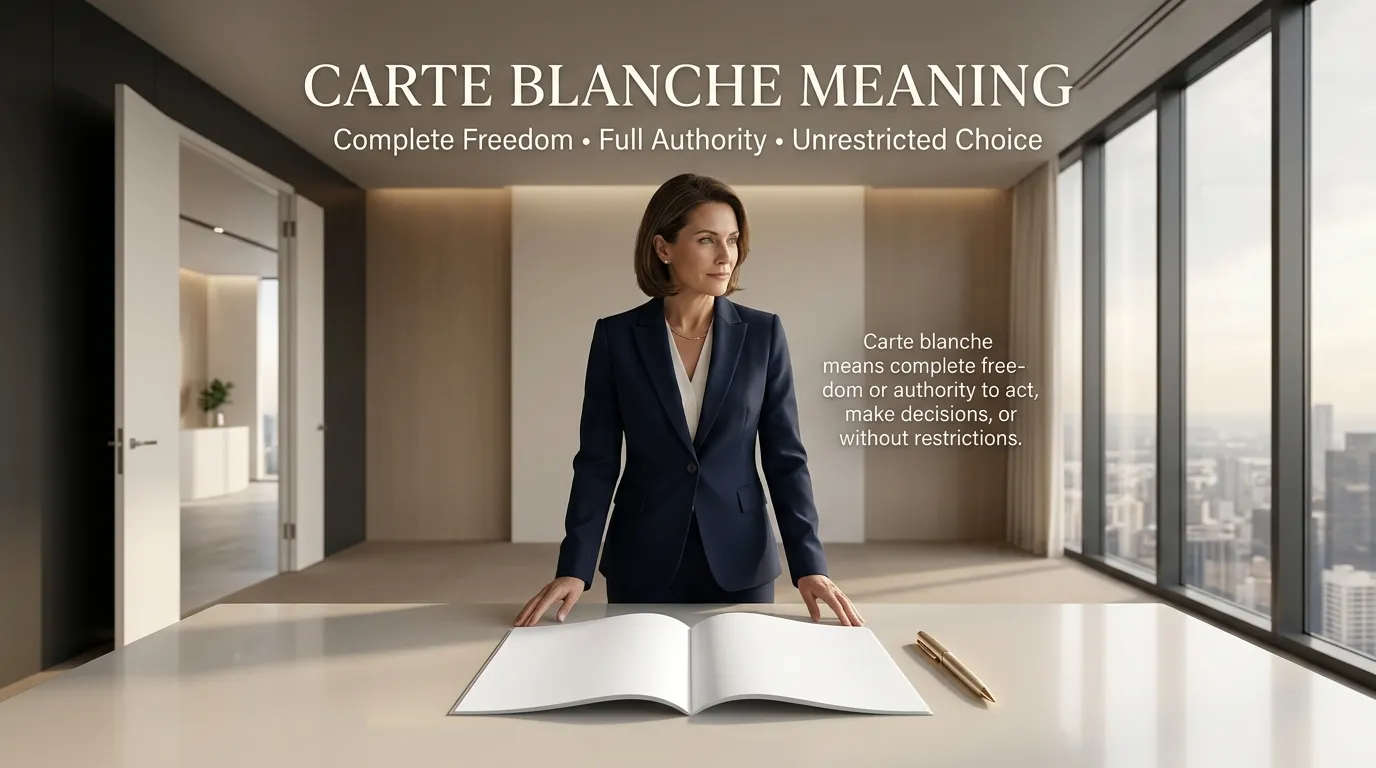
Carte blanche means complete freedom, full authority, or unlimited permission to make decisions without having to ask for further approval.
The phrase comes from French and literally translates to “blank card” or “blank paper.” In English, it is commonly used when someone is given the power to decide what happens next, often without restrictions.
Imagine your boss tells you, “You have carte blanche to redesign the entire website.” They are not simply asking for your opinion.
They are giving you full freedom to choose the design, layout, features, and direction. That is the core idea behind the expression.
The phrase appears in business, politics, entertainment, relationships, literature, and everyday conversation. You may also see it in phrases such as “give someone carte blanche,” “have carte blanche,” or “with carte blanche.”
Understanding the carte blanche meaning can help you recognize if a speaker is describing genuine freedom, broad authority, or permission that comes with very few limits.
Carte Blanche Meaning at a Glance
| Key Fact | Explanation |
| Meaning | Complete freedom or unrestricted authority |
| Literal meaning | “Blank card” or “blank paper” in French |
| Language of origin | French |
| English use | Figurative expression |
| Part of speech | Noun phrase |
| Tone | Formal, sophisticated, or conversational |
| Common phrase | “Give someone carte blanche” |
| Main idea | Freedom to act or decide without specific restrictions |
| Common synonyms | Full authority, complete freedom, free rein, unlimited discretion |
| Opposite idea | Restricted authority, limited permission, strict instructions |
What Does Carte Blanche Mean?
The simplest carte blanche definition is:
Carte blanche means complete freedom or authority to act, decide, or proceed without restrictions.
When someone gives you carte blanche, they are essentially saying, “You have complete freedom to decide.”
For example:
- “The director gave the designer carte blanche.”
- “She was given carte blanche to organize the event.”
- “The new manager has carte blanche to change the department.”
- “He gave his lawyer carte blanche to negotiate the deal.”
In each example, the person has considerable freedom over what happens next.
However, carte blanche does not necessarily mean that literally anything is allowed. The phrase usually means that someone has broad or unrestricted discretion within a particular situation.
For example, if your manager gives you carte blanche to redesign a webpage, that does not automatically mean you can spend millions of dollars or break company policies. The expression describes the scope of freedom granted in context.
What Is the Literal Meaning of Carte Blanche?
The literal French meaning of carte blanche is “blank card” or “blank paper.”
The idea is easy to understand.
A blank document contains nothing written on it. Whoever receives it can potentially write whatever they want.
This concept developed into a metaphor for unrestricted authority. Instead of receiving a document containing detailed instructions, a person effectively receives a blank page and is trusted to determine what should happen.
That metaphor is why the expression works so well in English.
Carte Blanche in Simple English
If you want to explain carte blanche in everyday language, you could say:
- Complete freedom
- Full permission
- Full authority
- Free rein
- No specific restrictions
- The freedom to make your own decisions
For example:
“My boss gave me carte blanche.”
Simply means:
“My boss gave me complete freedom to decide what to do.”
Where Does Carte Blanche Come From?
Carte blanche is a French expression.
The individual words are:
- Carte = card, paper, or document
- Blanche = white or blank
Together, the phrase literally means “blank card” or “blank document.”
Historically, the expression was associated with giving someone a blank document that could be completed or used according to the recipient’s authority.
Over time, the literal concept developed a broader figurative meaning: giving someone complete discretion to determine the outcome of a situation.
English adopted the expression as a loan phrase from French. Unlike many translated expressions, English speakers generally continue to use the French wording rather than translating it into “blank card.”
How Did Carte Blanche Become an English Expression?
The expression reflects an old idea of delegated authority.
Imagine a powerful person giving an official a blank document and trusting that person to fill it in according to their judgment. The blank document represents freedom from detailed instructions.
The expression gradually moved beyond literal documents and became a metaphor.
Today, when someone says:
“She was given carte blanche,”
they usually do not mean that she literally received a blank piece of paper.
They mean:
She was trusted with broad authority to decide what should happen.
This transition from a literal object to a figurative concept is common in language. Many idiomatic expressions survive even after their original physical context becomes less familiar.
How to Pronounce Carte Blanche
For many English speakers, pronunciation is one of the trickiest parts of the phrase because it retains its French spelling and sound.
The pronunciation can vary somewhat depending on if a speaker uses a more French-influenced pronunciation or an English-adapted one.
When writing the expression, however, the standard spelling is:
carte blanche
Do not change it to “cart blanch” simply because that may reflect how it sounds.
How Is Carte Blanche Used in a Sentence?
The most common construction is:
give someone carte blanche
This means giving that person complete freedom or authority.
Examples
- The CEO gave the marketing team carte blanche to develop the campaign.
- The homeowner gave the architect carte blanche to redesign the kitchen.
- The director was given carte blanche to cast the movie.
- My editor gave me carte blanche to rewrite the article.
- The committee gave the organizer carte blanche to plan the celebration.
Another common construction is:
have carte blanche
For example:
“The creative director has carte blanche when it comes to the brand’s visual identity.”
This means the creative director has broad freedom to make decisions in that area.
Carte Blanche in Business
The phrase is particularly useful in professional settings.
Companies sometimes hire specialists and give them considerable independence because they trust their expertise.
For example:
“The new product manager was given carte blanche to improve the customer experience.”
This means the manager can make many decisions without needing approval for every small change.
Why Businesses Give Carte Blanche
Organizations may give someone broad authority when:
- The person has specialized expertise.
- The project requires creativity.
- Decisions need to be made quickly.
- Senior leadership trusts the individual.
- The organization wants to encourage innovation.
- The person’s role already carries significant responsibility.
However, carte blanche does not always mean unlimited power.
A person can have carte blanche over one project while still being subject to company policies, budgets, laws, or professional standards.
Carte Blanche in Relationships
The expression can also appear in personal relationships.
For example:
“I gave my partner carte blanche to plan our vacation.”
This means the partner had complete freedom to choose the destination, activities, schedule, or other details.
It can also be used humorously:
“You have carte blanche when choosing the restaurant tonight.”
Here, the speaker is giving the other person complete freedom to make the choice.
In relationships, the phrase often sounds playful or slightly formal because it is more sophisticated than simply saying “You choose.”
Carte Blanche in Politics and Government
In political writing, carte blanche often describes broad authority granted to a leader, official, organization, or institution.
For example:
“The government gave the committee carte blanche to investigate the issue.”
The phrase can be neutral, positive, or critical depending on context.
A journalist might say:
“The minister appears to have been given carte blanche to negotiate the agreement.”
This could suggest trust and efficiency.
But another writer might say:
“The decision effectively gave the agency carte blanche.”
In that context, the phrase could imply concern about too much unchecked authority.
That distinction is important.
Is Carte Blanche Positive or Negative?
Carte blanche is not inherently positive or negative. Its connotation depends on how freedom is used and how the speaker views unrestricted authority.
Positive Connotation
The phrase can suggest:
- Trust
- Confidence
- Independence
- Creativity
- Responsibility
- Professional expertise
Example:
“The designer was given carte blanche, and the final result was incredible.”
Here, unrestricted freedom is presented as a benefit.
Negative Connotation
The phrase can also suggest:
- Lack of oversight
- Excessive power
- Poor accountability
- Risk
- Abuse of authority
Example:
“The executive was given carte blanche, which created concerns among employees.”
Here, the speaker sees unrestricted authority as potentially dangerous.
Neutral Connotation
It can simply describe a situation:
“The committee gave the consultant carte blanche to develop several proposals.”
There is no obvious praise or criticism.
Carte Blanche vs. Free Rein
Free rein is probably the closest everyday English expression to carte blanche.
Both describe giving someone substantial freedom to act.
| Expression | Meaning | Tone |
| Carte blanche | Complete or broad freedom and authority | Formal/sophisticated |
| Free rein | Freedom to act or make decisions | Everyday |
| Full authority | Official power to make decisions | Professional |
| Blank check | Unrestricted permission, often involving money or resources | Informal/figurative |
| Complete discretion | Freedom to decide based on judgment | Formal |
Example
Carte blanche:
“The director was given carte blanche over the production.”
Free rein:
“The director was given free rein over the production.”
These sentences are very similar in meaning.
Carte Blanche vs. Blank Check
These expressions are related but not identical.
A blank check can mean permission to spend or commit resources without a fixed limit. Figuratively, it can also mean unrestricted approval.
Carte blanche is broader.
It focuses on freedom and authority to make decisions, not necessarily money.
For example:
“The designer received carte blanche to redesign the website.”
This does not necessarily mean the designer can spend unlimited money.
But:
“The project received a blank check.”
often suggests that financial limits are not being tightly controlled.
Carte Blanche vs. Complete Freedom
Complete freedom is the plain-English equivalent of carte blanche.
The difference is mainly style.
Compare:
“You have complete freedom to choose the design.”
with:
“You have carte blanche to choose the design.”
The first is direct and easy to understand.
The second sounds more formal, literary, or sophisticated.
For everyday conversations, complete freedom may be clearer. In journalism, essays, professional writing, or polished conversation, carte blanche can provide a more concise expression.
Common Synonyms for Carte Blanche
Depending on the context, useful synonyms include:
- Complete freedom
- Full freedom
- Free rein
- Full authority
- Unlimited authority
- Complete discretion
- Unrestricted permission
- Broad authority
- Freedom of choice
- Full control
- Unrestricted power
- Blank check in certain contexts
Not every synonym works perfectly in every sentence.
For example, full authority emphasizes official power, while free rein emphasizes freedom to act.
Common Antonyms of Carte Blanche
Opposite concepts include:
- Limited authority
- Restricted permission
- Strict instructions
- Tight control
- Limited discretion
- Supervision
- Oversight
- Constraints
- Restrictions
- Narrow guidelines
For example:
“Unlike his predecessor, the new manager was given very little discretion.”
This expresses almost the opposite of having carte blanche.
Real-Life Scenarios Where Carte Blanche Makes Sense
Scenario 1: A Website Redesign
A business owner hires an experienced web designer.
Instead of providing detailed instructions, the owner says:
“I trust your judgment. You have carte blanche with the redesign.”
The designer now has broad creative freedom.
Scenario 2: Planning a Wedding
Someone asks a friend to organize a surprise celebration:
“You have carte blanche. Choose the venue, food, decorations, and music.”
The friend can make most decisions independently.
Scenario 3: Film Production
A producer trusts an experienced director:
“The director was given carte blanche to interpret the novel.”
This means the director has considerable creative freedom.
Scenario 4: Workplace Management
A company hires a turnaround specialist:
“She was given carte blanche to restructure the department.”
This indicates broad authority to make organizational changes.
Scenario 5: Travel Planning
A couple says:
“You have carte blanche to plan our weekend trip.”
One person can choose the destination and itinerary.
How to Use Carte Blanche Correctly
Use carte blanche when you want to communicate that someone has been given substantial freedom or authority.
A simple formula is:
Subject + give + person + carte blanche + to + verb
Examples:
- “They gave her carte blanche to negotiate.”
- “The board gave him carte blanche to restructure the company.”
- “My parents gave me carte blanche to decorate my room.”
Another structure is:
Subject + have + carte blanche + to + verb
Examples:
- “The director has carte blanche to make creative decisions.”
- “The consultant has carte blanche to recommend changes.”
Common Mistakes With Carte Blanche
Mistake 1: Treating It as a Verb
Incorrect:
“She carte blanche the project.”
Carte blanche is not normally used as a verb.
Better:
“She was given carte blanche over the project.”
Mistake 2: Assuming It Always Means Unlimited Power
The expression usually refers to freedom within a particular context.
If someone has carte blanche to design a logo, that does not necessarily mean they control the entire company.
Mistake 3: Confusing It With “Blank Check”
The expressions overlap but are not interchangeable in every situation.
Carte blanche focuses more broadly on authority and discretion.
Mistake 4: Using It in Extremely Casual Situations
You technically can use it casually, but it may sound more formal than necessary.
Instead of:
“You have carte blanche to pick a pizza.”
Still, using carte blanche humorously can make the conversation more playful or sophisticated.
Is Carte Blanche Formal?
Yes, carte blanche is generally more formal or sophisticated than everyday phrases such as “you can choose” or “you have free rein.”
It is common in:
- Journalism
- Business writing
- Academic writing
- Books
- Professional conversations
- Political commentary
- Entertainment reporting
It can also appear in casual conversation, especially among speakers comfortable with borrowed French expressions.
Can Carte Blanche Be Used in Text Messages or Social Media?
Yes, although it is not a slang term.
Someone might write:
“You have carte blanche 😂 Pick wherever you want.”
Or:
“They gave me carte blanche for the party.”
On social media, the phrase may appear in captions, comments, discussions, or posts about creativity, travel, fashion, design, or lifestyle choices.
It is less common than simple phrases such as “you decide,” “your choice,” or “do whatever you want.”
Carte Blanche in Dating Conversations
In dating, the phrase can be playful:
“You have carte blanche to plan our next date.”
This means:
“You get to choose everything about our next date.”
Another example:
“I gave her carte blanche to choose the restaurant.”
The expression can make a simple statement sound more polished.
However, if the audience is unfamiliar with the phrase, “you choose” is much clearer.
Carte Blanche in Gaming
The expression can also be used metaphorically in gaming discussions.
For example:
“The game gives players carte blanche to build their own worlds.”
This means players have broad creative freedom.
A gaming community might use it when discussing:
- Character customization
- Open-world games
- Sandbox mechanics
- Modding
- Level design
- Player-created content
It does not refer to a specific gaming mechanic unless the context defines it that way.
Carte Blanche in Literature and Media
Writers often use carte blanche because it communicates a large amount of freedom in just two words.
For example:
“The novelist was given carte blanche to adapt the story.”
The phrase can make writing sound more precise than repeatedly using “complete freedom.”
It is especially useful when describing:
- Creative projects
- Artistic interpretation
- Film adaptations
- Editorial independence
- Political authority
- Institutional decisions
Does Carte Blanche Mean “Do Whatever You Want”?
Sometimes, yes but context matters.
If someone says:
“You have carte blanche.”
they may effectively mean:
“You can do whatever you think is appropriate.”
But it usually means within the relevant area of responsibility.
For example:
“You have carte blanche to redesign the office.”
means you can make design decisions.
It does not necessarily mean:
“You can do literally anything.”
That distinction prevents overinterpreting the phrase.
Why Does Carte Blanche Matter?
Understanding expressions like carte blanche is useful because language often communicates more than a dictionary definition.
When someone says a person was given carte blanche, they may be highlighting:
- Trust Someone believes the person can make good decisions.
- Authority The person has power to act.
- Independence They do not need constant approval.
- Creativity: They have room to develop their own ideas.
- Risk: Too much freedom can sometimes create problems.
- Accountability Broad authority may come with significant responsibility.
The phrase therefore often carries an underlying story about power, trust, and responsibility.
Frequently Asked Questions About Carte Blanche
1. What does carte blanche mean in simple words?
Carte blanche means complete freedom or permission to make decisions without specific restrictions. In simple English, it can mean “you have full freedom to decide.”
2. Is carte blanche French?
Yes. Carte blanche is a French expression that literally means “blank card” or “blank paper.” English adopted it as a figurative expression for unrestricted authority or freedom.
3. What is an example of carte blanche?
A simple example is:
“The manager gave the designer carte blanche to redesign the website.”
This means the designer has broad freedom to decide how the website should look.
4. Is carte blanche the same as free rein?
They are very similar. Both describe giving someone substantial freedom to act. Carte blanche generally sounds more formal or sophisticated, while free rein is more common in everyday English.
5. Is carte blanche positive or negative?
It can be either. It may suggest trust, creativity, and independence, but it can also suggest unchecked power or insufficient oversight. The surrounding context determines the tone.
6. What is the opposite of carte blanche?
Opposite ideas include restricted authority, limited discretion, strict instructions, tight control, and limited permission.
7. Can you say “give me carte blanche”?
Yes. For example:
“Give me carte blanche, and I’ll handle the project.”
This means the speaker is asking for complete freedom to make decisions concerning the project.
8. Is carte blanche commonly used in English?
Yes, although it is not one of the most common everyday expressions. It appears frequently in professional writing, journalism, literature, politics, business, and discussions about creative freedom.
9. Does carte blanche mean unlimited money?
Not necessarily. Carte blanche means broad freedom or authority. If the context concerns finances, it can imply significant spending freedom, but the phrase itself does not specifically mean unlimited money.
10. What is a good synonym for carte blanche?
The closest everyday synonym is free rein. Other alternatives include complete freedom, full authority, complete discretion, unrestricted permission, and broad authority.
Conclusion
The carte blanche meaning is straightforward once you understand the image behind the expression: a blank document represents a person being trusted to determine what comes next.
In modern English, carte blanche means complete or broad freedom, authority, or permission to make decisions without detailed restrictions. It is especially useful when discussing business, creative work, politics, management, relationships, travel, and personal choices.
Remember these key points:
- Carte blanche comes from French.
- Its literal meaning is “blank card” or “blank paper.”
- Its figurative meaning is complete freedom or authority.
- “Give someone carte blanche” means giving that person broad decision-making power.
- “Have carte blanche” means having that freedom or authority.
- It is similar to free rein, but generally sounds more formal.
- It can have a positive, negative, or neutral tone depending on context.
- It does not necessarily mean literally unlimited power or money.
- It works best when describing freedom within a particular situation or responsibility.
If you encounter the phrase in a book, article, workplace conversation, or social media post, think of it this way: someone has been handed a blank page and trusted to decide what gets written on it.

I am Sophia Bennett, is a digital resources and online tools writer at LinkVistaHub. She enjoys exploring useful websites, emerging digital tools, productivity platforms, and practical online resources that help people work smarter and discover valuable information.