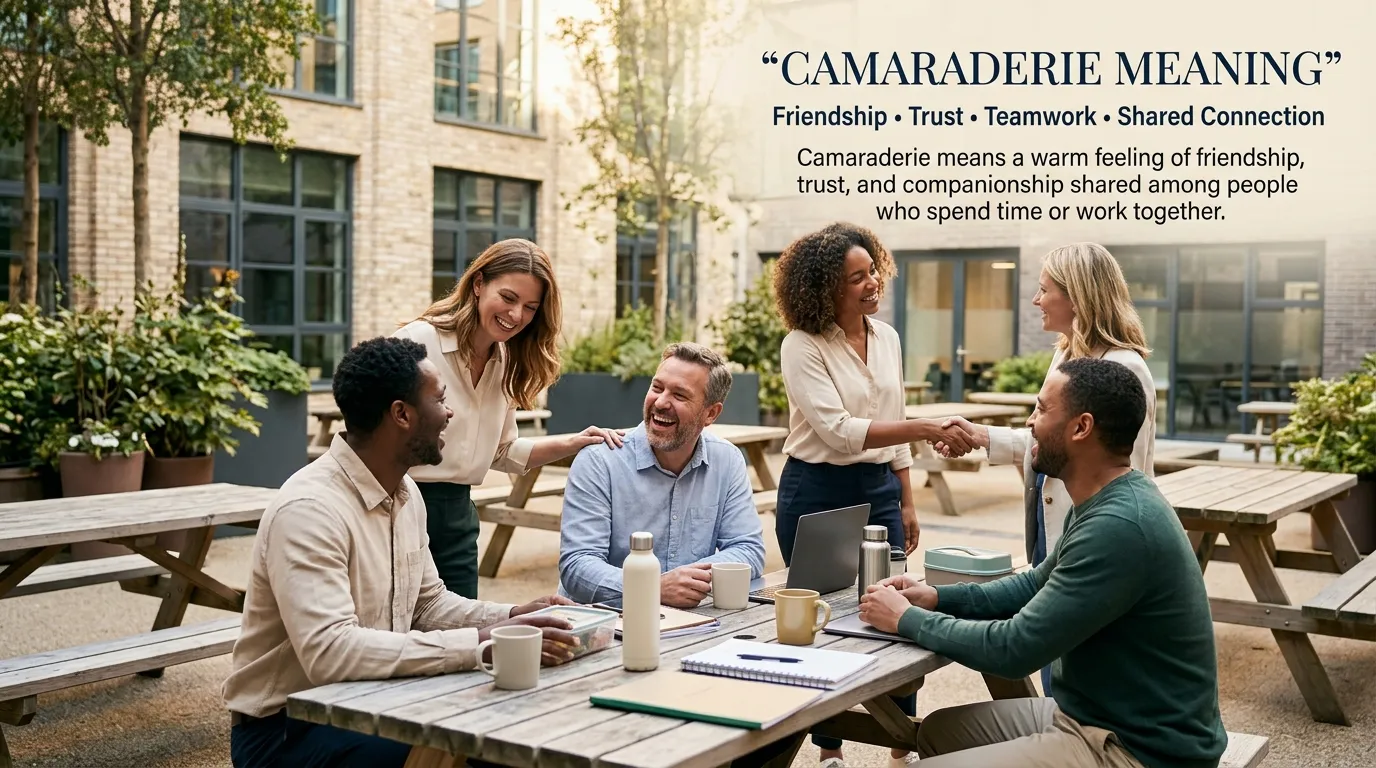
Camaraderie means a feeling of friendship, trust, mutual support, and closeness shared by people who spend time together or work toward a common goal.
It describes the warm bond that develops when people feel comfortable with one another and enjoy being part of the same group.
You might hear camaraderie used to describe teammates celebrating after a difficult game, coworkers helping each other through a busy project, soldiers relying on one another, or friends laughing together after years of shared experiences.
The word often suggests more than ordinary friendship because it emphasizes shared experiences, teamwork, loyalty, and a sense of belonging.
Understanding the camaraderie meaning is useful because the word appears frequently in workplace communication, sports, education, friendships, social groups, and everyday conversations.
It can also help you understand related expressions such as team spirit, fellowship, companionship, solidarity, mutual support, and friendship.
What Does Camaraderie Mean?
The simplest camaraderie definition is:
Camaraderie is a feeling of friendship, trust, and mutual support among people who share experiences, activities, or goals.
The word usually describes a group relationship, although it can also describe the bond between two people.
For example:
- The players developed strong camaraderie during the season.
- There was a wonderful sense of camaraderie among the volunteers.
- Working together on the project created camaraderie among the employees.
- The team won because of its talent and strong camaraderie.
Camaraderie is generally a positive word. It suggests that people cooperate, support each other, communicate comfortably, and feel connected.
Camaraderie in Simple English
If someone asks, “What does camaraderie mean in simple words?” you can say:
Camaraderie means a friendly and supportive relationship between people who share something in common.
Think about a group of coworkers who have worked together for several years. They know each other’s strengths, help one another, laugh together, and handle stressful situations as a team. That feeling of connection is camaraderie.
Camaraderie Meaning at a Glance
| Feature | Details |
| Meaning | Friendship, trust, and mutual support |
| Part of speech | Noun |
| Tone | Positive, warm, friendly |
| Usually describes | Groups, teams, coworkers, friends, communities |
| Common contexts | Work, sports, military, school, friendships |
| Main idea | A strong bond created through shared experiences |
| Related words | Fellowship, companionship, solidarity, friendship |
| Opposite ideas | Isolation, hostility, division, alienation |
| Common phrase | “A sense of camaraderie” |
What Is the Origin of Camaraderie?
The history of camaraderie helps explain why the word is so strongly connected with friendship and shared experiences.
The English word comes from French camaraderie, which developed from camarade, meaning a companion or comrade. The deeper history is connected with the idea of people sharing a room or space and becoming companions.
The concept is closely related to comrade, a word associated with someone who shares an activity, experience, cause, or situation with another person.
Over time, camaraderie became a common English word for the friendly relationship and mutual trust that develops among companions.
Its meaning has remained remarkably consistent. If people are soldiers, athletes, students, coworkers, or friends, camaraderie generally involves a feeling of togetherness created through shared experiences.
How Is Camaraderie Used in a Sentence?
Camaraderie is a noun, so it is commonly used after words such as:
- strong
- genuine
- great
- close
- wonderful
- team
- mutual
- sense of
Common sentence patterns
1. A sense of camaraderie
The event created a strong sense of camaraderie among the participants.
2. Build camaraderie
Team-building activities can help employees build camaraderie.
3. Develop camaraderie
The players developed camaraderie after spending months training together.
4. Foster camaraderie
Shared goals can foster camaraderie within a group.
5. Show camaraderie
The teammates showed camaraderie by supporting one another after the loss.
Camaraderie Examples in Everyday Life
Camaraderie is easier to understand when you see it in realistic situations.
Example 1: Workplace
Imagine a team working late to finish an important project. Everyone helps each other, shares ideas, brings coffee, and celebrates when the work is completed.
That shared experience can create workplace camaraderie.
Example 2: Sports
A soccer team practices together for months. Players learn to trust one another and encourage teammates after mistakes.
That connection is camaraderie.
Example 3: School
Students working together on a difficult assignment may develop friendships and a stronger sense of belonging.
This is another example of camaraderie among classmates.
Example 4: Volunteers
People volunteering for the same charity may come from completely different backgrounds. Their shared purpose can bring them together.
The resulting bond is camaraderie.
Example 5: Friends
A group of friends who have traveled together, survived difficult situations, and created years of memories may have deep camaraderie.
Camaraderie in the Workplace
One of the most common modern uses of the word is workplace camaraderie.
A workplace can have talented employees without having much camaraderie. People may complete their individual responsibilities but rarely communicate, help one another, or feel connected.
A workplace with strong camaraderie feels different.
Employees may:
- Help coworkers solve problems
- Celebrate each other’s achievements
- Communicate openly
- Share knowledge
- Support colleagues during stressful periods
- Feel comfortable asking for help
- Enjoy spending time together
- Work toward common goals
Why Workplace Camaraderie Matters
Camaraderie can make teamwork feel more natural.
For example, imagine two departments facing a difficult deadline. Without trust, employees might blame one another. With camaraderie, they are more likely to think:
“How can we solve this together?”
That difference can influence communication, cooperation, and workplace morale.
However, camaraderie does not mean everyone must become close friends. Professional respect and mutual support can create camaraderie even when coworkers have very different personalities.
Camaraderie in Sports
Sports provide one of the clearest examples of camaraderie.
Athletes train together, experience victories and defeats, face pressure, and depend on teammates. These shared experiences can create powerful bonds.
You might hear:
“The team had incredible camaraderie.”
This means the players appeared connected, supportive, and united.
Examples of Sports Camaraderie
- Teammates encouraging a struggling player
- Players celebrating a teammate’s achievement
- Athletes helping each other during training
- A team staying united after losing
- Players trusting one another during competition
Camaraderie can exist even between rival teams. Players may compete intensely during a game but respect and socialize with one another afterward.
Camaraderie in Friendships
Although camaraderie is often associated with teams and groups, it can also exist in friendships.
A friendship based on camaraderie usually involves:
- Mutual respect
- Shared experiences
- Humor
- Trust
- Emotional support
- Common interests
- Loyalty
For example, two friends who have worked together on several projects, traveled together, and supported each other through difficult periods may have strong camaraderie.
The important point is that camaraderie focuses on the bond created through companionship and shared experiences.
Camaraderie vs. Friendship
These words are closely related, but they are not exactly the same.
| Camaraderie | Friendship |
| Often develops within groups | Can exist between two people |
| Strongly connected to shared experiences | Can develop from emotional closeness |
| Often involves teamwork | May or may not involve teamwork |
| Common in workplaces and sports | Common in personal relationships |
| Emphasizes mutual support | Can involve deeper personal affection |
A person can be your friend without sharing camaraderie with you.
For example, you may have a close childhood friend who lives far away. Your relationship is primarily friendship.
Meanwhile, you might feel camaraderie with coworkers you are not personally close to because you work together effectively and share common experiences.
Camaraderie vs. Comradery
One of the most interesting questions surrounding this word is the difference between camaraderie and comradery.
Both forms are used in English.
Camaraderie
Camaraderie is the traditional and widely recognized form.
Example:
The employees developed strong camaraderie after working together for several years.
Comradery
Comradery is also used, particularly in American English, as a variant influenced by the word comrade.
Example:
The athletes enjoyed the comradery of being part of the same team.
If you want the safest choice for formal writing, camaraderie is generally the better option.
Camaraderie vs. Fellowship
Fellowship and camaraderie overlap significantly.
Fellowship often emphasizes a sense of community, companionship, or shared interests, while camaraderie often emphasizes mutual trust and bonding through shared experiences.
For example:
The hikers developed camaraderie after completing the difficult trail together.
Meanwhile:
The organization provided a sense of fellowship among its members.
Both words express connection, but their emphasis can differ depending on context.
Camaraderie vs. Companionship
Companionship means the state of having someone with whom you spend time and share experiences.
Camaraderie adds a stronger sense of mutual spirit, teamwork, or group connection.
For example:
- A pet can provide companionship.
- Teammates can develop camaraderie.
You would not normally describe a relationship between a person and their dog as camaraderie, even though the dog provides meaningful companionship.
Camaraderie vs. Solidarity
Solidarity is another related word, but it usually emphasizes unity around a shared interest, cause, struggle, or belief.
Camaraderie is more focused on friendship and interpersonal connection.
For example:
The workers showed solidarity during the negotiations.
This suggests unity around a common issue.
But:
The workers developed camaraderie after spending years together.
This emphasizes their personal bond.
Synonyms for Camaraderie
Depending on the context, useful camaraderie synonyms include:
- Friendship
- Fellowship
- Companionship
- Comradeship
- Solidarity
- Brotherhood
- Team spirit
- Kinship
- Mutual support
- Togetherness
- Community
- Affinity
- Rapport
- Unity
These words are related, but they are not always interchangeable.
Best synonym by context
Workplace: team spirit, rapport, mutual support
Sports: team spirit, comradeship, unity
Friends: companionship, friendship, kinship
Community: fellowship, solidarity, togetherness
Antonyms of Camaraderie
The opposite of camaraderie involves separation, hostility, or lack of trust.
Common antonyms include:
- Isolation
- Alienation
- Hostility
- Division
- Conflict
- Disunity
- Distrust
- Estrangement
- Loneliness
- Separation
For example:
Instead of camaraderie, the team experienced constant conflict and distrust.
Positive and Negative Connotations of Camaraderie
Camaraderie almost always has a positive connotation.
When someone says:
“There was a great sense of camaraderie.”
They usually mean that people felt comfortable, connected, supportive, and united.
However, context can change how the word feels.
For example, if a group becomes extremely close and excludes everyone else, outsiders might see that relationship as cliquish.
So camaraderie itself is generally positive, but exclusive group behavior can create negative consequences.
Healthy camaraderie should support belonging without requiring people to shut others out.
How Do You Build Camaraderie?
Camaraderie usually develops naturally, but certain activities can encourage it.
1. Create Shared Experiences
People often become closer after experiencing something together.
Examples include:
- Team projects
- Group trips
- Sports
- Volunteer work
- Workshops
- Challenges
- Celebrations
2. Encourage Open Communication
People are more likely to trust each other when communication is respectful and honest.
3. Celebrate Success Together
Recognizing group achievements can strengthen a shared identity.
4. Help Others
Small acts of support can create trust.
5. Make Space for Humor
Appropriate humor can make groups feel more relaxed and comfortable.
6. Include Everyone
True camaraderie should not depend on excluding outsiders.
Real-Life Conversation Examples
Here are several natural ways people might use camaraderie in conversation.
At Work
Alex: “Everyone stayed late to finish the presentation.”
Maria: “Yeah, I think that’s why our team has such great camaraderie.”
After a Sports Game
Coach: “What makes this team special?”
Player: “We trust each other. There’s a lot of camaraderie.”
Talking About College
Student: “Did you enjoy your university experience?”
Graduate: “Absolutely. The classes were great, but the camaraderie between students was my favorite part.”
Talking About a Group Trip
Friend: “You all seem really close.”
Traveler: “We spent two weeks traveling together. That experience created a lot of camaraderie.”
Common Mistakes When Using Camaraderie
Mistake 1: Treating It as an Adjective
Camaraderie is a noun.
Incorrect:
“They are very camaraderie.”
Better:
“They have strong camaraderie.”
Mistake 2: Using It for Any Relationship
Camaraderie usually suggests shared experiences or group connection.
For a romantic relationship, words such as love, intimacy, or affection may be more appropriate.
Mistake 3: Assuming It Means Exactly “Friendship”
Friendship and camaraderie overlap, but camaraderie often emphasizes shared goals, teamwork, and mutual support.
Mistake 4: Assuming Everyone Must Be Best Friends
People can have camaraderie without being personally close outside the shared activity.
Is Camaraderie Formal or Casual?
Camaraderie is moderately formal.
It works well in:
- Academic writing
- Workplace communication
- News articles
- Essays
- Speeches
- Professional presentations
- Everyday conversation
In casual conversation, people may simply say:
- “We get along really well.”
- “We’re a close group.”
- “There’s a great team spirit.”
- “Everyone supports each other.”
So while camaraderie is perfectly natural, simpler expressions may sound more conversational.
Camaraderie in Modern Communication
Unlike slang terms that change rapidly, camaraderie is a standard English vocabulary word, not internet slang.
You may encounter it in:
- Workplace discussions
- LinkedIn posts
- Sports commentary
- Instagram captions
- TikTok captions
- Reddit discussions
- Discord communities
- Gaming communities
- Online team chats
- School groups
For example, someone might post:
“Six months of gaming together created an amazing sense of camaraderie.”
In gaming communities, the word can describe the bond between players who communicate regularly, cooperate during matches, and share victories and defeats.
Camaraderie in Gaming and Online Communities
Online communities can develop genuine camaraderie even when members have never met in person.
Gaming groups often develop this feeling through:
- Playing together regularly
- Helping new players
- Sharing strategies
- Celebrating victories
- Laughing about mistakes
- Supporting teammates
- Participating in community events
A Discord gaming group, for example, might begin as a collection of strangers. After months of playing together, members may develop a strong sense of belonging.
That is a modern example of digital camaraderie.
Is Camaraderie the Same as Teamwork?
No.
Teamwork is the process of working together effectively.
Camaraderie is the feeling of friendship and connection that can develop among people working together.
You can have teamwork without much camaraderie.
For example, employees may cooperate professionally because they have assigned responsibilities. They may work efficiently but have little personal connection.
A team can also have both:
Teamwork + trust + shared experiences = strong camaraderie
Why Is Camaraderie Important?
Camaraderie matters because people generally function better in environments where they feel supported, respected, and connected.
In a group, camaraderie can contribute to:
- Better communication
- Stronger relationships
- Greater trust
- A sense of belonging
- More cooperation
- Positive group morale
- Shared identity
- Stronger social connections
It is particularly valuable when people face difficult situations together.
When a group knows that members will support one another, challenges can feel more manageable.
Camaraderie: Quick Summary
Camaraderie means a friendly, supportive bond between people who share experiences, activities, or goals.
Remember these key points:
- It is a noun.
- It usually has a positive meaning.
- It often describes groups and teams.
- Shared experiences frequently create camaraderie.
- It is related to friendship, fellowship, companionship, and solidarity.
- It is common in workplaces, sports, schools, communities, and online groups.
- Camaraderie is the safest traditional spelling for formal writing.
- It does not necessarily mean that everyone in a group is close friends.
Frequently Asked Questions About Camaraderie
1. What does camaraderie mean in simple words?
Camaraderie means a friendly feeling of trust, support, and togetherness between people. It often develops when people share experiences or work toward the same goal.
2. What is an example of camaraderie?
A group of coworkers helping one another through a stressful project and celebrating together after finishing it is an example of camaraderie.
3. Is camaraderie the same as friendship?
Not exactly. Friendship can describe a personal relationship between two people, while camaraderie often emphasizes shared experiences, teamwork, mutual support, and group connection.
4. What is a synonym for camaraderie?
Common synonyms include fellowship, companionship, comradeship, friendship, solidarity, team spirit, kinship, and togetherness.
5. What is the opposite of camaraderie?
Opposite concepts include isolation, hostility, division, distrust, alienation, conflict, and disunity.
6. How do you use camaraderie in a sentence?
You can say: “The team developed a strong sense of camaraderie after working together for several months.”
7. Is camaraderie a positive word?
Yes. Camaraderie is generally positive and suggests friendship, trust, mutual support, and a feeling of belonging.
8. What is the difference between camaraderie and comradery?
Both forms are used to describe friendly relationships among companions. Camaraderie is the traditional and widely recognized form and is generally the better choice in formal writing.
9. Can camaraderie exist between coworkers?
Absolutely. Coworkers can develop camaraderie through shared projects, challenges, teamwork, humor, mutual support, and common goals without necessarily becoming close personal friends.
10. Can camaraderie be used for online friendships?
Yes. People in gaming communities, social groups, forums, and other online communities can develop camaraderie through regular interaction, shared interests, cooperation, and common experiences.
Conclusion
The camaraderie meaning is simple but powerful: it describes the friendship, trust, mutual support, and sense of togetherness that develops between people who share experiences or goals.
Unlike ordinary cooperation, camaraderie has an emotional element. It makes people feel that they belong to something together.
That is why the word is so common in discussions about sports teams, workplaces, friendships, schools, volunteer groups, military units, and online communities.
Camaraderie is closely related to friendship, fellowship, companionship, solidarity, teamwork, and team spirit, but each word carries a slightly different emphasis.
Understanding those differences can help you choose the right word for professional writing and everyday conversations.

I am Alex Carter, is a web resources and digital tools writer at Linkvistahub. He enjoys discovering useful websites, online tools, productivity resources, and practical digital solutions that can make everyday tasks easier.