
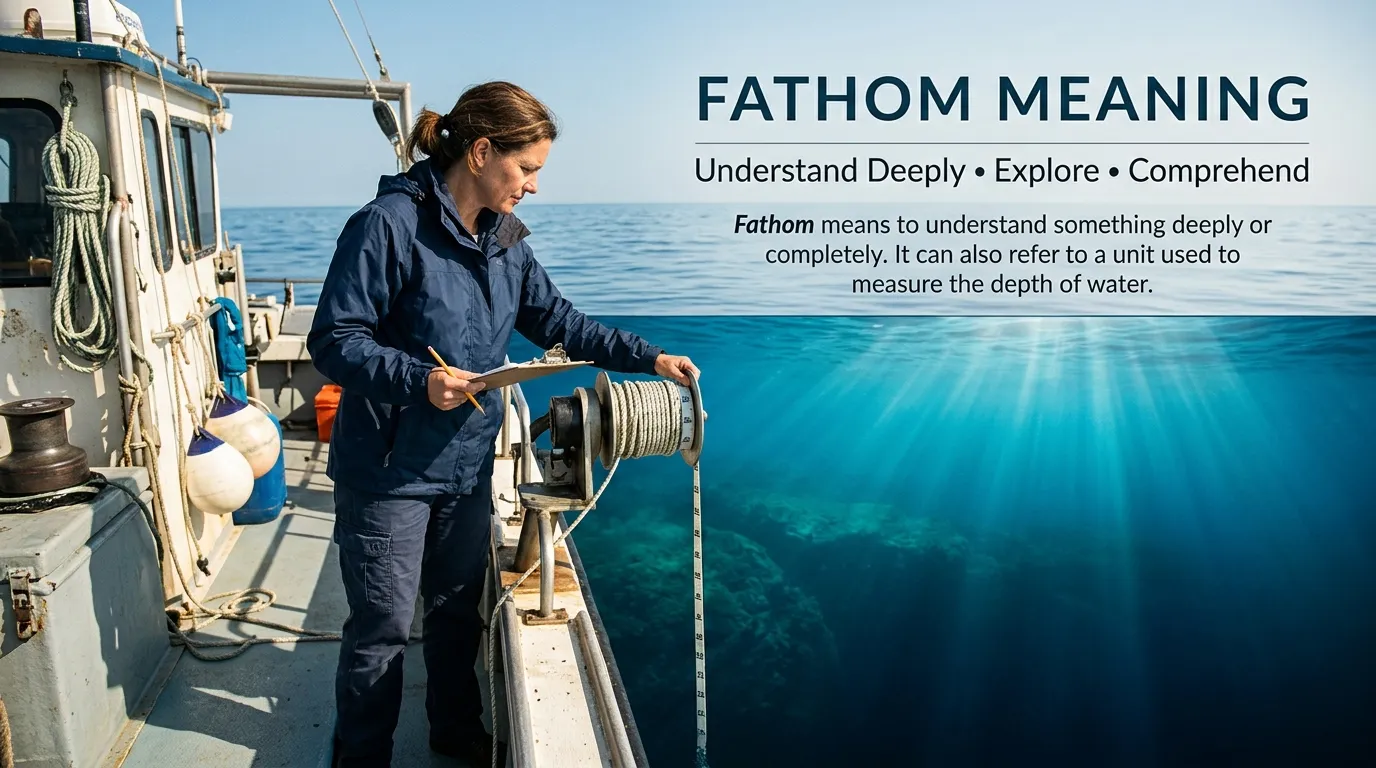
Have you ever heard someone say, “I can’t fathom what happened,” and wondered what they really meant? The word fathom can seem unusual because it has both a modern figurative meaning and a literal historical meaning connected to measurement.
Today, fathom meaning most often refers to the ability to understand, comprehend, or imagine something, especially when an idea or situation is difficult to grasp.
For example, if someone says, “I can’t fathom why she left,” they mean, “I can’t understand why she left.” The word can also describe something that is extremely difficult to understand: “It’s hard to fathom how such a small mistake caused such a big problem.”
But fathom is not only a verb. Historically, a fathom is also a unit of measurement used to measure water depth, particularly in nautical contexts. One fathom equals six feet, or about 1.83 meters.
Understanding these two meanings makes the word much easier to recognize in books, conversations, news articles, workplace communication, and everyday English. This guide explains the definition of fathom, its origin, examples, synonyms, grammar, common expressions, and the difference between literal and figurative uses.
What Does Fathom Mean?
Fathom primarily means to understand or comprehend something deeply, especially something complicated, mysterious, or difficult to explain.
Fathom as a Verb
When used as a verb, fathom means to figure something out or understand something that is not immediately clear.
Example:
“I can’t fathom why he made that decision.”
This means:
“I can’t understand why he made that decision.”
Another example is:
“She tried to fathom what had gone wrong.”
Here, fathom means that she tried to understand the situation.
Fathom as a Noun
As a noun, fathom is a traditional unit of length equal to six feet.
It is especially associated with measuring the depth of water.
Example:
“The ship was sailing through 20 fathoms of water.”
That means the water was 20 fathoms deep, or 120 feet.
Fathom Meaning at a Glance
| Feature | Meaning |
| Word | Fathom |
| Part of speech | Verb and noun |
| Main modern meaning | Understand or comprehend |
| Literal meaning | A unit measuring six feet |
| Common phrase | “I can’t fathom…” |
| Tone | Neutral to slightly formal |
| Context | Everyday, academic, literary, nautical |
| Similar words | Understand, comprehend, grasp, figure out |
| Opposite ideas | Misunderstand, overlook, ignore |
Fathom Definition in Simple English
In simple English, fathom means to understand something deeply.
If something is easy to understand, you normally would not say you need to fathom it. The word is more useful when the subject is confusing, surprising, complicated, mysterious, or difficult to believe.
For example:
- “I understand the instructions.” — Simple and ordinary.
- “I can’t fathom his decision.” — His decision is difficult to understand.
- “She fathomed the reason behind the strange behavior.” — She eventually understood it.
So, fathom often carries the idea of looking beneath the surface to discover what something really means.
What Does “I Can’t Fathom” Mean?
The expression “I can’t fathom” means “I cannot understand, comprehend, or imagine.”
It is one of the most common ways the word appears in modern English.
Examples
“I can’t fathom why anyone would do that.”
Meaning: I cannot understand why anyone would do that.
“I can’t fathom how he solved the problem so quickly.”
Meaning: I cannot understand or imagine how he solved it so quickly.
“She couldn’t fathom the reason for his silence.”
Meaning: She could not understand why he was silent.
The expression can also communicate surprise, disbelief, confusion, or frustration.
Fathom Meaning in Different Contexts
The meaning of fathom stays relatively consistent, but the feeling can change depending on the context.
1. Fathom in Everyday Conversation
In casual conversation, fathom usually means understand.
“I can’t fathom why they canceled the event.”
The speaker is confused about the decision.
However, fathom can sound slightly more formal than simply saying understand.
2. Fathom in the Workplace
At work, the word can be used when discussing complicated decisions, business problems, or unexpected results.
“We’re still trying to fathom why sales dropped so quickly.”
This sounds more polished than:
“We’re still trying to understand why sales dropped.”
Both are correct, but fathom emphasizes that the answer is difficult to determine.
3. Fathom in Academic Writing
The word can also appear in academic or analytical writing.
“Researchers are still attempting to fathom the complexity of the phenomenon.”
Here, fathom suggests deep investigation and careful analysis.
4. Fathom in Literature
Writers often use fathom when describing emotions, mysteries, human behavior, or situations that seem beyond ordinary understanding.
“No one could fathom the depth of his grief.”
The word adds emotional and literary weight.
5. Fathom in Nautical Language
The original literal meaning remains important in nautical contexts.
A fathom is a unit of water depth equal to six feet.
For example:
“The chart showed a depth of 15 fathoms.”
That equals:
15 × 6 = 90 feet
The plural is usually fathoms.
The Origin and History of Fathom
The history of fathom is particularly interesting because its literal measurement meaning is closely connected to the human body.
The word comes from Old English “fæðm,” referring to an outstretched pair of arms or an embrace. The measurement was traditionally associated with the distance between the fingertips when a person’s arms were stretched outward.
Over time, this bodily measurement became standardized as a nautical unit.
The traditional English fathom became established as six feet.
This history also helps explain the development of the figurative meaning. The idea of measuring depth gradually became associated with measuring or grasping something mentally.
In other words, if you can “fathom” something, you can mentally reach into its depth and understand it.
How Fathom Developed a Figurative Meaning
The transition from physical measurement to mental understanding is a useful example of how language evolves.
Originally, a fathom referred to physical reach or depth. Later, English speakers began using the word metaphorically for intellectual or emotional depth.
Consider these two ideas:
Literal:
“The water is 30 fathoms deep.”
Figurative:
“I cannot fathom the depth of his sadness.”
The first describes measurable physical depth.
The second describes something that is difficult to understand or fully comprehend.
This metaphorical development is why fathom can now describe ideas, emotions, decisions, mysteries, and experiences.
Fathom vs. Understand
The words fathom and understand are closely related, but they are not always interchangeable in tone.
| Word | Basic meaning | Typical feeling |
| Understand | Know what something means | Neutral |
| Fathom | Understand something difficult or deep | More emphatic |
| Comprehend | Understand clearly | Formal |
| Grasp | Understand an idea | Natural and common |
| Figure out | Find an answer | Casual |
| Perceive | Become aware of something | Formal/analytical |
Compare:
“I don’t understand his decision.”
with:
“I can’t fathom his decision.”
The second sentence suggests that the decision is particularly difficult, surprising, or mysterious.
Fathom vs. Comprehend
Comprehend and fathom both mean understand, but fathom often suggests greater difficulty.
For example:
“Students must comprehend the lesson.”
This simply means they need to understand it.
But:
“I cannot fathom why the system keeps failing.”
This suggests that the reason is difficult to discover.
Simple distinction
- Comprehend: understand something.
- Fathom: understand something difficult, complex, or surprising.
Fathom vs. Grasp
Grasp is another close synonym.
“I grasp the basic concept.”
This means the person understands the idea.
“I can’t fathom why the machine stopped working.”
This emphasizes confusion about a difficult situation.
Grasp is usually more natural in everyday English, while fathom can sound more expressive or literary.
Common Synonyms for Fathom
Depending on the sentence, possible synonyms include:
- Understand
- Comprehend
- Grasp
- Figure out
- Work out
- Make sense of
- Interpret
- Analyze
- Determine
- Perceive
- Appreciate
- Realize
However, these words are not perfect replacements in every situation.
For example, “I can’t fathom it” sounds natural, while “I can’t analyze it” changes the meaning.
Antonyms of Fathom
If fathom means to understand, its opposite can involve failing to understand.
Possible antonyms include:
- Misunderstand
- Ignore
- Overlook
- Misinterpret
- Confuse
- Disregard
The exact opposite depends on the sentence.
Positive and Negative Connotations of Fathom
The word fathom itself is generally neutral. Its emotional tone comes from the context.
Negative or Difficult Context
“I can’t fathom why he lied.”
This expresses confusion or frustration.
Positive Context
“She finally fathomed the solution.”
This can suggest achievement or discovery.
Emotional Context
“He could never fathom the depth of her kindness.”
Here, fathom emphasizes something profound and difficult to measure emotionally.
Real-Life Examples of Fathom
Understanding the word becomes easier when you see it in realistic situations.
Example 1: A Surprising Decision
Person A: “Why did Sarah leave such a great job?”
Person B: “I honestly can’t fathom it.”
Meaning: Person B cannot understand Sarah’s decision.
Example 2: A Difficult Problem
“The engineers couldn’t fathom why the software kept crashing.”
Meaning: They couldn’t determine or understand the reason.
Example 3: An Emotional Situation
“I can’t fathom how difficult that experience must have been.”
Meaning: I cannot fully imagine or understand how difficult it was.
Example 4: Nautical Meaning
“The submarine descended to 100 fathoms.”
Meaning: The submarine went to a depth of 600 feet.
How to Use Fathom in a Sentence
The most common grammatical pattern is:
fathom + object
Examples:
- “I can’t fathom the answer.”
- “She couldn’t fathom his motives.”
- “They tried to fathom the mystery.”
- “We struggled to fathom what happened.”
Another common structure is:
fathom + why/how/what
Examples:
- “I can’t fathom why she left.”
- “He couldn’t fathom how they escaped.”
- “Nobody could fathom what had happened.”
A Useful Pattern
When you see:
I can’t fathom + why/how/what…
you can usually interpret it as:
I can’t understand or imagine + why/how/what…
Is Fathom a Formal Word?
Fathom is not extremely formal, but it is somewhat more sophisticated than “understand.”
It works well in:
- Professional writing
- News writing
- Essays
- Books
- Conversations
- Speeches
- Literary writing
It may sound slightly dramatic or polished in very casual conversation.
For example:
“I can’t fathom why my phone isn’t working.”
This is completely natural, although:
“I can’t figure out why my phone isn’t working.”
sounds more casual.
Is Fathom Still Common Today?
Yes. The figurative use of fathom remains recognizable and widely used in modern English.
The phrase “I can’t fathom…” is particularly common because it provides a concise way to express strong confusion or disbelief.
The literal measurement meaning is much more specialized today and is mainly encountered in nautical, maritime, historical, or technical contexts.
Common Expressions With Fathom
“I Can’t Fathom It”
This means:
I can’t understand it.
Example:
“The whole situation is so strange. I can’t fathom it.”
“Hard to Fathom”
This means something is difficult to understand or believe.
“It’s hard to fathom how quickly technology has changed.”
“Fathom Out”
The phrasal verb fathom out means to work something out or understand it.
Example:
“We’re trying to fathom out what went wrong.”
This form is particularly common in British English, while American English often simply uses fathom.
“Fathom the Depths”
Literally, this can refer to measuring the depth of water.
Figuratively, it can mean trying to understand something profound or complicated.
“She struggled to fathom the depths of his emotions.”
Common Mistakes When Using Fathom
Mistake 1: Treating Fathom Only as a Nautical Term
Some learners encounter the measurement definition first and assume fathom is only related to water.
Modern English frequently uses it figuratively to mean understand.
Mistake 2: Using It for Every Simple Idea
You technically can use fathom in many situations, but it is most effective when something is difficult or surprising.
Instead of:
“I fathomed what time the meeting starts.”
Use:
“I understood what time the meeting starts.”
But:
“I couldn’t fathom why the meeting was canceled.”
sounds natural.
Mistake 3: Confusing Fathom With “Figure Out”
The meanings overlap, but they are not identical.
Figure out often suggests actively solving a problem.
Fathom emphasizes understanding something deeply or making sense of it.
Fathom in Modern Digital Communication
Unlike internet slang or abbreviations, fathom does not have a separate secret meaning on platforms such as TikTok, Instagram, Snapchat, Reddit, Discord, or gaming communities.
If someone writes:
“I can’t fathom this.”
online, they normally mean:
“I can’t understand this.”
The word may appear in:
- Social media comments
- Reddit discussions
- Online debates
- Gaming conversations
- YouTube comments
- Text messages
- Workplace chats
Its meaning generally remains unchanged.
Example in a Text Message
Friend: “He sold his new car after owning it for two weeks.”
You: “I can’t fathom why 😂”
The phrase communicates confusion, with the emoji making the message more casual.
Fathom in Dating and Relationships
In relationship conversations, fathom can describe difficulty understanding another person’s feelings or behavior.
Examples:
“I can’t fathom why she suddenly stopped replying.”
“He couldn’t fathom what she was feeling.”
“It’s hard to fathom how someone can change so quickly.”
Here, the word often expresses emotional confusion.
Fathom in Business and Professional Communication
In professional settings, fathom can be useful when you want to describe a complex issue without sounding overly casual.
For example:
“The team is trying to fathom the cause of the unexpected decline.”
However, for very clear business communication, understand, identify, or determine may sometimes be more precise.
Choose the word based on your intended tone.
Fathom as a Measurement
The literal noun deserves special attention because it is a completely different grammatical use.
A fathom = six feet.
Therefore:
- 1 fathom = 6 feet
- 2 fathoms = 12 feet
- 5 fathoms = 30 feet
- 10 fathoms = 60 feet
- 20 fathoms = 120 feet
- 100 fathoms = 600 feet
In meters, one fathom is approximately 1.83 meters.
Why Was a Fathom Used?
A fathom was historically practical for measuring water depth because it was associated with the span of a person’s outstretched arms.
This made it particularly useful aboard ships before modern measurement technologies became widespread.
Fathom in Nautical History
Mariners needed reliable ways to determine whether ships could safely travel through an area.
Knowing water depth was crucial because a ship could run aground if the water was too shallow.
Fathoms therefore became an important unit in nautical measurement and navigation.
Even today, you may encounter fathoms in historical navigation documents, nautical charts, maritime literature, or discussions of ocean depth.
Why Does Fathom Mean “Understand”?
At first glance, the connection between water depth and understanding may seem strange.
The connection is metaphorical.
To fathom physical depth means to measure or reach the bottom of something.
To fathom an idea means to reach into its complexity and understand what lies beneath the surface.
That is why the word works so well when describing:
- Mysteries
- Human emotions
- Complex decisions
- Difficult concepts
- Unexpected events
- Hidden motives
- Complicated situations
Fathom: Literal vs. Figurative Meaning
| Meaning | Part of Speech | Example |
| Unit of six feet | Noun | “The water is 20 fathoms deep.” |
| Understand deeply | Verb | “I can’t fathom his decision.” |
| Work out something difficult | Verb | “They tried to fathom the mystery.” |
| Imagine something difficult | Verb | “I can’t fathom how she felt.” |
The surrounding words usually make the intended meaning obvious.
Frequently Asked Questions About Fathom Meaning
1. What does fathom mean in simple words?
Fathom means to understand something deeply, especially when it is difficult, complicated, surprising, or mysterious. As a noun, a fathom is also a measurement equal to six feet.
2. What does “I can’t fathom” mean?
“I can’t fathom” means “I can’t understand,” “I can’t comprehend,” or “I can’t imagine.” It is commonly used when something is confusing or difficult to believe.
3. Is fathom a synonym for understand?
Yes. Fathom can be a synonym for understand, particularly when the subject is complicated or difficult to comprehend. However, fathom often sounds more emphatic or expressive.
4. Is fathom a positive or negative word?
Fathom is generally neutral. The surrounding context determines whether it expresses confusion, frustration, curiosity, admiration, or another emotion.
5. What is the opposite of fathom?
When fathom means understand, possible opposites include misunderstand, misinterpret, overlook, ignore, and fail to comprehend.
6. What does fathom mean in water?
As a noun, a fathom is a unit of water depth equal to six feet, approximately 1.83 meters. It is traditionally associated with nautical measurement.
7. Is fathom an old-fashioned word?
The word has an old history, but its figurative use is still used in modern English. Expressions such as “I can’t fathom why” remain natural today.
8. Can I use fathom in academic writing?
Yes. Fathom can work well in academic writing when discussing something difficult to understand or analyze. However, comprehend, determine, or analyze may be more precise in technical contexts.
9. What is the difference between fathom and comprehend?
Both mean understand, but fathom often suggests that something is deep, complex, mysterious, or difficult to understand, while comprehend is a more general and formal term.
10. What does “hard to fathom” mean?
“Hard to fathom” means difficult to understand, explain, or believe. For example, “It’s hard to fathom how the project finished so quickly” means the result is difficult to understand or imagine.
Conclusion
The word fathom has a fascinating journey from a physical measurement to a powerful expression of human understanding. In modern English, its most common meaning is to understand, comprehend, or make sense of something that is difficult or deep.
When someone says, “I can’t fathom it,” they are usually saying that something is beyond their easy understanding. The word can communicate confusion, disbelief, emotional depth, or intellectual difficulty.
At the same time, fathom remains a traditional nautical measurement equal to six feet. This literal meaning explains much of the word’s history and helps reveal why the figurative meaning developed: just as sailors measured the depth of water, people can metaphorically try to measure the depth of an idea, mystery, or emotion.
For everyday English, remember the simplest rule:
Fathom = understand something deeply or with difficulty.
If you see “I can’t fathom why…”, read it as “I can’t understand why…”. If you see “20 fathoms” in a nautical context, think 120 feet of depth.
Once you understand these two meanings, fathom becomes a much easier and more useful word to recognize and use correctly.

I am Sophia Bennett, is a digital resources and online tools writer at LinkVistaHub. She enjoys exploring useful websites, emerging digital tools, productivity platforms, and practical online resources that help people work smarter and discover valuable information.