
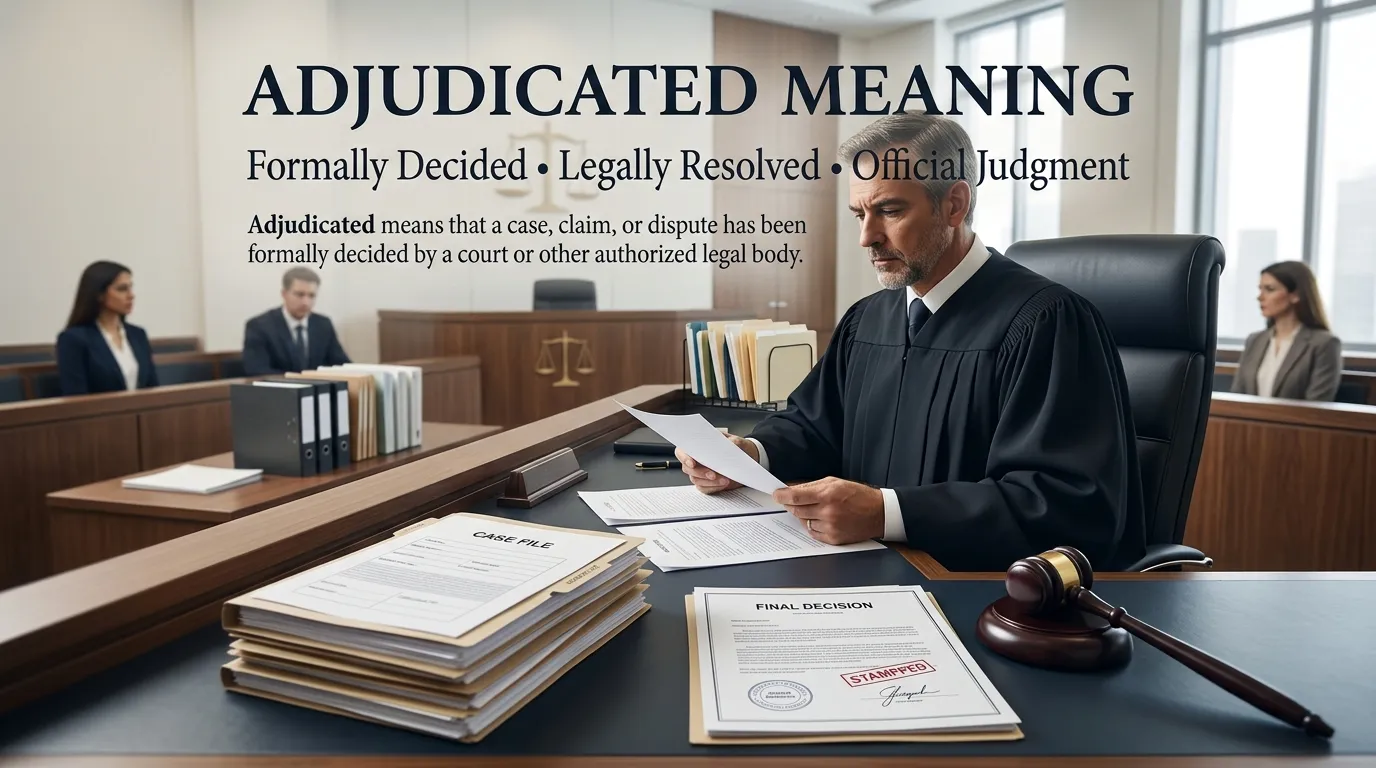
Adjudicated means that a dispute, claim, or legal matter has been officially reviewed and decided by a court, judge, or authorized authority.
In simple words, if something has been adjudicated, it means someone with legal or official authority has examined the matter and made a decision about it.
For example, if an insurance claim is adjudicated, the claim has been reviewed and a decision has been made about whether it should be approved, denied, or otherwise resolved.
In simple terms, adjudication means that a dispute, claim, case, or legal matter has been officially decided or determined by an authorized person, court, or institution. The decision usually follows a formal process in which facts, evidence, rules, or arguments are considered.
The word is especially common in legal terminology, where you might read phrases such as “case adjudicated,” “claim adjudicated,” “adjudicated by the court,” or “adjudicated judgment.”
However, the term is not limited to courtrooms. It can also describe decisions made by administrative agencies, tribunals, professional organizations, and other authorized decision-makers.
Adjudicated Meaning at a Glance
Adjudicated is the past tense and past participle of adjudicate. It means that something has been formally considered and decided by an authorized decision-maker.
| Key Fact | Details |
| Word | Adjudicated |
| Basic meaning | Officially decided or determined |
| Base verb | Adjudicate |
| Part of speech | Verb form |
| Common context | Law, courts, disputes, claims, administration |
| Tone | Formal and professional |
| Common synonym | Decided, determined, settled |
| Opposite idea | Undecided, pending |
| Related words | Adjudication, adjudicator, judgment |
| Most common use | Formal decisions about disputes or claims |
Simple Definition of Adjudicated
Adjudicated means officially decided after a formal review or evaluation.
For example:
“The court adjudicated the dispute.”
This means the court formally considered the dispute and made a decision.
Another example is:
“The insurance claim was adjudicated.”
This generally means the insurance company or its claims process reviewed the claim and determined how it should be handled.
What Does Adjudication Mean?
The word adjudicated describes something that has gone through an adjudication process.
Adjudication is a formal method of reaching a decision. The person or organization making the decision is known as an adjudicator.
The process can involve:
- Reviewing information
- Examining evidence
- Considering arguments or documentation
- Applying relevant rules or laws
- Reaching a decision
- Communicating the outcome
The exact process depends on the situation.
For instance, a court may adjudicate a legal dispute by examining evidence and hearing arguments from both sides. An insurance company may adjudicate a claim by reviewing the policy, medical records, bills, and other documentation.
The important point is that adjudication indicates a decision has been made through an established process.
What Does Adjudication Mean in Law?
In legal contexts, adjudication usually means that a court or another authorized legal body has formally decided a matter.
For example:
“The case was adjudicated in federal court.”
This means the court considered the case and reached a formal determination.
A matter can involve:
- Civil disputes
- Criminal proceedings
- Family-law matters
- Contract disputes
- Property disagreements
- Administrative proceedings
- Appeals
- Regulatory matters
However, adjudication does not automatically mean that someone was found guilty.
This is an important distinction.
A case can be adjudicated with many different outcomes. Depending on the circumstances, the decision could favor one party, reject a claim, impose an obligation, dismiss an action, or resolve another legal question.
Adjudicated Does Not Always Mean Guilty
One common misunderstanding is that “adjudicated” means guilty.
That is incorrect.
Adjudicated describes the fact that an authorized decision-maker has made a determination. It does not, by itself, tell you what that determination was.
Compare:
- Adjudicated: A formal decision was made.
- Convicted: A person was found guilty of a crime.
- Acquitted: A person was found not guilty.
- Dismissed: A case or charge was dismissed.
- Settled: The parties reached an agreement, usually without a full adjudication on the merits.
The actual outcome must be determined from the surrounding language.
Adjudicated Meaning in Court Cases
If you see “adjudicated case,” it generally indicates that the matter has been formally decided.
For example:
“The court adjudicated the plaintiff’s claim.”
The statement means the court made a formal determination concerning the claim.
Adjudicated vs. Pending
These terms often appear as opposites in legal or administrative records.
| Term | Meaning |
| Adjudicated | A formal decision has been made |
| Pending | A decision has not yet been finalized |
| Dismissed | The matter was ended without the expected final determination on the claim or charge |
| Settled | The parties reached an agreement |
| Appealed | A party is asking a higher authority to review a decision |
A case can also be adjudicated and then appealed. Therefore, adjudication does not necessarily mean that no further legal action is possible.
What Does Adjudication Mean on a Background Check?
The phrase can become confusing when it appears on a background check.
Background-check terminology varies by provider and jurisdiction, so the exact meaning should always be interpreted using the report’s definitions.
In some systems, an adjudicated result can indicate that information was reviewed against specific criteria and a formal employment-screening decision was reached.
For example, an employer may use an internal review process to determine if information in a background report affects a hiring decision.
In this context, adjudicated does not necessarily mean convicted.
It may simply mean that a result has been reviewed and classified according to the organization’s process.
If you see the word on an actual report, look for the provider’s explanation of terms rather than assuming it has one universal meaning.
Adjudicated Meaning in Insurance
The term adjudicated is also common in insurance.
When an insurance claim is adjudicated, it has been reviewed to determine how the claim should be handled under the applicable policy or rules.
For example:
“Your medical claim has been adjudicated.”
This can mean the claim was processed and a determination was made about payment, coverage, denial, or another outcome.
An insurance claim may be evaluated using information such as:
- The insurance policy
- Claim forms
- Medical or service records
- Billing information
- Eligibility information
- Coverage rules
- Deductibles
- Co-payments
- Other applicable requirements
Does Adjudicated Mean Approved?
No.
An adjudicated claim can be:
- Approved
- Partially approved
- Denied
- Adjusted
- Returned for additional information
The word refers to the decision process, not necessarily a favorable outcome.
Adjudicated Meaning in Healthcare
Healthcare billing often uses the term claim adjudication.
A healthcare claim goes through a process in which the payer evaluates the claim and determines how it should be processed.
For example:
“The provider’s claim was adjudicated by the health plan.”
This does not automatically mean that the entire amount was paid.
The payer may determine that:
- The service is covered.
- Only part of the service is covered.
- The patient owes a portion.
- The claim does not meet coverage requirements.
- Additional information is needed.
So if you see “adjudicated” on a healthcare portal, check the associated explanation, payment details, or Explanation of Benefits (EOB).
Adjudicated Meaning in Government and Administrative Decisions
Adjudication is not limited to traditional courts.
Government agencies and administrative bodies may also make formal decisions.
For example, an agency might adjudicate:
- Benefits claims
- Licensing disputes
- Regulatory matters
- Immigration-related administrative matters
- Tax disputes
- Eligibility questions
The exact rules vary by agency and jurisdiction.
In these situations, an adjudicated matter generally means that an authorized body has reviewed the issue and reached a formal determination.
Adjudicated Meaning in Everyday English
Although adjudicated is a formal word, its basic idea can be understood in everyday language as “officially decided.”
For example:
“The committee adjudicated the dispute.”
A simpler version would be:
“The committee officially decided the dispute.”
The formal version sounds more appropriate in professional, legal, or institutional writing.
Simple Examples
- “The judge adjudicated the case.”
- “The claim was adjudicated last week.”
- “The dispute has been adjudicated.”
- “The matter remains pending and has not yet been adjudicated.”
- “The panel adjudicated the complaint.”
- “The agency adjudicated the application.”
Adjudicated vs. Adjudication vs. Adjudicator
These three words are closely related.
Adjudicate
Adjudicate is the verb.
Example:
“The court will adjudicate the dispute.”
Adjudicated
Adjudicated is the past tense or past participle.
Example:
“The court adjudicated the dispute.”
Adjudication
Adjudication is the noun describing the process of formally deciding something.
Example:
“The dispute went through adjudication.”
Adjudicator
An adjudicator is the person or body responsible for making the decision.
Example:
“The adjudicator reviewed the evidence.”
| Word | Function | Example |
| Adjudicate | Verb | The court will adjudicate the case. |
| Adjudicated | Past form | The court adjudicated the case. |
| Adjudication | Noun | The matter went through adjudication. |
| Adjudicator | Decision-maker | The adjudicator reviewed the evidence. |
Origin and History of Adjudicated
The word adjudicate comes through Latin roots associated with judgment and deciding legal matters. It is related to the Latin judicare, meaning to judge or determine.
The broader word family is connected with the idea of judgment, which also appears in words such as:
- Judicial
- Judge
- Judgment
- Judiciary
- Judicious
Over time, adjudicate developed into a formal English term for making an official determination, particularly in legal and administrative settings.
Today, its meaning extends beyond traditional courts to various formal decision-making systems.
How to Use Adjudicated Correctly
Because the word is formal, it works best when the situation involves an actual decision-making process.
Correct Usage
“The dispute was adjudicated by the tribunal.”
This works because a tribunal has formal authority to decide the matter.
“The insurance claim was adjudicated.”
This works because claims can go through formal evaluation.
“The complaint was adjudicated by the review panel.”
Again, the word fits because there is an established decision-making process.
When It Sounds Unnatural
You generally would not use adjudication for casual personal choices.
For example:
“I adjudicated what pizza to order.”
This sounds unnecessarily formal and unnatural.
Instead:
“I decided what pizza to order.”
The word works best when the decision involves rules, evidence, competing claims, or institutional authority.
Adjudicated vs. Decided
These words are similar, but they are not always interchangeable.
The decision is much broader.
You can decide:
- What to eat
- Where to travel
- Which product to buy
- if to accept an offer
Adjudication usually suggests a more formal process.
Example
“The manager decided which employee would lead the project.”
Natural.
“The manager adjudicated which employee would lead the project.”
Possible in a very formal context, but unnecessarily legal-sounding unless there was a formal dispute or review process.
Adjudicated vs. Resolved
Resolved means a problem or disagreement has been brought to an end.
Adjudication specifically emphasizes a formal determination.
A dispute can be resolved through:
- Negotiation
- Mediation
- Settlement
- Agreement
- Adjudication
Therefore, not every resolved matter was adjudicated.
Adjudicated vs. Settled
This distinction is particularly important in law.
Adjudication generally indicates that an authorized decision-maker determined the matter.
Settled generally indicates that the parties reached an agreement.
For example:
“The court adjudicated the dispute.”
The court made the determination.
But:
“The parties settled the dispute.”
The parties reached an agreement.
A settlement can occur without a court deciding the underlying dispute.
Adjudicated vs. Convicted
These terms should never be treated as synonyms.
Adjudicated = formally decided.
Convicted = found guilty of a criminal offense through the applicable legal process.
A criminal case may be adjudicated without resulting in a conviction.
That distinction is especially important when reading legal or background-check terminology.
Positive and Negative Connotations
The word adjudicated is generally neutral.
It does not inherently communicate something positive or negative.
Its emotional effect depends on the context.
Neutral
“The claim was adjudicated.”
This simply states that the claim was processed and determined.
Potentially Negative Context
“The court adjudicated the defendant guilty.”
Here, the negative meaning comes from the outcome not from the word adjudicated itself.
Potentially Positive Context
“The dispute was finally adjudicated in favor of the claimant.”
Here, adjudication produced a favorable result for the claimant.
Common Mistakes About Adjudicated
Mistake 1: Thinking It Always Means Guilty
It doesn’t.
The word indicates a formal decision, not a particular outcome.
Mistake 2: Assuming It Means Approved
An adjudicated insurance claim can still be denied.
Mistake 3: Treating It as a Synonym for Settled
A settlement and adjudication can happen through different processes.
Mistake 4: Using It for Casual Decisions
“Adjudicating my lunch choice” is technically understandable but sounds unnatural.
Mistake 5: Assuming Every System Uses the Term the Same Way
Legal, insurance, healthcare, employment, and government systems can use specialized definitions.
Always check the relevant document or organization’s terminology when the distinction matters.
Real-Life Scenarios
Scenario 1: Court Dispute
Two businesses disagree over a contract.
The dispute goes before a court, evidence is considered, and the judge issues a ruling.
The dispute has been adjudicated.
Scenario 2: Insurance Claim
A patient submits a claim to an insurance provider.
The provider reviews eligibility, coverage, and billing information and makes a payment determination.
Scenario 3: Administrative Complaint
Someone files a formal complaint with an administrative body.
The body reviews the information and issues an official decision.
The complaint has been adjudicated.
Scenario 4: Pending Case
A court has not reached a final determination.
The case has not yet been adjudicated.
It remains pending.
Conversation Examples
Although adjudication is formal, you may hear it in professional conversations.
Person A: “Has the dispute been adjudicated yet?”
Person B: “Yes. The tribunal issued its decision yesterday.”
Person A: “Why does my insurance portal say the claim was adjudicated?”
Person B: “It means the claim was reviewed and a determination was made. Check the payment or denial details for the actual outcome.”
Person A: “Is an adjudicated case automatically a conviction?”
Person B: “No. Adjudication only means that a formal determination was made. You need to look at the actual outcome.”
Synonyms for Adjudicated
Depending on the context, possible alternatives include:
- Decided
- Determined
- Ruled on
- Judged
- Resolved
- Settled
- Evaluated
- Determined officially
- Formally decided
However, these words are not always exact replacements.
For legal writing, “adjudicated” can carry a more specific formal meaning than simply “decided.”
Antonyms of Adjudicated
Common opposite concepts include:
- Undecided
- Pending
- Unresolved
- Unsettled
- Awaiting determination
For example:
“The claim is still pending.”
This indicates that the final determination has not yet been made.
Is Adjudicated a Formal Word?
Yes.
Adjudication is strongly associated with formal language.
You are more likely to encounter it in:
- Court documents
- Government notices
- Insurance documents
- Healthcare billing
- Contracts
- Administrative proceedings
- Professional reports
- Regulatory documents
In everyday conversation, people usually say “decided,” “reviewed,” or “resolved.”
How to Remember the Meaning
A simple memory trick is to connect adjudication with a judge.
Think:
Adjudicated → judgment → officially decided
This makes it easier to remember the word when you encounter it in legal or professional documents.
Why the Word Matters
Understanding adjudication can help you interpret documents more accurately.
For example, if a document says:
Don’t immediately assume:
“The claim was approved.”
Instead, understand it as:
“The claim has been formally reviewed and a determination has been made.”
Then look for the actual determination.
This small distinction can prevent significant misunderstandings.
Adjudicated Meaning in Different Contexts
| Context | Meaning |
| Court | A court formally decided a matter |
| Criminal law | A legal matter received a formal determination; it does not itself mean guilty |
| Insurance | A claim was reviewed and a determination was made |
| Healthcare | A healthcare claim was processed and determined |
| Government | An agency or authorized body formally decided an issue |
| Employment | A screening or review result may have been formally evaluated under an organization’s process |
| Everyday English | Something was formally decided |
Frequently Asked Questions
What is the simplest meaning of adjudicated?
The simplest meaning of adjudication is officially decided after formal consideration.
It usually involves a court, agency, organization, insurer, tribunal, or other authorized decision-maker.
Does adjudicated mean guilty?
No. Adjudication does not automatically mean guilty. It only indicates that a formal determination has been made. The actual outcome must be identified separately.
Does adjudicated mean approved?
Not necessarily. An adjudicated insurance or healthcare claim can be approved, partially approved, denied, or otherwise processed depending on the applicable rules.
What is the difference between adjudicated and pending?
Adjudication means a formal determination has been made. Pending means the matter is still awaiting a determination.
What does adjudication mean on an insurance claim?
It generally means the insurer or claims administrator has reviewed the claim and made a determination according to the applicable policy and processing rules.
Is adjudication the same as settled?
No. Adjudication generally involves a formal decision by an authorized decision-maker, while settlement generally involves the parties reaching an agreement.
What is an adjudicator?
An adjudicator is a person or authorized body that evaluates a matter and makes a formal determination.
Is adjudicated a negative word?
Not by itself. Adjudication is generally neutral. The outcome determines if the situation is favorable or unfavorable.
What is the opposite of adjudication?
Depending on the context, common opposites include pending, undecided, unresolved, and unsettled.
Conclusion
So, what does adjudicated mean?
In plain English, adjudicated means officially decided after a formal review or decision-making process. The term is most common in legal, insurance, healthcare, government, and administrative contexts.
The most important thing to remember is that adjudication describes the process or status of a formal determination not necessarily if the result was good or bad.
An adjudicated case is not automatically a conviction. And an adjudicated dispute is not necessarily the same as a negotiated settlement.
When you encounter the word, look at the surrounding information to determine who made the decision, what was decided, and what the final outcome was. Once you understand that distinction, the word becomes much easier to interpret.

I am Alex Carter, is a web resources and digital tools writer at Linkvistahub. He enjoys discovering useful websites, online tools, productivity resources, and practical digital solutions that can make everyday tasks easier.