Have you ever met someone who seemed to know something before there was any obvious way they could know it?
Maybe they described a person they had never met, sensed that something was about to happen, or claimed to receive a vivid mental image without relying on their normal senses. Experiences like these are often described with the word clairvoyant.
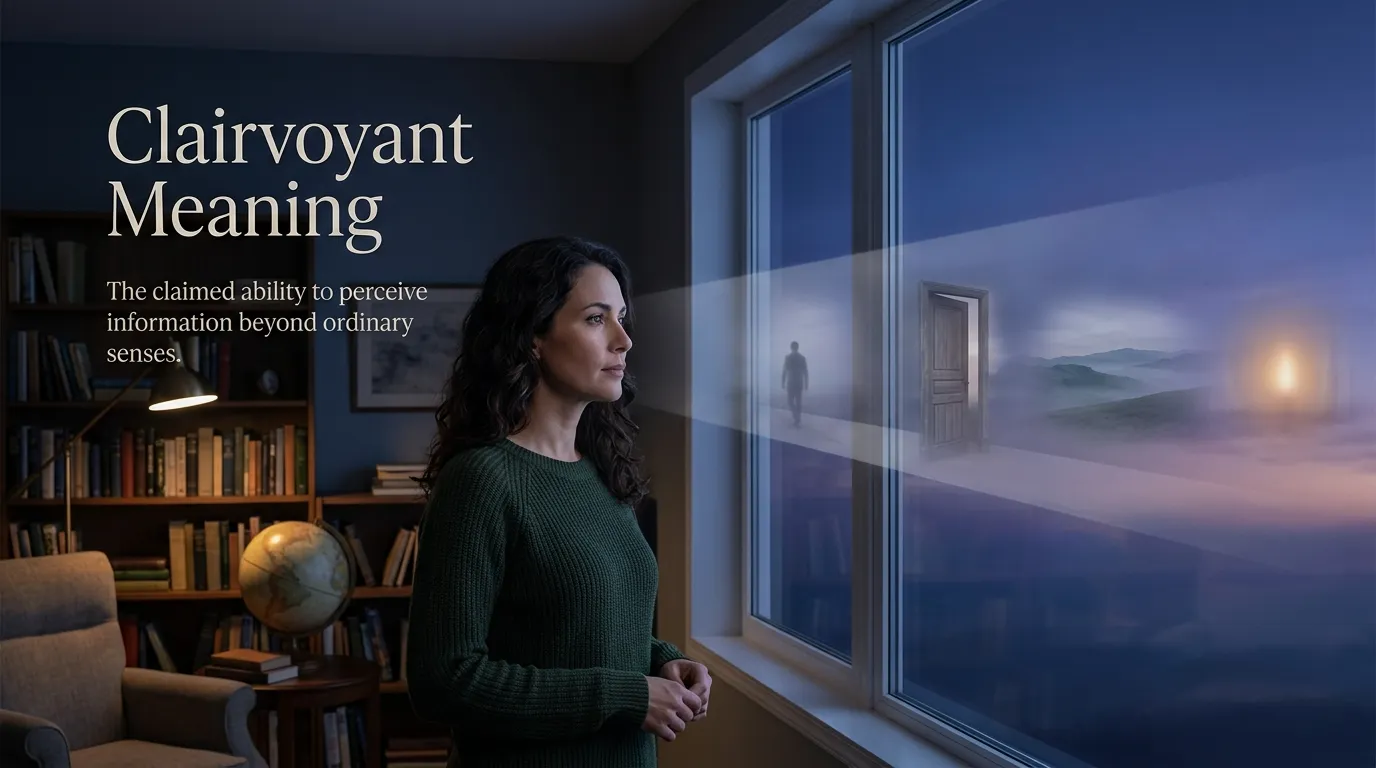
The clairvoyant meaning is generally connected with the claimed ability to perceive information that is not available through the ordinary five senses.
The word is especially common in discussions about psychic abilities, spiritual practices, intuition, extrasensory perception (ESP), and paranormal experiences.
But what does clairvoyant actually mean? Is it the same as being psychic or intuitive? Where did the word come from, and how is it used today?
In this guide, we’ll explore the clairvoyant definition, its French origin, historical background, common examples, related terms, modern usage, and the difference between clairvoyance and ordinary intuition.
We’ll also look at the subject from both cultural and psychological perspectives so you can understand the term without confusing a spiritual belief with scientifically established fact.
What Does Clairvoyant Mean?
Clairvoyant describes a person who is believed to have the ability to perceive information beyond what can normally be detected through the physical senses.
The word can also refer to the supposed ability itself.
In simple terms:
Clairvoyant means having or claiming an ability to perceive people, events, objects, or information through means beyond ordinary sensory perception.
For example, someone might say:
“She claims to be clairvoyant and says she sometimes receives images about future events.”
The important word here is claims. Clairvoyance is associated with paranormal or spiritual beliefs, but it has not been established by mainstream science as a reliable ability.
Clairvoyant Meaning in Simple Words
Think of the word as describing someone who supposedly “sees” information beyond normal sight.
That doesn’t necessarily mean literally seeing something with the eyes. In spiritual or psychic traditions, clairvoyant experiences may reportedly appear as:
- Mental images
- Symbols
- Colors
- Scenes
- Faces
- Locations
- Brief visual impressions
- Dreams or visions
A person who experiences these impressions may interpret them as messages or information from a source beyond ordinary perception.
Clairvoyant Definition
The adjective clairvoyant traditionally refers to someone possessing or claiming clairvoyance, which is commonly described as an alleged form of extrasensory perception.
It can also be used more loosely to describe someone who appears unusually perceptive or able to anticipate events.
For example:
- “The psychic described herself as clairvoyant.”
- “His prediction seemed almost clairvoyant.”
- “She had a clairvoyant impression about the situation.”
The third type of usage can sometimes be metaphorical rather than a literal claim about supernatural ability.
What Is Clairvoyance?
Clairvoyance is the noun form related to clairvoyant.
It is traditionally described as an alleged ability to obtain visual or visual-like information without using ordinary sensory channels.
The term is often discussed alongside other claimed psychic abilities, including:
- Clairaudience alleged perception of sounds or voices beyond ordinary hearing
- Clairsentience alleged perception through feelings or bodily sensations
- Claircognizance alleged sudden knowledge without an obvious source
- Clairalience alleged perception of smells without an identifiable physical source
- Clairgustance alleged perception of tastes without an identifiable physical source
These terms belong largely to spiritual and paranormal vocabulary rather than established scientific categories.
Where Does the Word Clairvoyant Come From?
The word clairvoyant comes from French.
It combines:
- clair “clear”
- voyant “seeing” or “seeing one”
The literal idea is therefore close to “clear-seeing.”
The related English noun clairvoyance developed from the same French roots.
This origin helps explain why clairvoyance is so strongly associated with the idea of seeing information that is hidden, distant, or unavailable through ordinary vision.
History of Clairvoyance
Ideas resembling clairvoyance existed long before the modern word became popular.
Many cultures throughout history have included traditions involving:
- Prophecy
- Visions
- Dreams
- Divination
- Oracles
- Spiritual revelation
- Foreknowledge
However, these practices were not necessarily understood as “clairvoyance” in the modern sense.
Clairvoyance in the 19th Century
The modern concept became especially prominent in Europe and North America during the 19th century, alongside growing interest in Spiritualism and investigations into alleged psychic phenomena.
People became interested in claims involving:
- Mediumship
- Telepathy
- Apparitions
- Remote perception
- Communication with spirits
- Unusual mental experiences
The development of psychical research also encouraged some researchers to investigate these claims more systematically.
Clairvoyance in Modern Culture
Today, clairvoyance appears in many forms of popular culture, including:
- Psychic readings
- Spiritual communities
- Books
- Podcasts
- Television
- Movies
- Fiction
- Social media
- Online spiritual communities
The word has therefore developed both a specific paranormal meaning and a broader cultural meaning connected with unusual intuition and perception.
What Does a Clairvoyant Person Supposedly Experience?
Descriptions vary considerably from one person to another.
People who identify as clairvoyant may report experiencing information through mental imagery rather than physical eyesight.
They might describe:
Mental Images
A person may suddenly visualize a location, object, person, or event.
Symbolic Images
Instead of seeing something literally, they may experience a symbol.
For example, someone might associate a bridge with transition or a door with a new opportunity.
Brief Visual Impressions
Some people describe short flashes of imagery that appear unexpectedly.
Dreams
Certain spiritual traditions interpret unusually vivid or meaningful dreams as possible clairvoyant experiences.
However, a vivid dream by itself does not demonstrate clairvoyance. Dreams can have many psychological and neurological explanations.
Clairvoyant vs. Psychic
The words clairvoyant and psychic are closely related, but they are not identical.
A psychic is a broad term commonly used for someone believed to possess one or more paranormal abilities.
A clairvoyant specifically refers to the claimed ability to perceive information through an unusual visual or visual-like sense.
| Term | General Meaning |
| Psychic | Broad term for alleged paranormal abilities |
| Clairvoyant | Someone believed to receive visual or image-like information |
| Clairaudient | Someone believed to receive information through unusual auditory impressions |
| Intuitive | Someone who relies strongly on instinct or immediate understanding |
| Medium | Someone who claims to communicate with spirits |
So, a clairvoyant may be described as a psychic, but not every person called a psychic is specifically clairvoyant.
Clairvoyant vs. Intuitive
This is one of the most important distinctions.
Intuition is a normal human experience. People can sometimes make rapid judgments based on patterns, memories, emotional signals, and subtle information without consciously analyzing every detail.
For example:
“I had a feeling that something wasn’t right.”
That doesn’t automatically mean the person is clairvoyant.
A clairvoyant claim goes further by suggesting that information was received through an extrasensory or paranormal process.
Simple Difference
Intuition: A feeling or impression that may arise from unconscious processing.
Clairvoyance: A claimed ability to perceive information beyond ordinary sensory processes.
The two can feel similar to the person experiencing them, but they represent different explanations.
Examples of Clairvoyant Experiences
Here are some hypothetical examples showing how the word is commonly used.
Example 1: Seeing an Unknown Place
“During the reading, she said she could see a house surrounded by tall trees.”
The person might interpret the mental image as a clairvoyant impression.
Example 2: Describing Someone
“He claimed to have a clairvoyant image of a person wearing a red jacket.”
Again, this describes a claimed paranormal perception, not scientifically verified evidence.
Example 3: Predicting an Event
“Her friends jokingly called her clairvoyant after she predicted the outcome.”
Here, clairvoyant may be used figuratively to describe someone who made an unusually accurate prediction.
What Is Clairvoyant Mean?
A clairvoyant person is traditionally described as someone who can receive information through visions, images, or impressions that other people cannot perceive.
For example:
“She is believed to be clairvoyant and sometimes sees images of events before they happen.”
In simple words, clairvoyant means “able to see beyond ordinary sight.”
Clairvoyant Meaning in Simple Words
The easiest way to understand the word is:
Clairvoyant = a person who is believed to have a special ability to see or know things that cannot normally be detected.
The word can refer to someone who claims to:
- See future events
- Receive spiritual visions
- Sense information about distant people or places
- Perceive things beyond the five physical senses
- Receive unusual images or impressions
Clairvoyant Meaning in Everyday Language
You don’t have to be discussing psychic abilities to use the word.
Sometimes clairvoyant is used humorously or metaphorically.
For example:
“I’m not clairvoyant, I couldn’t possibly have known you’d arrive early.”
In this sentence, the speaker isn’t necessarily claiming a supernatural ability. They’re joking about not being able to know something in advance.
Another example:
“You must be clairvoyant; I was just about to call you.”
This is a playful way of saying someone seemed to know what was going to happen.
Clairvoyant Meaning in Spirituality
Within spiritual communities, clairvoyance is often viewed as one type of intuitive or psychic perception.
Some practitioners believe clairvoyant impressions can help people:
- Reflect on personal situations
- Explore emotions
- Understand relationships
- Consider possible future outcomes
- Connect with spiritual beliefs
- Gain personal insight
Interpretations vary widely between traditions.
It is useful to remember that spiritual interpretation and scientific evidence are not the same thing. A person can find an experience personally meaningful without that experience being scientifically proven to have a paranormal cause.
Clairvoyant Meaning in Psychology
Psychology approaches unusual perceptions differently.
A person may experience vivid mental imagery, strong intuitions, coincidences, dreams, or a powerful sense of knowing for many possible reasons.
Potential explanations can include:
- Pattern recognition
- Memory
- Expectation
- Confirmation bias
- Unconscious processing
- Coincidence
- Imagination
- Emotional sensitivity
For example, someone may remember their accurate predictions more strongly than their inaccurate ones. This can make their apparent predictive ability seem greater over time.
This doesn’t mean every personal experience is meaningless. It simply means that an unusual experience does not automatically prove a paranormal explanation.
Is Clairvoyance Scientifically Proven?
There is no broadly accepted scientific evidence establishing clairvoyance as a reliable paranormal ability.
Researchers have investigated various forms of claimed extrasensory perception, but the subject remains controversial and is not accepted as an established scientific ability.
This distinction is important when writing or speaking about clairvoyance:
- Spiritual traditions may accept it as real.
- Some individuals report personal experiences they interpret as clairvoyant.
- Mainstream science does not currently recognize clairvoyance as a reliably demonstrated paranormal ability.
A balanced explanation should acknowledge these different perspectives without presenting an unproven claim as established fact.
Common Misconceptions About Clairvoyance
Myth 1: Clairvoyants Literally See the Future
Not necessarily.
Some people who identify as clairvoyant claim to receive information about possible future events, but the concept is broader than simply predicting the future.
Myth 2: Clairvoyance Means Perfect Predictions
A clairvoyant claim does not imply that every impression is accurate.
Different traditions describe impressions as incomplete, symbolic, or open to interpretation.
Myth 3: Clairvoyance and Intuition Are Exactly the Same
They’re related in everyday conversation but conceptually different.
Intuition can occur through ordinary psychological processes, while clairvoyance generally implies extrasensory perception.
Myth 4: Every Vivid Dream Is Clairvoyant
A vivid dream is not automatically evidence of clairvoyance.
Dreams can reflect memories, emotions, concerns, imagination, and normal brain activity during sleep.
How Is Clairvoyant Used in a Sentence?
Here are several natural examples:
- “She described herself as clairvoyant.”
- “His prediction was so accurate that his friends jokingly called him clairvoyant.”
- “The clairvoyant claimed to see an image of a distant location.”
- “I’m not clairvoyant, so I couldn’t have known what you were planning.”
- “The novel portrays its main character as a clairvoyant.”
- “She believed her recurring visions were clairvoyant experiences.”
- “The movie features a clairvoyant who receives mysterious images.”
- “He made a surprisingly accurate guess, but that doesn’t make him clairvoyant.”
Clairvoyant, Clairvoyance, and Psychic: Word Forms
Understanding the related forms makes the vocabulary easier to remember.
| Word | Part of Speech | Meaning |
| Clairvoyant | Noun/Adjective | A person believed to have clairvoyant abilities; relating to clairvoyance |
| Clairvoyance | Noun | The alleged ability itself |
| Psychically | Adverb | In a manner associated with psychic perception |
| Psychic | Noun/Adjective | A broader term relating to alleged paranormal abilities |
For example:
Clairvoyant: “She is a clairvoyant.”
Clairvoyance: “She claims to have clairvoyance.”
Synonyms and Related Words
There is no perfect synonym for clairvoyant, but several words may overlap depending on context.
Related terms include:
- Psychic
- Seer
- Visionary
- Oracle
- Medium
- Intuitive
- Perceptive
- Prophetic
These words are not interchangeable in every situation.
For example, a medium traditionally refers to someone who claims to communicate with spirits, while a clairvoyant is associated more specifically with alleged visual perception.
Clairvoyant in Popular Culture
The concept of clairvoyance has become a familiar storytelling device.
Books, movies, and television shows often use clairvoyant characters to explore themes such as:
- Fate
- Free will
- Mystery
- Fear
- Destiny
- Hidden knowledge
- The future
- Human uncertainty
Fiction often exaggerates clairvoyant abilities for dramatic effect. A character may instantly know exactly what will happen, while real-world accounts of clairvoyant experiences are generally much less clear and predictable.
Quick Facts About Clairvoyant Meaning
| Feature | Key Information |
| Meaning | A person believed to perceive information beyond ordinary senses |
| Word origin | French |
| Literal idea | “Clear-seeing” |
| Related noun | Clairvoyance |
| Common context | Psychic and spiritual discussions |
| Broader usage | Sometimes metaphorical or humorous |
| Related term | Psychic |
| Scientific status | Not established as a reliable paranormal ability |
| Common imagery | Visions, symbols, mental images |
| Main distinction | Different from ordinary intuition |
FAQs
What does clairvoyant mean in simple words?
Clairvoyant means someone who is believed to perceive information beyond the ordinary senses, often through mental images or visions.
What is the difference between psychic and clairvoyant?
Psychic is a broad term for someone believed to have paranormal abilities. Clairvoyant refers more specifically to the claimed ability to receive visual or image-like information beyond normal sensory perception.
What does clairvoyance mean spiritually?
In spiritual contexts, clairvoyance is often understood as a form of intuitive or psychic perception involving images, visions, symbols, or visual impressions. Different spiritual traditions interpret it differently.
Is clairvoyance the same as intuition?
No. Intuition is a common human experience that can involve unconscious pattern recognition and rapid judgment. Clairvoyance generally refers to a claimed paranormal or extrasensory ability.
Where does the word clairvoyant come from?
The word comes from French, combining clair, meaning “clear,” with voyant, meaning “seeing” or “seeing one.”
Can clairvoyants see the future?
Some people who identify as clairvoyant claim to receive information about future events. However, this is a belief or claim rather than an ability established by mainstream scientific evidence.
Is clairvoyance scientifically proven?
Clairvoyance has been investigated as part of research into claimed extrasensory perception, but it is not recognized by mainstream science as a reliably demonstrated paranormal ability.
What is another word for clairvoyant?
Depending on context, related words include psychic, seer, visionary, oracle, and intuitive. These words have different meanings, so they should not always be treated as exact synonyms.
Can clairvoyant be used as an adjective?
Yes. For example:
“The story follows a clairvoyant character who experiences mysterious visions.”
What is the noun form of clairvoyant?
The related noun is clairvoyance, which refers to the alleged ability itself.
Conclusion
The clairvoyant meaning centers on the claimed ability to perceive information beyond ordinary sensory experience, especially through mental images, visions, or visual impressions.
The word comes from French roots meaning roughly “clear-seeing” and is closely associated with psychic and spiritual traditions.
At the same time, clairvoyance should be distinguished from intuition, imagination, dreams, and ordinary pattern recognition.
People may interpret unusual experiences spiritually, while psychology and science may explore alternative explanations.
Understanding these distinctions makes it easier to use clairvoyant, clairvoyance, and related terms accurately if you’re reading about spirituality, discussing psychic abilities, analyzing a novel, or simply using the word in everyday conversation.

I am Sophia Bennett, is a digital resources and online tools writer at LinkVistaHub. She enjoys exploring useful websites, emerging digital tools, productivity platforms, and practical online resources that help people work smarter and discover valuable information.