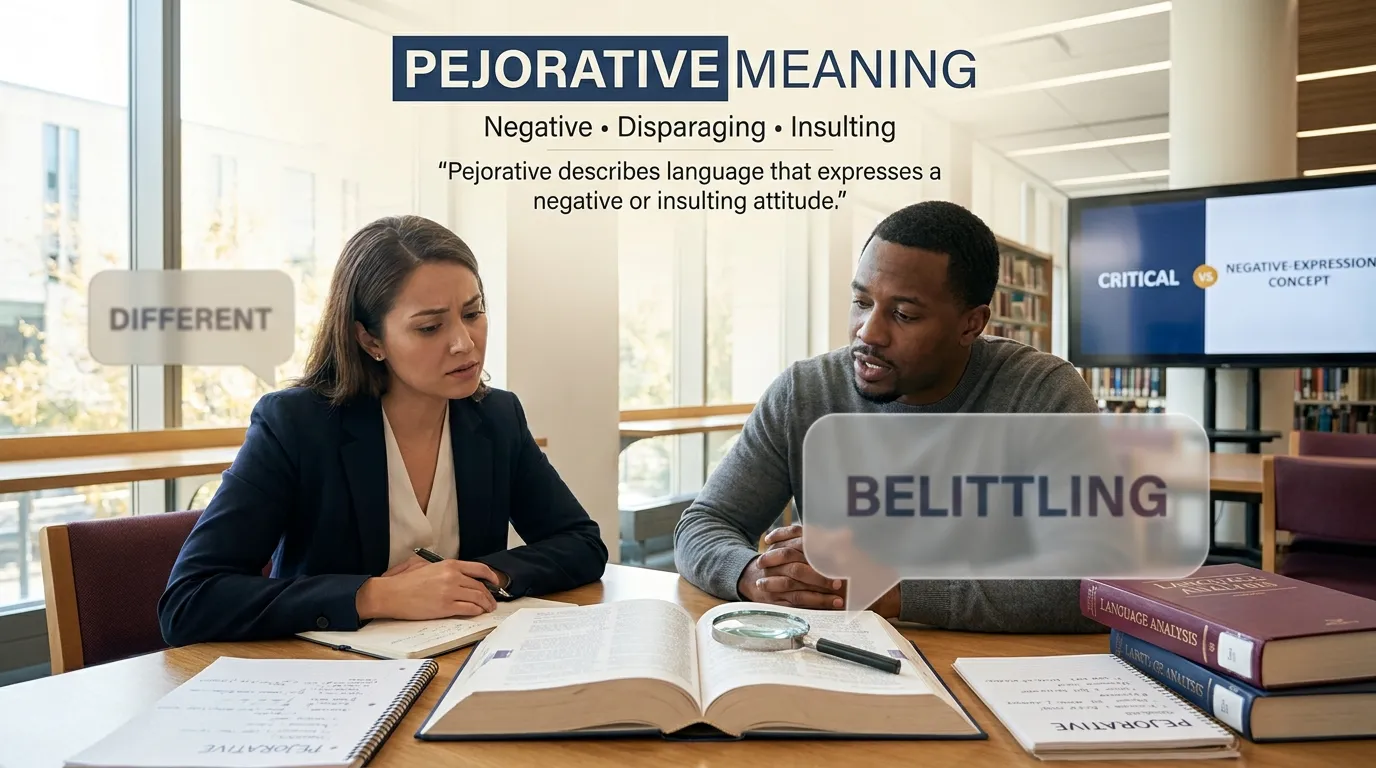
Have you ever heard someone describe a word, nickname, comment, or expression as pejorative and wondered what they actually meant? The pejorative meaning of a word is usually negative, insulting, dismissive, or disrespectful. A pejorative term does more than identify a person, group, object, or idea; it often communicates disapproval, contempt, criticism, or a low opinion.
Understanding what pejorative means is useful because language can carry emotional meaning beyond a dictionary definition. A word may appear neutral in one context but become derogatory, offensive, or insulting in another. This is especially important when reading news articles, academic writing, social media posts, workplace communication, or everyday conversations.
In simple terms, pejorative means expressing a negative judgment or showing that something is considered inferior, unpleasant, or undesirable. For example, calling someone’s idea “ridiculous” can be pejorative because the word expresses strong disapproval rather than simply describing the idea.
This guide explains the pejorative definition, its origin, examples, synonyms, antonyms, common contexts, and differences from related terms such as derogatory, disparaging, and insulting. By the end, you’ll know exactly when and how the word is used.
What Does Pejorative Mean?
Pejorative means expressing a negative opinion, criticism, disrespect, or contempt toward someone or something.
It can describe either:
- A word or expression with a negative or insulting sense
- A tone or statement that puts someone or something down
- A meaning that has become more negative over time
Pejorative Meaning in Simple Words
In simple English, pejorative means “negative or insulting in meaning.”
For example:
“That term is pejorative.”
This means the term is considered disrespectful, insulting, or negative.
Another example:
“He used a pejorative description of his former employer.”
This means he described his former employer using negative or disparaging language.
Quick Definition
| Term | Meaning |
| Pejorative | Negative, insulting, or expressing disapproval |
| Part of speech | Adjective and noun |
| Pronunciation | /pɪˈdʒɔːrətɪv/ |
| Tone | Usually negative |
| Common contexts | Language, criticism, politics, media, academia, everyday speech |
| Synonyms | Derogatory, disparaging, insulting, demeaning |
| Antonyms | Complimentary, positive, approving, laudatory |
What Is a Pejorative Term?
A pejorative term is a word or expression that carries a negative or insulting connotation.
For example, some words may identify a group or behavior while also suggesting that the speaker views it negatively. The important point is that a pejorative term does not merely describe what it evaluates.
Consider these examples:
- “Lazy” can be pejorative when used to criticize someone’s work ethic.
- “Fool” can be pejorative when used to insult someone’s intelligence.
- “Wannabe” can be pejorative when used to dismiss someone as an imitation.
- “Junk” can be pejorative when describing something as worthless or poor quality.
if a particular expression is pejorative can depend on context, speaker intention, audience, history, and tone.
Pejorative Meaning vs. Literal Meaning
One of the easiest ways to understand pejorative language is to distinguish literal meaning from connotation.
The literal meaning is what a word directly identifies. The connotation is the feeling, attitude, or association attached to it.
For example, two words may refer to a similar type of person but have very different emotional effects.
| Expression | Basic reference | Possible tone |
| Young person | A person who is young | Neutral |
| Kid | Young person | Informal, usually neutral |
| Brat | Misbehaving child | Negative |
| Child | Young person | Neutral |
| Spoiled brat | Child perceived as entitled | Strongly negative |
The difference is not simply what the words refer to. It is how the speaker presents the subject.
Where Does the Word Pejorative Come From?
The word pejorative comes from the Latin pejor, meaning “worse.”
Its history reflects the idea of making something seem worse, lower, or less valuable.
The related verb pejorate means to make something worse or to cause it to deteriorate. In language studies, pejoration refers to a change in meaning in which a word develops a more negative sense over time.
This gives us an important linguistic distinction.
Pejorative Language
This refers to language that is negative or disparaging.
Pejoration
This refers to a historical change in meaning in which a word becomes more negative.
These concepts are related but are not identical.
What Is Pejoration in Linguistics?
Pejoration is a semantic change where a word’s meaning becomes more negative over time.
Language constantly evolves. Words can become more positive, more negative, broader, narrower, or simply different in meaning.
A word may begin with a relatively neutral meaning and later acquire a negative association.
This is why dictionaries sometimes list historical, archaic, or offensive meanings separately from modern meanings.
Pejoration can happen because of:
- Social attitudes
- Cultural changes
- Stereotypes
- Political developments
- Class distinctions
- Changes in common usage
- Repeated association with negative ideas
Understanding pejoration helps explain why some words that once sounded ordinary may now be perceived as offensive or dismissive.
Pejorative Meaning in Everyday Language
You encounter pejorative language much more often than you may realize.
People use negative expressions when they:
- Criticize someone’s behavior
- Express frustration
- Mock another person
- Dismiss an idea
- Describe something as inferior
- Show disagreement
- Make sarcastic comments
- Attack someone’s reputation
For example:
“He called the proposal a joke.”
The word “joke” can be neutral in many contexts, but here it is being used pejoratively because the speaker is dismissing the proposal as ridiculous or worthless.
Another example:
“She described the restaurant as a dump.”
“Dump” is pejorative because it communicates a strongly negative opinion about the restaurant.
Pejorative Meaning in Text Messages
In texting, people frequently use informal words that can carry pejorative meanings.
For example:
Person A: “Did you see his presentation?”
Person B: “Yeah, it was terrible.”
“Terrible” is pejorative because it expresses a negative evaluation.
Another example:
Person A: “Why did he quit?”
Person B: “He said the company was a mess.”
The phrase “a mess” is pejorative in this context because it criticizes the company.
Texting can make pejorative language harder to interpret because tone is missing. A sarcastic comment may sound serious, while a playful insult between friends may not be intended as genuinely offensive.
Pejorative Meaning on Social Media
Social media has made the study of pejorative language even more relevant.
On platforms such as Instagram, TikTok, Reddit, Discord, and X, users often communicate through:
- Slang
- Sarcasm
- Memes
- Nicknames
- Short comments
- Irony
- Reaction phrases
- Insults
A phrase may be harmless within one online community but offensive in another.
For example, users might call a poorly designed product “trash.” In casual online language, this can function as a pejorative expression meaning the product is extremely poor.
However, context matters.
A person might jokingly say:
“This game is trash, but I can’t stop playing it.”
Here, “trash” is still negative, but the overall statement may be humorous rather than seriously hostile.
Pejorative Meaning in the Workplace
Pejorative language can be especially important in professional communication.
Calling a coworker’s proposal:
- “stupid”
- “ridiculous”
- “amateurish”
- “pointless”
may communicate criticism, but these expressions can also damage professional relationships.
A more constructive approach is to criticize the specific problem rather than attack the person.
Instead of:
“That’s a stupid idea.”
A professional alternative would be:
“I don’t think this approach addresses the main issue.”
The second sentence communicates disagreement without using an unnecessarily pejorative label.
Pejorative vs. Derogatory
Pejorative broadly refers to language that expresses a negative judgment or unfavorable attitude.
Derogatory more strongly emphasizes disrespect, belittlement, or insult.
For example:
“The word has a pejorative meaning.”
This focuses on the negative meaning associated with the word.
“He made a derogatory comment about his colleague.”
This emphasizes that the comment was disrespectful or insulting.
Simple Difference
Pejorative = negative or unfavorable
Derogatory = disrespectfully negative or belittling
There is considerable overlap between the two.
Pejorative vs. Disparaging
Disparaging means speaking about someone or something in a way that shows it is unimportant, inferior, or unworthy.
For example:
“She made disparaging remarks about the competitor.”
This means she spoke negatively about the competitor in a way that belittled it.
Pejorative is often used when discussing the language itself, especially in linguistics.
“The expression has a pejorative connotation.”
Disparaging more often describes the act of criticizing or belittling.
Pejorative vs. Insulting
The words are related, but they emphasize different things.
Insulting usually means offensive or disrespectful toward a person.
The pejorative is broader. It can describe language about:
- People
- Groups
- Ideas
- Objects
- Behaviors
- Institutions
- Concepts
For example:
“That is an insulting comment.”
The comment directly offends someone.
“That word has a pejorative connotation.”
The word carries a negative meaning.
Pejorative vs. Negative
Not every negative statement is necessarily pejorative.
Consider:
“The laptop battery lasts only four hours.”
This is negative information, but it is not necessarily pejorative.
Now consider:
“That laptop is a pathetic piece of junk.”
This is clearly pejorative because the speaker uses emotionally negative language to belittle the product.
The distinction is useful:
Negative information can simply describe an unfavorable fact.
Pejorative language expresses a negative evaluation or attitude.
Positive and Negative Connotations
Pejorative language is closely connected to connotation.
A word can have:
- Positive connotation
- Negative connotation
- Neutral connotation
Consider:
| Word | Possible connotation |
| Confident | Positive |
| Assertive | Usually positive or neutral |
| Arrogant | Negative / pejorative |
| Economical | Positive or neutral |
| Cheap | Often negative, depending on context |
| Frugal | Usually positive |
| Persistent | Positive |
| Stubborn | Often negative |
These words may describe related behaviors, but their connotations differ.
Examples of Pejorative Words
Here are common examples of words that can be used pejoratively:
- Fool
- Idiot
- Jerk
- Brat
- Loser
- Coward
- Snob
- Wannabe
- Cheap
- Pathetic
- Ridiculous
- Useless
- Lazy
- Clueless
- Arrogant
- Miserable
- Worthless
- Incompetent
Not every use of these words has exactly the same force. Some may be playful among friends, while others can be deeply offensive in serious situations.
Real-Life Examples of Pejorative Language
Example 1: Criticizing an Idea
“That proposal is ridiculous.”
“Ridiculous” is pejorative because it expresses strong negative judgment.
Example 2: Criticizing a Person
“He’s an arrogant fool.”
Both “arrogant” and “fool” carry negative evaluations.
Example 3: Criticizing an Object
“This phone is junk.”
“Junk” is pejorative because the speaker is dismissing the phone as worthless or poor quality.
Example 4: Describing Behavior
“Stop acting like a brat.”
“Brat” is pejorative because it negatively characterizes someone’s behavior.
Example 5: Professional Disagreement
“That was an amateurish presentation.”
“Amateurish” can be pejorative because it implies poor skill or professionalism.
How Context Changes Pejorative Meaning
Context is one of the most important factors in understanding pejorative language.
The same word can be:
- Serious
- Playful
- Sarcastic
- Affectionate
- Insulting
- Humorous
depending on the situation.
Imagine two close friends saying:
“You idiot!”
They might be joking.
Now imagine a manager saying the same thing to an employee during a disciplinary meeting.
The social meaning is very different.
When interpreting a potentially pejorative expression, consider:
- Who said it?
- Who was the target?
- What was the relationship between them?
- What was the surrounding conversation?
- Was the speaker joking?
- Was the expression historically associated with discrimination or stigma?
- How did the listener interpret it?
Can a Pejorative Word Be Used Positively?
Sometimes a word with a normally negative meaning can be used humorously or affectionately.
For example, friends may jokingly call each other:
“You absolute menace.”
The word “menace” normally suggests someone who causes trouble. But between close friends, it can become playful.
This does not necessarily erase the word’s pejorative meaning. Instead, context changes how the expression functions.
This phenomenon is common in informal speech, online communities, comedy, and close relationships.
Common Misconceptions About Pejorative Meaning
Misconception 1: Every Negative Word Is an Insult
Not necessarily.
A word can express criticism without directly insulting a person.
Misconception 2: Pejorative Always Means Offensive
Not always.
Some pejorative expressions are mild, humorous, or context-dependent.
Misconception 3: Pejorative and Derogatory Are Completely Different
They overlap significantly.
“Derogatory” usually carries a stronger sense of belittling or disrespect, while “pejorative” is a broader linguistic term.
Misconception 4: A Word Is Always Pejorative
Meaning depends on context.
A word may have a negative connotation in one setting and a neutral or playful meaning in another.
Misconception 5: Pejorative Only Applies to People
No.
Pejorative language can describe ideas, products, behaviors, institutions, groups, and situations.
How to Identify a Pejorative Expression
When you’re unsure if a word is pejorative, ask these questions:
- Does the word express disapproval?
- Does it make the subject seem inferior?
- Does it communicate contempt or disrespect?
- Does it have a negative connotation?
- Would a neutral alternative communicate the same basic information?
- Could the word be interpreted as belittling?
If the answer to several of these questions is yes, the expression may be functioning pejoratively.
How to Avoid Pejorative Language
If you are writing professionally, academically, or publicly, you may want to avoid unnecessarily pejorative wording.
Instead of attacking a person, focus on:
- Evidence
- Behavior
- Specific problems
- Measurable results
- Clear observations
For example:
Pejorative:
“The company has a clueless management team.”
More objective:
“The company’s management has made several decisions that employees have criticized as ineffective.”
The second statement is more precise and easier to support with evidence.
Why Pejorative Language Matters
Pejorative language can influence how people perceive:
- Individuals
- Social groups
- Political ideas
- Brands
- Products
- Institutions
- Historical events
Words do not simply communicate information. They can also frame the way information is understood.
For example, describing a person as a “reformer” and describing the same person as a “troublemaker” can create very different impressions.
This is why journalists, researchers, advertisers, politicians, and writers pay close attention to word choice.
Pejorative Language in Media and Politics
Political communication frequently involves emotionally loaded language.
A political opponent may be described as:
- Radical
- Extremist
- Elitist
- Opportunist
- Puppet
- Bureaucrat
if a particular word is pejorative depends on context and speaker perspective.
In media analysis, recognizing such language helps readers separate description from evaluation.
A useful question is:
“Is this word simply identifying the subject, or is it telling me how I should feel about the subject?”
That question can reveal hidden evaluative language.
Pejorative Meaning in Academic Writing
In academic writing, the term pejorative is often used to discuss language objectively.
For example:
“The term gradually developed a pejorative sense.”
This does not mean the academic writer personally dislikes the term. Instead, the writer is describing its semantic history or social connotation.
Academic discussions may also examine:
- Semantic change
- Language attitudes
- Euphemism
- Dysphemism
- Social stigma
- Language prejudice
- Connotation
- Pragmatics
- Sociolinguistics
Related Terms You Should Know
Derogatory
Expressing disrespect or belittling someone or something.
Disparaging
Showing that someone or something is considered inferior or unimportant.
Demeaning
Reducing someone’s dignity, value, or status.
Contemptuous
Showing strong disrespect or lack of respect.
Insulting
Likely to offend or hurt someone’s feelings.
Offensive
Likely to cause anger, hurt, or discomfort.
Denigrating
Describing someone or something as unimportant or inferior.
Disapproving
Expressing a negative judgment without necessarily being insulting.
Pejorative Antonyms
The opposite of pejorative language can include:
- Complimentary
- Praising
- Positive
- Approving
- Laudatory
- Respectful
- Admiring
- Favorable
- Appreciative
- Affirming
For example:
“She used complimentary language to describe the team’s work.”
This contrasts with:
“She used pejorative language to describe the team’s work.”
Pejorative Meaning: Key Facts at a Glance
| Fact | Answer |
| Meaning | Negative, disparaging, or insulting |
| Primary use | Describing words, expressions, or attitudes |
| Origin | Latin pejor, meaning “worse” |
| Related concept | Pejoration |
| Tone | Usually negative |
| Common settings | Everyday speech, media, academia, politics, social media |
| Main synonyms | Derogatory, disparaging, demeaning |
| Main antonyms | Complimentary, favorable, approving |
| Depends on context? | Yes |
| Can it be humorous? | Yes, depending on context |
Frequently Asked Questions About Pejorative Meaning
1. What does pejorative mean in simple English?
Pejorative means negative, insulting, or expressing disapproval. A pejorative word or phrase makes someone or something sound inferior, undesirable, foolish, or otherwise unfavorable.
2. Is pejorative a bad word?
No. “Pejorative” itself is not a bad or offensive word. It is a neutral term used to describe language that has a negative or disparaging meaning.
3. What is an example of a pejorative word?
Words such as “loser,” “brat,” “fool,” “pathetic,” and “worthless” can be pejorative when they are used to express contempt or negative judgment.
4. What is the difference between pejorative and derogatory?
Both refer to negative language. Pejorative is a broad term for language expressing a negative evaluation, while derogatory often emphasizes disrespect, belittlement, or insult.
5. Is pejorative the opposite of positive?
Generally, yes. In discussions of meaning and connotation, pejorative describes negative or unfavorable language, while positive or complimentary language expresses approval or admiration.
6. Can a joke be pejorative?
Yes. A joke can use pejorative language if it negatively characterizes or belittles its target. However, humor and relationships can affect how the expression is interpreted.
7. What is a pejorative connotation?
A pejorative connotation is a negative emotional or social association attached to a word beyond its basic literal meaning.
8. What is pejoration in linguistics?
Pejoration is a type of semantic change in which a word develops a more negative meaning or connotation over time.
9. Can pejorative words be used affectionately?
Sometimes. Friends, family members, and online communities may use normally negative expressions playfully. The relationship, tone, context, and shared understanding determine how the expression is received.
10. How do I know if a word is pejorative?
Look at its connotation, context, target, speaker’s intention, and effect. If the expression communicates contempt, disapproval, inferiority, or belittlement, it may be functioning pejoratively.
Conclusion
The pejorative meaning of a word is essentially its negative, disparaging, or insulting sense. Pejorative language does more than describe something; it often communicates the speaker’s unfavorable attitude toward it.
Understanding this concept can make you a more careful reader, writer, and communicator. It helps you recognize the difference between neutral description and emotional judgment, especially in social media, journalism, politics, workplace communication, and everyday conversation.
Remember the simplest definition:
Pejorative means expressing a negative or unfavorable judgment.
The word itself comes from the Latin pejor, meaning “worse,” and its linguistic counterpart, pejoration, describes the process by which a word develops a more negative meaning over time.
When you encounter a word that seems insulting or dismissive, don’t look only at its dictionary definition. Consider its connotation, context, tone, speaker, audience, and history. Those factors often determine if a term is functioning as neutral language or as a pejorative expression.
In short, learning what pejorative means gives you a sharper understanding of how words influence attitudes and shape communication. The better you recognize these subtle differences, the more effectively you can choose language that is clear, respectful, and appropriate for the situation.

I am Alex Carter, is a web resources and digital tools writer at Linkvistahub. He enjoys discovering useful websites, online tools, productivity resources, and practical digital solutions that can make everyday tasks easier.