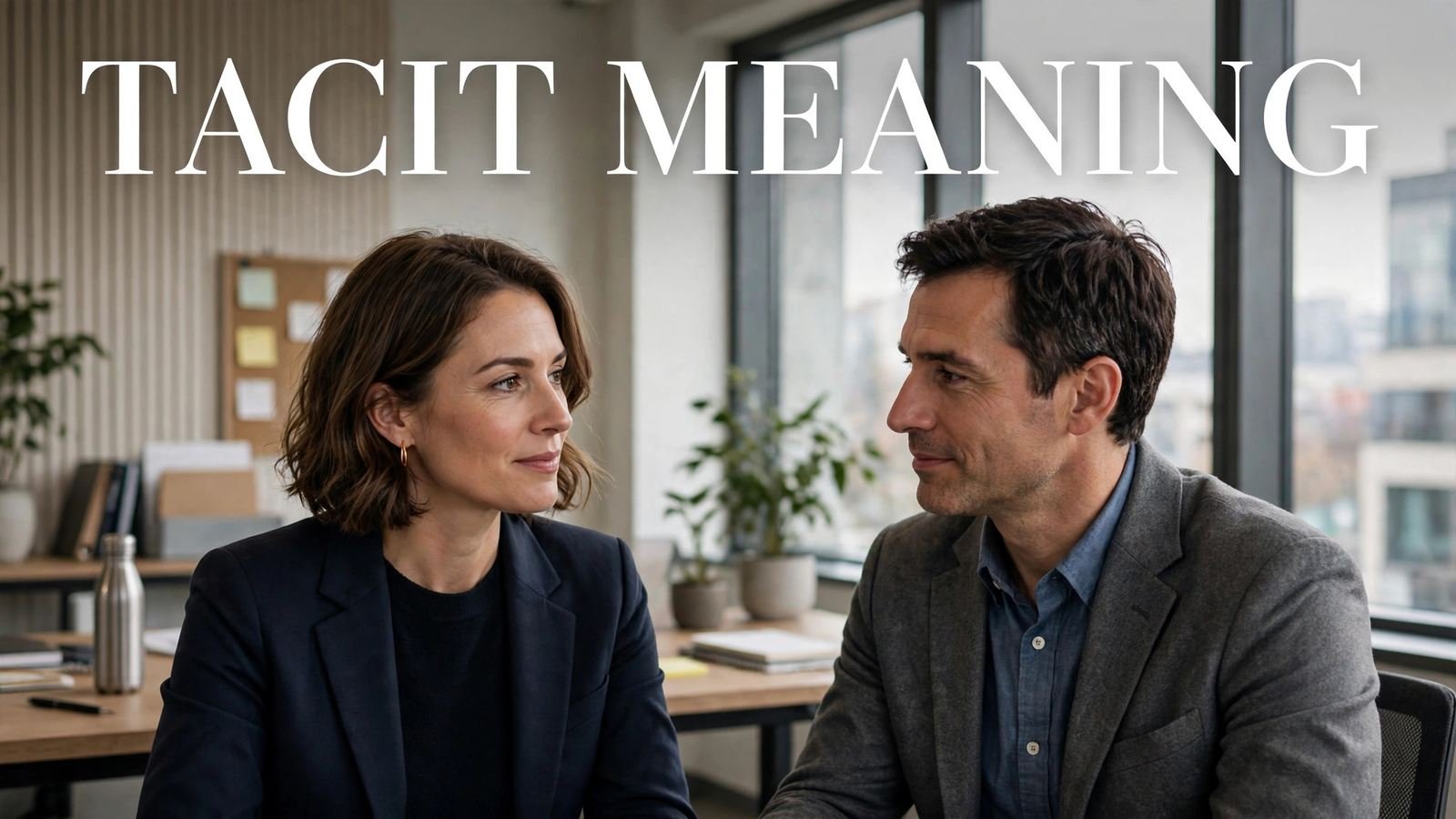
Some of the strongest agreements in life are never spoken out loud. A team knows who leads in a crisis without holding a vote. A parent and child agree on a rule without ever writing it down.
English has a precise word for this silent kind of understanding, and understanding the tacit meaning helps you spot it everywhere, in workplaces, families, contracts, and conversations.
Tacit means understood or implied without being said directly. If something is tacit, nobody stated it in words, yet everybody involved knows it is there.
The word appears most often in phrases such as tacit agreement, tacit approval, and tacit knowledge, a famous idea in business and psychology about skills people carry in their heads but cannot fully explain.
So what is the tacit meaning in simple terms, where does the word come from, and how do you use it correctly in a sentence?
This guide covers the definition, the Latin origin, the different uses, real examples from work and daily life, the difference between tacit and explicit, and the mistakes learners often make with this quiet but powerful word.
What Is the Tacit Meaning?
Tacit means understood, implied, or agreed without being expressed in words. It describes something that is not stated openly, yet is clearly understood by the people involved.
In simple English, tacit means “unspoken but understood.” If two colleagues have a tacit understanding, they never signed a paper or made a speech about it. They simply both know how things work between them.
The word almost always describes ideas, agreements, and knowledge, not physical objects. You will hear about tacit support, tacit consent, and tacit approval far more often than about anything you can touch.
Three quick examples show the core sense:
- The manager never announced the rule, but there was a tacit agreement that nobody scheduled meetings on Friday afternoons.
- By staying silent during the vote, the committee gave its tacit approval to the plan.
- Her years of experience gave her a tacit knowledge of customers that no training manual could teach.
How to Pronounce Tacit
Tacit is pronounced “TAS-it.” The first syllable sounds like the start of “tassel,” and the second syllable is a short “it.”
A few points on spelling and form:
- The correct spelling is tacit, with a c in the middle.
- It is often confused with tactic, a different word that means a plan or method. The two sound close but share no meaning.
- Tacit is an adjective, so it describes a noun: a tacit rule, a tacit signal, a tacit promise.
- Its adverb form is tacitly, as in “they tacitly agreed to drop the subject.”
Where the Word Tacit Comes From
The Latin Root
Tacit comes from the Latin word “tacitus,” which means silent, unspoken, or kept quiet. Tacitus itself comes from “tacere,” the Latin verb meaning to be silent.
The meaning has stayed remarkably stable for centuries. From Latin, the word passed into French as “tacite” and entered English in the late 1500s, already carrying the sense of something understood without words.
A Famous Roman Namesake
Latin speakers will recognize the name Tacitus, the great Roman historian who wrote the “Annals” and the “Histories.” His family name came from the same root and roughly meant “the silent one,” which is an amusing label for a man who wrote some of the most quoted history in the ancient world.
The shared root is a useful memory trick. Anything connected with tacit has silence at its core.
Why the Word Still Matters
Modern life runs on unspoken rules. Offices, friendships, markets, and even countries coordinate through signals that nobody announces. English keeps the word tacit because no simpler word covers this exact idea: real, binding, and understood, yet never said.
The Main Uses of Tacit
Tacit Agreement and Tacit Understanding
This is the most common use. A tacit agreement is a deal that people honor without ever stating it. No contract, no handshake speech, just shared behavior that shows both sides accept the arrangement.
Roommates often have a tacit agreement about dishes. Business partners may have a tacit understanding about who speaks first in client meetings. Countries sometimes keep a tacit agreement to avoid escalating a dispute, even while they argue in public.
Because nothing is written, tacit agreements depend on trust and habit. They work well until one side breaks the pattern, and then the other side feels the violation sharply, precisely because the rule was understood by everyone.
Tacit Approval, Consent, and Support
Tacit approval means approval shown by silence or by the absence of objection. If a proposal is announced, questions are invited, and nobody objects, leaders often read the silence as tacit consent.
The same logic applies to tacit support. A senior leader who attends a junior colleague’s presentation and says nothing negative afterward may be offering tacit support: present, visible, and understood, without a single word of praise.
This use carries a warning. Silence can be misread. Smart communicators confirm important approvals in writing instead of relying only on what silence seemed to say.
Tacit Knowledge
Tacit knowledge is the most famous idea attached to the word. The philosopher Michael Polanyi introduced it in the 1950s and summed it up in one line: “We can know more than we can tell.”
Tacit knowledge is skill and judgment gained through experience that a person cannot fully write down. Examples include:
- Riding a bicycle and keeping your balance without thinking about physics
- A doctor sensing that a patient “does not look right” before test results arrive
- A chef knowing by smell and sound that a pan is ready
- A salesperson reading a customer’s mood in the first ten seconds
Businesses care deeply about tacit knowledge because it walks out of the door when experienced employees leave. Companies try to convert it into manuals, training, and mentoring, a process the management thinker Ikujiro Nonaka later described as turning tacit knowledge into explicit knowledge.
Tacit Meaning in Everyday Life: Real Examples
At work: Two teammates never discussed it, but both know the senior engineer reviews every big decision before it ships. That is a tacit rule of the team.
In families: Many households have a tacit understanding that the person who cooks does not wash up. Nobody voted on it. It simply became the way things are done.
In friendships: Close friends often hold a tacit agreement that some topics stay off the table. The friendship survives because both sides respect a boundary that was never announced.
In law and business: Courts and regulators sometimes discuss tacit consent, where a person’s actions or silence in a clear situation count as agreement. Because real money and rights are involved, professionals treat this area carefully and prefer written terms.
In politics and diplomacy: Rival countries sometimes keep a tacit understanding about limits neither side will cross. The arrangement is real and stabilizing, even if officials deny on camera that any deal exists.
Example Sentences With Tacit
- There was a tacit agreement in the office that the last person to leave locked the doors.
- Her nod gave tacit approval to the suggestion, and the meeting moved on.
- The two companies reached a tacit understanding and quietly stopped undercutting each other’s prices.
- He offered tacit support by attending every hearing, even though he never spoke.
- Much of a craftsperson’s skill is tacit knowledge, learned by watching and doing.
- By not objecting, the board gave its tacit consent to the budget.
- The couple had a tacit rule: arguments ended before midnight, no matter what.
- The reviewer praised the design and ignored the flaws, which the team read as tacit criticism of the writing.
Tacit vs. Explicit
Tacit and explicit are opposites, and seeing them side by side fixes the meaning fast.
- Tacit: implied, unspoken, understood from behavior or silence. Example: a tacit agreement.
- Explicit: stated clearly and directly, in plain words, leaving nothing to guess. Example: an explicit written contract.
Everyday life mixes the two. Healthy workplaces make the important things explicit, in writing, and let small courtesies stay tacit. Confusion starts when people treat a big commitment as tacit and later discover that the other side understood something different.
A useful rule of thumb: the higher the stakes, the more explicit the agreement should be.
Tacit vs. Taciturn vs. Tactic
Three similar words cause regular confusion.
Tacit vs. taciturn: Tacit describes understandings, agreements, and knowledge. Taciturn describes a person who speaks very little by habit. A taciturn manager might create many tacit rules, but the words are not interchangeable.
Tacit vs. tactic: A tactic is a planned action used to reach a goal, as in a marketing tactic or a chess tactic. Tacit is about silence and implication. The spelling differs by one letter, and the meanings share nothing.
Tacit vs. implicit: These two are close cousins. Implicit also means implied rather than stated, and in most everyday sentences they overlap. Tacit leans a little more toward silent agreement between people, while implicit is used more broadly for meanings hidden inside statements and logic.
Common Mistakes and Misunderstandings
Mistake 1: Using tacit to mean secret.
Tacit does not mean hidden on purpose. A tacit understanding is usually obvious to everyone involved. It is unspoken, not concealed.
Mistake 2: Applying tacit to physical things.
Tacit describes ideas and signals. A “tacit chair” makes no sense. Keep it with agreements, approval, knowledge, support, and similar abstract nouns.
Mistake 3: Reading silence as guaranteed consent.
In real life, silence can mean confusion, politeness, or fear of speaking up. Treating every silence as tacit approval is a common and costly error, at work and in relationships.
Mistake 4: Confusing tacit with tactic in writing.
Spell-checkers may not save you, because both words are real. A quick read-aloud test helps: if the sentence is about a plan, the word is tactic; if it is about something unspoken, the word is tacit.
Mistake 5: Assuming tacit agreements are weak.
Unwritten understandings can be extremely strong. Social pressure, habit, and shared history enforce them every day, sometimes more reliably than a signed paper that nobody reads.
Tacit Meaning Key Facts
- Meaning: Understood or implied without being said directly
- Simple wording: Unspoken but understood
- Part of speech: Adjective (adverb form: tacitly)
- Pronunciation: TAS-it
- Origin: Latin “tacitus,” meaning silent or unspoken
- Opposite: Explicit
- Common partners: Agreement, understanding, approval, consent, support, knowledge
- Tone: Formal, common in business, legal, and academic writing
- Related words: Taciturn, implicit, unspoken, implied
FAQs About Tacit Meaning
What does tacit mean in simple words?
In simple words, tacit means understood without being said. If something is tacit, nobody expressed it in words, yet everyone involved understands it clearly. A tacit agreement, for example, is a deal people follow even though they never discussed it openly.
How do you pronounce tacit?
Tacit is pronounced “TAS-it.” The stress falls on the first syllable, and the c is silent in the sense that the word sounds like “tass-it” spoken quickly.
What is an example of a tacit agreement?
A classic example is the unspoken rule in many homes that the person who cooks does not wash the dishes. Nobody signed anything or held a meeting. Both sides simply follow the pattern, and that shared pattern is a tacit agreement.
What is tacit knowledge?
Tacit knowledge is what a person knows from experience but cannot fully explain in words. Riding a bike, judging a customer’s mood, or sensing that a machine sounds wrong are all forms of tacit knowledge. The philosopher Michael Polanyi described it with the line “We can know more than we can tell.”
What is the difference between tacit and explicit?
Tacit means implied and unspoken. Explicit means stated clearly and directly. A tacit understanding lives in behavior and silence, while an explicit instruction is written or spoken in plain language that leaves nothing to guess.
What is the difference between tacit and taciturn?
Tacit describes agreements, approval, and knowledge that are unspoken. Taciturn describes a person who habitually speaks very little. One word is about ideas; the other is about personality.
Is tacit a positive or negative word?
Tacit is neutral. It takes its tone from the noun it describes. Tacit support is positive, tacit approval is usually positive, and tacit acceptance of a bad practice is negative. The word itself only tells you that something was implied rather than stated.
What is the opposite of tacit?
The clearest opposite is explicit. Other near-opposites include stated, declared, open, and express, all of which describe something put into words directly.
Where does the word tacit come from?
Tacit comes from the Latin word “tacitus,” meaning silent or unspoken, from the verb “tacere,” to be silent. It reached English through French in the late 1500s and has kept the same core meaning ever since.
Conclusion
The tacit meaning is easy to learn and hard to forget: understood without being said. From its Latin root for silence, tacit has become the standard word for the unspoken agreements, silent approvals, and experience-based knowledge that hold daily life together.
Once you know the tacit meaning, you start seeing tacit arrangements everywhere: in offices that run on unwritten rules, in families with quiet traditions, and in experts whose best skills cannot be written in a manual.
Use the word with confidence. Reach for tacit when something real was communicated without words, choose explicit when the stakes demand a written record, and remember the simple test: if nobody said it but everybody knew it, it was tacit.

I am Alex Carter, is a web resources and digital tools writer at Linkvistahub. He enjoys discovering useful websites, online tools, productivity resources, and practical digital solutions that can make everyday tasks easier.