
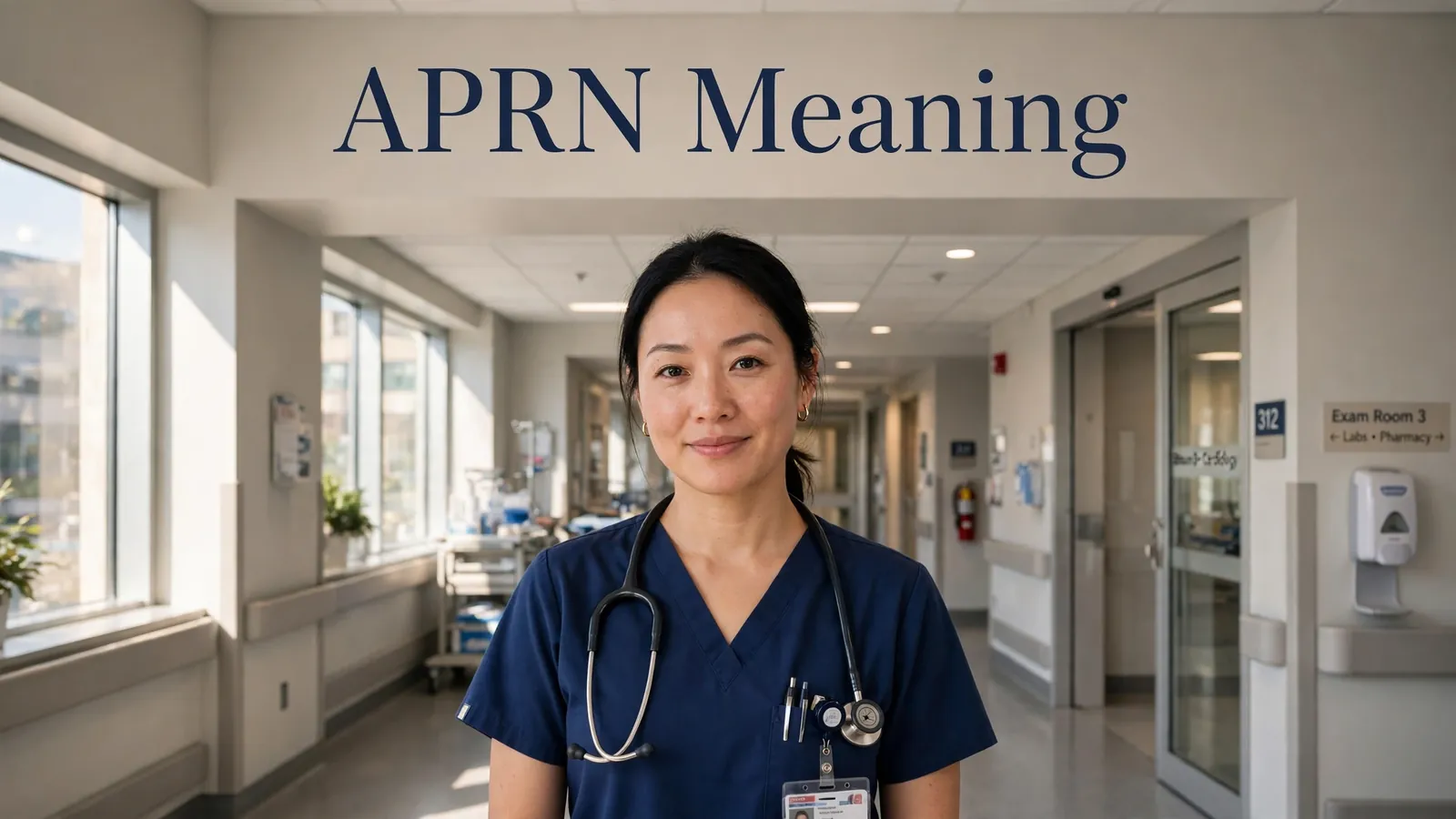
If you have ever seen the letters APRN on a hospital badge, a clinic door, or a job posting and wondered what they stand for, this guide has the full answer. APRN Meaning is straightforward: APRN stands for Advanced Practice Registered Nurse, a registered nurse who has completed advanced graduate education and clinical training beyond the standard nursing degree.
The APRN Meaning carries real weight in modern healthcare. APRNs are highly trained professionals who diagnose illnesses, order and interpret tests, prescribe medications, and manage patient care. In many parts of the United States, they serve as primary care providers, especially in communities where doctors are in short supply.
In this complete guide, you will learn the true APRN Meaning, from its definition and the four APRN roles to education requirements, scope of practice, how APRNs differ from registered nurses, salary expectations, and career outlook. We will also clear up common misconceptions, define related terms, and answer frequently asked questions. By the end, you will know exactly what APRN means and why these nurses matter so much. You will also see why demand for these advanced nurses keeps growing across the country.
APRN Meaning: The Definition First
At its core, the APRN Meaning is simple. APRN stands for Advanced Practice Registered Nurse.
An APRN is a registered nurse (RN) who has earned a graduate degree, usually a Master of Science in Nursing (MSN) or a Doctor of Nursing Practice (DNP), and has passed a national certification exam in one of four specialty roles. This advanced training gives APRNs a wider scope of practice than a standard RN.
The key word in the APRN Meaning is “advanced.” It refers to advanced education, advanced clinical skills, and advanced responsibility. While an RN provides essential bedside care, an APRN can do many things traditionally associated with physicians, such as diagnosing conditions and prescribing treatment.
It is important to note that APRN is a protected professional title. You cannot call yourself an APRN simply because you are an experienced nurse. The title requires specific graduate education, national certification, and a state license in an APRN role.
The Four APRN Roles
The APRN Meaning covers exactly four recognized roles. Every APRN in the United States falls into one of these categories. Each role has its own education path, certification exam, and scope of practice.
Nurse Practitioner (NP)
The nurse practitioner is the largest and best-known APRN role. NPs provide primary and specialty care across the lifespan. They diagnose illnesses, order lab tests and imaging, prescribe medications, and manage chronic conditions like diabetes and high blood pressure.
Many NPs run their own practices or serve as the main healthcare provider for families. In rural and underserved areas, an NP is often the only provider available. NPs can specialize further in areas like family practice, pediatrics, psychiatry, or acute care.
Certified Nurse-Midwife (CNM)
A certified nurse-midwife provides care related to pregnancy, childbirth, and reproductive health. CNMs attend births, provide prenatal and postpartum care, and offer gynecological services such as annual exams and family planning.
Most CNMs work in hospitals, birth centers, or private practices. They are experts in supporting natural, low-intervention births while being trained to recognize complications and collaborate with physicians when needed.
Clinical Nurse Specialist (CNS)
A clinical nurse specialist is an expert clinician in a defined area of nursing practice, such as oncology, critical care, or psychiatric health. CNSs work directly with patients, but they also improve systems of care by educating staff, leading quality projects, and translating research into practice.
The CNS role blends bedside expertise with leadership. A CNS might redesign a hospital’s fall-prevention program or train nurses on new wound-care protocols, affecting hundreds of patients at once.
Certified Registered Nurse Anesthetist (CRNA)
A certified registered nurse anesthetist administers anesthesia for surgery, labor and delivery, and pain management. CRNAs are among the most independent APRNs. They assess patients before procedures, develop anesthesia plans, deliver anesthesia, and monitor patients through recovery.
In many rural hospitals, CRNAs are the sole anesthesia providers. The role requires exceptional precision, because anesthesia decisions directly affect patient safety every minute of a procedure.
History of the APRN Role
The APRN Meaning has deep roots in American healthcare history. Advanced nursing practice did not appear overnight. It grew over more than a century.
The earliest APRN role was nurse anesthesia. In the late 1800s, during the Civil War era and beyond, nurses began administering anesthesia when few physicians specialized in it. Formal nurse anesthesia education started in the early 1900s.
Nurse-midwifery followed. In 1925, the Frontier Nursing Service in Kentucky sent nurse-midwives on horseback to care for mothers in remote Appalachian communities. Their success proved that advanced nurses could deliver excellent outcomes with limited resources.
The nurse practitioner role was born in 1965, when Dr. Loretta Ford, a nurse, and Dr. Henry Silver, a pediatrician, created the first NP program at the University of Colorado. They designed it to address a shortage of primary care for children.
The clinical nurse specialist role emerged in the 1970s as hospitals recognized the need for expert clinicians who could also lead improvements in care quality.
In 2008, nursing leaders created the APRN Consensus Model, a national framework that standardized APRN education, certification, and licensure across the four roles. This model gave the APRN Meaning the clear, consistent definition it has today.
Education and Certification Requirements
Becoming an APRN takes serious commitment. The path is longer and more demanding than becoming an RN, which is exactly why the APRN Meaning commands respect.
Step 1: Become a Registered Nurse
Every APRN starts as an RN. That means earning either an Associate Degree in Nursing (ADN) or a Bachelor of Science in Nursing (BSN) and passing the NCLEX-RN licensing exam. Most APRN graduate programs now prefer or require a BSN.
Step 2: Gain Clinical Experience
Many graduate programs want applicants to have real bedside experience first. This is especially true for CRNA programs, which often require at least one to two years of critical care nursing experience.
Step 3: Earn a Graduate Degree
APRNs must complete a graduate program in their chosen role. The traditional degree is the Master of Science in Nursing (MSN). Increasingly, schools offer the Doctor of Nursing Practice (DNP), a practice-focused doctoral degree that is becoming the recommended standard.
Graduate programs include advanced courses in pathophysiology, pharmacology, and health assessment, plus hundreds of hours of supervised clinical practice in the specialty.
Step 4: Pass National Certification
After graduation, candidates must pass a national certification exam specific to their role and population focus. These exams are administered by bodies such as the American Nurses Credentialing Center (ANCC) or the American Association of Nurse Practitioners (AANP).
Step 5: Get Licensed by the State
Finally, the APRN applies for an APRN license in the state where they will practice. State boards of nursing verify the education and certification before granting the license.
Scope of Practice and Prescriptive Authority
One of the most important parts of the APRN Meaning is scope of practice: what an APRN is legally allowed to do. This varies significantly by US state.
States fall into three broad categories. In full practice states, APRNs can evaluate patients, diagnose, order tests, and prescribe medications independently, without physician oversight. More than half of US states now grant full practice authority to NPs.
In reduced practice states, APRNs can perform many advanced functions but must have a collaborative agreement with a physician for at least one element of practice, often prescribing.
In restricted practice states, APRNs need physician supervision or delegation for most advanced functions.
Prescriptive authority follows a similar pattern. In full practice states, APRNs can prescribe medications, including controlled substances, on their own authority. In other states, they need a collaborative or supervisory relationship with a physician.
This state-by-state variation is one of the most debated topics in healthcare policy. Supporters of full practice authority point to research showing that APRNs deliver safe, high-quality, cost-effective care. Understanding this debate is part of fully grasping the APRN Meaning today.
APRN vs RN: Key Differences
People often ask how an APRN differs from an RN. The APRN Meaning becomes clearer through this comparison.
Education. An RN typically holds an ADN or BSN. An APRN holds a graduate degree (MSN or DNP) plus national certification in a specialty role.
Scope. An RN assesses patients, administers medications, and carries out care plans. An APRN can diagnose conditions, order and interpret diagnostic tests, prescribe medications, and develop treatment plans independently in many states.
Autonomy. RNs generally work under the direction of physicians or APRNs. APRNs in full practice states can run their own practices and serve as a patient’s primary provider.
Specialization. While RNs can specialize, APRN roles are defined specialties from the start. Each of the four APRN roles has its own certification and focused scope.
Responsibility. With greater authority comes greater accountability. APRNs carry full responsibility for their diagnostic and prescribing decisions, just as physicians do.
Think of it this way: every APRN is an RN, but not every RN is an APRN. The APRN title marks additional education, certification, and legal authority.
Salary and Career Outlook
The APRN Meaning also includes strong career prospects. Advanced practice nursing is one of the fastest-growing and best-paid paths in healthcare.
According to the US Bureau of Labor Statistics, nurse practitioners, nurse midwives, and nurse anesthetists all rank among the highest-paid nursing roles. Median annual pay for NPs is well above six figures. CRNAs are among the highest-paid APRNs, often earning significantly more than the NP median, reflecting the intensity and responsibility of anesthesia practice.
Job growth projections are equally strong. The Bureau of Labor Statistics projects much faster than average growth for APRN roles over the coming decade. Several forces drive this demand.
First, the US population is aging, which increases the need for chronic disease management and primary care. Second, many regions face physician shortages, and APRNs help fill the gap. Third, the shift toward team-based and value-based care rewards the holistic, prevention-focused approach that APRNs bring.
For nurses considering the next step, the APRN Meaning translates into real opportunity: more autonomy, higher pay, and a growing national demand.
Common Misconceptions About APRN Meaning
Several misconceptions about APRN roles persist. Here are the main ones, corrected.
- Misconception: APRNs are “almost doctors” or doctor substitutes. APRNs are not substitute physicians. They are advanced nurses with their own distinct education, philosophy, and scope. Many work alongside physicians as partners, not replacements.
- Misconception: APRN care is lower quality than physician care. Decades of research show that APRNs provide safe, effective care with patient outcomes comparable to physicians in their areas of practice.
- Misconception: All APRNs can prescribe everywhere. Prescriptive authority depends on the state. In some states APRNs prescribe independently, while in others they need physician collaboration.
- Misconception: APRN is just a title for experienced RNs. Experience alone does not make an APRN. The title requires graduate education, national certification, and state licensure in one of the four roles.
- Misconception: The DNP is required to become an APRN. The DNP is increasingly recommended, but a Master of Science in Nursing remains a valid entry path in most states today.
Related Terms to APRN Meaning
If you are exploring this topic, these related terms will help.
NP (Nurse Practitioner)
The most common APRN role. NPs diagnose, treat, and prescribe across primary and specialty care settings.
CRNA (Certified Registered Nurse Anesthetist)
The APRN role focused on anesthesia care for surgery, childbirth, and pain management.
CNM (Certified Nurse-Midwife)
The APRN role focused on pregnancy, childbirth, and reproductive health.
CNS (Clinical Nurse Specialist)
The APRN role focused on expert clinical practice, staff education, and systems improvement in a specialty area.
DNP (Doctor of Nursing Practice)
A practice-focused doctoral degree. It is the highest clinical nursing degree and the recommended preparation for APRNs.
MSN (Master of Science in Nursing)
The traditional graduate degree for APRN preparation, still widely accepted for entry into APRN roles.
RN (Registered Nurse)
The foundational nursing license. Every APRN is first an RN before pursuing advanced practice.
APRN Meaning in Conversation: Examples
Here is how the term comes up in everyday speech.
- Job hunting: “I just passed my boards, so now I can apply for APRN positions at the clinic.”
- At the doctor’s office: “Your appointment tomorrow is with an APRN. She can diagnose your condition and prescribe treatment just like your regular provider.”
- Career advice: “If you want more autonomy in nursing, the APRN path is worth it, but plan for graduate school.”
- Rural healthcare: “Our town’s only provider is an APRN. She handles everything from checkups to minor procedures.”
- Nursing school: “I am deciding between the NP and CNS tracks for my APRN program.”
- Policy discussion: “Our state just moved to full practice authority, so APRNs here can now prescribe independently.”
In each case, APRN signals advanced training and expanded responsibility, not just a job title.
Summary of APRN Meaning
Here is the full APRN Meaning in one clear view.
- Core definition: APRN stands for Advanced Practice Registered Nurse.
- Requirement: Graduate nursing education (MSN or DNP), national certification, and state licensure.
- The four roles: Nurse Practitioner (NP), Certified Nurse-Midwife (CNM), Clinical Nurse Specialist (CNS), Certified Registered Nurse Anesthetist (CRNA).
- Scope: Diagnose, order and interpret tests, prescribe, and manage care. Exact authority varies by state.
- APRN vs RN: More education, wider scope, greater autonomy, and full accountability for clinical decisions.
- Outlook: Strong salary levels and much faster than average job growth.
- History: Roots in 19th-century nurse anesthesia, formalized by the 2008 APRN Consensus Model.
If you remember one thing, remember this: an APRN is a registered nurse with advanced graduate training and the authority to diagnose, treat, and prescribe.
FAQs About APRN Meaning
What does APRN stand for?
APRN stands for Advanced Practice Registered Nurse. It is a registered nurse who has completed graduate-level education and national certification in one of four advanced roles.
What are the four types of APRN?
The four APRN roles are Nurse Practitioner (NP), Certified Nurse-Midwife (CNM), Clinical Nurse Specialist (CNS), and Certified Registered Nurse Anesthetist (CRNA).
Can an APRN prescribe medication?
In many states, yes. APRNs in full practice states can prescribe independently, including controlled substances. In reduced or restricted practice states, they need a collaborative or supervisory relationship with a physician.
What is the difference between an APRN and an RN?
An APRN has graduate education, national certification, and a wider legal scope that includes diagnosing and prescribing. An RN provides essential nursing care but generally works under the direction of a physician or APRN.
How long does it take to become an APRN?
Typically six to eight years total. That includes a nursing degree and RN license (two to four years), clinical experience, and a graduate program (two to four more years), followed by certification and state licensure.
Is a DNP required to become an APRN?
No. The Doctor of Nursing Practice is increasingly recommended, but a Master of Science in Nursing remains a valid entry path in most states.
Do APRNs provide the same quality of care as doctors?
Research consistently shows that APRNs deliver safe, high-quality care with outcomes comparable to physicians within their areas of practice.
Where do APRNs work?
APRNs work in hospitals, clinics, private practices, birth centers, surgical centers, schools, nursing homes, and community health centers. Many also run their own practices in full practice states.
What is full practice authority?
Full practice authority means a state allows APRNs to evaluate patients, diagnose, order tests, and prescribe without a required physician agreement. More than half of US states grant this to nurse practitioners.
Is APRN a good career choice?
For many nurses, yes. APRN roles offer strong salaries, high job growth, greater autonomy, and the chance to serve as a primary provider, especially in underserved communities.
Conclusion
The APRN Meaning is now clear: Advanced Practice Registered Nurse, a title earned through graduate education, national certification, and state licensure in one of four specialty roles. These professionals diagnose illness, prescribe treatment, deliver babies, administer anesthesia, and lead improvements in care.
What makes the APRN role remarkable is its blend of nursing values and advanced clinical authority. Every APRN began as a bedside nurse, learning to listen, comfort, and advocate. That foundation stays with them as they take on greater responsibility.
If you ever meet a nurse in a clinic or hospital, you are meeting one of the most thoroughly trained professionals in healthcare. The next time you see those four letters on a badge, you will know exactly what they stand for, and the years of study behind them.

I am Sophia Bennett, is a digital resources and online tools writer at LinkVistaHub. She enjoys exploring useful websites, emerging digital tools, productivity platforms, and practical online resources that help people work smarter and discover valuable information.