
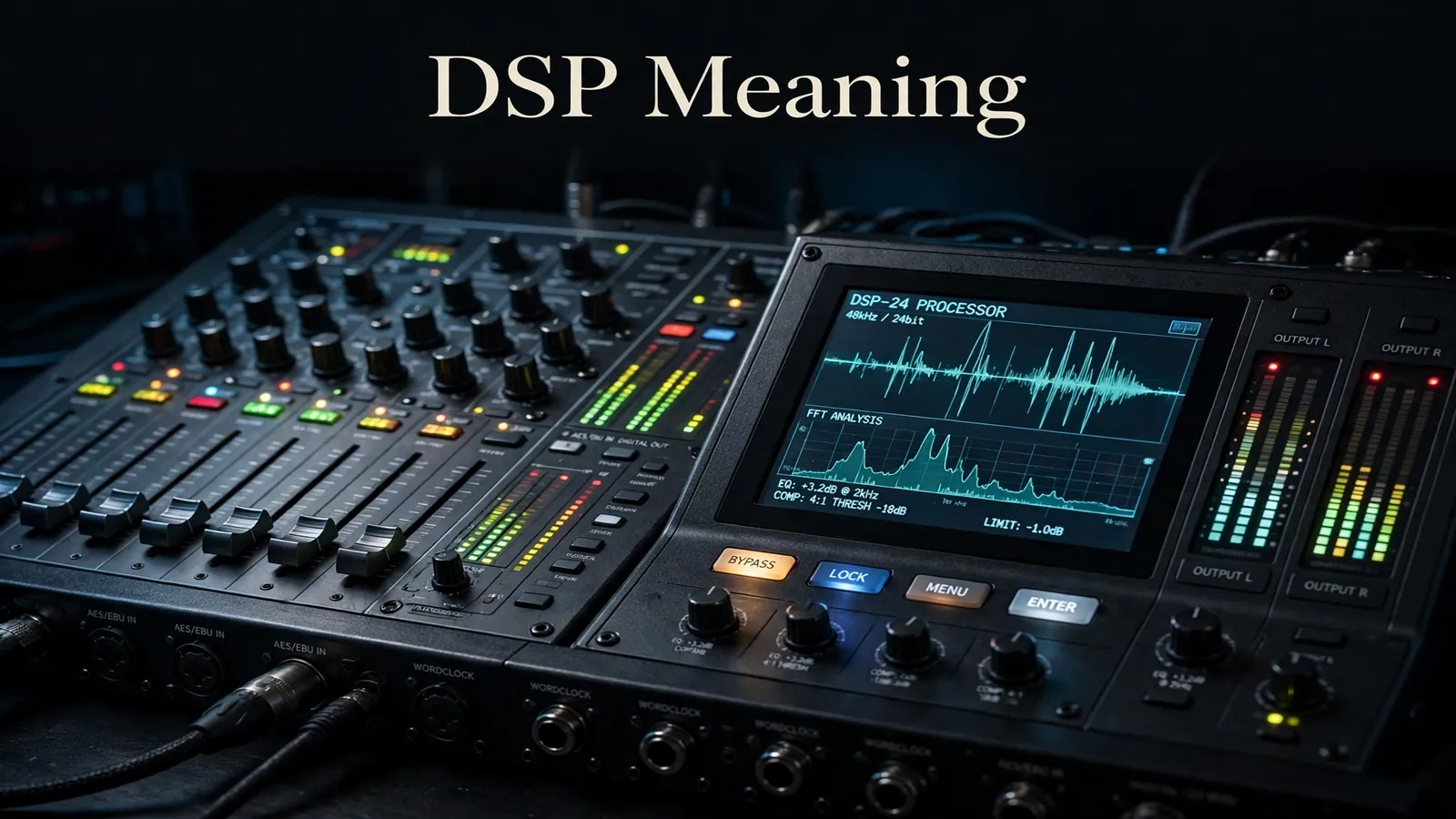
If you have ever seen the letters DSP and wondered what they stand for, you are not alone. The full DSP Meaning changes with the setting. For instance, in a tech article, DSP usually means Digital Signal Processing. By contrast, in South Asia, the same letters often mean Deputy Superintendent of Police. Both uses are correct. Context tells you which one fits.
This guide unpacks every important DSP Meaning in plain language. We start with Digital Signal Processing, the most common meaning worldwide, and explain how it shapes the devices you use every day. Then we cover the Deputy Superintendent of Police rank used in countries like Pakistan and India. Finally, we list the other common meanings, such as Delivery Service Partner and Demand-Side Platform, so you are never confused again.
By the end, you will know exactly what DSP means in tech, in government service, and in business. Furthermore, you will see how to use the term correctly in sentences, clear up common misconceptions, and answer the questions people ask most often about these three letters. Keep reading, and you will master every DSP Meaning with confidence.
DSP Meaning: The Definitions First
The most widely used DSP Meaning is Digital Signal Processing. In other words, this is the mathematical manipulation of digital signals to improve them, extract information from them, or turn them into something useful. Audio, images, video, and sensor data all pass through DSP.
However, DSP also stands for Deputy Superintendent of Police in South Asia, including Pakistan and India. There, a DSP is a senior police officer who commands a subdivision of a district. In short, the two meanings share nothing except the letters.
The rule of thumb is simple. If the topic is technology, electronics, or audio, DSP means Digital Signal Processing. On the other hand, if the topic is policing in Pakistan or India, DSP means Deputy Superintendent of Police. Business writers add more meanings, which we cover later in this guide.
Digital Signal Processing: The Main DSP Meaning
Digital Signal Processing is the use of mathematics and algorithms to change digital signals. For example, a signal is anything that carries information over time or space: a voice on a call, a song on your phone, a photo from your camera, or data from a weather sensor.
Most real-world signals start as analog, meaning they vary continuously. For instance, a microphone captures sound waves. Similarly, a camera sensor captures light. DSP begins by converting these analog inputs into digital form, a step called sampling and quantization. Then a processor runs calculations on the numbers. Finally, the result may be converted back to analog, such as sound from a speaker.
Every smartphone you have ever used runs DSP constantly. For example, when you call someone in a noisy street and the other person still hears you clearly, that is DSP reducing the background noise. Similarly, when your phone plays music through tiny earbuds and it still sounds rich, that is DSP shaping the sound.
How DSP Works in Simple Terms
Think of DSP as a very fast calculator that works on streams of numbers. Here is the basic flow in four steps.
Step 1: Capture. A sensor, such as a microphone or antenna, picks up a real-world signal. This signal is analog and messy.
Step 2: Convert. An analog-to-digital converter samples the signal thousands of times per second. As a result, each sample becomes a number. The messy wave is now a list of numbers.
Step 3: Process. A DSP chip or software applies math to the numbers. For instance, it can remove noise, compress data, boost certain frequencies, or detect patterns. A filter, for example, might erase the hiss from an old recording.
Step 4: Output. The cleaned or changed numbers are turned back into something useful. For example, they may become sound in your earbuds, a sharper photo on your screen, or a text message your phone understood.
This entire cycle can happen thousands or millions of times per second. Consequently, that speed is why we call it processing, and why specialized chips exist to do it.
DSP Chips and Processors
A DSP chip is a microprocessor designed for one job: doing math on signals very fast. In contrast, ordinary processors handle many kinds of tasks. Specifically, a DSP chip is optimized for repeated calculations like multiply-and-add operations, which filters and transforms need constantly.
You will find DSP chips in many places. They sit inside smartphones, hearing aids, car audio systems, routers, radar equipment, and medical devices. For instance, some are standalone chips. Alternatively, others are dedicated blocks inside a larger system-on-chip, such as the audio pipeline in a phone.
Software DSP matters too. Music apps, video calling tools, and audio editors all run DSP algorithms on ordinary processors. However, the math is the same. Only the hardware differs.
Uses of Digital Signal Processing in Daily Life
DSP touches your life more often than almost any other technology. Here are the main areas.
Audio and music. Noise cancellation in earbuds and headphones uses DSP to erase background sound in real time. In addition, equalizers, reverb, and auto-tune are all DSP effects. Similarly, voice assistants depend on DSP to pick your voice out of room noise.
Phones and telecommunications. Every call, text, and data session on a mobile network uses DSP. Specifically, it compresses your voice, corrects errors from a weak signal, and lets many users share the same airwaves without chaos.
Photos and video. For example, your phone camera uses DSP to sharpen images, reduce noise in low light, and merge multiple frames into one clear photo. Likewise, video streaming uses DSP-based compression so a movie fits through your internet connection.
Medical imaging. MRI, CT, and ultrasound machines rely on DSP to turn raw sensor readings into the images doctors read. In fact, without DSP, these machines could not produce clear pictures of the human body.
Radar and navigation. Airplanes, ships, and cars use DSP to process radar and sonar signals. Similarly, GPS receivers use it to lock onto weak satellite signals and calculate your position.
Industrial sensors. Factories use DSP to monitor vibration, temperature, and pressure. As a result, the algorithms detect problems early, before a machine breaks down.
Origin and History of Digital Signal Processing
The DSP Meaning in technology grew out of mathematics that is centuries old. The Fourier transform, published by Joseph Fourier in 1822, showed that complex signals can be broken into simple waves. In fact, that idea still sits at the heart of modern DSP.
Digital computers made the theory practical. In 1965, James Cooley and John Tukey published the fast Fourier transform, an algorithm that made signal calculations enormously faster. As a result, engineers could now process real signals on real machines in reasonable time.
The 1970s brought the first commercial DSP chips. Texas Instruments, Bell Labs, and others built processors tuned for signal math. Consequently, audio engineers, telecom companies, and the military became early adopters.
The 1990s and 2000s brought DSP to everyone. For instance, mobile phones needed it for calls. Similarly, the internet needed it for audio and video streaming. Likewise, digital cameras needed it for image processing. Today, DSP is so deeply embedded that most people use it all day without ever hearing the term.
Deputy Superintendent of Police: The South Asian DSP Meaning
In Pakistan, India, and several other South Asian countries, DSP stands for Deputy Superintendent of Police. This is a senior, gazetted officer rank in the police service.
A DSP typically commands a police subdivision, which is a group of police stations within a district. In practice, the DSP supervises station house officers, oversees investigations, maintains law and order in the area, and reports to the Superintendent of Police.
In Pakistan, officers reach the DSP rank through the Provincial Public Service Commission examination, often called the PMS or PCS exam. In India, the equivalent route is the State Public Service Commission exam. Next, successful candidates train at a police academy before their first posting.
The rank sits above Inspector and below Superintendent of Police. In the field, people often address a DSP as “DSP Sahab.” Indeed, it is a respected position with real authority over a subdivision.
It is worth noting that this meaning has no connection to technology. For example, when a news headline in Lahore or Delhi says “DSP,” it almost always means the police officer, not digital signal processing.
Other Common Meanings of DSP
The letters DSP carry a few more meanings in business and tech. Here are the ones you are most likely to meet.
Delivery Service Partner (Amazon)
Amazon’s Delivery Service Partner program lets entrepreneurs run their own package delivery businesses using Amazon branding and logistics support. In practice, a DSP owner hires drivers, manages routes, and delivers Amazon parcels in a local area. Therefore, if you see “DSP” in a job ad about driving delivery vans, this is usually the meaning.
Demand-Side Platform (Advertising)
In digital advertising, a Demand-Side Platform is software that lets advertisers buy ad space automatically. Instead of negotiating with each website, an advertiser sets a budget and targeting rules, and the DSP bids on ad impressions in real time. Consequently, this meaning is common in marketing and media jobs.
Digital Service Provider
Digital Service Provider is a general term for companies that deliver services over the internet, such as cloud storage, streaming, or online software. However, it is less standardized than the other meanings, but it appears in business documents and contracts.
DSP Meaning in Conversation: Real Examples
Seeing DSP in context shows how the meaning shifts. Here are short conversation examples.
Example 1: Technology
- Raza: “Why does my noise cancelling work so well on the bus?”
- Hina: “That is DSP. The chip erases the engine sound in real time.”
Example 2: Policing in South Asia
- Ali: “Who is handling the case in our area?”
- Bilal: “The DSP. He visited the station this morning.”
Example 3: Advertising job
- Sara: “The new role is at a DSP.”
- Omar: “So you will be buying ad inventory programmatically?”
Example 4: Delivery work
- Ahmed: “I joined a DSP last month.”
- Fatima: “Driving the blue vans? How are the shifts?”
In each exchange, the setting makes the meaning clear. Generally, tech talk points to Digital Signal Processing. By contrast, a police station points to Deputy Superintendent of Police.
Common Misconceptions About DSP Meaning
Several misconceptions about DSP keep appearing. Here are the main ones, corrected.
- Misconception: DSP always means Digital Signal Processing. It is the most common global meaning, but in South Asia the police rank is far more familiar to most people.
- Misconception: DSP and digital audio are the same thing. Digital audio is one application. DSP also covers images, video, radar, medical scans, and sensor data.
- Misconception: You need a DSP chip to do DSP. The math can run on any processor. Dedicated chips just do it faster and with less power.
- Misconception: A DSP (police) outranks an SP. No. DSP is Deputy Superintendent, one rank below the Superintendent of Police.
- Misconception: Demand-Side Platform and Digital Signal Processing are related. They share the letters by coincidence. One buys ads, the other processes signals.
- Misconception: DSP is too technical for everyday use. You use it every day through your phone, earbuds, and camera, even if you never say the term.
Related Terms to DSP Meaning
These related terms sit close to the different DSP meanings. In turn, knowing them helps you read tech and news articles with confidence.
Signal
A signal is anything that carries information: sound, light, radio waves, or data. In short, DSP exists to improve, analyze, or transform signals.
Filter
A filter is a DSP tool that keeps the parts of a signal you want and removes the parts you do not. In other words, noise reduction is filtering.
Sampling
Sampling is measuring an analog signal at regular intervals to turn it into digital numbers. Therefore, higher sampling rates capture more detail.
Codec
A codec compresses and decompresses audio or video. In fact, codecs are built on DSP math, and they make streaming possible.
Fourier Transform
The Fourier transform breaks a signal into its component frequencies. Indeed, it is the single most important mathematical tool in DSP.
Subdivision
In policing, a subdivision is the area a DSP commands, usually a group of police stations within a district.
Programmatic Advertising
Programmatic advertising is the automated buying and selling of ad space. Specifically, a Demand-Side Platform is the buyer’s tool in this system.
Summary of DSP Meaning
Here is the full DSP Meaning in one clear view.
- Main meaning (tech): Digital Signal Processing, the math-based manipulation of digital signals.
- South Asia (police): Deputy Superintendent of Police, a senior officer commanding a subdivision.
- Business meanings: Delivery Service Partner (Amazon), Demand-Side Platform (advertising), Digital Service Provider.
- How DSP works: Capture, convert, process, output. Sensors feed numbers to algorithms, which clean or transform them.
- Daily uses: Noise cancelling, phone calls, cameras, streaming, medical imaging, radar, GPS.
- History: Fourier’s math in 1822, fast algorithms in 1965, commercial chips in the 1970s, everywhere by the 2000s.
- Rule of thumb: Tech context means Digital Signal Processing. South Asian policing context means Deputy Superintendent of Police.
If you remember one thing, remember this: the letters are the same, but the setting decides the meaning.
FAQs About DSP Meaning
What is the full form of DSP?
The most common full form is Digital Signal Processing. In South Asia, DSP also stands for Deputy Superintendent of Police. Business uses include Delivery Service Partner and Demand-Side Platform.
What does DSP mean in technology?
In technology, DSP means Digital Signal Processing: using mathematics and algorithms to improve or analyze digital signals like audio, images, video, and sensor data.
What does DSP mean in Pakistan and India?
In Pakistan and India, DSP stands for Deputy Superintendent of Police, a senior gazetted officer who commands a police subdivision within a district.
How does digital signal processing work?
It follows four steps. First, a sensor captures an analog signal, a converter turns it into digital numbers, algorithms process the numbers, and the result is output as sound, images, or data.
What is a DSP chip?
A DSP chip is a microprocessor optimized for fast signal math. As such, it handles repeated calculations like filtering far more efficiently than a general-purpose processor.
Where is DSP used in daily life?
In noise-cancelling earbuds, phone calls, cameras, video streaming, GPS, medical scanners, and radar. In short, almost every modern device uses it.
How does one become a DSP in the police?
Through the Provincial Public Service Commission exam in Pakistan or the State Public Service Commission exam in India, followed by training at a police academy and field postings.
What is the difference between DSP and SP in police ranks?
DSP stands for Deputy Superintendent of Police, and SP stands for Superintendent of Police. In other words, the SP is one rank senior to the DSP.
What is a Demand-Side Platform?
A Demand-Side Platform is advertising software that lets advertisers buy digital ad space automatically through real-time bidding.
Is DSP the same as digital audio?
No. Digital audio is one application of DSP. In fact, the same math also processes images, video, radar signals, medical scans, and sensor data.
Conclusion
The DSP Meaning turns out to be a small lesson in context. For instance, in a lab or a product review, those three letters point to Digital Signal Processing, the quiet math that cleans your calls, sharpens your photos, and streams your music. By contrast, in a police station in Lahore or Lucknow, the same letters mean Deputy Superintendent of Police, an officer with real authority over a subdivision. Finally, in business, they can mean a delivery partner, an ad-buying platform, or a digital service provider.
What connects these meanings is nothing more than shared letters. In other words, the setting always tells you which one applies. And once you know the main three, the abbreviation stops being confusing.
So the next time you see DSP, pause for one second and read the room. For example, if wires and chips are involved, think signal and processing. On the other hand, if uniforms and stations are involved, think police rank. That single habit will keep you right every time.

I am Alex Carter, is a web resources and digital tools writer at Linkvistahub. He enjoys discovering useful websites, online tools, productivity resources, and practical digital solutions that can make everyday tasks easier.