Have you ever seen a warning that says a software feature is “deprecated” and wondered if it still works or if you need to stop using it?
The word appears in programming guides, app updates, website documentation, and workplace instructions. Although it may sound complicated, understanding deprecated meaning is easier than you might think.
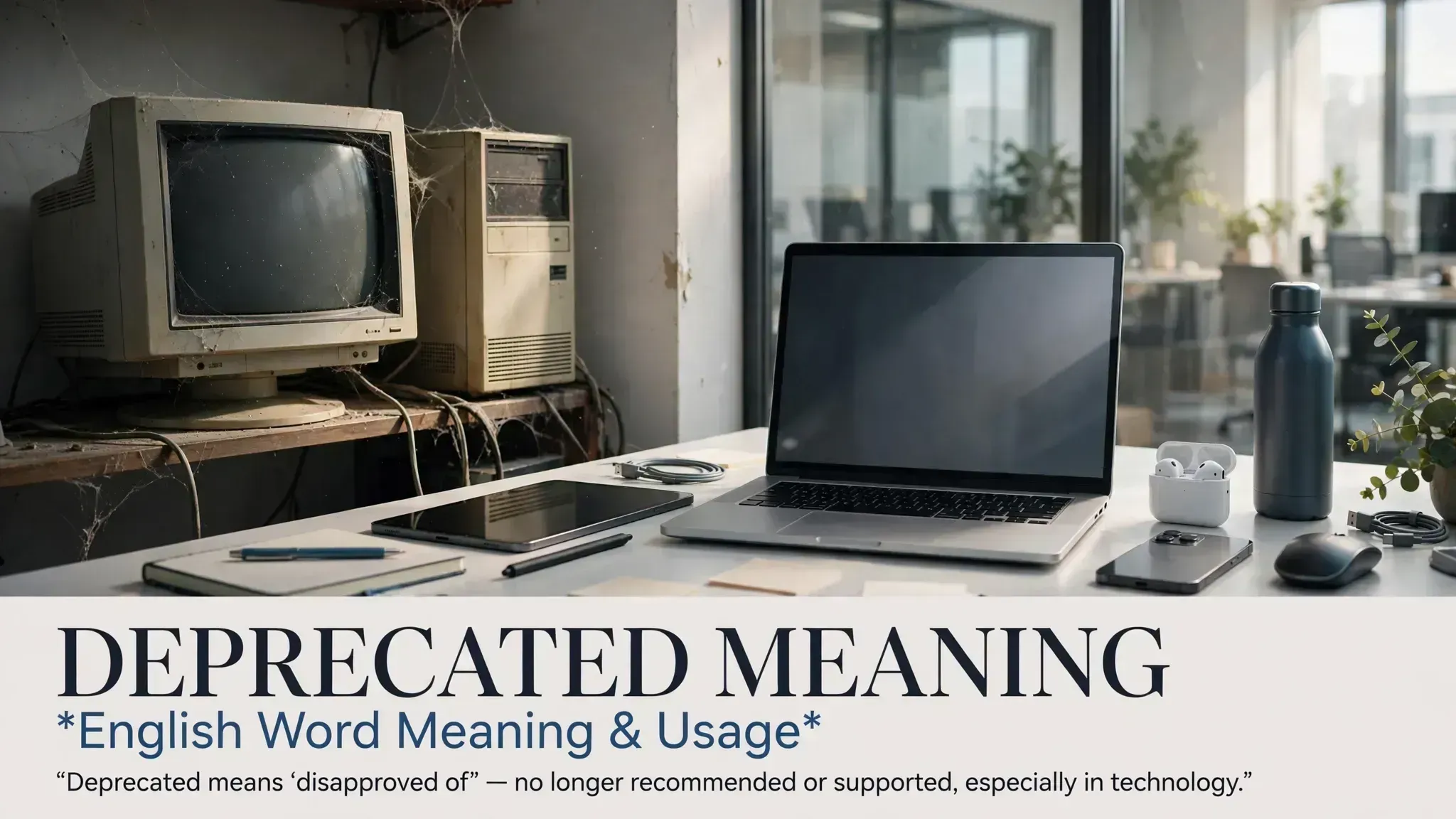
Deprecated means that something is no longer recommended or has been officially discouraged, even though it may still exist or function.
In technology, developers often use the term when an older feature, function, or application programming interface (API) has a newer or more suitable alternative. The old option may continue working for a while, giving users time to make the switch.
However, deprecated does not always mean deleted, broken, unsafe, or completely obsolete.
These words have different meanings, and knowing the difference can help you make better decisions when reading technical warnings or instructions.
What Does Deprecated Mean?
Deprecated means no longer recommended for use, even though something may still be available or working.
The term is commonly used when a feature, method, product, process, or practice is discouraged because a better alternative exists or circumstances have changed.
For example, imagine that a software company introduces a new way to upload files. The old upload method still works, but the company recommends that developers use the new method instead. The old method is now deprecated.
Here are a few simple examples:
- Deprecated feature: A feature is still available but is no longer recommended.
- Deprecated function: A programming function should be replaced with a newer option.
- Deprecated API: An interface or endpoint is discouraged in favor of an alternative.
- Deprecated process: An older procedure is no longer the preferred approach.
- Deprecated standard: A previous standard has been replaced or discouraged by a newer one.
In simple words, deprecated means “still there, but no longer recommended.”
The precise implications depend on the context. In software development, a deprecated feature may continue to work for existing applications, but developers should check if the documentation announces future removal or reduced support.
Deprecated Meaning in Simple English
In everyday English, deprecated describes something that people or an organization no longer recommend.
Suppose your workplace uses an old system to manage employee records. The company introduces a more efficient system and asks everyone to use it for new records. The old system may remain accessible, but it is no longer the preferred choice.
You could say that the old system has been deprecated.
Consider these examples:
- “This feature is deprecated.” It is no longer recommended.
- “The old method has been deprecated.” A different method is now preferred.
- “That setting is deprecated in the latest version.” Users should check for a newer option.
- “The company deprecated its previous workflow.” The company now recommends another process.
The word often sounds formal or technical. In casual conversation, people may use phrases such as “outdated,” “no longer recommended,” or “being phased out” instead.
Still, these alternatives are not always exact synonyms. Deprecated specifically emphasizes a change in recommendation or official status.
What Is the Origin of the Word Deprecated?
The word deprecated comes from the verb deprecate, which ultimately derives from the Latin deprecari, meaning to pray or plead to avert something.
Over time, the English verb developed meanings associated with expressing disapproval or discouraging something. In modern usage, it can describe an idea, practice, or feature that is no longer recommended.
The technical meaning became especially useful as software systems grew more complex. Developers needed a way to warn users about older functions without immediately removing them and potentially breaking existing applications.
Deprecation provides that middle ground. A feature can be marked as discouraged while remaining available during a transition period.
Today, the term commonly appears in:
- Software development and programming
- API documentation
- Web development
- Operating systems and applications
- Technical standards
- Business processes and policies
- Product and service documentation
The central idea remains consistent across these contexts: something is being discouraged, even if it has not completely disappeared.
Deprecated Meaning in Technology
In technology, deprecated usually means that a feature, function, command, interface, or setting is no longer recommended for use.
A development team might deprecate an item because a newer alternative is more efficient, the old design is difficult to maintain, or current requirements have changed.
Why Do Developers Deprecate Features?
There are several common reasons for deprecation.
1. A better alternative is available
A new function or interface may be simpler, faster, or easier to maintain. Developers can recommend the new option while keeping the old one temporarily available.
2. The original design has limitations
An older feature may be difficult to expand or may create unnecessary complexity. A replacement can address those limitations.
3. Security requirements have changed
An older method may no longer meet current security recommendations. Deprecation can encourage users to move to a safer approach, although a deprecation warning alone does not prove that a feature is insecure.
4. A system is being modernized
Software changes over time. Developers may replace older interfaces, commands, or workflows with designs that better fit current standards.
5. Compatibility must be preserved
Removing an older feature immediately could cause existing programs to fail. Deprecation gives developers time to update their code.
Does Deprecated Mean Broken?
No. A deprecated feature may continue to work normally.
For example, a library may still support an older function so that applications built around it do not immediately stop working. However, the library’s documentation may recommend a replacement for new development.
This distinction matters because a feature that works today is not necessarily guaranteed to work in future versions.
Always check the documentation for the feature’s current status, recommended replacement, and possible removal timeline.
Deprecated Meaning in Programming
In programming, deprecated describes a feature or element that developers are encouraged to stop using.
Common examples include:
- Functions and methods
- Classes and constructors
- Variables and constants
- Programming language features
- Libraries and dependencies
- API endpoints
- Commands and configuration options
Imagine that a software library provides two methods: an older method called oldMethod() and a replacement called newMethod().
If the library marks oldMethod() as deprecated, existing code may continue to run. However, developers should generally use newMethod() for new work if it is the documented replacement.
The actual names here are illustrative, not methods from a particular library.
What Is a Deprecated Function?
A deprecated function is a function that remains recognized by a programming language, framework, or library but is no longer recommended.
It might be deprecated because:
- A replacement offers improved functionality.
- The old function has confusing behavior.
- The feature is difficult to maintain.
- The development team is simplifying its interface.
- The project is preparing for a future change.
When you encounter a deprecated function, follow these steps:
- Read the warning and related documentation.
- Identify the recommended replacement, if one exists.
- Check if the replacement behaves differently.
- Update your code when appropriate.
- Run tests to confirm that the changes work.
- Review the project’s release notes for removal plans.
You do not always need to replace a deprecated function immediately. Large systems may require careful planning, and some projects support deprecated features for a long time.
What Is a Deprecated API?
An application programming interface, or API, allows different software components to communicate.
A deprecated API method or endpoint is one that its provider no longer recommends. A replacement may offer improved functionality, clearer behavior, better compatibility, or a more maintainable design.
For example, a service might announce that /api/v1/users is deprecated and recommend /api/v2/users for new integrations. These endpoint names are illustrative.
A deprecated API may remain available during a transition period. Before changing an integration, developers should review the provider’s migration guide, version policy, and any announced removal date.
Deprecated Meaning in Different Programming Languages
The general meaning remains similar across programming languages, but the way deprecation is announced and handled varies by language, library, and development environment.
Deprecated in Python
In Python, a package or framework may mark a function or method as deprecated. Depending on the implementation, developers may see a warning when the code runs, or they may find the information in the documentation.
The warning may explain why the item is deprecated and identify a replacement.
For example, a package might recommend a newer method instead of an older one. Developers should consult that package’s documentation rather than assuming every Python deprecation behaves the same way.
Deprecated in JavaScript
In JavaScript development, deprecation may affect a browser API, framework feature, or library method.
A developer might see a deprecation warning in a browser console or find a notice in the documentation. The feature may continue to work, but a newer option could be recommended.
A feature’s status may vary between browsers, libraries, and frameworks. Check the documentation for the specific environment you are using.
Deprecated in Java
Java documentation can mark classes, methods, constructors, and other program elements as deprecated.
Developers may see deprecation information in documentation or receive compiler warnings. Some notices also indicate if an item is scheduled for removal.
The correct next step is to read the relevant documentation and determine if a replacement is available.
Deprecated in HTML and CSS
In web development, older HTML elements, attributes, or styling practices may be discouraged or superseded by modern standards.
For example, an older presentation technique may be replaced with CSS-based styling. However, a technique that is considered outdated is not necessarily formally deprecated.
Website owners and developers should check current web standards and browser documentation before deciding how to update older code.
Deprecated Meaning in Software Development
Software developers use deprecation to manage change without immediately breaking existing applications.
When a product evolves, its developers may improve performance, introduce new features, simplify the architecture, or change how different components interact. Yet existing users may rely on older functionality.
Deprecation helps balance two priorities:
- Allowing developers to improve a product.
- Giving users time to update applications that depend on older features.
How Does Deprecation Work?
A typical deprecation process may follow these steps:
- A replacement becomes available. The development team introduces a newer feature, function, or workflow.
- The older option is deprecated. Documentation or warnings explain that it is no longer recommended.
- Users receive guidance. A migration guide may explain how to switch to the replacement.
- The old option remains available temporarily. Existing projects may continue using it during a transition period.
- Removal may happen later. The old feature might be removed in a future version, depending on the project’s policy.
Not every software project follows this exact sequence. Some deprecated features remain available for years, while others have a clearly announced removal date.
What Should Developers Do About Deprecated Code?
A deprecation warning should not automatically cause panic, but it should not be ignored indefinitely either.
Start by identifying the affected code and reading the warning. Then determine if the replacement introduces compatibility changes or requires updates elsewhere in the application.
Ask these questions:
- Is the deprecated item used in production?
- Does the documentation recommend a replacement?
- Is there an announced removal date?
- Could the change affect other components?
- Are tests available to verify the new behavior?
For a small project, the update might be straightforward. For a large application, a planned migration with testing and a rollback strategy may be safer.
Deprecated vs. Obsolete vs. Discontinued vs. Removed
These words are related, but they describe different situations.
| Term | Meaning | Does It Still Exist? | Example |
| Deprecated | No longer recommended | Often yes | An older API method still works |
| Obsolete | Outdated or no longer useful for its intended purpose | It may | A device no longer meets current needs |
| Discontinued | No longer produced, offered, or continued | Often no longer offered | A company stops selling a product |
| Removed | Taken out of a system or product | Not in its former form or location | A function is deleted from a new release |
| Retired | Taken out of active use | Depends on context | An organization retires an old service |
| Unsupported | No longer receives a particular type of support | It may still work | A system no longer receives updates |
Deprecated vs. Obsolete
Deprecated means something is discouraged or no longer recommended. Obsolete means it is outdated or no longer useful for its intended purpose.
A deprecated function may still be useful for existing applications. An obsolete technology may no longer meet current needs.
Deprecated vs. Discontinued
Deprecated does not necessarily mean a product has stopped being sold or supported. Discontinued generally means that a product, service, or activity is no longer being offered or continued.
A software feature might be deprecated before it is removed, while a discontinued product may no longer be available for purchase.
Deprecated vs. Removed
A deprecated feature may remain available. A removed feature is no longer available in the relevant version or environment.
For example, code that uses a deprecated method may still run today. If a future version removes that method, the same code may fail until it is updated.
Deprecated vs. Unsupported
A deprecated feature is no longer recommended. An unsupported product or feature no longer receives a particular kind of official support.
These conditions can overlap, but they are not interchangeable. A feature may be deprecated while still receiving maintenance support, or a product may be unsupported without having been formally labeled deprecated.
Deprecated Meaning in Everyday English
Although deprecated is common in technology, it can also describe a practice, idea, custom, or process that is discouraged.
For example:
- “The company deprecated its old approval process.” The company no longer recommends that process.
- “That terminology is deprecated in the style guide.” The guide discourages using that terminology.
- “The previous procedure has been deprecated in favor of a simpler one.” A different procedure is now preferred.
In everyday conversations, people often use simpler alternatives such as “outdated,” “discouraged,” or “no longer recommended.”
The word generally sounds formal, so it may feel unnatural in casual conversation unless people are discussing technology or deliberately using the term humorously.
Is Deprecated a Negative Word?
Deprecated can have a negative implication because it indicates that something is no longer preferred. However, it does not necessarily mean that the item was always bad or useless.
A feature might have been suitable when it was first introduced. Later, technology, standards, or user needs may change, making a different option preferable.
In this sense, deprecated is often a neutral status label rather than a personal criticism.
Deprecated Meaning in Text Messages and Social Media
Deprecated is not a widely established slang term with a separate meaning in everyday texting. However, people may use it informally when discussing apps, programming, old habits, or outdated trends.
Examples in Text Messages
Example 1: Talking about an app
Person A: “Why does the app show a warning next to this option?”
Person B: “That feature is deprecated. They recommend using the new one.”
Example 2: Discussing an old process
Person A: “Can we still use the old workflow?”
Person B: “It’s deprecated now, so we should follow the new process.”
Example 3: Discussing software
Person A: “Do I need to change this code?”
Person B: “Check the documentation. The method is deprecated, and there may be a replacement.”
How Is Deprecated Used on TikTok, Instagram, Snapchat, Discord, and Reddit?
On social platforms, the term is most likely to appear in programming tutorials, technology discussions, software updates, and posts about older digital tools.
Someone might also use it humorously to describe an outdated trend, saying something like, “That fashion choice is deprecated.” In that sentence, the speaker is borrowing a technical term to suggest that the trend is no longer recommended or fashionable.
This is a creative, figurative use rather than a separate, widely recognized slang definition.
In dating conversations, gaming chats, and ordinary social messages, the word is relatively uncommon unless the conversation involves technology or the speaker is using it jokingly.
Deprecated Meaning in Business and the Workplace
At work, deprecated can describe an older tool, policy, procedure, document, or system that employees should no longer use as their preferred option.
For example, an IT department might announce that an older file-sharing platform has been deprecated and recommend a new service.
The announcement might mean:
- Employees should use the new service for new projects.
- The old platform remains available temporarily.
- Existing files need to be migrated.
- A new procedure has replaced the old one.
- The old service may be removed in the future.
The exact implications depend on the organization’s policy.
How Should You Respond to a Deprecated Workplace Process?
If your manager or IT department says that a tool or procedure is deprecated, ask for the approved replacement and any relevant deadline.
You should also check if existing projects need to be migrated and if the older option remains available for special cases.
Do not assume that deprecated means you must immediately delete old files or stop every existing workflow. Follow the official transition instructions.
Examples of Deprecated in Sentences
These examples show how to use the word naturally in different contexts.
- “The developer deprecated the old function.” The developer no longer recommends using it.
- “This API endpoint is deprecated but remains available for existing clients.” The endpoint still works, but a replacement may be preferred.
- “The documentation identifies this method as deprecated.” The documentation warns readers that it is no longer recommended.
- “The company deprecated its legacy workflow.” The company now favors a different process.
- “A future release may remove the deprecated feature.” Removal is possible, but the timing needs confirmation.
- “The browser displayed a warning about a deprecated interface.” The warning indicates that the interface is no longer recommended.
- “The team replaced the deprecated setting with a newer configuration option.” A replacement is now preferred.
- “That term is deprecated in the organization’s writing guidelines.” The organization discourages using the term.
- “The old integration still works, although its main endpoint is deprecated.” The integration may continue functioning during the transition.
- “We reviewed the deprecated dependencies before updating the application.” The team checked older components that may require attention.
Common Usage Tip
Use deprecated when you want to emphasize that something is no longer recommended. Use removed when it is no longer present, and discontinued when a product or service is no longer offered or continued.
Choosing the right word makes your message more accurate.
Common Misconceptions About Deprecated
Several misunderstandings can make the term confusing.
Misconception 1: Deprecated Means Deleted
Not necessarily. A deprecated feature may remain available for a period of time. It might be removed later, but that depends on the project’s plans.
Misconception 2: Deprecated Means It No Longer Works
A deprecated feature can continue to work normally. Its status indicates that it is no longer recommended, not that it has automatically stopped functioning.
Misconception 3: Every Deprecated Feature Is Dangerous
Some features are deprecated because of security concerns, but others are deprecated because of design changes, maintenance needs, or better alternatives. Check the documentation to understand the specific reason.
Misconception 4: Deprecated and Obsolete Mean Exactly the Same Thing
They overlap, but deprecated emphasizes discouragement or a change in recommendation. Obsolete emphasizes being outdated or no longer useful.
Misconception 5: Deprecated Code Must Always Be Replaced Immediately
Not always. Some projects offer long transition periods. The appropriate timing depends on the feature’s status, potential risks, and planned removal date.
However, ignoring deprecation notices indefinitely can create avoidable maintenance problems.
Synonyms and Related Terms for Deprecated
The most suitable synonym depends on the situation.
| Word or Phrase | Meaning | Best Context |
| Discouraged | Not advised or recommended | General writing and policies |
| No longer recommended | A direct explanation of deprecated | Everyday explanations |
| Outdated | No longer current | Technology, ideas, and practices |
| Phased out | Gradually being withdrawn | Products and systems |
| Superseded | Replaced by something newer or better | Standards, methods, and technology |
| Obsolete | Outdated or no longer useful | Devices, systems, and practices |
| Retired | Taken out of active use | Products and services |
| Discontinued | No longer offered or continued | Products and services |
| Removed | Taken out of a system | Software and features |
In technical documentation, no longer recommended is often the clearest plain-English substitute for deprecated. However, it may not explain every detail of a formal deprecation policy, such as a planned removal date.
What Should You Do When Something Is Deprecated?
If you encounter a deprecated feature in software or documentation, follow a practical process.
1. Read the Warning Carefully
Identify the affected function, setting, API, or component. Check if the message explains why it was deprecated.
2. Look for an Official Replacement
The documentation may identify a newer function, endpoint, command, or workflow. Use the recommended replacement when it fits your needs.
3. Check the Timeline
Determine if the feature is simply deprecated or if removal has been scheduled. Do not assume a deadline unless the project announces one.
4. Review Compatibility
A replacement may require changes to other parts of your application. Check supported versions, dependencies, and integration requirements.
5. Test Before Deploying
Run appropriate tests after making changes. Confirm that the new implementation produces the expected results and does not break existing functionality.
6. Document the Change
For team projects, record what changed and why. This helps other developers understand the migration and avoid reintroducing deprecated code.
For nontechnical situations, follow the same principle: identify the new recommendation, understand the transition instructions, and stop relying on the old approach when appropriate.
Key Facts About Deprecated Meaning
| Fact | Explanation |
| Primary meaning | No longer recommended or officially discouraged |
| Part of speech | Past tense and past participle of “deprecate”; also used adjectivally |
| Word origin | Derived through Latin deprecari |
| Common modern context | Software, programming, APIs, and technical documentation |
| Does it mean deleted? | No, not necessarily |
| Does it mean broken? | No, a deprecated feature may still work |
| Common reason | A replacement, changed standard, or maintenance concern |
| Typical tone | Formal, technical, or neutral |
| Related terms | Discouraged, outdated, obsolete, superseded, removed |
| Best response | Check the documentation and use the recommended alternative when appropriate |
Frequently Asked Questions About Deprecated Meaning
1. What does deprecated mean in one sentence?
Deprecated means something is no longer recommended for use, even though it may still exist or work. The term is especially common in software development and technical documentation.
2. Does deprecated mean the same as deleted?
No. Deprecated means discouraged or no longer recommended, while deleted or removed means something has been taken out of a system. A deprecated feature may remain available until a later release.
3. Is deprecated good or bad?
Neither automatically. It is usually a neutral status label that communicates a change in recommendation. A feature may be deprecated because a better alternative exists, not because the original feature was always bad.
4. What does deprecated mean in an API?
A deprecated API is an interface, method, or endpoint that its provider no longer recommends using. It may continue working while users transition to a replacement, but developers should check the provider’s support and removal policy.
5. What happens if I keep using deprecated code?
The code may continue working, but it can become harder to maintain or incompatible with future versions. If the deprecated item is later removed, the code may fail until it is updated. Review the warning and plan changes based on the project’s timeline.
6. What is the difference between deprecated and unsupported?
Deprecated means something is no longer recommended. Unsupported means a particular type of assistance, maintenance, or official support is no longer provided. A deprecated feature can still be supported during a transition period.
7. What is the opposite of deprecated?
There is no single perfect opposite in every context. Words such as recommended, supported, current, and actively maintained may express the opposite idea, depending on what is being described.
8. How do you use deprecated in a sentence?
You could say, “The developer marked the old method as deprecated and recommended a newer alternative.” This means the old method may still work, but users should consider switching to the preferred method.
9. Can a deprecated feature still be used?
Yes, in many cases. Deprecation does not automatically disable a feature. However, check the relevant documentation because the feature may have restrictions, reduced support, or a planned removal date.
10. Is deprecated the same as outdated?
Not exactly. Outdated generally means something is no longer current. Deprecated specifically indicates that something is discouraged or no longer recommended. A deprecated item may still work, while an outdated item is not necessarily subject to an official warning.
Conclusion
The meaning of deprecated is straightforward: something has been marked as no longer recommended, even if it still exists or functions.
The term appears most often in programming, software documentation, APIs, and technical systems, but it can also describe older workplace procedures, standards, and general practices.
The most important distinction is that deprecated does not automatically mean deleted, broken, or unsupported.
It signals that another option may now be preferred and that users should review the relevant guidance.
When you encounter a deprecated function, API, or feature, read the official documentation, identify any recommended replacement, and check if a removal date has been announced.
If the word appears in everyday conversation, understand it as a formal way of saying that an approach is no longer favored.
Knowing the meaning of deprecated helps you interpret technical warnings accurately, make informed software decisions, and distinguish between a feature that is still available and one that has actually been removed.

I am Alex Carter, is a web resources and digital tools writer at Linkvistahub. He enjoys discovering useful websites, online tools, productivity resources, and practical digital solutions that can make everyday tasks easier.