
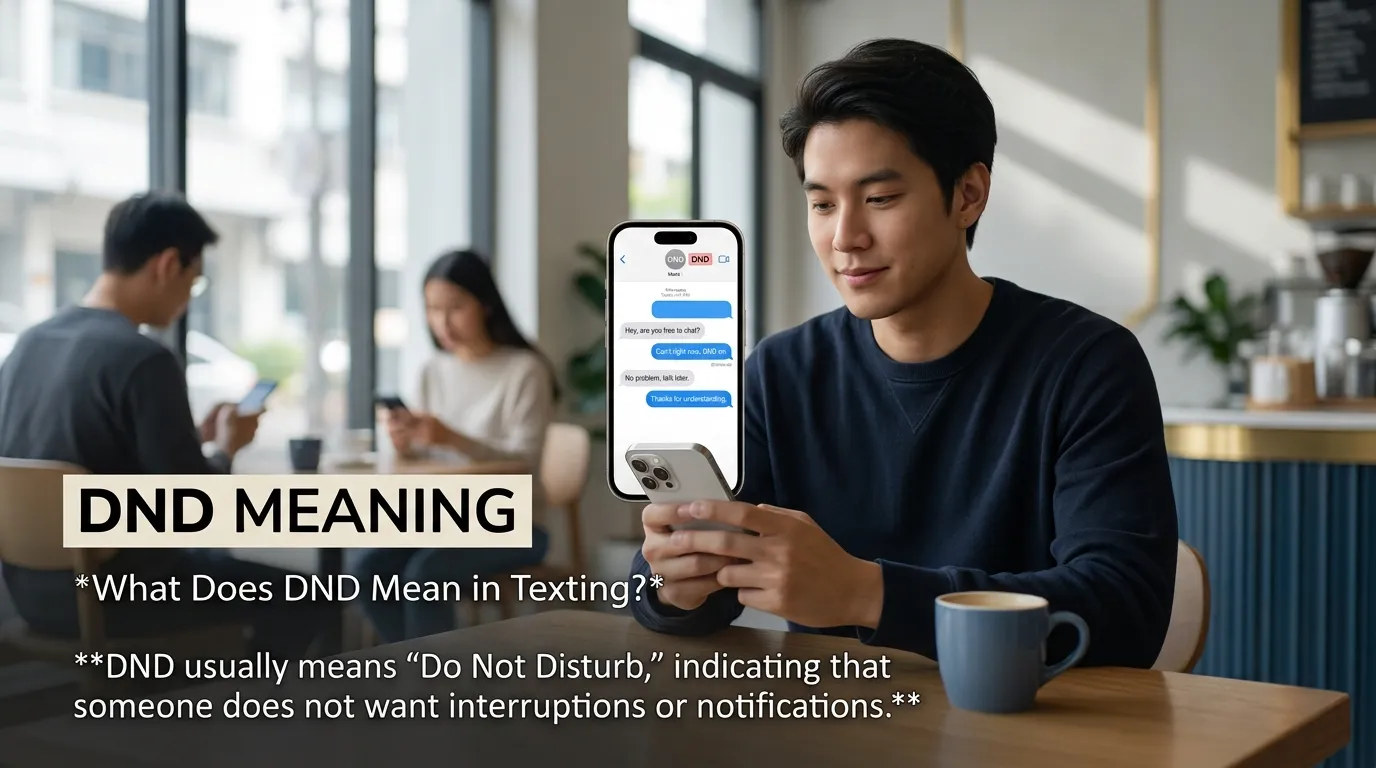
DND is an abbreviation with more than one common meaning, so its definition depends heavily on context. In texting, social media, smartphones, and everyday communication, DND usually means “Do Not Disturb.”
It tells other people that someone does not want to be interrupted or indicates that notifications are being silenced.
In gaming and entertainment, however, DND can mean “Dungeons & Dragons,” the famous tabletop role-playing game commonly abbreviated as D&D or DND.
So, what does DND mean? If you see “My phone is on DND,” it almost certainly means Do Not Disturb. If someone says, “We are playing DND tonight,” they are probably talking about Dungeons & Dragons.
This guide explains the DND definition, DND meaning in text, DND meaning on social media, DND meaning in gaming, Dungeons & Dragons, Do Not Disturb, examples, related abbreviations, common misunderstandings, and practical usage tips so you can recognize and use DND naturally.
What Does DND Mean?
The most common meanings of DND are:
- Do Not Disturb a setting or phrase indicating that someone does not want interruptions or notifications.
- Dungeons & Dragons a tabletop role-playing game involving characters, storytelling, adventures, rules, and collaborative gameplay.
The correct meaning depends on the context.
For example:
“I’m putting my phone on DND.”
Here, DND clearly means Do Not Disturb.
But:
“Our DND campaign starts tonight.”
Here, DND means Dungeons & Dragons.
Quick Definition
DND meaning in texting: Do Not Disturb.
DND meaning in gaming: Dungeons & Dragons.
Because both meanings are common, context is essential.
DND Meaning in Texting
In text messages, DND usually means “Do Not Disturb.”
Someone might use it to explain why they are not responding immediately or to tell others that they do not want to receive interruptions.
For example:
“I’m studying. My phone is on DND.”
This means the person has enabled a Do Not Disturb setting on their phone.
Another example:
“DND for the next two hours. I’ll text you later.”
The sender is saying that they are unavailable or do not want notifications during that period.
What Does DND Mean in a Text Message?
When someone sends DND in a text, it can communicate several closely related ideas:
- Don’t interrupt me.
- I’m unavailable right now.
- I’m focusing on something.
- My notifications are silenced.
- I don’t want distractions.
- I’ll respond later.
- Please give me some space.
However, it does not necessarily mean the person is ignoring you personally.
A person may activate DND because they are:
- Sleeping
- Studying
- Working
- Driving
- Exercising
- In a meeting
- Watching a movie
- Spending time with family
- Taking a break from their phone
DND Meaning on a Phone
On smartphones, Do Not Disturb is a feature designed to reduce interruptions from calls, messages, alerts, and notifications.
Depending on the device and the user’s settings, DND may allow certain calls or notifications to come through while silencing others.
For example:
“My phone automatically goes into DND when I’m sleeping.”
This means the phone has been configured to limit notifications during a particular time.
The exact behavior of DND can vary between devices and operating systems, so the abbreviation itself does not guarantee that every notification has been blocked.
DND Meaning on Social Media
On platforms such as TikTok, Instagram, Snapchat, Reddit, and Discord, DND can still mean Do Not Disturb.
People may use it casually to describe being unavailable or wanting fewer interruptions.
Someone might write:
“DND. I’m taking a social media break.”
The meaning is essentially:
“Please don’t disturb me.”
Snapchat
A user might say:
“I’m on DND tonight.”
This usually means they are not actively checking messages or do not want notifications.
TikTok
A caption might say:
“DND, just enjoying my peace.”
Here, DND communicates a desire not to be interrupted.
A Reddit user might use DND in a discussion about notifications:
“I keep my phone on DND while I’m working.”
Discord
Discord has an especially interesting connection to DND because Do Not Disturb is an availability/status option.
Someone may set their status to DND to indicate that they do not want to be disturbed by notifications or messages.
However, Discord users may also discuss Dungeons & Dragons, so context is particularly important there.
DND Meaning in Gaming
In gaming conversations, DND can mean “Dungeons & Dragons.”
Dungeons & Dragons is a tabletop role-playing game in which players create fictional characters and participate in collaborative adventures guided by a Dungeon Master, often abbreviated as DM.
Players may explore fantasy worlds, solve problems, interact with characters, fight enemies, and make decisions that shape the story.
For example:
“We’re playing DND on Saturday.”
This almost certainly refers to Dungeons & Dragons, not Do Not Disturb.
Another example:
“I need to finish my DND character sheet.”
Again, the context makes the meaning clear.
What Are Dungeons & Dragons?
Dungeons & Dragons is a tabletop role-playing game built around collaborative storytelling, character creation, exploration, decision-making, and rules-based gameplay.
A typical group includes:
- Players
- Player characters
- A Dungeon Master
- Dice
- Character sheets
- A campaign or adventure
- A fictional setting
The players control their characters, while the Dungeon Master describes the world, manages non-player characters, presents challenges, and helps guide the adventure.
Why Is It Called DND?
The official name is Dungeons & Dragons, commonly shortened to D&D.
Some people casually type DND because typing an ampersand is less convenient, particularly in chats and online communities.
Therefore, you may see:
- D&D
- DND
- DnD
- DnD game
- Dungeons and Dragons
All of these can refer to the same game.
DND Meaning in Discord
Discord is one of the places where the two major definitions can easily overlap.
For example:
“I’m on DND.”
This probably means Do Not Disturb, particularly if the conversation concerns Discord status.
But:
“We’re starting a new DND campaign.”
This means Dungeons & Dragons.
How to Tell Which Meaning Is Intended
Look for nearby words.
Do Not Disturb clues:
- Phone
- Notifications
- Status
- Messages
- Calls
- Busy
- Sleep
- Work
- Focus
Dungeons & Dragons clues:
- Campaign
- Character
- Dungeon Master
- Dice
- Party
- Quest
- Dungeon
- Character sheet
- Spell
- Dungeon Master
Context usually solves the ambiguity immediately.
DND Meaning in Dating and Relationships
In dating conversations, DND usually means Do Not Disturb.
For example:
“I’m going to put my phone on DND for a while.”
This generally means the person wants uninterrupted time.
Someone might also write:
“DND tonight. I need some alone time.”
This is a direct way to communicate a temporary need for privacy or space.
However, DND does not automatically mean someone is angry or losing interest.
It is important to consider the broader conversation before interpreting it emotionally.
Example
Person A: “Why didn’t you answer?”
Person B: “Sorry, I had my phone on DND while I was studying.”
In this case, the lack of response is explained by the phone setting rather than relationship problems.
DND Meaning in the Workplace
At work, DND commonly means Do Not Disturb, especially when discussing availability, notifications, meetings, or productivity.
Examples include:
“I’ll be on DND during the presentation.”
“Please use email; I’m on DND for the next hour.”
“I set my status to DND while working on the report.”
In a workplace, DND can communicate a professional boundary: the person is concentrating and does not want unnecessary interruptions.
DND and Productivity
Many people use Do Not Disturb or similar focus features to reduce distractions.
The idea is simple:
Fewer interruptions → fewer distractions → more focused work.
That does not mean DND guarantees productivity. It is simply a tool that can help limit unwanted notifications.
DND Meaning in Everyday Conversation
Outside technology, people sometimes use DND informally to mean:
- Don’t bother me.
- Don’t interrupt.
- Leave me alone for now.
- I’m busy.
- I’m unavailable.
- Give me some space.
For example:
“DND while I finish this assignment.”
The speaker is communicating a temporary boundary.
DND Examples in Conversations
Here are realistic examples showing how the meaning changes.
Example 1: Smartphone
A: “Why didn’t you answer my call?”
B: “Sorry, my phone was on DND.”
Meaning: Do Not Disturb.
Example 2: Studying
A: “Want to chat?”
B: “Not right now. DND until I finish studying.”
Meaning: Please don’t interrupt me.
Example 3: Gaming
A: “What are you doing tonight?”
B: “Playing DND with my friends.”
Meaning: Dungeons & Dragons.
Example 4: Discord
A: “Why is your Discord status on DND?”
B: “I’m working and don’t want notifications.”
Meaning: Do Not Disturb.
Example 5: Tabletop Gaming
A: “Did you make your character?”
B: “Yes. We’re starting our DND campaign this weekend.”
Meaning: Dungeons & Dragons.
DND vs. D&D
When referring to Dungeons & Dragons, D&D is the traditional abbreviation.
However, DND, DnD, and D&D are all commonly encountered online.
| Abbreviation | Common Meaning |
| DND | Do Not Disturb or Dungeons & Dragons |
| DnD | Often Dungeons & Dragons |
| D&D | Dungeons & Dragons |
| Do Not Disturb | Phone/device availability setting |
| DM | Dungeon Master or Direct Message, depending on context |
The capitalization does not always provide a reliable answer.
For example, someone could type:
“dnd tonight?”
and mean Dungeons & Dragons.
Another person could type:
“I’m on dnd.”
and mean Do Not Disturb.
The surrounding conversation matters more than capitalization.
DND vs. AFK
AFK means Away From Keyboard.
It is especially common in gaming and online communication.
DND
“I’m on DND.”
Usually means notifications are being limited or the person does not want interruptions.
AFK
“I’m AFK for 20 minutes.”
Means the person is temporarily away from their computer or device.
A person can be both:
“AFK and on DND.”
This means they are away and have also enabled Do Not Disturb.
DND vs. Busy
These terms are similar but not identical.
Busy tells people that someone is occupied.
DND specifically communicates that interruptions or notifications are unwanted or restricted.
For example:
“I’m busy.”
means the person is occupied.
“I’m on DND.”
suggests that notifications or interruptions are being deliberately limited.
DND vs. Offline
Being offline generally means someone is not connected or not currently available online.
DND is different.
Someone can be online while their status is set to Do Not Disturb.
For example, a person could actively use Discord while still displaying a DND status.
Common DND Synonyms and Related Expressions
When DND means Do Not Disturb, related expressions include:
- Do not disturb
- Don’t interrupt
- Don’t bother me
- I’m unavailable
- I’m busy
- Give me some space
- I’m focusing
- I’m taking a break
- Notifications are off
- I’m in focus mode
- I’ll respond later
These expressions vary in tone.
“Don’t bother me” can sound much stronger than “I’m on DND.”
If you want to sound polite, “I’m on DND right now; I’ll get back to you later” is generally clearer.
Positive and Negative Connotations of DND
DND itself is usually neutral.
Its emotional meaning depends on how it is used.
Positive or Neutral
“I’m putting my phone on DND so I can focus on my work.”
This communicates healthy focus and organization.
Potentially Negative
“DND. Don’t message me.”
Depending on the relationship, this could sound dismissive or irritated.
The setting itself is neutral; the wording around it determines the tone.
Common Misconceptions About DND
Misconception 1: DND Always Means Someone Is Ignoring You
Not necessarily.
A person may have DND enabled automatically or may be busy with something unrelated to you.
Misconception 2: DND Means Every Notification Is Blocked
Not always.
Modern devices and applications can offer exceptions, schedules, or priority contacts.
Misconception 3: DND Always Means Do Not Disturb
No. In gaming communities, DND frequently refers to Dungeons & Dragons.
Misconception 4: DND and D&D Are Completely Different Games
When people use DND to mean Dungeons & Dragons, they are generally referring to the same tabletop role-playing game commonly written as D&D.
Misconception 5: DND Is Internet Slang
Do Not Disturb is not simply slang. It is a standard phrase and an established device feature. The abbreviation DND is a convenient shortened form used in digital communication.
How to Determine the Meaning of DND
When you encounter DND, ask yourself what the conversation is about.
Step 1: Look for Technology Words
If you see words like:
- Phone
- Notifications
- Status
- Calls
- Messages
- Busy
- Focus
DND probably means Do Not Disturb.
Step 2: Look for Gaming Words
If you see:
- Campaign
- Dice
- Character
- Dungeon Master
- Quest
- Party
- Spell
- Adventure
DND probably means Dungeons & Dragons.
Step 3: Consider the Platform
On a phone or Discord status, Do Not Disturb is highly likely.
In a tabletop gaming community, Dungeons & Dragons is more likely.
Step 4: Read the Full Sentence
The surrounding sentence usually provides enough information to identify the intended meaning.
Summary Table: DND Meaning at a Glance
| Category | Details |
| Abbreviation | DND |
| Most common texting meaning | Do Not Disturb |
| Gaming meaning | Dungeons & Dragons |
| D&D abbreviation | Dungeons & Dragons |
| Tone | Usually neutral; can vary by context |
| Common platforms | Phones, Discord, Instagram, Snapchat, TikTok, Reddit |
| Workplace meaning | Usually Do Not Disturb |
| Dating meaning | Usually Do Not Disturb |
| Gaming meaning | Usually Dungeons & Dragons |
| Related term | AFK |
| Related status | Busy |
| Main clue for Do Not Disturb | Phone, notifications, status, calls |
| Main clue for Dungeons & Dragons | Campaign, dice, character, DM |
How to Use DND Naturally
If you want to use DND in a message, make the context clear.
Instead of simply saying:
“DND.”
you could write:
“I’m on DND while I study.”
or:
“We’re playing DND tonight.”
These sentences make the intended meaning obvious.
If there is a possibility of confusion, spell out the phrase:
“My phone is on Do Not Disturb.”
Or:
“We’re playing Dungeons & Dragons tonight.”
Clear wording is especially useful in professional communication.
Frequently Asked Questions About DND
1. What does DND mean in texting?
In texting, DND most commonly means “Do Not Disturb.” It usually indicates that someone is unavailable, wants to avoid interruptions, or has enabled a setting that limits notifications.
2. What does DND mean on a phone?
On a phone, DND generally means Do Not Disturb, a feature that can silence or limit selected notifications, calls, and alerts according to the device’s settings.
3. What does DND mean in gaming?
In gaming conversations, DND usually means Dungeons & Dragons, a tabletop role-playing game. People may discuss DND campaigns, characters, dice, adventures, and Dungeon Masters.
4. What does DND mean on Discord?
On Discord, DND commonly means Do Not Disturb, a status indicating that the user does not want normal interruptions. However, Discord users may also use DND to refer to Dungeons & Dragons, so context is important.
5. Is DND the same as D&D?
When DND is being used to refer to Dungeons & Dragons, yes. D&D is the traditional abbreviation, while DND or DnD is also widely used in online conversations.
6. Does DND mean someone is ignoring you?
Not necessarily. Someone may have DND enabled because they are working, sleeping, studying, driving, or simply taking a break from notifications. It does not automatically indicate that they are deliberately ignoring you.
7. What is the difference between DND and AFK?
DND generally means Do Not Disturb, while AFK means Away From Keyboard. DND concerns interruptions or availability, whereas AFK usually indicates that someone is temporarily away from their device or keyboard.
8. What does DND mean in a relationship?
In relationship conversations, DND usually means Do Not Disturb. Someone may use it to say they are busy, need some personal space, or do not want phone notifications for a while. The meaning should be interpreted according to the surrounding conversation.
9. Is DND considered slang?
DND is better described as an abbreviation than slang. “Do Not Disturb” is a standard English phrase, while DND is a shortened form commonly used in digital communication. DND can also abbreviate Dungeons & Dragons.
10. Why does DND have two different meanings?
DND is an abbreviation shared by two widely recognized phrases: Do Not Disturb and Dungeons & Dragons. Because both are common in digital and gaming communities, context determines which meaning is intended.
Conclusion
The DND meaning depends on where and how you see the abbreviation. In texting, smartphones, workplace communication, dating conversations, and online status indicators.
DND most often means Do Not Disturb. It generally tells others that someone does not want interruptions or is limiting notifications.
In gaming, tabletop communities, Discord gaming groups, and fantasy-related conversations, DND can mean Dungeons & Dragons. Words such as campaign, character, dice, quest, and Dungeon Master usually make this meaning obvious.
The easiest way to remember the distinction is:
DND + phone/notifications = Do Not Disturb
DND + gaming/campaign/dice = Dungeons & Dragons
Because abbreviations can have multiple meanings, never interpret DND from the three letters alone.
Look at the surrounding words, platform, and conversation topic. Once you understand those context clues, recognizing DND meaning in text, social media, gaming, Discord, workplace communication, and everyday conversations becomes straightforward.
If someone is silencing notifications or preparing for a fantasy adventure, the meaning of DND is usually easy to identify when you pay attention to context.

I am Sophia Bennett, is a digital resources and online tools writer at LinkVistaHub. She enjoys exploring useful websites, emerging digital tools, productivity platforms, and practical online resources that help people work smarter and discover valuable information.