Have you ever heard someone say “animal fodder,” “cannon fodder,” or “fodder for discussion” and wondered what the word actually means?
The word fodder has a simple everyday meaning, but it can also appear in agriculture, literature, journalism, entertainment, military language, and casual conversation.
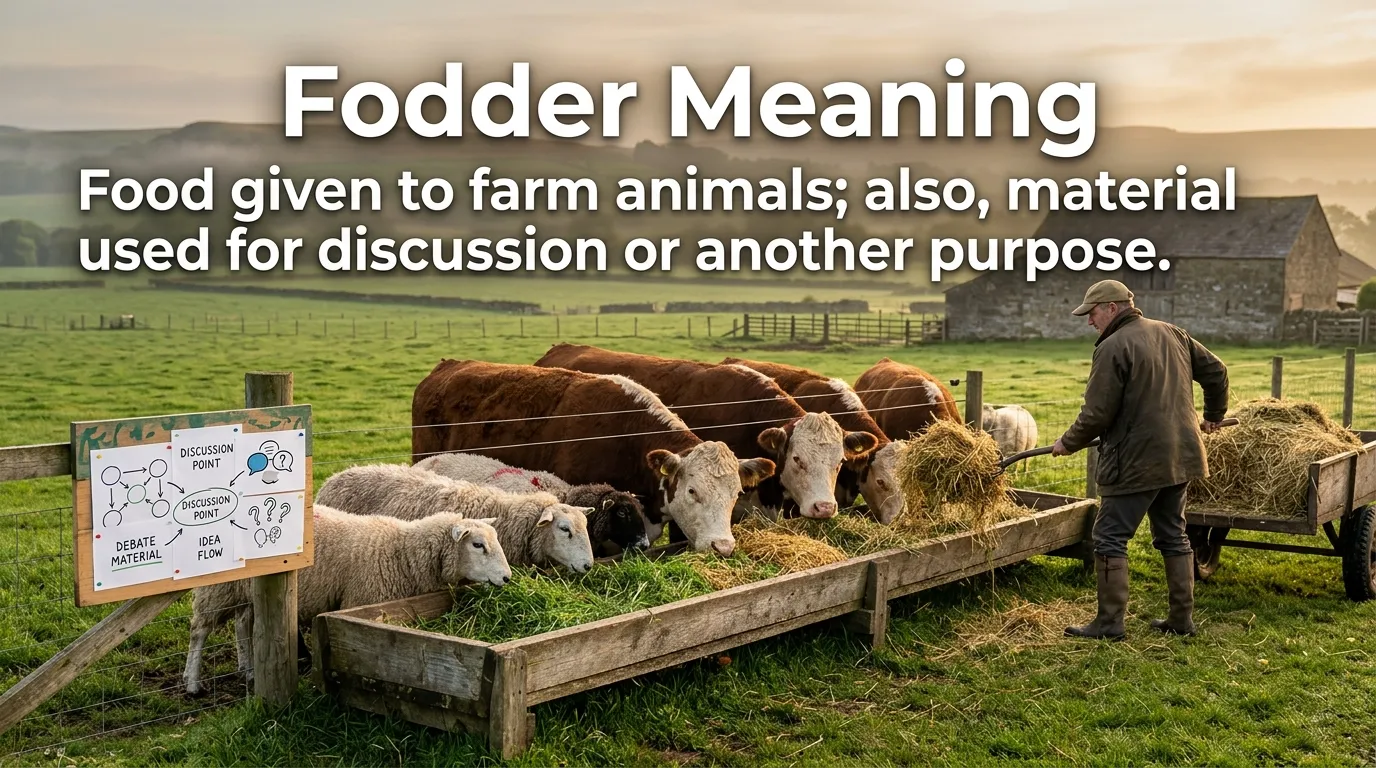
In its most common sense, fodder means food given to farm animals, especially hay, straw, grass, grains, and other materials used to feed livestock.
However, the word can also have a figurative meaning: something or someone that is used as material for a particular purpose.
For example, a farmer may store fodder for cattle, while a journalist might describe a controversial event as fodder for debate.
You may also encounter the phrase “cannon fodder,” which refers to people considered expendable in war or another dangerous situation.
Understanding fodder meaning is therefore useful if you want to improve your English vocabulary and recognize the word in different contexts.
In this guide, we’ll explore the fodder definition, origin, pronunciation, examples, synonyms, figurative meanings, common phrases, and practical uses so you can understand exactly when and how to use it.
Fodder Definition in Simple Words
In simple English, fodder is food for animals.
Think of it this way:
Fodder = food or feed prepared or provided for livestock.
The word can also mean something used as material for another purpose.
What Does Fodder Mean?
Fodder means food given to farm animals, particularly livestock such as cattle, horses, sheep, and goats.
Fodder can include materials such as:
- Hay
- Grass
- Straw
- Corn
- Grain
- Silage
- Leaves
- Other prepared animal feed
The word can also be used figuratively to mean material that provides something to work with, discuss, think about, or use for a particular purpose.
For example:
The farmer stored enough fodder to feed the cattle throughout the winter.
In a figurative sense:
The celebrity’s controversial comment became fodder for online discussion.
Here, “fodder” does not mean actual food. It means material that gives people something to discuss.
Two Basic Meanings of Fodder
| Meaning | Explanation | Example |
| Literal | Food given to farm animals | The cows were given fresh fodder. |
| Figurative | Material used for discussion, entertainment, thought, or another purpose | The story became fodder for debate. |
The literal agricultural meaning is the original and most common meaning.
What Is Fodder in Agriculture?
In agriculture, fodder refers to feed given to domesticated animals, especially livestock.
Farmers need reliable animal feed because cattle, sheep, goats, horses, and other animals depend on appropriate nutrition for growth, health, reproduction, and productivity.
Fodder can be grown specifically for animals or produced from agricultural crops.
Common examples include:
- Fresh grass
- Hay
- Corn
- Alfalfa
- Sorghum
- Silage
- Straw
- Legume plants
- Crop residues
The exact type of fodder used depends on the animal, climate, farming system, and available resources.
Fodder vs. Animal Feed
The terms fodder and animal feed are closely related, but they are not always used in exactly the same way.
Animal feed is a broad term covering food provided to animals.
Fodder often refers specifically to feed intended for livestock, particularly plant-based materials such as grass, hay, or harvested crops.
For example:
The farmer bought animal feed for the chickens.
But:
The farmer harvested fodder for the cattle.
Both sentences describe food for animals, but “fodder” is especially associated with livestock and agricultural feeding.
Fodder Meaning in Different Contexts
One reason the word fodder can be confusing is that its meaning changes depending on context.
Fodder in Farming
This is the traditional meaning.
The farmer planted alfalfa as fodder for the horses.
Here, fodder simply means animal feed.
Fodder in Conversation
Fodder can mean something that gives people material to talk about.
The unusual decision provided plenty of fodder for conversation.
The event itself is not food. Instead, it provides material for discussion.
Fodder in Media
Journalists and commentators may use “fodder” to describe information or events that generate stories, debate, or speculation.
The announcement became fodder for news coverage.
Fodder in Entertainment
A character, event, or situation can become fodder for jokes, comedy, or creative work.
His embarrassing mistake became fodder for the comedian’s routine.
Fodder in Military Language
The phrase “cannon fodder” describes soldiers or other people viewed as expendable in warfare.
It is generally a negative and critical expression.
The soldiers feared they were being treated as cannon fodder.
Fodder Meaning in a Sentence
Here are some examples showing the word’s different uses:
- The cows need fresh fodder every morning.
- The farmer stored dry fodder for the winter.
- Grass is an important source of fodder for many livestock animals.
- The scandal became fodder for public debate.
- His strange comment provided fodder for jokes.
- The photograph became fodder for social media discussions.
- The story gave writers plenty of fodder for speculation.
- The army was criticized for treating inexperienced soldiers as cannon fodder.
- The farmer grew corn specifically for fodder.
- The controversial interview became fodder for television commentators.
These examples show why context matters when interpreting the word.
Fodder as a Figurative Expression
The figurative use of fodder comes from the idea of something being consumed or used as a resource.
When someone says something is “fodder for discussion,” they mean it provides material that people can discuss.
Common expressions include:
- Fodder for discussion
- Fodder for debate
- Fodder for conversation
- Fodder for speculation
- Fodder for jokes
- Fodder for criticism
- Fodder for stories
- Fodder for the media
Example
The politician’s unexpected statement became fodder for debate.
This means the statement gave people something to debate.
What Does “Fodder for Thought” Mean?
“Fodder for thought” means something that provides material for thinking or reflection.
It is similar to the more familiar expression “food for thought.”
For example:
The documentary provided plenty of fodder for thought.
The sentence means the documentary gave the viewer ideas or information worth thinking about.
However, “food for thought” is much more common in everyday English.
What Does “Cannon Fodder” Mean?
“Cannon fodder” is an idiom describing people who are regarded as expendable in a dangerous conflict, especially war.
The expression comes from the image of soldiers being sent into situations where they face serious danger from enemy weapons.
For example:
The recruits feared they would be used as cannon fodder.
The phrase usually carries a strongly negative or critical tone because it suggests that people’s lives are being treated as disposable.
It can also be used figuratively outside war:
The inexperienced workers felt like cannon fodder during the company’s risky project.
In this example, the expression suggests that the workers believe they are being placed in danger or sacrificed for someone else’s objectives.
Fodder Synonyms
The best synonym depends on which meaning of fodder you are using.
Synonyms for Animal Fodder
- Feed
- Animal feed
- Forage
- Hay
- Grass
- Provender
These words are related, but they are not always interchangeable.
Forage, for example, can refer to food that animals find or consume while grazing, while fodder can refer more generally to food provided to livestock.
Synonyms for Figurative Fodder
When fodder means material for discussion or another activity, possible alternatives include:
- Material
- Subject
- Content
- Source
- Topic
- Fuel
- Input
For example:
The story became fodder for debate.
Could be rewritten as:
The story became material for debate.
Or:
The story fueled the debate.
The exact synonym depends on the sentence.
Fodder vs Forage
Fodder and forage are closely related agricultural terms, but they have slightly different uses.
Forage can refer to plants or other food that animals naturally search for and consume, especially while grazing.
For example:
The farmer prepared fodder for the cattle.
versus:
The sheep searched for forage in the field.
Both involve animal nutrition, but the emphasis is different.
Fodder vs. Feed
Feed is the broader term.
Animal feed can include many different products and formulations. Fodder is often used more specifically for livestock feed, especially plant-based material.
A simple way to remember the distinction is:
Feed = broad category
Fodder = commonly used term for livestock food, especially agricultural or plant-based feed
The terms can overlap in everyday conversation.
Origin and History of the Word Fodder
The word fodder has a long history in English and is closely connected with the feeding of animals.
It comes from an old Germanic word related to food or nourishment. Similar forms can be found in other Germanic languages.
Historically, the word was strongly associated with food provided to livestock.
Over time, its use expanded metaphorically. The basic idea remained the same: just as animals consume fodder, something can figuratively “feed” a discussion, story, argument, or creative activity.
This development explains expressions such as:
fodder for debate
and:
fodder for the imagination
The figurative meaning is now well established in English.
How to Use Fodder Correctly
If you want to use fodder naturally, first determine if you are talking about animals or using the word figuratively.
For Animals
Use it when discussing livestock or animal nutrition:
We need to buy more fodder for the cattle.
For Discussion
Use it when something provides material for people to discuss:
The announcement became fodder for political debate.
For Entertainment
Use it when something provides material for jokes, stories, or creative work:
The incident became fodder for the comedian.
For Critical Expressions
Be careful with phrases such as cannon fodder, because they often carry a negative or serious tone.
Common Mistakes With the Word Fodder
Mistake 1: Assuming Fodder Only Means Animal Food
While this is the original and most familiar meaning, the figurative meaning is also common.
Mistake 2: Treating Fodder and Food as Exact Synonyms
Fodder usually refers to food provided for animals, particularly livestock. Saying “fodder” for ordinary human food would normally sound incorrect.
Mistake 3: Assuming “Cannon Fodder” Is Literal
In most modern uses, cannon fodder is an idiom describing people viewed as expendable.
Mistake 4: Using Fodder Without Considering Tone
The figurative word can sometimes suggest that something is being used as a resource or consumed for a purpose. Context determines if that sounds neutral, humorous, or critical.
Is Fodder a Positive or Negative Word?
The word fodder itself is generally neutral when used in agriculture.
For example:
The farmer prepared high-quality fodder for the cattle.
There is nothing negative about this usage.
The figurative meaning can be neutral:
The interview provided fodder for further research.
It can also be negative:
The workers felt like cannon fodder.
Therefore, the context and expression determine the emotional tone.
Real-Life Scenario: Fodder on a Farm
Imagine a farmer preparing for winter.
During warmer months, the farmer grows and stores grass, hay, or other crops. When fresh vegetation becomes less available, the stored material can be used to feed livestock.
A conversation might sound like this:
Farmer: Did you finish storing the fodder?
Worker: Yes. We have enough hay for the cattle.
Here, fodder has its literal agricultural meaning.
Real-Life Scenario: Fodder on Social Media
Now imagine a celebrity makes an unusual statement.
People begin discussing it online, creating posts, videos, jokes, and commentary.
Someone might say:
“That interview is going to be fodder for social media all week.”
Here, fodder means material that fuels online discussion or entertainment.
This figurative usage has become especially common in discussions about news, celebrities, politics, television, and internet culture.
Quick Facts About Fodder
| Fact | Details |
| Primary meaning | Food given to livestock |
| Common context | Agriculture and animal care |
| Figurative meaning | Material for discussion, entertainment, thought, or another purpose |
| Word origin | Germanic roots associated with food or nourishment |
| Common phrase | Cannon fodder |
| Related words | Feed, forage, material, fuel |
| Tone | Usually neutral; can become negative depending on context |
| Example | The cattle were given fresh fodder. |
Frequently Asked Questions About Fodder Meaning
What does fodder mean in simple English?
Fodder means food given to farm animals, especially livestock such as cattle, horses, sheep, and goats. Figuratively, it can mean material used for discussion, entertainment, or another purpose.
Is fodder the same as animal feed?
They are closely related. Animal feed is a broad term, while fodder commonly refers to food provided to livestock, particularly plant-based materials such as hay, grass, and harvested crops.
What does fodder mean in slang?
Fodder is not primarily a slang word. Its figurative use means material that can be used for discussion, jokes, stories, speculation, or another purpose. For example, something can become “fodder for jokes.”
What does “fodder for discussion” mean?
It means something that provides people with material or a subject to discuss.
For example:
The new research gave us fodder for discussion.
The research provided ideas and information that could be discussed.
What does “fodder for thought” mean?
“Fodder for thought” means something that gives you material to think about or reflect on. It is similar in meaning to the more common expression “food for thought.”
What does “cannon fodder” mean?
Cannon fodder refers to people considered expendable in a conflict or dangerous situation, particularly soldiers sent into situations where they may be killed or seriously injured.
It is a negative and critical expression.
What is another word for fodder?
For animal fodder, related words include feed, forage, hay, and provender. For the figurative meaning, words such as material, subject, content, source, or fuel may work depending on the context.
Is fodder used for humans?
In its literal sense, fodder is intended for animals rather than humans. Figuratively, however, people or events can sometimes be described as fodder for a particular purpose, such as “fodder for the media.”
What is the difference between fodder and forage?
Fodder generally refers to food provided to livestock, while forage often refers to food that animals find and consume, particularly vegetation available for grazing. The terms can overlap depending on the context.
Is “fodder” a negative word?
Not usually. Fodder is neutral when referring to animal feed. Its figurative uses can be neutral, humorous, or negative depending on the expression. “Cannon fodder,” for example, has a distinctly negative meaning.
Conclusion
The simplest fodder meaning is food provided to farm animals, especially livestock. Hay, grass, grain, silage, and other agricultural materials can all be described as fodder depending on the context.
But the word has an important figurative meaning too. When something becomes fodder for discussion, debate, jokes, media coverage, or thought, it provides material that can be used for that purpose.
The well-known expression “cannon fodder” takes the idea in a more serious direction, describing people viewed as expendable in dangerous situations.
So, when you encounter fodder, look at the surrounding words. If the context involves cattle or farming, it probably means animal feed.
If it involves news, conversation, entertainment, or debate, it likely means material that fuels a particular activity.
That distinction makes this versatile English word much easier to understand and use naturally.

I am Alex Carter, is a web resources and digital tools writer at Linkvistahub. He enjoys discovering useful websites, online tools, productivity resources, and practical digital solutions that can make everyday tasks easier.