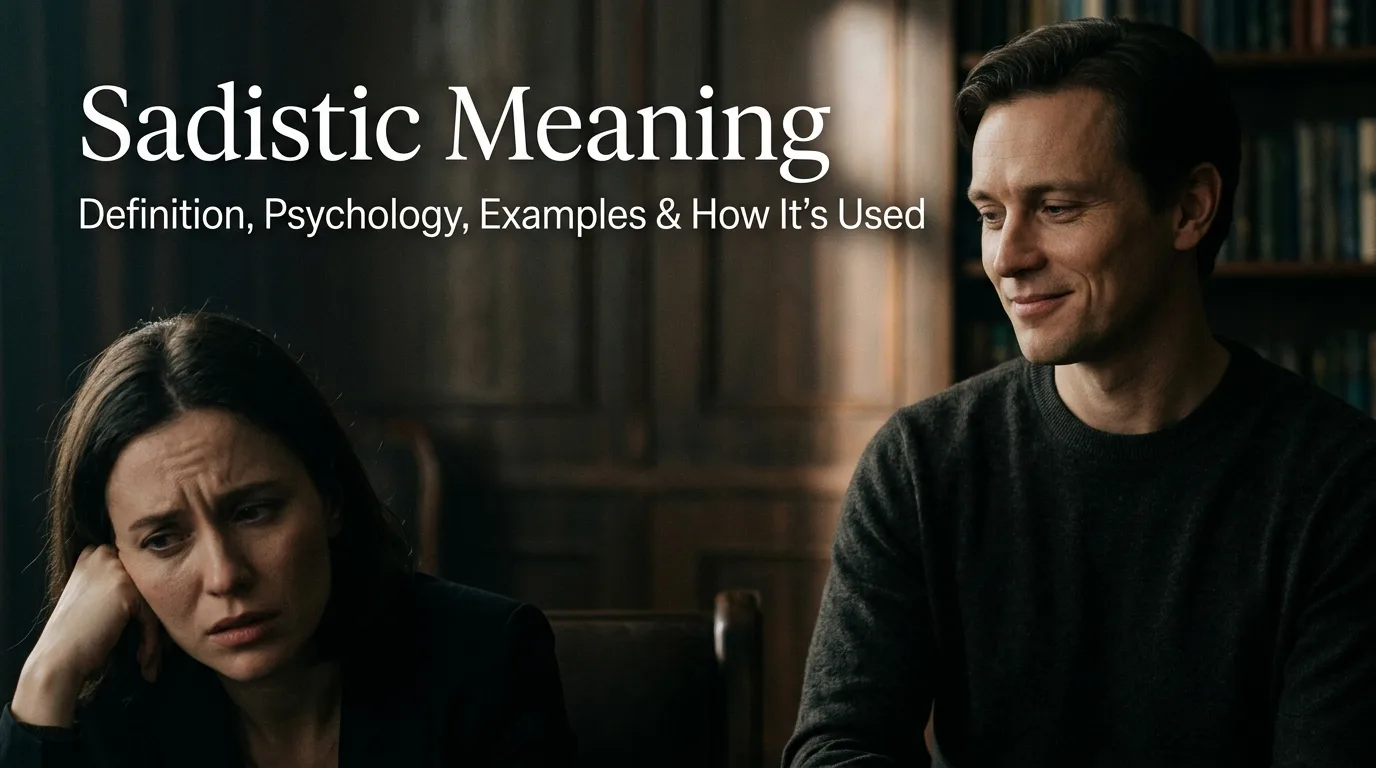
Have you ever heard someone described as “sadistic” and wondered if it simply means cruel, or if the word has a deeper psychological meaning?
The term sadistic meaning can be confusing because it appears in everyday conversations, psychology, literature, relationships, entertainment, and social media yet its meaning can change depending on context.
In simple terms, sadism generally describes someone who takes pleasure or satisfaction from causing pain, humiliation, distress, or suffering to another person.
However, using the word casually does not necessarily mean that someone has a psychological disorder. Understanding the difference between everyday language and clinical terminology is important.
The word is also related to sadism, cruelty, malice, and psychological aggression, but these terms are not interchangeable.
A person who enjoys watching a fictional villain behave cruelly, for example, is not automatically sadistic.
In this guide, we’ll explore the sadistic meaning, its origin and history, psychological context, everyday uses, examples, related words, misconceptions, and how the term is used in modern communication.
By the end, you’ll have a clear understanding of what “sadistic” means and when it is appropriate to use the word.
What Does Sadism Mean?
Sadistic means taking pleasure, satisfaction, or enjoyment in causing pain, suffering, humiliation, or distress to another person or sometimes to an animal.
The word is commonly used to describe cruel behavior that appears to involve enjoyment of another person’s suffering.
For example:
“The villain was portrayed as a sadistic character who enjoyed frightening his victims.”
Here, sadistic does not simply mean “bad.” It emphasizes the idea that the person appears to derive pleasure from another person’s suffering.
Sadistic Meaning in Simple Words
In simple language:
Sadistic = enjoying or taking satisfaction from causing pain, suffering, fear, or humiliation.
The word can describe behavior, attitudes, personalities, fictional characters, or situations.
However, context matters. Calling someone “sadistic” is a strong statement and should not be used casually as a diagnosis.
Sadistic Definition
The adjective sadistic comes from the noun sadism.
A general dictionary-style definition would describe sadistic behavior as behavior involving the enjoyment of causing pain or suffering to others.
The word can refer to:
- Physical cruelty
- Emotional cruelty
- Psychological humiliation
- Deliberate intimidation
- Enjoyment of another person’s distress
- Cruel treatment motivated partly by pleasure or satisfaction
The key idea is not simply that someone causes harm. The element of enjoyment or gratification is what makes “sadistic” distinctive.
Someone can hurt another person because of anger, fear, self-defense, or carelessness without that behavior necessarily being sadistic.
Sadistic vs. Cruel: What’s the Difference?
These words are closely related, but they are not identical.
| Term | General Meaning |
| Sadistic | Enjoying or taking satisfaction from another person’s suffering |
| Cruel | Causing pain or suffering without necessarily enjoying it |
| Malicious | Intending to cause harm or trouble |
| Abusive | Using harmful or controlling behavior toward another person |
| Aggressive | Acting forcefully or violently toward someone |
| Heartless | Showing little sympathy or compassion |
Consider two situations.
Example 1:
Someone deliberately humiliates another person because they enjoy seeing them become upset.
That behavior may be described as sadistic.
Example 2:
Someone behaves cruelly because they are angry but shows no pleasure in the other person’s suffering.
That may be cruel, but “sadistic” may not be the most accurate description.
What Is Sadism?
Sadism is the noun form related to sadistic.
In general usage, sadism refers to deriving pleasure or satisfaction from causing suffering, pain, humiliation, or distress to others.
The concept can appear in different contexts, including:
- Psychology
- Literature
- History
- Everyday language
- Relationships
- Fiction
- Sexual behavior
These contexts should not automatically be treated as equivalent.
Psychological Context
In psychology, sadistic traits can refer to tendencies involving cruelty, aggression, callousness, or enjoyment of another person’s suffering.
However, describing someone as having “sadistic traits” is not the same as diagnosing them with a mental disorder.
This distinction is especially important online, where psychological vocabulary is often used loosely.
Where Did the Word “Sadistic” Come From?
The word sadistic comes from the name of Marquis de Sade, an eighteenth-century French aristocrat and writer.
His writings became associated with extreme depictions of cruelty, violence, and sexual behavior involving domination and suffering.
From his name came the term sadism, which later developed into sadistic as an adjective.
The history of the word is therefore unusual: unlike many English adjectives, it developed from the name of a historical person rather than from an ordinary descriptive root.
The Origin of “Sadism”
The term sadism was introduced in the nineteenth century in discussions influenced by the writings of Marquis de Sade.
Over time, its meaning expanded beyond literary descriptions and became part of psychological and medical terminology.
Today, the word has both:
- A general everyday meaning, involving enjoyment of another person’s suffering.
- More specialized meanings, particularly in psychological and sexual contexts.
Because of this history, context is essential when interpreting the word.
Sadistic Meaning in Psychology
The psychological meaning of sadism requires more care than the everyday definition.
A person may occasionally behave cruelly without having a persistent sadistic personality. Human behavior can be influenced by anger, insecurity, social pressure, trauma, competition, or other factors.
When psychologists discuss sadistic traits, they may be referring to patterns involving:
- Enjoyment of cruelty
- Deliberate humiliation
- Aggressive behavior
- Lack of concern for another person’s suffering
- Pleasure associated with another person’s distress
A single unpleasant action is generally not enough to establish a stable personality pattern.
Is Sadism a Mental Disorder?
This is an important distinction.
Sadism as a general trait or behavior is not automatically a mental disorder.
There are specialized psychological and psychiatric concepts involving sadistic behavior, but the everyday adjective “sadistic” should not be treated as a clinical diagnosis.
For example, saying:
“That fictional character is sadistic.”
is very different from claiming:
“This person has a psychiatric disorder.”
The second statement requires professional assessment and cannot be established simply by observing one behavior.
Sadistic Meaning in Everyday Conversation
In everyday English, people often use sadistic to describe someone who seems unusually cruel or who appears to enjoy making others uncomfortable.
For example:
“He had a sadistic sense of humor.”
This could mean that his jokes involve enjoying other people’s embarrassment or discomfort.
Another example:
“The movie shows a sadistic villain.”
Here, the word emphasizes the villain’s apparent enjoyment of causing fear or suffering.
In casual speech, however, people sometimes use sadistic simply as an exaggerated synonym for “mean” or “cruel.” That usage can weaken the word’s actual meaning.
Sadistic Meaning in Text Messages
In texting, sadistic usually keeps its ordinary meaning, but the tone can be exaggerated.
Someone might text:
“You actually enjoyed watching me struggle with that puzzle? That’s sadistic 😂”
In this context, the speaker may be joking rather than making a serious psychological claim.
Another example:
“That prank was seriously sadistic.”
Here, the speaker may be criticizing a prank that caused unnecessary embarrassment or distress.
Is “Sadistic” Always Serious in Texting?
No.
Depending on the conversation, it can be:
- Serious
- Sarcastic
- Humorous
- Exaggerated
- Critical
The surrounding conversation determines the intended tone.
Sadistic Meaning on Social Media
On platforms such as TikTok, Instagram, Reddit, Discord, and X, people may use sadistic to describe:
- Fictional villains
- Dark humor
- Cruel jokes
- Extreme pranks
- Disturbing videos
- Online behavior
- Characters in movies or games
For example:
“That character is genuinely sadistic.”
This usually means the character appears to enjoy hurting or frightening others.
Social media users may also use the word casually:
“Why would you do that? That’s sadistic.”
In such cases, the speaker may simply mean “extremely cruel.”
Sadistic Meaning in Relationships
The word can also appear in conversations about relationships and interpersonal behavior.
A person might describe repeated behavior as sadistic if someone seems to deliberately cause emotional pain and appears to enjoy the other person’s distress.
Possible examples could include deliberately humiliating someone, intentionally provoking emotional suffering, or repeatedly exploiting someone’s vulnerabilities for enjoyment.
However, it is important not to label every unhealthy relationship as sadistic.
Terms such as emotional abuse, manipulation, coercion, controlling behavior, or cruelty may sometimes be more precise.
Sadistic Meaning in Literature
“Sadistic” is often used in literary criticism to describe fictional characters who enjoy cruelty or suffering.
Writers may create sadistic characters to represent:
- Evil
- Power
- Corruption
- Violence
- Lack of empathy
- Psychological darkness
- Abuse of authority
A sadistic villain can create fear because the character does not merely cause harm the character appears to enjoy causing it.
Example
Imagine a fictional ruler who punishes people not because punishment is necessary, but because watching them suffer entertains him.
A writer could describe this character as sadistic.
Sadistic Meaning in Movies and TV
Film and television frequently use the concept of sadism when portraying villains.
A villain might:
- Enjoy frightening victims
- Laugh while causing suffering
- Prolong punishment unnecessarily
- Humiliate people for entertainment
- Take pleasure in controlling others
These characteristics help audiences understand that the character is not merely aggressive but actively enjoys cruelty.
Because fictional storytelling often exaggerates personality traits, calling a fictional character sadistic is usually a description of characterization rather than a clinical judgment.
Sadistic Meaning in Gaming
In gaming communities, players sometimes describe villains, enemies, or even game mechanics as “sadistic.”
For example:
“The developer must be sadistic for creating this level.”
This is usually a humorous exaggeration.
It may mean the game is:
- Extremely difficult
- Frustrating
- Punishing
- Designed to test patience
The speaker does not necessarily mean that the developer literally enjoys human suffering.
Sadistic Meaning in Dating
The word can appear in dating conversations when someone describes behavior that seems intentionally cruel.
For example:
“He kept making jokes about her insecurity because he knew it upset her. That seemed sadistic.”
The important feature here is deliberate emotional harm combined with apparent enjoyment or satisfaction.
Still, labels should be used carefully. Describing a specific behavior as cruel or harmful can sometimes be more accurate than labeling an entire person.
Sadistic Meaning in Sexual Contexts
The word can also have a sexual meaning.
In consensual adult sexual contexts, sadism can refer to deriving sexual pleasure from inflicting pain, discomfort, or humiliation, typically within negotiated boundaries.
This is distinct from non-consensual abuse.
Consent Is Essential
Consensual adult practices and abuse are not the same thing.
Healthy consensual activity requires:
- Mutual agreement
- Clear boundaries
- The ability to stop
- Communication
- Respect for consent
Without meaningful consent, causing pain or humiliation can become abusive or harmful.
Positive or Negative Connotation?
The word sadistic generally has a strongly negative connotation in ordinary conversation.
Calling someone sadistic usually suggests:
- Cruelty
- Lack of compassion
- Enjoyment of suffering
- Deliberate harm
- Disturbing behavior
However, fictional storytelling and consensual adult contexts can use the word differently.
This is why the surrounding context matters.
Examples of “Sadistic” in a Sentence
Here are several natural examples:
- The villain was portrayed as a sadistic ruler who enjoyed frightening his enemies.
- That was a sadistic prank because the person clearly enjoyed the victim’s embarrassment.
- The novel features a sadistic character who takes pleasure in cruelty.
- Calling every strict teacher sadistic would be an exaggeration.
- The movie’s antagonist has a particularly sadistic personality.
- He made a sadistic joke about something that was clearly painful for her.
- The game jokingly describes its hardest challenge as sadistic.
- The character’s sadistic behavior made the scene especially disturbing.
- She described his repeated humiliation of others as sadistic.
- The term “sadistic” is stronger than simply calling someone mean.
Real-Life Scenario: Cruelty vs. Sadism
Imagine two coworkers arguing.
One employee says something harsh because they are angry and immediately regrets it.
Another employee repeatedly humiliates a coworker because they find the person’s embarrassment entertaining.
Both behaviors may be harmful.
But the second situation more closely fits the everyday meaning of sadistic, because enjoyment of another person’s distress is part of the behavior.
This example shows why context matters when choosing words.
Common Misconceptions About Sadistic Meaning
1. Sadistic Means Simply “Mean”
Not exactly.
Someone can be mean without enjoying another person’s suffering.
Sadism carries the additional idea of deriving pleasure or satisfaction from cruelty.
2. Anyone Who Likes Horror Is Sadistic
No.
Enjoying horror movies, fictional violence, or dark stories does not automatically indicate sadism.
People can enjoy frightening fiction for many reasons, including suspense, curiosity, storytelling, or adrenaline.
3. Sadistic Is Always a Medical Diagnosis
No.
In everyday English, sadistic is a descriptive adjective. It does not automatically diagnose a mental health condition.
4. Sadism and Abuse Are the Same Thing
Not necessarily.
Sadism involves enjoyment or satisfaction connected to suffering. Abuse refers to harmful behavior and can occur for many different reasons.
5. A Single Cruel Action Proves Someone Is Sadistic
Not necessarily.
A person’s broader behavior, motivation, and pattern matter when making such a characterization.
Sadistic vs. Sadism vs. Sadist
These words are related but have different grammatical roles.
| Word | Meaning | Example |
| Sadism | The concept or tendency involving enjoyment of suffering | “The story explores sadism and power.” |
| Sadistic | Describes behavior or a person associated with sadism | “The villain has a sadistic personality.” |
| Sadist | A person characterized as experiencing pleasure from causing suffering | “The character is portrayed as a sadist.” |
Simple Way to Remember
Sadism = the concept
Sadistic = describes it
Sadist = the person
Sadistic vs. Masochistic
These words are sometimes confused because they are often discussed together.
Sadism generally relates to deriving pleasure or satisfaction from causing suffering.
Masochism generally relates to deriving pleasure or satisfaction from experiencing pain, humiliation, or suffering.
They describe different directions of experience.
The terms can appear in psychological, literary, and sexual discussions, so context remains important.
Related Words to Sadistic
Depending on the context, related words include:
- Cruel
- Ruthless
- Brutal
- Malicious
- Vicious
- Callous
- Heartless
- Aggressive
- Abusive
- Tyrannical
These are not perfect synonyms.
For example, “ruthless” emphasizes a lack of mercy, while “sadistic” emphasizes enjoyment of suffering.
How to Use “Sadistic” Correctly
Use sadistic when the situation involves more than simple cruelty and there is an indication of enjoyment, satisfaction, or gratification connected to another person’s suffering.
Better:
“The character is sadistic because he seems to enjoy humiliating people.”
Less Precise:
“The teacher gave us a difficult exam, so she is sadistic.”
The second sentence may be exaggerated unless there is evidence that the teacher actually enjoys students’ suffering.
Practical Tip
Before using the word, ask:
“Is there evidence of enjoyment of another person’s suffering, or am I simply describing something as unpleasant or cruel?”
That question can help you choose the most accurate term.
Quick Summary of Sadistic Meaning
| Fact | Explanation |
| Meaning | Taking pleasure or satisfaction in another person’s suffering |
| Part of speech | Adjective |
| Noun form | Sadism |
| Person | Sadist |
| Origin | Associated with Marquis de Sade |
| Tone | Usually strongly negative |
| Common contexts | Everyday speech, psychology, literature, entertainment, social media |
| Related words | Cruel, ruthless, malicious, vicious |
| Opposite ideas | Compassion, empathy, kindness |
| Key distinction | Enjoyment of suffering separates it from ordinary cruelty |
Frequently Asked Questions
What does sadism mean in simple words?
Sadistic means enjoying or taking satisfaction from causing another person pain, suffering, humiliation, or distress.
Is sadistic the same as cruel?
Not exactly. Cruel means causing suffering or showing a lack of compassion, while sadistic specifically suggests enjoyment or satisfaction connected to that suffering.
What does sadism mean in texting?
In texting, sadistic usually means cruel in a way that seems to involve enjoying another person’s discomfort. It can also be used jokingly or sarcastically.
Is being sadistic a mental illness?
The word itself is not automatically a diagnosis. Sadistic is commonly used as a descriptive term, while specialized psychological concepts require professional assessment and context.
What is an example of sadistic behavior?
A person repeatedly humiliating someone because they enjoy watching that person become upset could be described as behaving sadistically.
What is the difference between sadistic and masochistic?
Sadistic generally refers to deriving pleasure or satisfaction from causing suffering, while masochistic generally refers to deriving pleasure or satisfaction from experiencing pain or humiliation.
Where did the word sadistic come from?
The term is historically associated with Marquis de Sade, whose writings became closely linked with depictions of cruelty and extreme sexual behavior.
Can a fictional character be sadistic?
Yes. “Sadistic” is commonly used to describe fictional villains or characters who appear to enjoy causing pain, fear, or humiliation.
Does enjoying horror make someone sadistic?
No. Enjoying fictional horror does not by itself mean that someone enjoys real suffering. Fictional entertainment and real-world behavior are different.
Is sadistic always a negative word?
In ordinary conversation, it usually has a negative connotation. Its meaning can be more specialized in psychological, literary, or consensual adult contexts.
Conclusion
The sadistic meaning is more specific than simply being cruel or unpleasant. At its core, sadism describes behavior or a person associated with taking pleasure or satisfaction in another person’s pain, suffering, humiliation, or distress.
The word can appear in everyday conversations, texting, social media, literature, movies, gaming, psychology, relationships, and other contexts. Its exact interpretation depends on how it is being used.
One of the most important distinctions is between sadistic behavior and ordinary cruelty. Cruelty involves causing suffering, while sadism adds the idea of enjoyment or gratification connected to that suffering.
It is also important not to use sadism as an automatic psychological diagnosis. A single cruel action, dark joke, difficult game, or interest in horror does not establish a person’s psychological traits.
When used carefully, the word can be a precise way to describe a particular kind of cruelty especially when someone appears to enjoy the suffering they cause.

I am Sophia Bennett, is a digital resources and online tools writer at LinkVistaHub. She enjoys exploring useful websites, emerging digital tools, productivity platforms, and practical online resources that help people work smarter and discover valuable information.