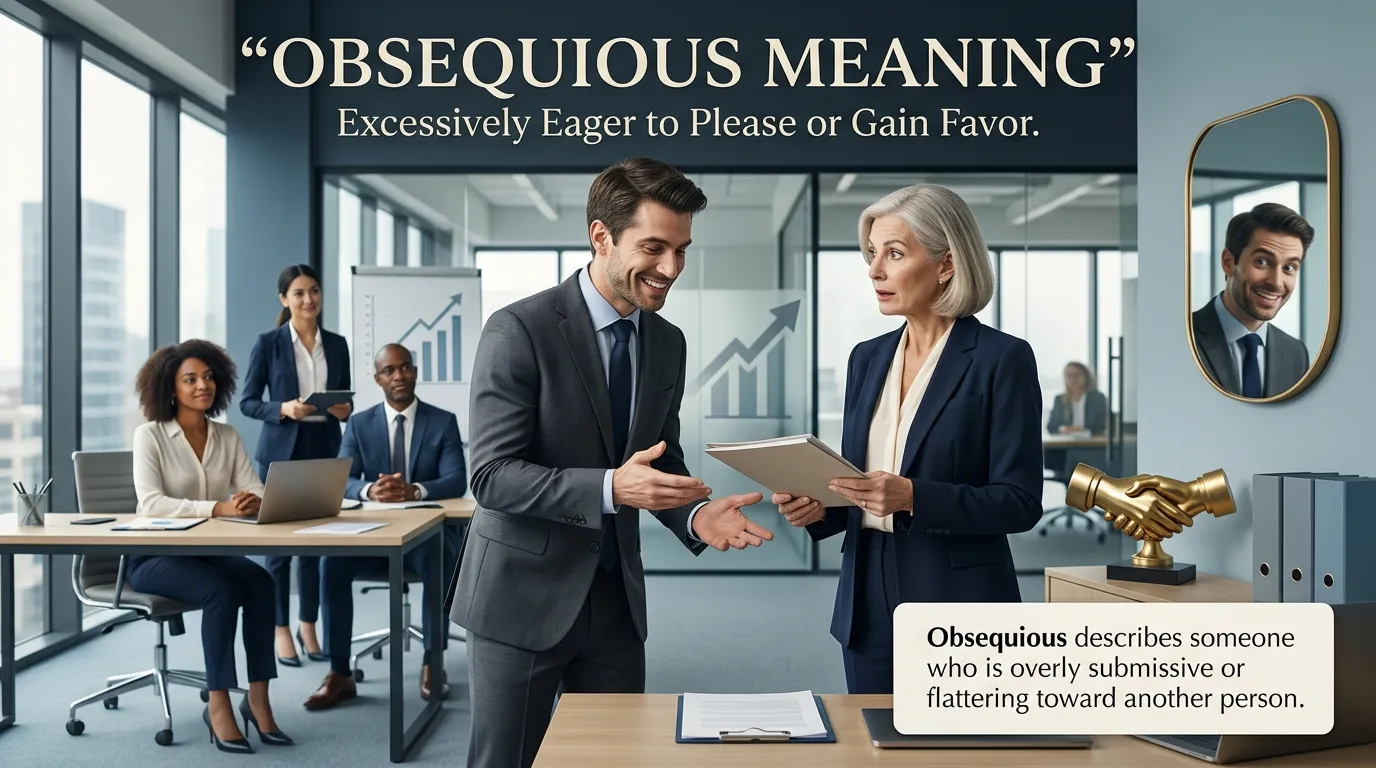
The word obsequious describes someone who is too eager to please, obey, or flatter another person, especially someone they see as more powerful, important, or influential. I
If a person constantly agrees with a boss, praises a powerful person excessively, or changes their behavior simply to gain approval, you might describe that behavior as obsequious.
Understanding the obsequious meaning matters because the word carries a stronger judgment than simple politeness or friendliness. An obsequious person is not merely respectful.
Their behavior often seems excessively submissive, flattering, servile, or eager for approval. The word is usually negative and is often used to criticize behavior that appears insincere.
You may encounter obsequious behavior in workplaces, politics, social situations, literature, and everyday conversations.
It can describe someone who agrees with everything a superior says, laughs too hard at their jokes, or offers praise that feels exaggerated and calculated.
In this guide, we will explore the definition of obsequious, its pronunciation and origin, synonyms and antonyms, examples, common contexts, positive and negative connotations, and the differences between obsequious, servile, sycophantic, submissive, flattering, and polite..
What Does Obsequious Mean?
Obsequious means excessively eager to please or obey someone, usually because that person has power, authority, status, or influence.
In simple terms, an obsequious person tries too hard to win someone’s approval.
For example:
- An employee constantly praises a manager and agrees with every opinion they express.
- A person behaves extremely submissively around someone wealthy or powerful.
- Someone repeatedly compliments a celebrity because they want attention or favor.
- A subordinate never disagrees with a superior, even when they privately think the superior is wrong.
The key idea is excessive eagerness to please.
Being respectful is normal. Being helpful is usually positive. But when the behavior becomes exaggerated, submissive, or obviously motivated by personal gain, obsequious may be the right word.
Obsequious Meaning in Simple English
A simple definition is:
Obsequious = trying too hard to please someone, especially a powerful person.
You can think of it as over-the-top politeness mixed with submission and a desire for approval.
Obsequious Definition and Part of Speech
Obsequious is an adjective.
It is commonly used to describe:
- A person
- A personality
- An attitude
- A manner
- A tone
- A behavior
- A response
- A relationship
Examples
- She was obsequious toward her supervisor.
- His obsequious behavior made everyone uncomfortable.
- The assistant gave an obsequious smile.
- He sounded obsequious rather than genuinely respectful.
- The politician was surrounded by obsequious supporters.
The related noun is obsequiousness, meaning the quality of being obsequious.
Obsequious Meaning at a Glance
| Key Fact | Explanation |
| Word | Obsequious |
| Part of speech | Adjective |
| Basic meaning | Excessively eager to please or obey |
| Typical tone | Negative or critical |
| Common context | Work, authority, politics, social relationships |
| Usually describes | Behavior, attitude, personality, or manner |
| Related noun | Obsequiousness |
| Common synonyms | Servile, sycophantic, fawning, submissive |
| Opposite ideas | Independent, assertive, confident |
| Main implication | Excessive submission or approval-seeking |
What Is the Origin of Obsequious?
The history of obsequiousness is interesting because its original sense was more neutral than its modern meaning.
The word comes from the Latin obsequiosus, which was associated with being compliant, accommodating, or obedient. It ultimately relates to the Latin verb obsequi, meaning to follow, comply, or accommodate.
Over time, the English word developed a more negative sense. Instead of simply describing someone who was compliant or willing to accommodate others, obsequious increasingly suggested excessive compliance or submission.
This shift explains why modern English speakers generally understand obsequiousness as criticism rather than praise.
Today, calling someone obsequious usually suggests that their eagerness to please has gone too far.
Obsequious Pronunciation
The standard pronunciation is approximately:
uhb-SEE-kwee-us
The main stress falls on the second syllable.
Because the spelling can look intimidating, learners sometimes hesitate before using the word. Once you become familiar with its rhythm, however, it is relatively easy to recognize and pronounce.
What Does Obsequious Mean in a Sentence?
Here are several examples that show the word in different contexts.
Workplace Example
- The new employee seemed obsequious around the company president, agreeing with every suggestion he made.
This suggests the employee was not simply respectful but seemed overly eager to impress the president.
Social Example
- His obsequious compliments made it obvious that he wanted something.
The word suggests the compliments were excessive and possibly insincere.
Political Example
- The leader was surrounded by obsequious advisers who rarely challenged his decisions.
Here, obsequious describes advisers who appear too eager to please someone with authority.
Literary Example
- The novel portrays the court officials as obsequious servants competing for the king’s favor.
This usage is especially common in descriptions of historical courts, aristocratic societies, and hierarchical institutions.
Obsequious vs. Polite: What Is the Difference?
One of the most important distinctions is between obsequious and polite.
Politeness is generally considered socially appropriate and respectful.
Obsequiousness goes beyond ordinary politeness.
| Polite | Obsequious |
| Shows respect | Shows excessive submission |
| Usually sincere or socially appropriate | May seem calculated |
| Does not necessarily seek approval | Often seeks approval or favor |
| Balanced behavior | Excessive behavior |
| Usually positive | Usually negative |
For example:
Polite:
Thank you for your help. I really appreciate it.
Obsequious:
You are absolutely brilliant. I cannot believe someone as talented as you would take the time to help someone like me.
The second example may sound exaggerated and unnecessarily submissive.
Obsequious vs. Sycophantic
Sycophantic is one of the closest words to obsequious.
Both can describe someone who excessively flatters a person with power or influence.
However, there is a slight difference in emphasis.
Obsequious focuses more on excessive obedience, submission, or eagerness to please.
Sycophantic focuses more strongly on flattery used to gain advantage or favor.
For example:
- An obsequious employee may agree with everything their boss says.
- A sycophantic employee may constantly praise the boss because they hope to receive a promotion.
The two words can overlap, and in many situations either could work.
Obsequious vs. Servile
Servile means excessively willing to serve or obey another person.
It is very close to obsequious.
However, servile often emphasizes a loss of independence or dignity, while obsequious often emphasizes excessive eagerness to please.
Example
- His servile attitude suggested that he was afraid to make his own decisions.
- Her obsequious behavior suggested that she desperately wanted the director’s approval.
Both are negative, but the focus is slightly different.
Obsequious vs. Submissive
Submissive means willing to accept another person’s authority, control, or direction.
Submissiveness is not always negative.
For example, someone may voluntarily take a submissive role in a particular situation.
Obsequious, however, usually carries a stronger negative judgment because it suggests excessive eagerness to please.
In short:
- Submissive: willing to yield or follow.
- Obsequious: excessively eager to please or obey.
Obsequious vs. Flattering
Flattery can be positive, neutral, or negative depending on the situation.
A sincere compliment is not necessarily obsequious.
For example:
- Your presentation was excellent.
That is simply a compliment.
But:
- Your presentation was absolutely perfect. No one else here could possibly match your brilliance.
If the praise is exaggerated and motivated by a desire to gain favor, it may be described as obsequious flattery.
Common Synonyms for Obsequious
Several words share similar meanings.
Sycophantic
Excessively flattering someone powerful for personal advantage.
Servile
Extremely submissive or willing to obey.
Fawning
Showing excessive admiration or affection, often insincerely.
Ingratiating
Trying hard to make yourself liked or accepted.
Subservient
Too willing to obey or serve someone else.
Groveling
Behaving in an extremely submissive or humiliating way to gain forgiveness or favor.
Bootlicking
A strongly negative, informal expression for excessive submission to powerful people.
Flattering
Giving praise, although this word is not automatically negative.
Antonyms of Obsequious
Words with meanings opposite to obsequious include:
- Assertive
- Independent
- Confident
- Self-reliant
- Uncompromising
- Strong-willed
- Autonomous
- Frank
- Candid
- Self-assured
For example, an assertive employee might respectfully disagree with their manager when they believe a decision is wrong.
An obsequious employee might agree simply because they want the manager’s approval.
Is Obsequious a Positive or Negative Word?
Obsequious is usually negative.
When you call someone obsequious, you are normally suggesting that their behavior is excessive, submissive, insincere, or motivated by a desire for approval.
However, context matters.
Someone could theoretically use the word humorously or playfully, especially when exaggerating someone’s behavior.
For example:
- He became hilariously obsequious when the famous actor walked into the restaurant.
Here, the word is still describing excessive behavior, but the speaker may be amused rather than seriously condemning the person.
How Is Obsequious Used in Everyday Life?
Although obsequious is not usually part of casual slang, it appears frequently in formal writing, journalism, criticism, literature, workplace discussions, and educated conversation.
You might use it when discussing:
Workplace Behavior
An employee who constantly seeks a manager’s approval may appear obsequious.
Politics
Political advisers or supporters who never challenge a leader may be described as obsequious.
Business
Executives may criticize employees who flatter senior management instead of providing honest feedback.
Social Relationships
Someone may appear obsequious when they constantly seek validation from a socially influential person.
Literature
Authors often use obsequious characters to represent corrupt hierarchies, power structures, or social ambition.
Obsequious Meaning in the Workplace
The workplace is one of the clearest environments for understanding this word.
Imagine a manager proposes a new strategy.
Most employees respond professionally. Some agree, while others raise concerns.
One employee immediately says:
- This is the greatest idea anyone has ever had.
- Everything you suggest works perfectly.
- I completely agree with you.
- You always know exactly what to do.
The employee may be showing obsequious behavior, particularly if this pattern happens repeatedly and appears designed to gain favor.
Why Obsequious Behavior Can Be a Problem
Excessive approval-seeking can create several workplace problems:
- Honest feedback may disappear.
- Poor decisions may go unchallenged.
- Team members may lose trust.
- Favoritism may appear.
- Communication can become less authentic.
- Managers may receive a distorted view of employee opinions.
Healthy workplaces usually benefit from respectful disagreement rather than automatic agreement.
Obsequious Meaning in Social Situations
Socially, an obsequious person may behave differently depending on someone’s status.
For example, imagine someone treats their ordinary friends casually but becomes dramatically flattering when a wealthy or famous person arrives.
That contrast may make their behavior seem calculated.
An observer might say:
- He becomes incredibly obsequious whenever someone important enters the room.
The criticism is not that the person is friendly. It is that their behavior becomes excessively deferential when status is involved.
Obsequious Meaning in Texting and Social Media
Obsequious is not common slang on TikTok, Instagram, Snapchat, Discord, Reddit, or ordinary text messaging. It is a standard English adjective rather than an internet acronym or trendy abbreviation.
However, the behavior it describes can certainly appear on social media.
For example, someone might:
- Constantly praise an influencer.
- Agree with every opinion posted by a popular creator.
- Defend a celebrity regardless of the facts.
- Repeatedly compliment someone hoping for recognition.
- Change their views to match a popular person’s opinions.
Someone discussing that behavior might describe the person as obsequious.
Example Social Media Conversation
Alex: Why does he agree with every single thing that an influencer says?
Sam: I think he is being obsequious because he wants the influencer to notice him.
Here, obsequious means excessively eager to please someone influential.
Obsequious Meaning in Dating
In dating, the word can describe someone who is excessively eager to please a romantic interest.
For example:
- He became so obsequious on the first date that he agreed with everything she said.
This does not mean being considerate is bad.
The issue is losing authenticity in an attempt to gain approval.
Healthy dating usually involves mutual respect, honesty, and the ability to express different opinions.
Real-Life Scenarios That Explain Obsequious
Scenario 1: The Office Meeting
A manager presents a questionable idea.
Everyone looks uncertain.
One employee immediately praises it as brilliant and says they would support anything the manager proposes.
That employee may be acting obsequiously.
Scenario 2: The Celebrity Encounter
Someone meets a celebrity and begins excessive praise, compliments every detail about them, and constantly tries to gain their attention.
An observer might describe the behavior as obsequious.
Scenario 3: The Family Gathering
A relative suddenly becomes extremely flattering whenever a wealthy family member arrives because they want financial assistance.
The behavior could be described as obsequious.
Scenario 4: The Classroom
A student agrees with every opinion expressed by a professor, not because they genuinely agree but because they want special approval.
That student may be acting obsequiously.
Common Misconceptions About Obsequious
Misconception 1: Obsequious Means Nice
Not exactly.
An obsequious person may appear extremely nice, but the word suggests that their behavior is excessively eager to please.
Misconception 2: It Means Any Kind of Respect
Respect is not automatically obsequious.
A person can respect a boss, teacher, parent, or leader without being obsequious.
Misconception 3: It Always Means Dishonest
Obsequious behavior often appears insincere, but the word primarily describes excessive submission or eagerness to please. The person’s internal motivation cannot always be known.
Misconception 4: It Is an Internet Slang Term
No. Obsequious is a traditional English vocabulary word, not a modern social-media acronym.
Misconception 5: It Means Weak
Obsequious behavior can suggest weakness or lack of confidence, but the exact implication depends on context.
How to Use Obsequious Correctly
Use obsequious when you want to emphasize that someone’s eagerness to please has gone beyond normal politeness or respect.
A useful formula is:
obsequious + person/behavior/attitude/manner
Examples:
- an obsequious assistant
- an obsequious employee
- an obsequious manner
- an obsequious attitude
- obsequious behavior
- an obsequious response
- an obsequious smile
- obsequious flattery
A Simple Test
Ask yourself:
Is this person merely being polite, or are they excessively trying to win someone’s approval?
If the second description fits, obsequious may be appropriate.
Common Mistakes to Avoid
Using It as a Positive Compliment
Calling someone obsequious normally sounds critical.
If you mean genuinely respectful, consider:
- Respectful
- Courteous
- Considerate
- Thoughtful
- Polite
Using It for Ordinary Agreement
Agreeing with someone does not automatically make a person obsequious.
The word implies excessive eagerness to please.
Confusing It With Obsequies
This is an important vocabulary distinction.
Obsequious means excessively eager to please or obey.
Obsequies refers to funeral rites or ceremonies.
The words look similar but have completely different meanings.
Examples of Obsequious in Sentences
Here are more examples to strengthen your understanding:
- The assistant’s obsequious manner irritated the rest of the staff.
- His obsequious compliments seemed designed to win the director’s favor.
- She refused to be obsequious, even when speaking with the company’s founder.
- The king was surrounded by obsequious courtiers.
- His constant agreement came across as obsequious rather than respectful.
- The salesperson became increasingly obsequious around wealthy customers.
- Her manager appreciated honesty and disliked obsequious behavior.
- The character’s obsequious personality revealed his desire for social advancement.
- The employee was helpful without becoming obsequious.
- His exaggerated praise sounded almost obsequious.
Obsequious in Literature and Storytelling
The word is especially useful when analyzing characters in literature.
Authors often create obsequious characters to show:
- Social hierarchy
- Fear of authority
- Desire for status
- Political ambition
- Insecurity
- Corruption
- Manipulation
- Dependence on powerful people
An obsequious character may praise a king, employer, politician, wealthy patron, or other authority figure while secretly pursuing personal goals.
This makes the word particularly useful in literary analysis because it communicates more than simple obedience. It suggests a complicated relationship between power and approval.
Why Do People Become Obsequious?
People may behave obsequiously for many reasons.
Desire for Approval
Some people strongly want validation from authority figures.
Career Advancement
An employee may believe excessive agreement will help them receive promotions or opportunities.
Fear
Someone may avoid disagreement because they are afraid of consequences.
Social Ambition
A person may flatter influential individuals to gain access to powerful social circles.
Insecurity
Low confidence can sometimes cause someone to overvalue another person’s approval.
Strategic Behavior
Some people deliberately use excessive praise because they believe it will produce a specific benefit.
Importantly, you cannot determine someone’s exact motivation simply by observing their behavior. The word describes what the behavior looks like, not necessarily the person’s private thoughts.
How to Stop Sounding Obsequious
If you want to communicate respectfully without appearing excessively submissive, focus on authenticity.
Give Specific Praise
Instead of excessive compliments, explain exactly what you appreciate.
Express Honest Opinions
Respectfully disagree when you have a legitimate reason.
Avoid Constant Agreement
You do not need to agree with every statement from someone who has more authority.
Ask Questions
Thoughtful questions demonstrate engagement without excessive flattery.
Keep Your Identity
Respect someone else’s status without abandoning your own judgment.
A useful communication principle is:
Respect does not require surrendering your independence.
Quick Comparison: Obsequious and Related Words
| Word | Main Idea | Usually Negative? |
| Obsequious | Excessively eager to please or obey | Yes |
| Sycophantic | Excessive flattery for advantage | Yes |
| Servile | Excessively submissive | Yes |
| Submissive | Willing to yield or follow | Sometimes |
| Fawning | Excessive admiration or flattery | Yes |
| Ingratiating | Trying hard to become liked | Often |
| Polite | Showing good manners | No |
| Respectful | Showing regard for others | No |
| Assertive | Confidently expressing opinions | No |
FAQ About Obsequious Meaning
What is the simplest meaning of obsequious?
Obsequious means being excessively eager to please, flatter, or obey someone, especially a person with authority or higher social status.
Is obsequious a bad word?
Usually, yes. Obsequious generally has a negative connotation because it suggests excessive submission, flattery, or approval-seeking.
What is a synonym for obsequious?
Common synonyms include sycophantic, servile, fawning, subservient, ingratiating, and submissive. The best synonym depends on the specific context.
What is the opposite of obsequious?
Common opposites include assertive, independent, confident, self-reliant, candid, and self-assured.
Can obsequious be used for a woman and a man?
Yes. Obsequious is gender-neutral and can describe anyone whose behavior is excessively eager to please or obey.
Does obsequious mean respectful?
Not exactly. A respectful person shows appropriate consideration for others. An obsequious person goes beyond normal respect and appears excessively eager to gain approval or favor.
What is the difference between obsequious and sycophantic?
Both describe excessive eagerness to please. Obsequious emphasizes submission and obedience, while sycophantic more strongly emphasizes exaggerated flattery intended to gain favor.
Is obsequious formal English?
Yes. Obsequious is a relatively formal vocabulary word and is more common in writing, criticism, journalism, literature, and educated conversation than in casual everyday speech.
Is obsequious the same as submissive?
No. Submissive means willing to yield or follow another person’s authority. Obsequious adds the idea of excessive eagerness to please, often with a negative connotation.
How can I remember the meaning of obsequious?
Think of someone who is trying way too hard to please a powerful person. Imagine an employee agreeing with every statement their boss makes and constantly offering exaggerated compliments. That image captures the core idea of obsequiousness.
Conclusion
The obsequious meaning is easier to understand when you focus on one central idea: excessive eagerness to please or obey someone.
An obsequious person does more than show ordinary respect. They may constantly agree, offer exaggerated compliments, act unusually submissive, or seek approval from someone they consider powerful or important. That is why the obsequious usually carries a negative or critical tone.
The word is especially useful when discussing workplace behavior, politics, social status, literature, leadership, and interpersonal relationships. It can help distinguish healthy respect from excessive submission.
Remember these key points:
- Obsequious is an adjective.
- It means excessively eager to please or obey.
- It usually has a negative connotation.
- It is closely related to sycophantic, servile, fawning, and subservient.
- It is different from ordinary politeness or respect.
- It is not primarily a slang or social-media term.
- It can describe a person’s behavior, attitude, manner, or personality.
- The strongest clue is excessive approval-seeking.
When you see someone behaving respectfully, that does not automatically make them obsequious. The word becomes appropriate when their behavior crosses the line from normal courtesy into excessive submission, flattery, or eagerness to gain favor.

I am Alex Carter, is a web resources and digital tools writer at Linkvistahub. He enjoys discovering useful websites, online tools, productivity resources, and practical digital solutions that can make everyday tasks easier.