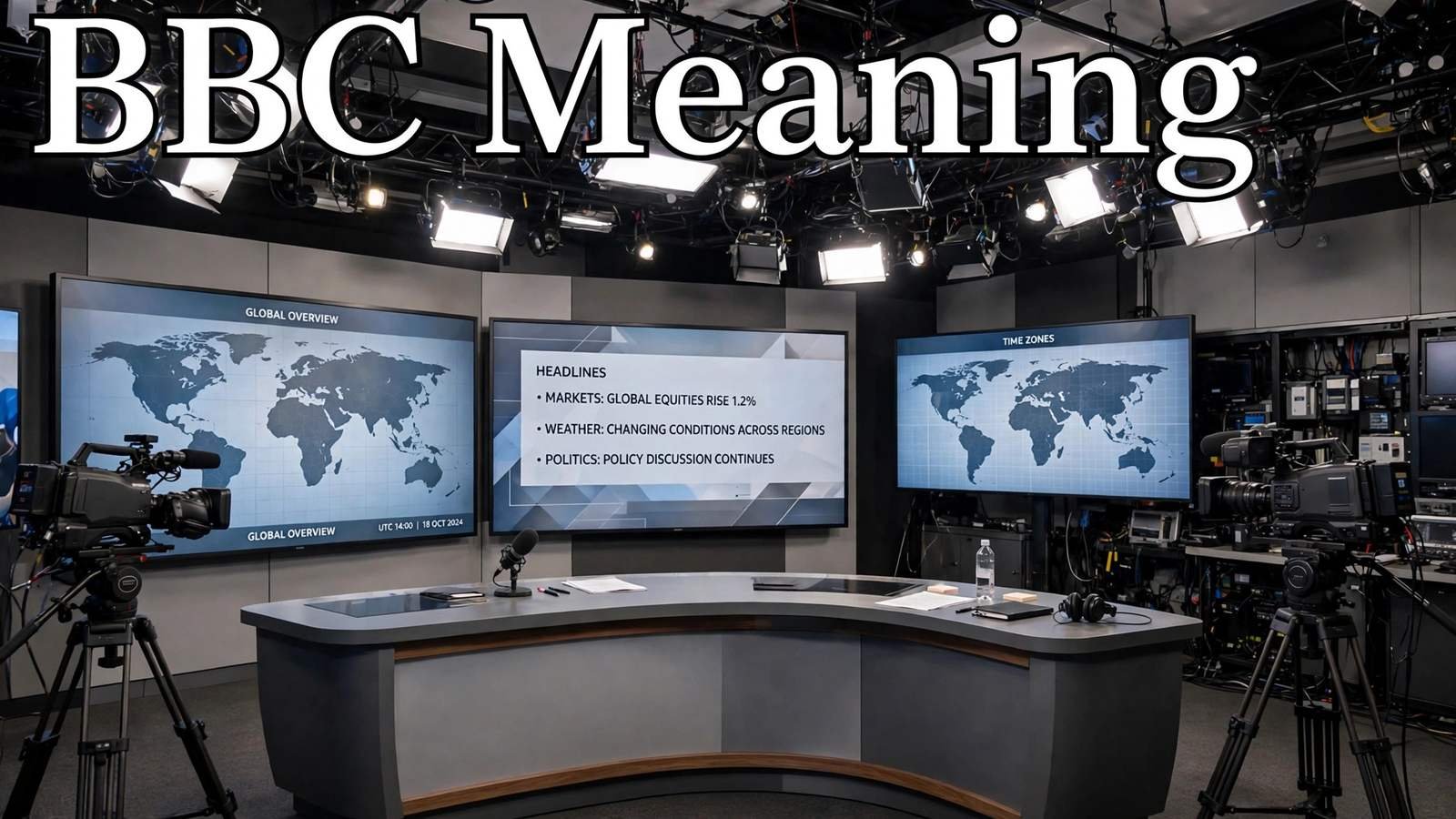
You have seen the three letters on news screens, heard them on the radio, and read them on websites all over the world.
But what is the full BBC meaning, and why do people trust those three letters so much?
In short, BBC stands for the British Broadcasting Corporation, the national public broadcaster of the United Kingdom.
It is one of the oldest and largest broadcasting organizations on the planet, and its news service reaches hundreds of millions of people every week.
People search for the meaning of BBC for many reasons. Students meet the name in history lessons, news readers see BBC News on their phones, and language learners hear the BBC World Service on the radio.
Others simply want the BBC full form and a clear picture of what this organization actually does.
This guide gives you the complete answer in simple US English.
You will learn the full form, the history from 1922 to today, the channels and services it runs, and the simple way it is funded.
You will also find other meanings of the abbreviation, common mistakes people make about it, real examples, and clear answers to the questions people ask most.
What Does BBC Stand For? The Clear Answer
BBC stands for British Broadcasting Corporation.
It is the public service broadcaster of the United Kingdom. That means it makes television, radio, and online content for the public, and it is funded mainly by the public through a fee called the licence fee.
The BBC is not a normal company that sells products for profit. It exists to inform, educate, and entertain, and that mission has guided it for more than one hundred years.
Here is the answer in one line: the BBC meaning is the British Broadcasting Corporation, a public broadcaster from the UK that is famous across the world for news, radio, and television.
BBC Meaning and Overview
The BBC is a large media organization based in London, England. Its main home is Broadcasting House in London, and it has offices, studios, and reporters in cities across the UK and around the world.
It runs national and local television channels, national and local radio stations, and one of the most visited news websites on the internet.
Millions of people use its services every day. In the UK, almost every home watches, hears, or reads something from the BBC each week.
Around the world, its international services reach audiences in more than 200 countries and territories.
The BBC is known for a few clear qualities:
- News that aims to be accurate and impartial
- Programs made for the public, not for advertisers
- Content in many languages, not only English
- A long history of trusted reporting during wars, elections, and world events
The Origin and History of the BBC
The story of the BBC begins in the early days of radio, when the technology was new and exciting.
1922: The British Broadcasting Company
The BBC was founded on 18 October 1922 as the British Broadcasting Company Ltd.
At that time, radio was a brand new invention for the public. A group of radio manufacturers set up the company so that people who bought radio sets would have programs to listen to.
The first broadcasts were simple: news bulletins, music, and talks from a small studio in London.
John Reith, a Scottish engineer, became the first general manager. He believed broadcasting should educate and inform the public, not just sell products. His ideas shaped the BBC for decades.
1927: Becoming the British Broadcasting Corporation
On 1 January 1927, the company changed into a corporation under a Royal Charter.
From that day, its name became the British Broadcasting Corporation, the name it still carries today.
A Royal Charter is an official document from the monarch that sets out what the organization is for and how it must run. The charter is renewed about every ten years, and it protects the BBC as a public body rather than a private business.
Growth Through Radio and Television
Radio grew fast in the 1920s and 1930s, and the BBC became part of daily life in Britain.
In 1932, it launched an international radio service, which later became the BBC World Service. During the Second World War, its broadcasts carried news to people across Europe and beyond, and its reputation for honest reporting grew strong.
In 1936, the BBC started the world’s first regular television service. Television stopped during the war and returned in 1946. Color television followed in the 1960s, and a second channel, BBC Two, launched in 1964.
In the 1990s and 2000s, the BBC moved onto the internet. Its news website became one of the most read in the world, and later its streaming service, BBC iPlayer, changed how people in the UK watch programs.
What the BBC Does Today
Today the BBC works across television, radio, and online platforms, all at the same time.
Television
The BBC runs well known channels such as BBC One and BBC Two, plus channels for children, news channels, and regional channels for Scotland, Wales, and Northern Ireland.
Its television output includes news, drama, comedy, documentaries, sport, and famous nature series watched across the globe.
Radio
BBC radio includes national stations for music, speech, drama, and sport, plus many local stations that serve towns and regions across the UK.
Radio remains one of its strongest areas, with morning news programs that set the agenda for the day in Britain.
BBC News
BBC News is the news arm of the organization. It gathers and reports news for television, radio, and online platforms, in English and in many other languages.
Its journalists work in bureaus around the world, and its website and app are used by millions of readers every day.
BBC World Service
The BBC World Service is the international service. It broadcasts radio and digital content in more than 40 languages, from Arabic and Hindi to Hausa and Ukrainian.
For many listeners, it is a trusted source of independent news, especially in places where local media is limited or controlled.
Online Services and BBC iPlayer
BBC iPlayer is the streaming service for viewers in the UK. It lets people watch programs live and on demand, and catch up on shows they missed.
The BBC also runs popular websites and apps for news, sport, weather, learning, and children’s content.
Why the BBC Is Famous Worldwide
The BBC is famous for three main reasons: trust, reach, and quality.
First, trust. For generations, listeners and viewers have turned to the BBC during major events because its reporters aim to check facts and stay impartial. The phrase “the BBC reports” carries weight in homes far from London.
Second, reach. Through the World Service, BBC News, and global digital platforms, its content reaches hundreds of millions of people each week in many languages.
Third, quality. Its dramas, comedies, and nature documentaries are sold and watched around the world, and its journalism training and style have influenced broadcasters in many countries.
The BBC model has also inspired public broadcasters in other nations, which copied its idea of media funded by the public and made for the public.
How the BBC Is Funded: The Licence Fee in Simple Terms
Many people ask how the BBC pays for its programs if it does not show adverts on its UK services.
The main answer is the licence fee. In the UK, households pay a yearly fee if they watch live television or use BBC iPlayer. The money goes to the BBC and pays for its television, radio, and online services.
Here is the simple picture:
- The fee is set by the government and collected under UK law.
- Most of the BBC budget comes from this fee.
- UK BBC channels carry no advertising breaks.
- The BBC also earns extra money by selling programs abroad through its commercial arm, BBC Studios.
This funding model is the reason the BBC is called a public broadcaster. The public pays, and the BBC makes programs for the public rather than for advertisers.
Other Meanings of the Abbreviation BBC
In daily life and in search results, BBC almost always means the British Broadcasting Corporation. Still, the same three letters appear in a few other general contexts.
- Billionaire Boys Club: a streetwear and fashion brand founded in 2003, which uses the initials BBC on its clothing labels.
- Local names: some schools, clubs, churches, and small businesses in different countries use BBC as short initials for their own names. In those cases, the meaning depends on the local name itself.
- Codes and short forms: in travel, sport, and technical lists, three-letter codes can repeat by chance, so BBC can appear as a short code with a meaning that belongs only to that list.
If you see BBC in a news story, on a television screen, or on a radio, it is the British broadcaster in almost every case.
Common Misconceptions About the BBC
A few wrong ideas about the BBC appear again and again. Clearing them up helps you understand the word and the organization better.
Misconception 1: The BBC Is a Private Company
It is not. The BBC is a public corporation set up under a Royal Charter. It does not have private owners or shareholders, and it does not exist to make a profit for investors.
Misconception 2: The Government Runs the BBC
The BBC is editorially independent. The government does not choose its news stories or edit its programs. Its journalists are expected to report without fear or favor, and they often question government ministers on air.
Misconception 3: The BBC Only Makes News
News is only one part of its work. The BBC also produces drama, comedy, children’s shows, sport, music, documentaries, education content, and entertainment formats that are watched around the world.
Misconception 4: The Licence Fee Is a Normal Subscription
It is different from a subscription like a streaming plan. A subscription is a private choice with a private company. The licence fee is a legal charge set by law in the UK, and it funds a public service that everyone in the country can use.
Related Terms You Should Know
These terms appear often with the BBC, and knowing them makes news stories easier to follow.
- Public broadcaster: a media organization funded by the public and run for the public, not for profit.
- BBC News: the news division of the BBC, covering UK and world news on TV, radio, and online.
- BBC iPlayer: the BBC streaming service for viewers in the UK, with live and on-demand programs.
- BBC World Service: the international service of the BBC, broadcasting in more than 40 languages.
- Licence fee: the yearly charge in the UK that mainly funds the BBC.
- Royal Charter: the official document that sets out the BBC purpose and rules.
- BBC Studios: the commercial arm that sells BBC programs and formats to other countries.
Examples of BBC in Sentences
Real sentences show how the word works in daily English.
- She checks BBC News every morning before work.
- The BBC reported the election results through the night.
- My grandfather listened to the BBC World Service during the war.
- That nature documentary was made by the BBC.
- He works as a reporter for the BBC in Nairobi.
- The interview will be broadcast on BBC Radio tonight.
- Students in many countries practice English with BBC lessons.
- The BBC has offices in more than 70 countries.
- We watched the match highlights on the BBC website.
- The new drama series on the BBC starts on Sunday.
BBC in Conversation
Short dialogues show how people use the name in real talk.
Planning the Evening News
Ayesha: “Did you see the report about the floods?”
Bilal: “Yes, I read it on BBC News this morning. The pictures were powerful.”
Ayesha: “That is why I trust the BBC. They send their own reporters everywhere.”
Learning English
Teacher: “For homework, listen to ten minutes of English radio.”
Student: “Which station should I choose?”
Teacher: “Try the BBC World Service. The speech is clear and the topics are interesting.”
Talking About a Favorite Show
Marco: “I just finished that ocean documentary. The filming was amazing.”
Priya: “Was it the BBC one? Their nature programs are the best in the world.”
Marco: “Yes, and there were no adverts at all. It felt so calm to watch.”
Summary
BBC means British Broadcasting Corporation, the public broadcaster of the United Kingdom.
It began in 1922 as the British Broadcasting Company and became a corporation under a Royal Charter in 1927.
Today it runs television channels, radio stations, BBC News, the BBC World Service in more than 40 languages, and the BBC iPlayer streaming service.
It is funded mainly by the licence fee paid by UK households, which is why its UK services carry no advertising.
People across the world know the BBC for trusted news and high quality programs, and the abbreviation rarely means anything else in general use.
Frequently Asked Questions
What is the full form of BBC?
The full form of BBC is British Broadcasting Corporation. It is the national public broadcaster of the United Kingdom, based in London.
When was the BBC founded?
The BBC was founded in 1922 as the British Broadcasting Company. It became the British Broadcasting Corporation in 1927 under a Royal Charter.
Is the BBC only a news channel?
No. News is one part of its work. The BBC also makes drama, comedy, sport, documentaries, children’s programs, music, and education content.
How is the BBC funded?
It is funded mainly by the licence fee, a yearly charge paid by UK households that watch live TV or use BBC iPlayer. It also earns money by selling programs abroad.
What is the BBC World Service?
The BBC World Service is the international service of the BBC. It provides news and programs in more than 40 languages for audiences around the world.
Does the BBC show adverts?
Its UK television and radio services carry no advertising. This is possible because the licence fee pays for them. Some international and commercial services work differently.
Who owns the BBC?
No private person or company owns the BBC. It is a public corporation held for the public under a Royal Charter, and it is governed by the BBC Board.
What is BBC iPlayer?
BBC iPlayer is the streaming service of the BBC for viewers in the UK. It offers live channels and a large library of programs to watch on demand.
Why is the BBC so trusted?
Its charter requires it to be impartial and accurate, and its journalists follow strict editorial rules. A long record of reporting during world events built its reputation over time.
Conclusion
BBC is far more than three short letters. It is a century of public service media, from the first radio broadcasts in 1922 to the global digital services of today.
To understand the BBC meaning is to understand an idea: media that the public funds, the public owns in spirit, and the public can trust.
Use the name with confidence now. When you see it on a screen, hear it on the radio, or read it in a headline, you know the full form, the history, and the purpose behind it.
Above all, the BBC shows how broadcasting can serve everyone when it is built on trust, independence, and public value.

I am Sophia Bennett, is a digital resources and online tools writer at LinkVistaHub. She enjoys exploring useful websites, emerging digital tools, productivity platforms, and practical online resources that help people work smarter and discover valuable information.