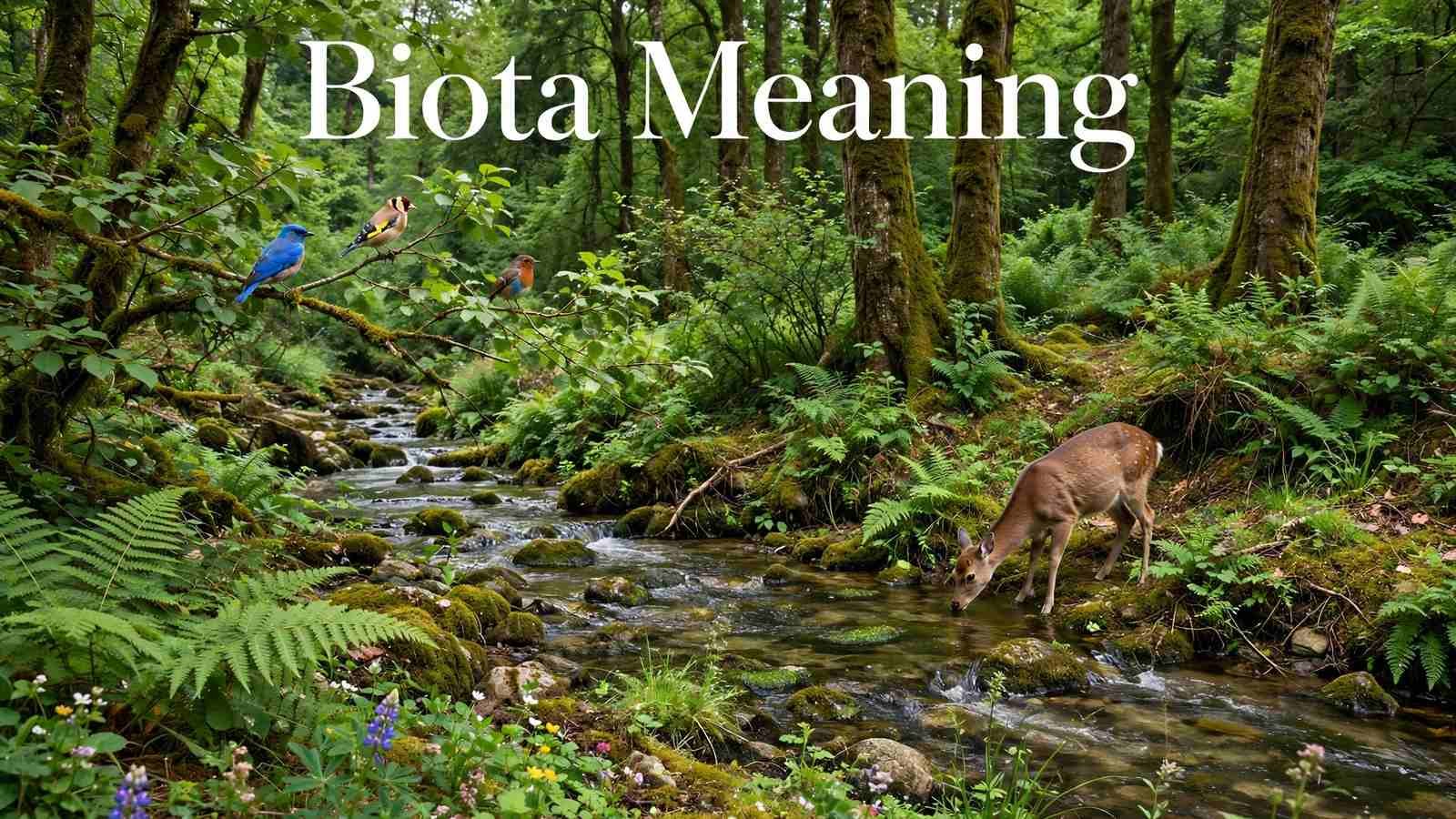
Stand in a forest for one quiet minute and look around you.
Trees rise above you, birds move through the branches, insects work in the leaf litter, and fungi spread through the soil under your boots.
All of that life, taken together, has one collective name, and people search for the biota meaning when they meet the word in a science book or a nature report.
In simple terms, biota means all the living organisms that live in a particular region or during a particular period of time.
The word covers everything alive: the plants we call flora, the animals we call fauna, and the fungi and tiny microbes we cannot see with the naked eye.
It is wider than a single species and wider than a single group, because biota always points to the whole living community of a place.
Scientists use the word when they study an ecosystem, protect a wetland, or record the life of an island before and after a change.
This guide explains the full meaning of biota, its Greek origin, and its history in clear US English.
You will also see how biota differs from flora, fauna, and ecosystem, with plenty of real examples along the way.
By the end, you will understand the word fully and use it with confidence in study, writing, and daily talk.
What Does Biota Mean? The Clear Definition
Biota is a noun. It means the animals, plants, fungi, and microorganisms that live in a particular region, habitat, or period of time, considered as one whole.
The key idea is completeness. Biota does not name one creature or one kind of creature. It names the full set of living things that share a place or a time.
A scientist might speak of the biota of a lake, the biota of an island, or the biota of the ancient oceans. In each case, the word gathers every living thing in that setting into one group.
Here is the core idea in one line: biota means all life in a place, taken together.
Biota Meaning in Simple Words
If the formal definition feels heavy, here is the same idea in plain everyday words.
Biota means every living thing in an area, all counted as one big family of life.
Think of a garden pond. The fish, the frogs, the water plants, the insects, and even the bacteria in the mud are all part of that pond’s biota.
Leave out one group and the picture is incomplete. Biota is the word we use when we want the complete picture.
Origin and Etymology of Biota
The word biota comes from the Greek word bios, which means life.
In ancient Greek, bios named the course and manner of a living life, the way a being spends its days on Earth.
The ending of biota gives the word a collective sense. Biota is treated as a plural-style collective noun, one word that stands for a vast crowd of living things.
That collective sense is the heart of the word. Biota never points at a lone animal or a single plant. It always gathers life into one total group.
The word passed from Greek into scientific Latin, and from there into modern English, where biologists adopted it as a precise technical term.
The same Greek root gives us biology, the study of life, and biography, the written story of a person’s life.
A Brief History of the Word Biota
The word biota is younger than many people expect. It became common in scientific writing in the late 1800s and early 1900s.
Before that, naturalists usually listed plants and animals under separate names, flora for plants and fauna for animals.
As the science of ecology grew, researchers needed one word for all living things together. They were no longer studying species in isolation. They were studying whole living communities and the ties between them.
Biota filled that gap. It let a scientist speak about every organism in a forest, a reef, or a region in a single word.
During the 1900s, the word spread into geology and paleontology. Scientists used it for the living world of past eras, such as the biota of the Cambrian seas.
In recent decades, biota has moved into conservation reports, environmental law, and news writing. If a report says a spill harmed the local biota, it means the damage touched the whole living community, not just one species.
Today the word stands as a standard term in biology and ecology, and it appears in textbooks, museum displays, and nature documentaries around the world.
How Biota Is Used Today
Biota is a formal, scientific word, but its uses reach into many parts of modern life.
In Scientific Writing
In research papers, biota is the standard word for the full set of organisms in a study area.
A paper might describe the soil biota of a farm field or the marine biota of a coral reef. The word keeps the writing precise and short.
In Conservation and Environment Reports
Conservation teams use biota when they assess the health of a place.
If a wetland is drained or a forest is cut, reports describe the impact on the native biota. The word signals that every living group matters, from tall trees to tiny soil microbes.
Government agencies also use it in environmental impact studies before roads, dams, or mines are approved.
In Education and Textbooks
Teachers use biota to help students think in whole systems.
A lesson on a desert, a rainforest, or a pond often begins with its biota, then moves to the climate and land that support it.
The word gives students one handle for a very large idea: all the life of a place at once.
In Everyday and News Writing
News writers borrow biota when a story concerns the living world as a whole.
A report on an oil spill, a wildfire, or an invasive species may say the event threatens the region’s biota. The word sounds formal, yet most readers grasp its meaning from context.
Biota vs. Flora vs. Fauna vs. Ecosystem
These four words often appear side by side, and each one has its own job. Knowing the difference makes the meaning of biota much clearer.
Biota vs. Flora
Flora means the plant life of a region or period. It covers trees, flowers, grasses, mosses, and algae.
Biota is wider. It includes the flora, but it also includes animals, fungi, and microbes. Flora is one part of the biota, never the whole.
Biota vs. Fauna
Fauna means the animal life of a region or period. It covers mammals, birds, fish, insects, and every other animal group.
Biota includes the fauna as well, and then adds plants, fungi, and microorganisms. If a word names only the animals, that word is fauna, not biota.
Biota vs. Ecosystem
An ecosystem includes the living community and the nonliving setting around it: the water, soil, air, sunlight, and climate.
Biota is only the living part of that system. The rocks, rivers, and weather belong to the ecosystem, but they are not part of the biota.
A simple way to remember it: ecosystem equals biota plus environment.
Biota vs. Biodiversity
Biodiversity describes the variety of life: how many species exist, how varied their genes are, and how rich the whole web of life is.
Biota names the set of living things itself. Biodiversity describes how diverse that set is.
In short, biota is the cast of living characters, and biodiversity is a measure of how varied that cast is.
Examples of Biota in Sentences
Real sentences are the fastest way to fix the meaning in your mind.
- The biota of the island includes rare birds, ancient trees, and thousands of insect species.
- Scientists recorded the river’s biota before the dam was built.
- The oil spill damaged the coastal biota for many years.
- Soil biota, such as worms and fungi, keeps farmland healthy and rich.
- The museum displays fossils of the biota that lived here millions of years ago.
- Protecting the wetland biota protects clean water for the whole town.
- The team studied how the desert biota survives extreme heat.
- Invasive fish can upset the balance of a lake’s native biota.
- The report lists the full biota of the national park, from bears to bacteria.
- Climate change is reshaping the biota of the Arctic faster than expected.
Common Misconceptions About Biota
A few misunderstandings follow this word around. Clearing them up will help you use it with care.
Misconception 1: Biota Means Only Animals
It does not. Biota covers animals, plants, fungi, and microorganisms together.
If a speaker means only the animals of a place, the correct word is fauna.
Misconception 2: Biota and Ecosystem Mean the Same Thing
They are close, but not the same. An ecosystem includes nonliving parts such as water, soil, and sunlight.
Biota is only the living part. Mixing the two words up can make a report or an exam answer inaccurate.
Misconception 3: Biota Is a Plural of One Creature
Biota is a collective noun. It treats a whole community of organisms as one unit.
You would not say “a biota” for a single frog. You would say the frog is part of the pond’s biota.
Misconception 4: Biota Only Belongs in Old Science Books
The word is alive in modern writing. It appears in today’s conservation plans, climate reports, and environmental news.
It sounds formal because it is precise, not because it is outdated.
Related Terms and Synonyms
English and science offer a rich set of words near biota in meaning. Each one fits a slightly different scope or tone.
Common related terms include:
- Flora: the plant life of a region or period.
- Fauna: the animal life of a region or period.
- Biodiversity: the variety of living things in a place.
- Ecosystem: living things plus their nonliving environment.
- Biome: a large natural region with its own climate and life, such as a desert or a rainforest.
- Microbiota: the community of microorganisms living in a place, such as the human gut.
- Wildlife: wild animals and plants of an area, used in everyday language.
- Organisms: individual living things of any kind.
- Species: a group of living things that share traits and can breed together.
- Habitat: the natural home or environment of a plant or animal.
Biota is the broadest of these everyday terms for life in a place, because it leaves nothing living out.
Conversation Examples
Short dialogues show the word at work in real speech. Notice how naturally it fits once the meaning is clear.
At a Nature Reserve
Guide: “This reserve protects the biota of the whole valley, from the eagles down to the soil fungi.”
Visitor: “So biota means every living thing here?”
Guide: “Exactly. Plants, animals, fungi, and microbes, all of them together.”
In a Classroom
Teacher: “For your project, describe the biota of a pond.”
Student: “Do I include the plants, or only the animals?”
Teacher: “Include everything alive. The plants are the flora, the animals are the fauna, and together with the microbes they form the biota.”
Between Two Hikers
Sara: “The fire changed this hillside so much.”
Omar: “Yes, but look, the biota is coming back. New grass, insects, even birds again.”
Sara: “Nature repairs its own community, one species at a time.”
Summary
Biota means all the living organisms of a region, habitat, or period of time, considered as one whole.
The word comes from the Greek bios, meaning life, and it carries a collective sense: one word for the entire living community of a place.
Flora names the plants, fauna names the animals, and an ecosystem adds the nonliving environment. Biota includes every living group and nothing nonliving.
Scientists, conservation teams, teachers, and news writers use biota when they need to speak about the whole web of life in a single, precise word.
Frequently Asked Questions
What is the simple meaning of biota?
Biota means every living thing in a place or time period, taken together as one group. It includes plants, animals, fungi, and microorganisms.
What is the difference between biota and flora and fauna?
Flora is the plant life and fauna is the animal life of a place. Biota is the wider word that covers both, and it also adds fungi and microbes.
Is biota singular or plural?
Biota is a collective noun. It names a whole community of living things as one unit, so writers usually treat it as a singular mass word in a sentence.
Does biota include humans?
In a scientific sense, yes. Humans are living organisms, so people form part of the biota of any place where they live.
Does biota include bacteria and fungi?
Yes. Bacteria, fungi, and other microorganisms are living things, so they are full members of the biota, even if we need a microscope to see them.
What is the difference between biota and an ecosystem?
Biota is only the living part. An ecosystem includes the biota plus nonliving parts such as water, soil, air, and sunlight.
How do you use biota in a sentence?
You can say, “The biota of the rainforest is among the richest on Earth.” You can also say, “The spill harmed the marine biota along the coast.”
Where does the word biota come from?
It comes from the Greek word bios, meaning life. The word entered scientific English through Latin and grew common as the science of ecology developed.
Conclusion
Biota is a compact word with a generous reach, from the Greek idea of life itself to the modern science of whole living communities.
To use the word well is to see a place as one living family: the trees and the birds, the fungi and the fish, the seen and the unseen, all bound together.
Reach for biota when a list of species is not enough and you need the whole picture of life in a place.
Above all, remember that every place on Earth has its own biota, and caring for that living community, with all its biodiversity, is one of the great tasks of our time.

I am Alex Carter, is a web resources and digital tools writer at Linkvistahub. He enjoys discovering useful websites, online tools, productivity resources, and practical digital solutions that can make everyday tasks easier.