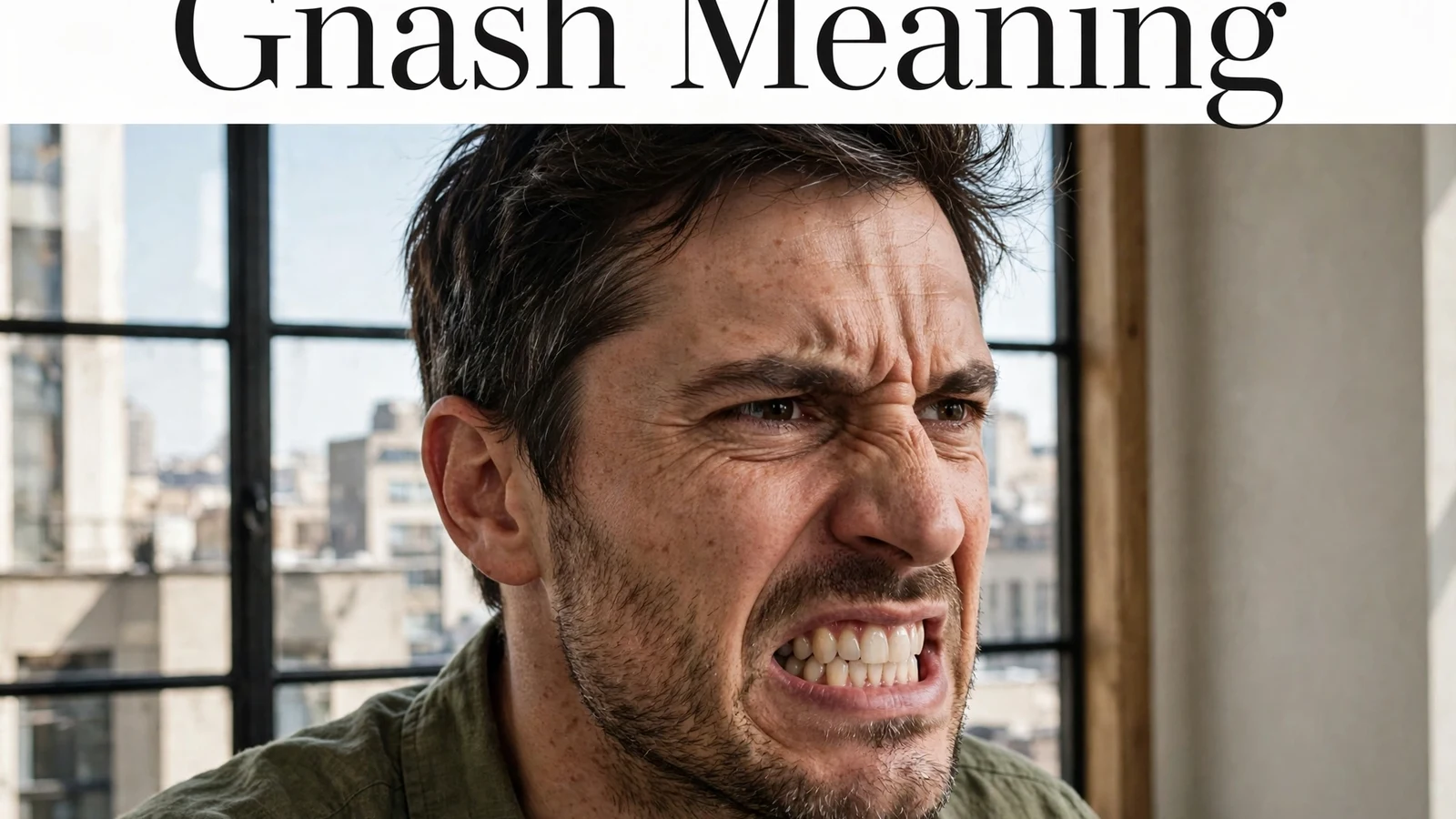
Picture a person who has just heard terrible news. Their jaw tightens, their teeth press hard together, and a harsh grinding sound fills the silence.
That single action has a name, and people search for the gnash meaning because the word sounds strange and old, yet it still appears in books, sermons, and everyday speech.
In simple terms, gnash means to grind or strike your teeth together, usually in anger, pain, or deep frustration.
The most famous use is the phrase gnash your teeth, which describes a person so upset that they grind their teeth in rage or despair.
This guide explains the full meaning of gnash, its Old English origin, and its history from the Bible to modern novels.
You will learn how gnashing of teeth became a powerful image, how the word is used today, and how it differs from close words like grind, grit, and gnaw.
By the end, you will know the word well and use it with full confidence in your own speech and writing.
In this guide you will also find clear examples, common mistakes, and simple tips for using gnash in conversation, so the word feels natural rather than strange when you meet it again.
What Does Gnash Mean? The Clear Definition
Gnash is a verb. It means to grind your teeth together, often with force, as a sign of anger, pain, or bitter disappointment.
When a person gnashes their teeth, the upper and lower teeth rub hard against each other. The sound is harsh, and the face usually shows tension in the jaw.
Here is the core idea in one line: to gnash is to grind your teeth together because of a strong, painful feeling.
Gnash Meaning in Simple Words
If the formal definition feels stiff, here is the same idea in plain everyday words.
Gnash means to grind your teeth when you are very angry or upset. Think of a person who clenches their jaw so hard that you can hear their teeth scrape.
It is not gentle chewing. It is a rough, forceful action, and it almost always shows a strong emotion behind it.
Origin and Etymology of Gnash
The word gnash comes from Old English, and its history is a story of sound and teeth.
The Old English verb was gnagan, which meant to gnaw, to bite, or to chew with effort. Over time, a related form developed for the specific act of grinding the teeth together.
Middle English kept the word in forms like gnasshen and gnashen. By the 1500s, the modern spelling gnash was settled in English writing.
The word is closely related to gnaw. Both words share the idea of teeth working hard against something. Gnaw means to bite and wear away at food or an object, while gnash means to grind the teeth against each other.
The silent g at the start is a clue to its age. Old English had many words that began with gn, such as gnat, gnome, and gnaw. In modern speech the g fell silent, but the spelling kept the old form.
A Brief History of Gnash
Gnash has lived in English for more than a thousand years, and most of its fame comes from one powerful source: the Bible.
In the King James Bible, the phrase “gnashing of teeth” appears again and again. It describes the suffering of people in darkness, weeping and gnashing their teeth in regret and pain.
Because the Bible was the most widely read book in English for centuries, the phrase entered common speech. Even people who never opened a Bible knew what gnashing of teeth meant: the deepest kind of misery and anger.
Writers of later centuries borrowed the image. Shakespeare used gnashing teeth for characters in rage. Gothic novelists used it for villains in torment. Victorian writers used it for crowds in fury.
In the modern era, the word still carries that old weight. A novelist who writes that a character gnashed his teeth is not describing a dental problem. The writer is painting a picture of rage, defeat, or bitter grief in a single vivid verb.
How Gnash Is Used Today
Gnash is a literary and expressive word today. It is less common in casual chat than in books, articles, sermons, and speeches.
In Literature and Storytelling
Writers love gnash because it shows emotion through the body. Instead of writing “he was very angry,” a writer can write “he gnashed his teeth,” and the reader sees and hears the anger at once.
Fantasy and horror stories use it often. A defeated villain, a caged beast, or a tormented ghost may gnash its teeth to show fury that words cannot hold.
In Religious and Formal Speech
The phrase “gnashing of teeth” still appears in sermons and religious writing. It keeps its biblical sense of suffering and regret in the afterlife.
Speakers use it when they want a solemn, old, and weighty tone. The phrase carries centuries of meaning in just three words.
In Everyday Speech
In daily talk, people use gnash more lightly, often with a touch of humor. Someone might say, “I gnashed my teeth through that whole boring meeting,” meaning they endured it with silent impatience.
It also appears in sports and news writing. A losing team may be described as gnashing its teeth after a narrow defeat, a colorful way to say the loss hurt badly.
In Medical and Dental Contexts
Doctors and dentists use a related term, bruxism, for the habit of grinding teeth, often during sleep. Gnash describes the same physical action in plain language.
If a person gnashes their teeth at night, a dentist may suggest a mouth guard to protect the teeth from wear.
Gnash vs. Similar Words
Gnash sits in a small family of tooth words. Each one has its own shade of meaning, so it pays to know the difference.
Gnash vs. Grind
Grind is the broad word. You can grind coffee beans, grind a heel into the ground, or grind your teeth.
Gnash is narrower. It means to grind the teeth together, and it almost always carries an emotion like anger or pain.
Gnash vs. Grit
To grit your teeth means to press them firmly together and bear something hard. Soldiers grit their teeth and carry on. The tone is brave endurance.
Gnash is rougher and louder. It suggests rage or torment rather than quiet courage.
Gnash vs. Gnaw
Gnaw means to bite at something again and again, wearing it down. A dog gnaws a bone. Worry can gnaw at a person.
Gnash does not need an object to bite. The teeth grind against each other, and the action itself is the point.
Gnash vs. Clench
To clench means to close something tightly, such as a fist or a jaw. You can clench your jaw without moving your teeth.
Gnash adds motion and sound. The teeth do not just press together, they grind and scrape.
Examples of Gnash in Sentences
Real sentences are the fastest way to fix the meaning in your mind.
- He gnashed his teeth when he saw the final score.
- The villain gnashed his teeth in rage as his plan fell apart.
- She lay awake, gnashing her teeth over the unfair decision.
- The old sailor gnashed his teeth against the cold wind.
- In the story, the lost souls wept and gnashed their teeth.
- He gnashed his teeth through the long, dull lecture.
- The dog gnashed its teeth at the fence, eager to get out.
- She gnashed her teeth in frustration when the computer crashed again.
- The crowd gnashed its teeth as the referee made the bad call.
- He tried not to gnash his teeth, but the anger showed on his face.
Common Misconceptions About Gnash
A few misunderstandings follow this word around. Clearing them up will help you use it with care.
Misconception 1: Gnash Only Means Anger
Anger is the most common cause, but not the only one. People also gnash their teeth in pain, grief, cold, fear, and bitter regret.
The Bible pairs gnashing with weeping, which shows sorrow as well as rage.
Misconception 2: Gnashing of Teeth Is Only a Religious Phrase
The phrase began in scripture, but it now belongs to general English too. Novelists, journalists, and ordinary speakers use it for any scene of deep misery or fury.
You do not need a religious context to use it well.
Misconception 3: Gnash and Gnaw Mean the Same Thing
They are cousins, not twins. Gnaw needs something to bite and wear down, like food or wood.
Gnash needs only the teeth themselves, grinding together in a strong feeling.
Misconception 4: Gnash Is an Archaic Word Nobody Uses
Gnash is old, but it is not dead. It appears in modern novels, news stories, sermons, and everyday jokes about frustrating days.
Its age is part of its power. A rare, vivid word can hit harder than a common one.
Related Terms and Synonyms
English offers a rich set of words near gnash in meaning. Each one fits a slightly different tone or setting.
Common related terms include:
- Grind: to rub or crush with force, including grinding teeth.
- Grit: to press the teeth firmly together and endure.
- Gnaw: to bite at something again and again.
- Clench: to close the jaw or fist tightly.
- Grate: to rub with a harsh, scraping sound.
- Champ: to bite and chew noisily, often used for a horse champing at its bit.
- Bruxism: the medical term for habitual tooth grinding, often in sleep.
- Gnashing of teeth: the fixed phrase for suffering, regret, or rage shown by grinding teeth.
- Weeping and wailing: the phrases often paired with gnashing in biblical language.
Useful opposites include relax, unclench, smile, and rest, all of which describe a jaw at peace.
The noun form is gnashing, as in “the gnashing of teeth.” There is no common adjective form, so writers usually use the phrase “gnashing” before a noun, as in “a gnashing sound.”
Conversation Examples
Short dialogues show the word at work in real speech. Notice how vivid one verb can be.
After a Lost Match
Ali: “Did you see the final minute? We lost by one point.”
Sara: “I was gnashing my teeth the whole time. That referee call was terrible.”
Ali: “Same here. I think I ground a year off my teeth.”
At the Office
Manager: “The system crashed again, right before the deadline.”
Danish: “I know. I sat there gnashing my teeth while IT fixed it.”
Manager: “Next time, take a walk first. The teeth will thank you.”
Talking About a Book
Hina: “The villain in this novel is terrifying.”
Omar: “The part where he gnashes his teeth in the dungeon gave me chills.”
Hina: “Exactly. One verb, and you feel his whole rage.”
How to Use Gnash Well
Gnash is a strong word, so a little care makes it land well.
- Use it for strong feelings, not mild annoyance. A small delay does not deserve gnashing.
- Pair it with the cause. “He gnashed his teeth in frustration” is clearer than the verb alone.
- Save “gnashing of teeth” for serious scenes. Its biblical weight suits real suffering or fury.
- In formal writing, prefer “ground his teeth” if you want a plainer tone.
- In stories, let the verb do the showing. It paints anger faster than a long explanation.
Start small. Try the word once in a story or a joke about a frustrating day, and its meaning will stick fast.
Summary
Gnash means to grind your teeth together, usually in anger, pain, or deep frustration.
The word comes from Old English gnagan, related to gnaw, and it became famous through the biblical phrase “gnashing of teeth.”
Gnash differs from grind, grit, gnaw, and clench: it is the rough, sounding grind of teeth against teeth, driven by a strong feeling.
Writers, speakers, and preachers still use it today, from novels and sermons to jokes about bad days and lost matches.
Used with care, gnash is one of the most vivid verbs in English, packing a whole scene of emotion into a single word.
Frequently Asked Questions
What is the simple meaning of gnash?
Gnash means to grind your teeth together, usually because you are angry, in pain, or deeply frustrated.
What does gnash your teeth mean?
It means to grind your teeth together as a sign of rage, suffering, or bitter regret. The phrase is famous from the Bible.
What is gnashing of teeth in the Bible?
In the Bible, “gnashing of teeth” describes the suffering of people in darkness, weeping in regret and pain. It appears in the Gospels of Matthew and Luke.
Where does the word gnash come from?
It comes from Old English gnagan, meaning to gnaw or bite. It is related to gnaw, and its silent g shows its ancient Germanic roots.
What is the difference between gnash and grind your teeth?
Grind is the general word for rubbing things together. Gnash is the specific, emotional version: grinding your own teeth together in anger or pain.
Is gnash a real word people still use?
Yes. It appears in modern novels, news writing, sermons, and everyday speech, often in the phrase “gnashing of teeth” or in jokes about frustrating days.
How do you pronounce gnash?
Say NASH. The g is silent, just as in gnaw and gnome. It rhymes with cash and clash.
Can animals gnash their teeth?
Yes. Writers describe dogs, horses, and wild beasts gnashing their teeth in fury or eagerness, though the word is most often used for people.
How do you use gnash in a sentence?
You can say, “He gnashed his teeth when he heard the bad news.” You can also say, “She gnashed her teeth through the long delay.”
Conclusion
Gnash is a small word with a long and powerful story, from Old English gnagan to the biblical image of weeping and gnashing of teeth.
To gnash your teeth is to let a strong feeling speak through your body, if that feeling is anger at an unfair loss, pain that words cannot hold, or grief that has nowhere else to go.
Use the word with care and confidence now: for the villain in a story, the fan after a lost match, and the quiet moment of frustration when only gritted teeth will do.
Above all, remember that gnash earns its power from restraint. Save it for feelings big enough to grind teeth, and it will hit exactly as hard as you mean it to.

I am Alex Carter, is a web resources and digital tools writer at Linkvistahub. He enjoys discovering useful websites, online tools, productivity resources, and practical digital solutions that can make everyday tasks easier.