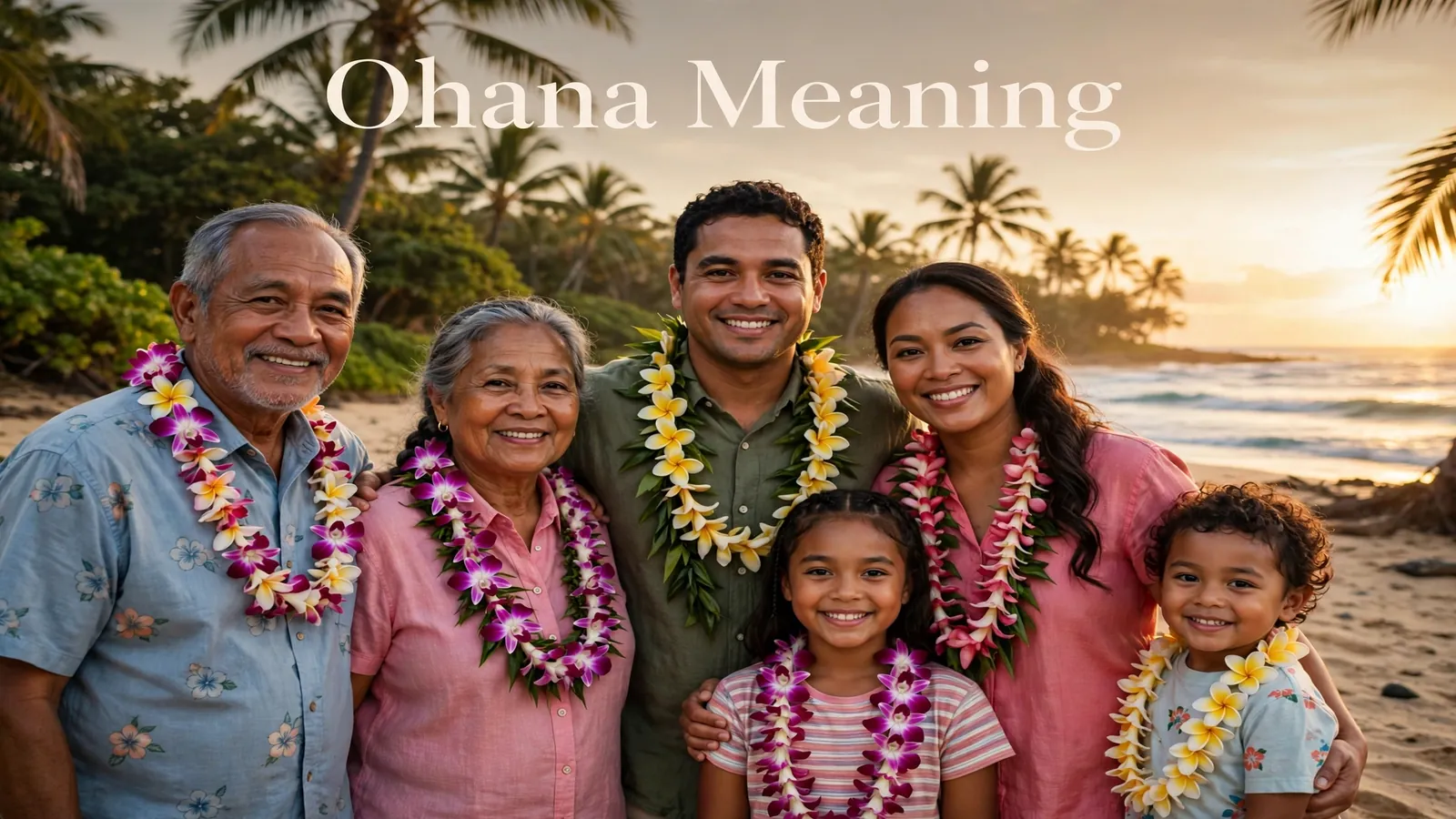
If you have ever heard the phrase “Ohana means family” and felt a warm pull in your chest, then you already understand the heart of Ohana Meaning. In fact, this beautiful Hawaiian word carries one of the most powerful ideas in human language: that family is not only about blood, but about belonging, loyalty, and love that never lets go.
The Ohana Meaning goes far beyond the simple definition you might find in a short dictionary entry. However, it describes an entire way of life in Hawaii, where extended family, adopted family, close friends, and even whole communities can be ohana to one another. When someone says “You are my ohana,” they are making a promise: nobody gets left behind.
In this complete guide, you will learn the true Ohana Meaning, from its origin in the Hawaiian language to the Lilo & Stitch quote that carried it around the world. We will also explore its cultural significance, everyday uses, common misconceptions, and simple examples so you can use the word with respect and confidence.
By the end, you will know exactly what ohana means, how to pronounce it, and when it is right to say it, so this single word can add real warmth to your own vocabulary.
Ohana Meaning: The Simple Definition First
At its simplest, ohana is the Hawaiian word for family. But this one-line Ohana Meaning hides a much richer idea.
In Hawaiian thought, family does not stop at parents, siblings, and children. For instance, it reaches out to grandparents, cousins, in-laws, and distant relatives.
It also reaches further still. Close friends can be ohana. Neighbors who share meals can be ohana. A trusted work team can be ohana. The Ohana Meaning includes both blood relatives and chosen family, everyone bound by care and loyalty.
That is why a dictionary definition alone feels incomplete. In English, “family” often points to people you are related to by birth or marriage. By contrast, in Hawaiian culture, ohana points to people you are connected to by love, duty, and shared life.
The Deeper Ohana Meaning in Hawaiian Culture
To understand the full Ohana Meaning, you first have to look at how Hawaiian culture sees human connection. Family is not a private unit. Instead, it is the center of everything.
For example, in traditional Hawaiian life, ohana was the group that fished together, farmed together, raised children together, and cared for elders together. No one stood alone. Your strength came from your people, and their strength came from you.
This idea connects to other core Hawaiian values. The first is aloha, the spirit of love, kindness, and welcome. Next, kuleana means a sense of responsibility toward others. When you belong to an ohana, you hold kuleana for its members, and they hold kuleana for you.
So the Ohana Meaning is not just a warm feeling. It is a working system of mutual care. Elders are respected and protected. Children are raised by the whole group, not only by their parents. Guests are treated with aloha because they might one day become ohana too.
As a result, even today, many Native Hawaiians describe ohana as their greatest wealth. A person with strong ohana is never truly alone, no matter what life brings.
Origin and History of Ohana Meaning
The Ohana Meaning grows out of the Hawaiian language. Consequently, its roots tell a beautiful story.
Linguists trace ohana to the word ʻohā, which names the offshoot of the taro plant (kalo). In fact, taro was the staple food of ancient Hawaiians, and the plant survives by sending out new shoots from its root. Each shoot grows into its own plant, yet all of them share the same root.
That image became the model for family. Just as the ʻohā shoots spread from one root, family members spread out from shared ancestors. They grow in different directions, yet they are fed by the same source.
This origin matters because it shows that the Ohana Meaning was never about a narrow household. From the start, it described a growing, spreading network of people connected to one origin.
Over centuries, the word absorbed more meaning. For example, in the era of Hawaiian kingdoms, ohana included retainers, workers, and loyal followers of a chief. During the plantation era of the 1800s and 1900s, when workers arrived from Japan, China, Portugal, and the Philippines, many formed ohana bonds across ethnic lines, because survival demanded it.
As a result, today the word carries all of this history at once: the plant, the ancestors, the village, and the modern community.
How to Pronounce Ohana Correctly
The Ohana Meaning is best honored by saying the word right. Its pronunciation is “oh-HAH-nah.”
First, stress falls on the second syllable: HAH. Each vowel is pronounced clearly, the way Hawaiian vowels always are. Say it slowly at first: oh, HAH, nah.
A common mistake is to say “oh-HAN-uh” with a flat middle sound, or to rush it into “ohana” with no clear stress. Taking one extra second to place the stress on HAH shows respect for the language.
In addition, Hawaiian has only a few vowel sounds, and they are always short and pure. As a result, words like aloha, mahalo, and ohana all become easy to say.
How Ohana Meaning Is Used Today
Modern uses of ohana fall into several clear contexts. Here are the most common ones.
- Family gatherings: In Hawaii, people say “the whole ohana is coming” to mean everyone, from grandparents to cousins to close family friends.
- Work teams: Many Hawaii businesses call their staff “our ohana.” It signals that the workplace should feel like a family, with loyalty in both directions.
- Friend groups: Young people often call their closest circle “my ohana,” meaning friends who are as close as relatives.
- Community groups: Likewise, churches, sports teams, and neighborhood groups use ohana to describe their bond.
- Marketing and tourism: Hotels, restaurants, and tour companies in Hawaii use the word to promise a warm, family-style welcome.
- Social media: People caption group photos with “ohana” to show that the people in the picture are their chosen family.
Notice that in every case, the Ohana Meaning stays the same. In other words, it always points to a group bound by love and loyalty, never to a casual crowd.
Ohana Meaning in Everyday Examples
To begin with, examples make the Ohana Meaning concrete. Here are situations where the word fits naturally.
- A grandmother in Honolulu invites twenty people to Sunday lunch. Some are relatives, some are neighbors. She calls them all her ohana.
- For instance, a surf instructor in Maui tells new students, “Welcome to the ohana.” He means they are now part of his school community.
- Similarly, a nurse working a long hospital shift says her coworkers are her ohana because they look out for one another.
- Meanwhile, a family in California, far from Hawaii, names their group chat “Ohana” because the word captures how they feel about each other.
- Finally, a wedding invitation reads, “Please join our ohana as we celebrate,” inviting guests into the family’s joy.
In each example, ohana marks a boundary of care. Inside the boundary, for example, people are protected and included. That is the promise the word carries.
The Lilo & Stitch Quote That Made Ohana Famous
For many people outside Hawaii, the Ohana Meaning arrived through one sentence from Disney’s Lilo & Stitch (2002): “Ohana means family. Family means nobody gets left behind or forgotten.”
In the film, Lilo, a young Hawaiian girl, uses the word to teach Stitch, a lonely alien creature, what belonging feels like. Stitch has no family and no home. Through ohana, however, he learns that family is something you choose and protect, not something you are simply born into.
The quote worked because it captured the true Ohana Meaning in simple words. It also matched the film’s story: a broken family healing itself by widening its circle to include an outsider.
As a result of the film’s success, the word spread worldwide. It appeared on T-shirts, tattoos, wall art, and wedding decor. Millions of people who had never visited Hawaii now knew the word and its core idea.
Consequently, this global fame is mostly positive, because the quote is accurate. But it also created some of the misconceptions discussed below.
Common Misconceptions About Ohana Meaning
Because the word became trendy, several misconceptions about ohana spread along with it. Here are the main ones, corrected.
- Misconception: Ohana just means “family” in the English sense. In truth, the Ohana Meaning is wider. It includes chosen family, community, and deep bonds of loyalty, not only relatives.
- A related misconception: Anyone can claim ohana lightly. In Hawaiian culture, calling someone ohana is serious. It implies real commitment, not just friendly feelings.
- Another misconception: The word was invented by Disney. The film popularized ohana, but the word is centuries old and central to Native Hawaiian life.
- Yet another misconception: Ohana is only about warm feelings. The concept also carries kuleana, real responsibility. Ohana members show up, help out, and stay loyal in hard times.
- A final misconception: Using the word is always fine. Many Hawaiians welcome respectful use. But using it as decoration, without understanding its weight, can feel shallow to people for whom it is sacred.
Clearing up these points helps you use the word with the respect it deserves.
Related Words That Deepen Ohana Meaning
In addition, several Hawaiian words sit close to ohana. Learning them adds depth to the Ohana Meaning.
ʻOhā: The Taro Offshoot
Indeed, ʻOhā is the linguistic root of ohana. It names the young shoot that grows from the taro corm. Remember this image when you hear ohana: many shoots, one root.
Aloha: Love and Welcome
Aloha is the spirit of love, compassion, and hospitality. Ohana runs on aloha. Without aloha, a group of relatives is just a group. With aloha, they become ohana.
Kuleana: Responsibility
Kuleana means responsibility or privilege of care. Every ohana member carries kuleana for the others. Parents care for children, children care for aging parents, and everyone cares for the community.
Hānai: Adopted Family
Hānai describes the Hawaiian custom of informal adoption. A child might be raised by grandparents, aunties, or close family friends. Hānai children are fully ohana, with no difference in love or status.
Pono: Doing What Is Right
Pono means righteousness, balance, and doing what is right. Living pono keeps ohana healthy. It means resolving conflicts fairly and treating every member with dignity.
Together, these words form a full picture. Ohana is the group, aloha is its fuel, kuleana is its duty, hānai is its open door, and pono is its compass.
Ohana Meaning in Conversation: Real Examples
Finally, seeing ohana in dialogue shows how naturally the word works. Here are short conversation examples.
First example: Welcoming a newcomer
- Maya: “You just moved here? Then welcome to the ohana.”
- Jon: “Thanks, that means a lot.”
Second example: A family decision
- Dad: “We need everyone at the meeting. Ohana decides together.”
- Leila: “I will call uncle and auntie too.”
Third example: Friends as family
- Sam: “You guys are my ohana, you know that?”
- Priya: “Always. Nobody gets left behind.”
Fourth example: At work
- Manager: “We treat this team as ohana. If one of us struggles, we all help.”
- Team: “Agreed.”
Fifth example: Comforting someone
- Ana: “I feel so alone since the move.”
- Kimo: “You are ohana now. You are not alone.”
Notice the pattern. In every exchange, ohana does the same job: it turns “you” into “one of us.”
Summary of Ohana Meaning
In summary, here is the full Ohana Meaning in one clear view.
- Core definition: Ohana is the Hawaiian word for family, in the widest sense.
- Scope: It covers blood relatives, in-laws, adopted (hānai) family, close friends, and community.
- Root image: The ʻohā taro shoot, many plants from one root.
- Core promise: Nobody gets left behind or forgotten.
- Core duty: Kuleana, mutual responsibility among members.
- Core spirit: Aloha, love and welcome for all.
- Modern fame: Popularized worldwide by Lilo & Stitch (2002).
- Respectful use: Say it with understanding, not as decoration.
If you remember one thing, remember this: ohana is family you choose to never abandon.
FAQs About Ohana Meaning
What does ohana literally mean?
Ohana literally means family in the Hawaiian language. In fact, its root, ʻohā, refers to the offshoot of the taro plant, which gave Hawaiians the image of many shoots growing from one shared root.
Is ohana only about blood relatives?
No. The Ohana Meaning includes blood relatives, but it also covers adopted family, in-laws, close friends, and community members bound by loyalty and care.
How do you pronounce ohana?
Say “oh-HAH-nah,” with the stress on the second syllable. Each vowel is short and clear, the way Hawaiian vowels always sound.
What is the famous Lilo & Stitch ohana quote?
The quote is “Ohana means family. Family means nobody gets left behind or forgotten.” Lilo says it in Disney’s Lilo & Stitch (2002) to teach Stitch what belonging means.
Can friends be ohana?
Yes. In Hawaiian culture, close friends who share loyalty and care can absolutely be ohana. For example, the hānai tradition of informal adoption shows how open the circle is.
What is the difference between ohana and family?
The English word family often points to relatives by birth or marriage. However, the Ohana Meaning is wider: it adds chosen family, deep mutual responsibility (kuleana), and the spirit of aloha.
Is it disrespectful for non-Hawaiians to say ohana?
Not automatically. Many Hawaiians welcome respectful use. However, it becomes disrespectful only when the word is used as empty decoration, without understanding its cultural weight.
Why is taro connected to ohana?
Taro (kalo) was the staple food of ancient Hawaii. The plant survives through its ʻohā offshoots, so Hawaiians used that image to describe family members spreading from shared ancestors.
Can a work team be called ohana?
Yes, and many Hawaii businesses do. But the word carries a promise: if you call your team ohana, you are expected to show real loyalty and care, not just use a friendly label.
What values go with ohana?
The main ones are aloha (love and welcome), kuleana (responsibility toward others), and pono (doing what is right). Together they turn a group of people into a true ohana.
Conclusion
The journey through Ohana Meaning ends where it began: with a simple, powerful truth. Ohana means family, and family means nobody gets left behind or forgotten.
Indeed, this one Hawaiian word carries centuries of wisdom. It teaches that family is wider than blood, deeper than feeling, and stronger than distance. It also asks something of us: to show up, to stay loyal, and to widen our own circle when someone needs belonging.
If you take the meaning of family seriously, let ohana remind you of its fullest form. Love your people fiercely. Protect them. And when you meet someone with no one, offer them what Lilo offered Stitch: a place to belong.

I am Alex Carter, is a web resources and digital tools writer at Linkvistahub. He enjoys discovering useful websites, online tools, productivity resources, and practical digital solutions that can make everyday tasks easier.