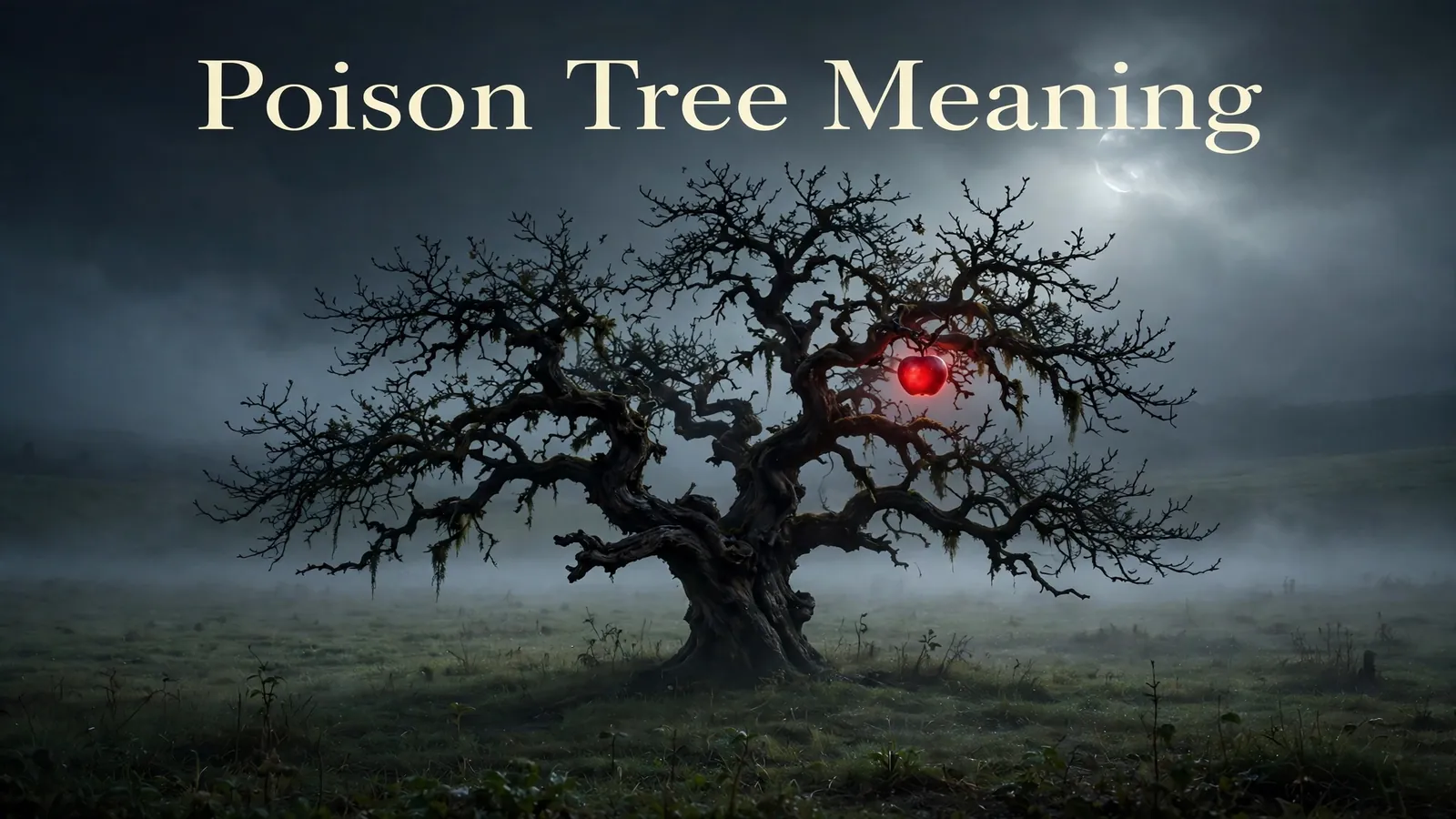
The phrase “poison tree meaning” carries two very different but equally fascinating senses. In fact, most people searching for it want to understand William Blake’s famous 1794 poem “A Poison Tree”, a short and chilling poem about what happens when anger is hidden instead of spoken. It describes a speaker who nurses wrath against an enemy, watering it like a garden until it grows into a tree that bears a bright, deadly apple.
The second sense is literal: a poisonous tree, a real tree whose leaves, sap, or fruit can harm or kill, like the infamous manchineel tree of the Caribbean. Both meanings are worth knowing, and this article covers them in full.
To begin with, in the pages ahead, you will find a clear definition of the phrase, the history of Blake’s poem, a stanza-by-stanza analysis, the rich symbolism of the tree and its apple, the moral lesson and its modern use in psychology, real poisonous trees, common misconceptions, related terms, conversation examples, a quick summary, an FAQ section, and a strong conclusion. By the end, you will know exactly what “poison tree” means in poetry and in nature.
What Does “Poison Tree” Mean?
At its core, the poison tree meaning splits into two definitions.
1. The poem. In William Blake’s “A Poison Tree,” the tree is a metaphor for anger that is kept secret. The speaker tells his friend about his wrath, and it ends. But he hides it from his enemy, and it grows. He waters it with fears and deceitful smiles until it produces a beautiful apple. The enemy sneaks in at night to steal the apple and is found dead under the tree in the morning. The poem teaches that buried anger poisons everyone, including the person who buries it.
2. The literal tree. A poison tree is any tree whose parts are toxic to humans or animals. The most famous example is the manchineel tree (Hippomane mancinella), often called the most dangerous tree in the world. Its sap causes severe burns, and its apple-like fruit can be deadly if eaten.
Therefore, this article leads with the poem, since that is what most readers are looking for, and then covers the literal meaning in its own section.
The History of “A Poison Tree” by William Blake
William Blake published “A Poison Tree” in 1794 as part of Songs of Experience, his companion volume to Songs of Innocence (1789). The two collections were meant to show “the two contrary states of the human soul.”
Moreover, Blake was a poet, painter, and engraver working in London at the end of the 18th century. He lived through the American and French revolutions. As a result, his work often questioned authority, organized religion, and social hypocrisy.
A Poison Tree appeared in a collection where each poem explores darker adult themes like oppression, guilt, jealousy, and fear. The poem fits this mood perfectly. It is a warning about the spiritual cost of suppressed emotion.
The poem is one of Blake’s shortest and most quoted works. Its simple rhyme and rhythm hide a dark message that has kept it alive in classrooms, therapy rooms, and popular culture for more than two centuries.
Why Blake Wrote It
Indeed, Blake believed that repression, especially repression demanded by polite society and rigid morality, damages the soul. In Songs of Experience, he shows what happens when natural human feelings are buried rather than faced honestly.
Consequently, the poison tree is the perfect image for this idea. A garden needs honesty and openness to grow healthy things. A soul that hides its anger grows something deadly instead.
Poison Tree Meaning: Stanza-by-Stanza Analysis
The poem has four short stanzas. Therefore, each one builds on the last, turning a small feeling into a fatal outcome.
Stanza One: Spoken Anger Dies, Hidden Anger Grows
“I was angry with my friend:
I told my wrath, my wrath did end.
I was angry with my foe:
I told it not, my wrath did grow.”
To begin with, the poem opens with a simple contrast. The speaker admits anger to a friend, and the anger ends. But he hides anger from his enemy, and it grows.
In other words, this is the thesis of the whole poem. Honest expression of feeling defuses conflict. Secrecy feeds it. Blake sets this up in just four lines with plain, nursery-rhyme-like language.
Stanza Two: The Anger Is Gardened
“And I waterd it in fears,
Night & morning with my tears:
And I sunned it with smiles,
And with soft deceitful wiles.”
Here the anger becomes a plant that the speaker tends. He waters it with fears and tears, and gives it sunlight made of smiles and deceit.
For instance, notice the gardening language: watered, sunned. The speaker is actively cultivating his hatred. The tears may be his own sadness, and the “soft deceitful wiles” are the friendly face he shows the enemy while plotting inside.
Stanza Three: The Tree Bears Fruit
“And it grew both day and night,
Till it bore an apple bright.
And my foe beheld it shine,
And he knew that it was mine.”
Then, the tree grows until it produces a bright apple. The apple is clearly tempting, shiny, and attractive. The enemy sees it and knows it belongs to the speaker.
In fact, the apple echoes the biblical fruit of knowledge from Genesis. Like that fruit, this one promises pleasure but brings death. The temptation is deliberate; the speaker has grown a trap.
Stanza Four: The Deadly Harvest
“And into my garden stole,
When the night had veild the pole;
In the morning glad I see;
My foe outstretched beneath the tree.”
Finally, the enemy steals into the garden at night to take the apple. In the morning, the speaker is glad to see his enemy lying dead beneath the tree.
Indeed, the final word, “glad,” is the most disturbing part. The speaker feels pleasure at the death. This shows how completely the anger has corrupted him. He has become a murderer who is happy about it.
Symbolism in the Poison Tree Meaning
First of all, every image in the poem carries symbolic weight. Here are the key symbols and what they mean.
The Tree
The tree stands for the speaker’s cultivated anger. Like a real tree, it starts small and grows slowly with daily care. Trees also recall the Tree of Knowledge in Eden, which connects the poem to ideas of original sin and forbidden fruit.
The Apple
The bright apple is temptation and revenge made beautiful. It looks like a gift but is poison inside. In addition, it mirrors the biblical apple, suggesting that the speaker is playing the serpent’s role, tempting his enemy to a fatal mistake.
The Friend vs. the Foe
The friend represents honest communication. When the speaker speaks his anger to the friend, the feeling dies naturally. By contrast, the foe represents the person we refuse to be honest with, and the hidden anger turns into a weapon.
The Poison
The poison is not just in the fruit; it is in the whole process. The tears, fears, smiles, and deceit are all poisonous attitudes. As a result, the speaker himself is poisoned by his own satisfaction at the death.
Night and Morning
Night hides the enemy’s theft, and morning reveals the result. Thus, this mirrors how hidden anger works: it grows in darkness and shows its damage in the light of day.
The Moral Lesson and Modern Uses of the Poison Tree Meaning
Overall, the moral of “A Poison Tree” is direct: unexpressed anger festers, and it harms both the angry person and the target. Speaking honestly about feelings prevents them from turning into revenge.
Psychology and Suppressed Anger
In fact, modern psychology supports Blake’s message. Suppressed anger is linked to stress, anxiety, high blood pressure, and damaged relationships. Therapists often use the poem to show clients what happens when feelings are buried instead of processed.
Key ideas the poem connects to today:
- Emotional expression: naming anger in a healthy way reduces its power
- Passive aggression: the speaker’s smiles and deceit are textbook passive-aggressive behavior
- Revenge fantasies: the apple shows how revenge planning poisons the planner first
- Conflict resolution: honest, early conversation prevents small hurts from growing
Use in Education and Culture
Moreover, the poem is a staple in English classrooms because it is short, musical, and easy to analyze. It is also quoted in books about anger management, leadership, and relationships. Its message appears in modern songs, films, and speeches about the cost of grudges.
The Literal Meaning: Real Poisonous Trees
While Blake’s tree is a metaphor, real poison trees exist and deserve respect and caution.
The Manchineel Tree
Specifically, the manchineel tree (Hippomane mancinella) grows along Caribbean, Florida, and Central and South American coasts. It is widely called the most dangerous tree in the world.
Its dangers include:
- Toxic sap: the milky sap causes severe skin burns and blisters
- Poisonous fruit: small apple-like fruits that can cause serious poisoning if eaten
- Harmful smoke: burning its wood releases smoke that irritates eyes and lungs
- Rain danger: even standing under the tree in rain can cause skin irritation from sap in the dripping water
In fact, warning signs are often posted near manchineel trees on public beaches.
Other Notable Poisonous Trees
- Oleander: beautiful flowers, but every part is toxic, including the smoke from burning wood
- Yew: its red berries look inviting, but the seeds inside are deadly
- Strychnine tree: source of the poison strychnine, native to India and Southeast Asia
- Cerbera (suicide tree): its seeds contain toxins that affect the heart
Safety Note
Above all, never eat wild fruit you cannot identify. If you travel in tropical coastal areas, watch for warning signs about manchineel trees and do not touch unfamiliar trees.
Common Misconceptions About Poison Tree Meaning
Still, several misunderstandings surround this phrase. Here are the most common ones, corrected.
- “It is only about revenge.” Revenge is the outcome, but the poem is mainly about what happens before revenge: the slow, daily nursing of anger. The tree matters more than the apple.
- “The speaker is the hero.” The speaker is glad about a death. Blake is not praising him; he is showing how anger corrupts even the victim into a killer.
- “Blake wrote it for children.” The simple rhyme sounds childlike, but the themes are adult. Songs of Experience was written about the darker side of adult life.
- “A poison tree is a real species name.” It is not a formal botanical name. It is a general description of any dangerously toxic tree, with the manchineel as the most famous example.
- “The apple is a real fruit.” In the poem, the apple is symbolic. It stands for a tempting trap, not a literal piece of fruit.
Related Terms to Poison Tree Meaning
If you are exploring this topic, these related terms may help:
- Songs of Experience: Blake’s 1794 poetry collection containing “A Poison Tree”
- William Blake: English poet, painter, and printmaker (1757 to 1827)
- Manchineel: the most dangerous real tree in the world
- Suppressed anger: anger that is hidden instead of expressed, a key theme of the poem
- Passive aggression: indirect hostility, like the speaker’s deceitful smiles
- Allegory: a story where characters and objects stand for abstract ideas, which is how the poem works
- Original sin: the biblical story echoed by the apple imagery
- Catharsis: the release of strong emotion, which the speaker fails to achieve with his foe
Poison Tree Meaning in Conversation: Examples
For example, here is how the phrase comes up in everyday speech:
- Literature class: “Our teacher said the poison tree meaning is really about honesty. If the speaker had just told his foe he was angry, nobody would have died.”
- Therapy discussion: “My therapist quoted ‘A Poison Tree’ when I said I never argue with my brother. She said buried anger grows its own poison tree.”
- Travel warning: “The guide pointed at a manchineel and said, ‘That is a real poison tree. Do not stand under it in the rain.'”
- Workplace conflict: “I did not want to grow a poison tree over the missed promotion, so I asked my manager for an honest conversation.”
- Book club: “The poison tree meaning hit me hard this time. The speaker is glad at the end, which means the anger poisoned him too.”
- Parenting: “I tell my kids the poem’s lesson simply: say you are angry now, or it grows into a poison tree later.”
Summary of Poison Tree Meaning
In summary, here is the full poison tree meaning in brief:
- In poetry, it refers to William Blake’s 1794 poem “A Poison Tree,” where hidden anger is nursed like a garden until it produces a deadly apple that kills the speaker’s enemy.
- The poem’s message is that spoken anger ends, while secret anger grows and corrupts the angry person as well.
- In nature, a poison tree is a real tree with toxic sap, leaves, or fruit, most famously the manchineel tree.
- The phrase appears in classrooms, therapy, and everyday speech as a warning against grudges and suppressed emotion.
FAQs About Poison Tree Meaning
1. What is the main meaning of “A Poison Tree” by William Blake?
Essentially, the main meaning is that hidden anger grows into something deadly. When the speaker tells his friend about his wrath, it ends. When he hides it from his foe, he nurses it until it produces a poisoned apple that kills the foe. The poem warns that unexpressed anger poisons both the holder and the target.
2. When was “A Poison Tree” written?
William Blake published “A Poison Tree” in 1794 as part of Songs of Experience. It was printed and illustrated by Blake himself using his illuminated printing method.
3. What does the apple symbolize in the poem?
The bright apple symbolizes temptation and revenge. It looks beautiful and desirable, but it is poison inside. It also echoes the biblical fruit of knowledge, casting the speaker as a serpent-like tempter who lures his enemy to death.
4. What is the moral lesson of “A Poison Tree”?
In short, the moral is that anger should be expressed honestly rather than buried. Secret anger grows with daily attention, turns into a desire for revenge, and ends up corrupting the angry person. Honest communication stops the cycle before it starts.
5. Is a poison tree a real thing?
Yes. While Blake’s tree is a metaphor, real poisonous trees exist. The most famous is the manchineel tree (Hippomane mancinella), whose sap, fruit, and even smoke can cause serious harm. Oleander, yew, and the strychnine tree are other examples.
6. What is the most dangerous tree in the world?
Indeed, the manchineel tree is widely considered the most dangerous tree in the world. Its sap burns skin, its apple-like fruit is toxic if eaten, and its smoke irritates eyes and lungs. It grows in coastal areas of the Caribbean, Florida, and Central and South America.
7. Why is the speaker “glad” at the end of the poem?
In other words, the word “glad” shows that the speaker’s anger has fully corrupted him. He is pleased to see his enemy dead, which proves the poem’s point: nursing hatred does not just hurt the enemy, it poisons the person who nurses it.
8. How is “A Poison Tree” used in psychology today?
For instance, therapists and counselors use the poem to illustrate the dangers of suppressed anger. It is a vivid image for how buried feelings grow through rumination and passive aggression, and it supports the value of honest, early conflict resolution.
9. What is the difference between the friend and the foe in the poem?
The friend stands for honest communication: the speaker tells his wrath and it ends. The foe stands for avoidance: the speaker hides his wrath and it grows. Thus, the contrast teaches that the same feeling has two very different outcomes depending on if it is spoken or hidden.
Conclusion
The poison tree meaning gives us one of literature’s clearest warnings about hidden feelings. William Blake’s short poem shows, step by step, how a small anger becomes a tended garden, how the garden bears a tempting apple, and how that apple brings death. The most chilling line is the last one, where the speaker feels glad. By then, the poison of anger has done its full work, harming the enemy’s body and the speaker’s soul.
At the same time, the literal poison tree reminds us that nature has its own version of this danger. The manchineel tree, with its burning sap and toxic fruit, earns its fearsome reputation honestly, just as Blake’s metaphor earns its place in classrooms and therapy rooms.
In conclusion, the lesson is simple enough for a child and deep enough for a lifetime: speak your anger while it is small, or watch it grow into a poison tree.

I am Sophia Bennett, is a digital resources and online tools writer at LinkVistaHub. She enjoys exploring useful websites, emerging digital tools, productivity platforms, and practical online resources that help people work smarter and discover valuable information.